Bad Bunny and Rosalía have fundamentally altered how the American music industry values global artistry by forcing the Recording Academy to evaluate Spanish-language and multilingual records on their own terms. Their unprecedented breakthroughs at the Grammy Awards demonstrate that singing in English is no longer mandatory to secure the world’s most coveted musical honors. This shift signals an enduring institutional evolution driven by undeniable commercial consumption, historic chart milestones, and deliberate internal reforms.
A quiet revolution has taken place across the American entertainment landscape over the last decade.
For generations, the global recording industry operated under an unspoken yet rigid commercial rule.
If an international recording artist wanted to attain ultimate critical prestige in the United States, they were expected to record in English.
Latin music, in particular, was frequently treated as an exotic novelty or sequestered away into specialized peripheral awards.
Even towering cultural legends had to engineer tailored English crossover hits to compete for marquee mainstream accolades.
That restrictive paradigm has now collapsed under the weight of modern streaming realities and artistic resolve.
Leading this historic transformation are Puerto Rican superstar Bad Bunny and Spanish visionary Rosalía.
Both artists have shattered institutional ceilings while performing almost entirely in Spanish and non-English tongues.
Their triumphs mark a turning point where language has ceased to function as a barrier to major American industry recognition.
The Recording Academy has been compelled to dismantle decades of gatekeeping in response to their cultural dominance.
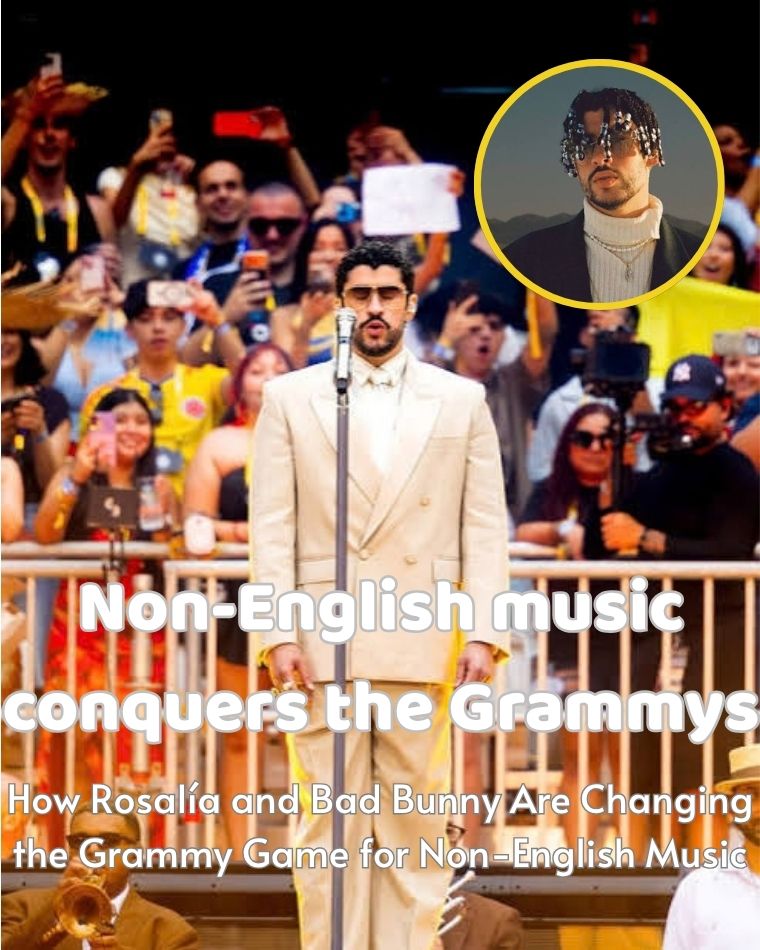
Cre: Wikimedia Commons — CC0 Public Domain / Ggoofy14
The Record-Breaking Journey to Album of the Year
When Benito Antonio Martínez Ocasio began working on his celebrated album DeBÍ TiRAR MáS FOToS (DTMF), global awards were not his priority.
His creative motivations were anchored strictly in his homeland and community.
“I said: I’m making an album in Puerto Rico, for Puerto Ricans,” he told Billboard during an in-depth conversation in 2025.
“I was perfectly happy to have it be successful in Puerto Rico … This one was for my own, for my family, for my friends,” he added.
Yet DTMF expanded rapidly far beyond the confines of a localized artistic venture.
The project quickly propelled the Puerto Rican icon to the absolute summit of the Billboard 200 albums chart for the fourth time in his career.
It also cleared the path for him to headline the Super Bowl Halftime Show, matching a milestone previously reached by only Shakira and Jennifer Lopez among Latin acts.
The defining moment of his career arrived when DTMF won Album of the Year at the 2026 Grammy Awards.
The monumental victory represented only the second time in the nearly seven-decade history of the Grammys that an album recorded predominantly in a language other than English took home the ceremony’s highest honor.
The only previous non-English LP to capture that prize was Stan Getz and João Gilberto’s timeless bossa nova record Getz/Gilberto, recorded primarily in Portuguese back in 1965.
It had taken sixty-one long years for the Recording Academy to hand its flagship golden gramophone to another non-English LP.
Benito’s victory confirmed that authentic Caribbean sounds—steeped in reggaeton, trap, and Puerto Rican musical heritage—could stand victorious over mainstream pop titans.
Equally compelling is the trajectory of Catalan singer-songwriter Rosalía, whose bold vision has redefined contemporary sonic landscapes.
Rosalía made Grammy history in 2020 by becoming the first artist performing primarily in Spanish to earn a nomination for Best New Artist.
While Puerto Rican singer José Feliciano had won Best New Artist in 1969, his win had been secured with an English-language crossover release.
Rosalía, by contrast, arrived entirely on her own creative terms, blending traditional flamenco cante jondo with experimental pop and modern urban rhythms.
Her ambitious album LUX elevated her global reach even further.
Across LUX, Rosalía sings in thirteen languages, weaving together Spanish, English, Latin, and Mandarin into a seamless sonic tapestry.
The project became a critical sensation and earned wide recognition as an undeniable Album of the Year contender.
The Long Road of Institutional Exclusion
To understand the magnitude of what Bad Bunny and Rosalía have accomplished, one must examine the history of the Recording Academy.
Throughout the twentieth century, the Grammys treated non-English music as an artistic anomaly.
Foreign-language recordings were habitually shunted to secondary categories, classical divisions, or foreign-language niches.
The general field—encompassing Album of the Year, Record of the Year, Song of the Year, and Best New Artist—remained virtually exclusive to English-language acts.
A rare exception occurred in 1995 when The 3 Tenors in Concert 1994 received an Album of the Year nomination.
Featuring Plácido Domingo, Luciano Pavarotti, José Carreras, and conductor Zubin Mehta, that nomination unleashed considerable industry controversy.
Critics argued that the Recording Academy was hopelessly disconnected from the emerging creative vanguard of hip-hop and alternative rock.
In response to the backlash, academy leadership introduced specialized nominating review committees composed of insider voting members.
These secret committees met behind closed doors to vet and finalize the nominations in the marquee categories.
For the next twenty-two years, those secretive review panels failed to nominate a single non-English song or album across any of the Big Four categories.
Latin acts were expected to pursue accolades at the Latin Grammy Awards, established around the turn of the millennium.
While the Latin Grammys provided a vital dedicated platform, their existence inadvertently allowed the main Grammy telecast to bypass non-English works.
Major American awards ceremonies operated as if Spanish, French, Korean, and Portuguese had no place in the highest echelons of modern music.
The Digital Explosion and Metric Realities
The barricades protecting the old gatekeeping structure eventually began to deteriorate under the force of digital streaming.
The earliest tremor arrived in 2017 with the unprecedented explosion of “Despacito” by Luis Fonsi and Daddy Yankee.
The track generated billions of streams across the globe and topped the Billboard Hot 100 for sixteen consecutive weeks.
At the 2018 Grammy Awards, its bilingual remix featuring Justin Bieber secured nominations for both Song of the Year and Record of the Year.
Although the record failed to win either category, the commercial message to the American music establishment was unmistakable.
Streaming platforms had eliminated traditional radio gatekeepers and transformed music consumption into an international marketplace.
Young music fans no longer required an English translation to fall in love with a melody, a vocal hook, or an infectious rhythm.
Luminate’s 2026 midyear data report crystallizes this monumental shift.
According to Luminate, the historic dominance of English-language tracks across modern streaming services is undergoing a steady, measurable decline.
In the United States alone, nearly one out of every ten music streams is now a track recorded in Spanish.
During the first quarter of 2026, casual listenership of Spanish-language music in America reached fifty-four percent, an all-time record.
Similar consumption patterns are playing out across Europe and Asia, where borderless streaming diversity has become the everyday norm.
Commercial charts have documented the explosive reach of multilingual recordings.
Rosalía’s LUX debuted at No. 4 on the all-genre Billboard 200 chart upon release.
Furthermore, LUX simultaneously captured the No. 1 spot on five distinct Billboard sales charts, including Top Latin Albums, Top Latin Pop Albums, Classical Albums, Classical Crossover, and World Albums.
Global pop superstars BTS achieved similar historical milestones with their bilingual Korean-and-English project ARIRANG.
That album claimed the top spot across multiple charts, debuting at No. 1 on the Billboard 200, Top Album Sales, and Vinyl Albums charts.
In Europe, ARIRANG emerged as the most-streamed pop album during the first half of the year.
The numbers proved beyond any doubt that global consumers were embracing language diversity at an unprecedented scale.
“Passion for music discovery has always been there, but now it’s intensified and spread to casual consumers, expanding possibilities for artists worldwide,” explains Colleen Theis, president and COO of The Orchard.
“People appreciate great artistry and long for a sense of community,” Theis observes.
“These things transcend language.”
“Artists that bring those elements together are drawing fans into their world more rapidly than ever,” she emphasizes.
“Rosalía’s LUX is an excellent example of an album that defies categorization and is an enduring work of art, and people responded accordingly.”
Structural Reforms Within the Recording Academy
Faced with a stark divide between consumer reality and industry accolades, the Recording Academy undertook significant institutional reforms.
The push for change gathered real momentum under the leadership of Harvey Mason Jr., who assumed the role of CEO.
The academy recognized that honoring the most impactful musical works required transforming the demographics of its voting membership.
In June 2019, the organization introduced a new membership model designed to actively recruit underrepresented creators.
The strategy focused aggressively on adding more women, people of color, and music professionals under the age of forty.
Over the past two years alone, 4,900 new voting members have been welcomed into the academy’s ranks.
In 2021, the academy took the bold step of eliminating secret nominating review committees altogether.
The final nominations in the Big Four categories were returned to the democratic ballot of the entire voting body.
“Since transforming our membership model seven years ago, we’ve made it our ongoing mission to build an active and engaged voting body,” Harvey Mason Jr. explained to Billboard.
“One where every genre and craft is well-represented and that reflects the vibrant ecosystem of our creative community today.”
Mason pointed out that while Latin music is an integral component of this transformation, the new structure welcomes music produced in every global dialect.
Tangible changes on the Grammy telecast soon mirrored these structural shifts.
In the five decades leading up to 2019, fewer than a dozen Latin artists had ever performed live during the annual Grammy broadcast.
The modern era made Spanish-language performance a vibrant fixture of the ceremony.
In 2019, the telecast opened with an energetic Latin medley spotlighting Camila Cabello, Young Thug, J Balvin, Ricky Martin, and Arturo Sandoval.
Every subsequent Grammy telecast has featured at least one dedicated Latin performance, turning Spanish-language art into a natural element of the night.
When Bad Bunny took the stage to open the 65th Grammy Awards in 2023 with a dynamic Puerto Rican plena and mambo performance, the global audience witnessed a cultural coronation.
The television screens in American living rooms vibrated with unconditional Boricua identity.
The institutional evolution reached other categories as well.
Following Rosalía’s groundbreaking Best New Artist nomination, Brazilian star Anitta—who releases music in Spanish, Portuguese, and English—earned a Best New Artist nod the following year.
“In any given year, the outcomes on Grammy night truly come down to what resonates with our voters,” Mason remarked.
“While our efforts to ensure a well-represented voting body matter enormously, so does the music itself.”
📸 [ẢNH: Chân dung ca sĩ kiêm nhạc sĩ người Puerto Rico Bad Bunny năm 2019]
Link: https://upload.wikimedia.org/wikipedia/commons/b/b3/Bad_Bunny_2019_by_Glenn_Francis_%28cropped%29.jpg
Nguồn: Wikimedia Commons — Bản quyền thuộc CC BY-SA 4.0 / Glenn Francis (PacificProDigital.com)

A Borderless Horizon for Global Music
The trail blazed by Bad Bunny and Rosalía has permanently redefined the creative calculus for international musicians.
For decades, foreign artists felt pressured to abandon their native languages if they hoped to capture American trophies.
Today, that outdated trade-off is recognized as completely obsolete.
Artistic authenticity has emerged as the supreme currency of the digital streaming era.
Benito Antonio Martínez Ocasio proved that an artist can remain steadfast in their regional dialect and still dominate global stadium tours and charts.
Rosalía showed that high-concept flamenco and classical avant-garde songwriting can captivate listeners across multiple continents.
Their victories have made institutional acknowledgment attainable for non-Anglophone performers across all genres.
Korean pop ensembles, Afrobeats vocalists from Nigeria, and regional Mexican stars are finding that language boundaries have softened.
Industry managers and label executives now recognize that true musical connection operates on an emotional, visceral wavelength.
“It’s an undeniable moment in time where we are one world,” observes Rebeca León, Rosalía’s former manager who now oversees the careers of Danny Ocean and Tokischa.
“Rosalía made a great album, and may the best album win,” León asserted.
“Good music can be made in any corner of the world.”
“And I hope it doesn’t stop with the Spanish language.”
“We have to advocate for more.”
The Recording Academy’s willingness to recognize Spanish, Portuguese, and multilingual masterpieces marks an essential modernization for American culture.
It reflects a nation where diverse voices, immigrant communities, and cross-cultural collaborations define everyday musical expression.
As music distribution systems continue to decentralize, the Grammys can no longer afford to retreat into monolingual isolation.
Bad Bunny and Rosalía did not achieve greatness by adapting their vision to fit traditional American industry standards.
Instead, they stayed true to their roots and compelled the American music establishment to adapt to them.
Their historic accomplishments stand as an enduring testament to the universality of musical artistry across the globe.
Để lại một phản hồi