Ten years ago, Benito Antonio Martínez Ocasio was bagging groceries at an Econo supermarket in Vega Baja while uploading self-produced tracks to SoundCloud late into the night. Today, the Puerto Rican visionary stands at the absolute pinnacle of global popular culture, having swept seven Creative Arts Emmy Awards in a single weekend for his groundbreaking Super Bowl LX halftime performance. This decade-long odyssey represents far more than standard commercial triumph; it reflects a historic cultural realignment where an uncompromising Spanish-language artist fundamentally redefined mainstream entertainment on his own terms.
1. The Grocery Aisles of Vega Baja and the DIY SoundCloud Era
Before filling stadiums across five continents, Benito Antonio Martínez Ocasio lived a life defined by modest ambition and intense artistic discipline.
He grew up in Almirante Sur, a rural neighborhood located inside the municipality of Vega Baja, Puerto Rico.
His household was filled with the sounds of traditional salsa, merengue, and classic Latin pop favored by his parents.
During his youth, he sang in a local church choir until the age of thirteen, developing an ear for vocal harmonies and melody.
As hip-hop and reggaeton swept Puerto Rico, he began experimenting with beats and writing verses in his bedroom.
While studying audiovisual communication at the University of Puerto Rico at Arecibo, he balanced coursework with an hourly job as a supermarket bagger.
He used his retail earnings to purchase rudimentary studio equipment, working tirelessly on free digital audio software.
Under the alias Bad Bunny—a moniker inspired by a childhood photograph showing him sullenly wearing bunny ears—he began uploading independent songs to SoundCloud around 2016.
The digital streaming landscape in Puerto Rico during that period was fiercely competitive and dominated by established urban record labels.
Unlike traditional artists seeking radio approval, Bad Bunny bypassed conventional gatekeepers entirely by delivering his music directly to underground listeners.
He poured raw emotion, moody Latin trap baselines, and conversational phrasing into tracks that felt remarkably fresh and uninhibited.
SoundCloud served as an unfiltered proving ground where he could test unconventional cadences and introspective themes without executive interference.
His distinctive baritone delivery immediately distinguished him from the higher, nasal registers typical of traditional reggaeton vocalists.
Rather than copying American trap styles wholesale, he fused imported southern 808 patterns with distinct Caribbean sensibilities.
His early uploads resonated strongly across San Juan and the digital underground, racking up tens of thousands of organic plays through digital word of mouth.
The bedroom producer demonstrated a relentless work ethic, writing and recording new material whenever his retail shifts concluded.
He proved that raw sonic identity and digital community building could dismantle long-standing institutional barriers in music distribution.
This foundational period established his lifelong habit of direct connection with fans across digital channels.
Cre: Wikimedia Commons — Glenn Francis / PacificProDigital.com
2. Breakthrough Anthems and Industry Disruption
The turning point arrived when his independent track “Diles” went viral on SoundCloud, catching the attention of influential Puerto Rican producer DJ Luian.
Recognizing the young artist’s singular tone and aesthetic, Luian signed Bad Bunny to the nascent Latin trap label Hear This Music.
Shortly thereafter, a collaborative remix of “Diles” featuring Arcángel, Ozuna, Farruko, and Ñengo Flow introduced Bad Bunny to mainstream Latin listeners.
Rather than acting as a humble newcomer, Bad Bunny commanded the track with a laid-back swagger that stole the spotlight.
A rapid sequence of standalone singles followed, cementing his reputation as an unstoppable hitmaker who refused to follow typical album release cycles.
His melancholic anthem “Soy Peor” struck an emotional chord with millions of young listeners navigating heartbreak, redefining modern Latin trap.
Subsequent tracks such as “Tu No Metes Cabra” and “Chambea” showcased an aggressive, unapologetic lyricism rooted in Puerto Rican street poetry.
Each music video challenged prevailing hyper-masculine stereotypes through bold fashion, neon color schemes, and avant-garde eyewear.
He treated style as an integral component of his musical storytelling, deliberately subverting urban genre conventions.
Radio programmers found themselves forced to adapt to his non-traditional tempos and deep bass arrangements rather than the other way around.
By 2017, Bad Bunny had accumulated hundreds of millions of views across YouTube without ever issuing a formal studio album.
His meteoric rise caught the attention of major American record labels, who sought to decipher how an unsigned indie talent was outperforming legacy acts.
He retained complete creative control over his songwriting, refusing to allow external producers to polish away his eccentricities.
His lyrical themes shifted effortlessly between hedonistic nightlife, intimate vulnerability, and existential musings.
This versatile range attracted listeners who previously felt alienated by the repetitive tropes of commercial radio reggaeton.
Every track released during this period felt like an organic cultural event, shared rapidly through messaging apps and social platforms.
Bad Bunny established a precedent for a new generation of Latin artists who no longer required legacy television or major corporate backing to thrive.
The music industry quickly realized that this grocery store clerk from Vega Baja was not a fleeting internet curiosity, but a once-in-a-generation talent.
3. High-Voltage Collaborations and Global Penetration
Armed with undisputed dominance across Latin America, Bad Bunny began engineering strategic cross-genre collaborations that dismantled English-language radio dominance.
In 2018, he joined forces with Cardi B and J Balvin on the summer smash “I Like It,” which sampled Pete Rodriguez’s 1967 boogaloo classic “I Like It Like That.”
The record skyrocketed to Number 1 on the Billboard Hot 100, marking Bad Bunny’s first leader on the definitive American singles chart.
Crucially, he delivered his rapid-fire verses exclusively in Spanish, proving that linguistic assimilation was completely unnecessary for mainstream US radio ubiquity.
Shortly thereafter, Canadian superstar Drake sought out Bad Bunny for the melodic collaboration “Mía.”
Rather than translating his style to suit Drake’s world, Bad Bunny brought Drake entirely into his sonic universe, with Drake singing entirely in Spanish.
The collaboration became an international sensation, demonstrating Bad Bunny’s extraordinary leverage in global pop negotiations.
He formed creative alliances with diverse artists ranging from pop icon Ricky Martin to indie experimentalists and hip-hop royalty.
Each joint project served to expand his global audience while reinforcing his creative autonomy.
In late 2018, he parted ways with his initial management and released his landmark debut studio album, X 100PRE, on Christmas Eve via Rimas Entertainment.
The record received rapturous critical acclaim for incorporating synth-pop, punk rock, and experimental electronica into urban Latin formats.
Instead of retreating into safe commercial formulas, Bad Bunny constantly expanded the musical vocabulary of urban music.
Subsequent projects, including his joint LP with J Balvin titled Oasis, dominated worldwide streaming leaderboards throughout 2019.
He continued to collaborate with emerging underground artists, frequently boosting the profiles of rising female and indie acts across Latin America.
His presence turned every guest verse into a guaranteed chart contender, yet he remained remarkably selective with his commercial endorsements.
International critics marvelled at how he retained his core sound while dominating music charts in non-Spanish speaking territories like Japan, France, and Germany.
His voice became a universal language carried by irresistible percussive grooves and emotional resonance.
Through these strategic masterstrokes, he erased the historical boundary separating Latin urban music from the global pop mainstream.
4. Uncompromising Authenticity and Political Identity
While many international artists dilute their native character to appeal to American audiences, Bad Bunny anchored his entire career in unapologetic Puerto Rican reality.
He deliberately resisted pressure from American record executives to record crossover singles in English.
He recognized that modern listeners crave genuine cultural specificity rather than homogenized, focus-grouped pop products.
His aesthetic choices defied traditional machismo, featuring painted fingernails, skirts, and flamboyant gender-bending runway fashions.
In 2020, his music video for “Yo Perreo Sola” featured Bad Bunny performing in full drag, sending a powerful message against sexual harassment and queerphobia.
When mass political protests erupted across Puerto Rico in the summer of 2019 demanding the resignation of Governor Ricardo Rosselló, Bad Bunny paused his European tour.
He flew immediately to San Juan to march shoulder-to-shoulder with hundreds of thousands of citizens on the front lines of the movement.
Alongside Residente and iLe, he co-wrote and released “Afilando los Cuchillos,” an incendiary protest anthem recorded during the height of the demonstrations.
The civic unrest succeeded in forcing the governor’s resignation, cementing Bad Bunny’s role as a trusted voice of his generation.
His 2022 magnum opus, Un Verano Sin Ti, became a worldwide cultural phenomenon, spending thirteen weeks at Number 1 on the Billboard 200.
It became the first Spanish-language project in history to earn a Grammy nomination for Album of the Year, shattering institutional glass ceilings.
Amid breezy beach tunes, the album featured “El Apagón,” an uncompromising critique of Puerto Rico’s private electrical grid and gentrification.
Accompanying the track was an investigative documentary detailing the displacement of local residents by wealthy foreign tax evasion schemes.
He consistently utilized his vast platform to highlight institutional neglect, hurricane recovery struggles, and colonial dilemmas confronting Puerto Rico.
During consecutive world stadium tours, he made certain that local Puerto Rican traditions and iconography were celebrated before millions of fans.
His music never treated Puerto Rico as a picturesque tropical paradise designed for foreign tourists, but as an island of resilient, complex people.
Audiences across the globe connected deeply with this authentic devotion to his homeland.
By staying completely true to his roots, he paradoxically built a global movement that crossed all geographic and cultural boundaries.
5. The Super Bowl Halftime Masterpiece
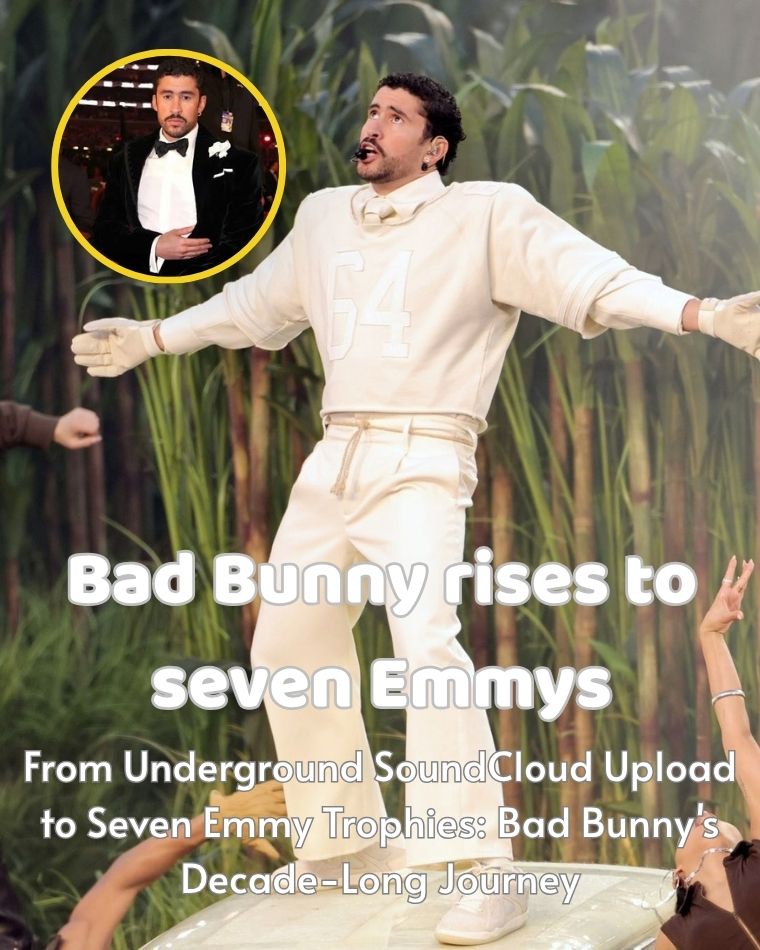
The culmination of Bad Bunny’s decade-long cultural mission arrived on the global stage of the Super Bowl LX Halftime Show.
Broadcast live to an audience of over 128 million viewers from Levi’s Stadium in Santa Clara, California, the thirteen-minute spectacle made history.
Bad Bunny served as both the primary headline performer and executive producer of the monumental live production.
Rather than delivering a generic stadium medley, he transformed American television’s most visible broadcast into an immersive homage to Puerto Rican life.
The performance opened dramatically inside a theatrical sugarcane field, with Bad Bunny surrounded by jíbaros wearing traditional straw pavas.
The set design meticulously recreated scenes from daily Puerto Rican life, featuring neighborhood elders playing dominoes and a street vendor with a piragua cart.
His attire celebrated rural and working-class heritage through a tailored guayabera and straw hat.
The setlist drew directly from his rich catalog, featuring blistering renditions of “Tití Me Preguntó,” “Yo Perreo Sola,” “Baile Inolvidable,” and “El Apagón”.
Traditional acoustic cuatro guitars blended seamlessly with futuristic urban synthesizers and thundering percussive rhythms.
Pop superstar Lady Gaga made a surprise appearance, joining him for an electrifying salsa-infused arrangement of “Die With a Smile”.
Latin pop pioneer Ricky Martin took the stage to perform “Lo Que Le Pasó a Hawaii,” delivering a poignant warning regarding gentrification and displacement.
Celebrity cameos from Cardi B, Karol G, Pedro Pascal, and Jessica Alba elevated the presentation into a triumphant celebration of pan-Latino excellence.
Breaking new ground in accessibility, the NFL incorporated Puerto Rican Sign Language into the broadcast, led by Deaf performer Celimar Rivera Cosme.
At the climax of the performance, Bad Bunny stood tall while raising a historical Puerto Rican flag featuring the light-blue triangle of the independence movement.
Visual metaphors subtly referenced the island’s chronic electrical grid failures and socio-economic struggles.
Crucially, the entire performance was delivered predominantly in Spanish, without any concessions or translations for the domestic television audience.
The spectacle mesmerized international critics, who hailed it as one of the most culturally substantive halftime shows ever staged.
Benito Antonio Martínez Ocasio turned America’s ultimate sporting showcase into an uncompromised monument to Boricua pride.
6. Seven Emmy Trophies and the Legacy of a Cultural Revolutionary
The critical acclaim of the Super Bowl LX performance translated into historic institutional validation at the 2026 Creative Arts Emmy Awards in Los Angeles.
Held at the Peacock Theater, the ceremony saw Bad Bunny’s halftime production capture an astonishing seven Emmy Awards out of nine nominations.
The triumph established a brand-new all-time record for the most Emmy wins ever achieved by a single Super Bowl halftime show in television history.
Bad Bunny earned his personal first Emmy Award as executive producer when the show took home Outstanding Variety Special (Live).
This marked the first time in Emmy history that a predominantly Spanish-language program captured the prestigious top live special category.
The production swept key artistic and technical honors, including Directing, Music Direction, Choreography, Sound Mixing, Lighting Design, and Technical Direction.
With these historic honors, Bad Bunny moved halfway toward achieving the rare and coveted EGOT status, adding an Emmy to his multiple Grammy accolades.
The sweeping recognition resonated far beyond typical industry congratulation circuits.
It served as definitive proof that cultural specificity and artistic integrity can triumph over commercial homogenization at the highest levels of global media.
Ten years after uploading unpolished tracks from his Vega Baja bedroom, Benito Antonio Martínez Ocasio reshaped the paradigm of global stardom.
His rise demonstrates that staying true to one’s roots, dialect, and heritage is not an obstacle to mainstream success, but its greatest superpower.
He proved that an artist does not need to compromise their identity to be embraced by the world; instead, the world will learn to listen.
From humble supermarket aisles to seven Emmy statues, Bad Bunny’s journey stands as a masterclass in creative vision, resilience, and unyielding authenticity.
His legacy is already carved into the history books, inspiring millions of independent creators worldwide to tell their own stories without fear.
The bunny who refused to behave has officially become the architect of a new global cultural era.
Để lại một phản hồi