In a high-profile August 2025 GQ cover interview, Kansas City Chiefs star Travis Kelce opened up about the intense personal realities of living under constant celebrity scrutiny.
Despite reaching the absolute pinnacle of professional sports and international fame, the veteran tight end pushed back against the myth that wealthy public figures can effortlessly brush off criticism.
Kelce explained that public perception genuinely matters to him, emphasizing that athletes must understand how their own actions shape how the world sees them.
The Surge of Relentless Spotlight
Travis Kelce has long been recognized as one of the most dominant tight ends in National Football League history.
Over the course of his decorated career with the Kansas City Chiefs, he accumulated multiple Super Bowl championships, Pro Bowl selections, and franchise records.
Yet over the past two years, his public profile experienced a massive, unprecedented transformation.
His high-profile romance with global pop superstar Taylor Swift catapulted him from gridiron icon to inescapable mainstream fixture.
Every single aspect of his life suddenly became subject to round-the-clock cultural analysis.
Paparazzi cameras began tracking his travels across continents to attend concerts and film premieres.
Entertainment tabloids, sports talk shows, and social media platforms started dissecting his wardrobe, gestures, and tone of voice.
When GQ featured Kelce as their cover star for the September 2025 issue, published in mid-August 2025, the conversation quickly dove beyond standard football playbooks.
Writer and interviewer pressed the football star on how he navigates an environment where privacy virtually ceased to exist.
The resulting comments quickly caught fire because they defied typical modern celebrity bravado.
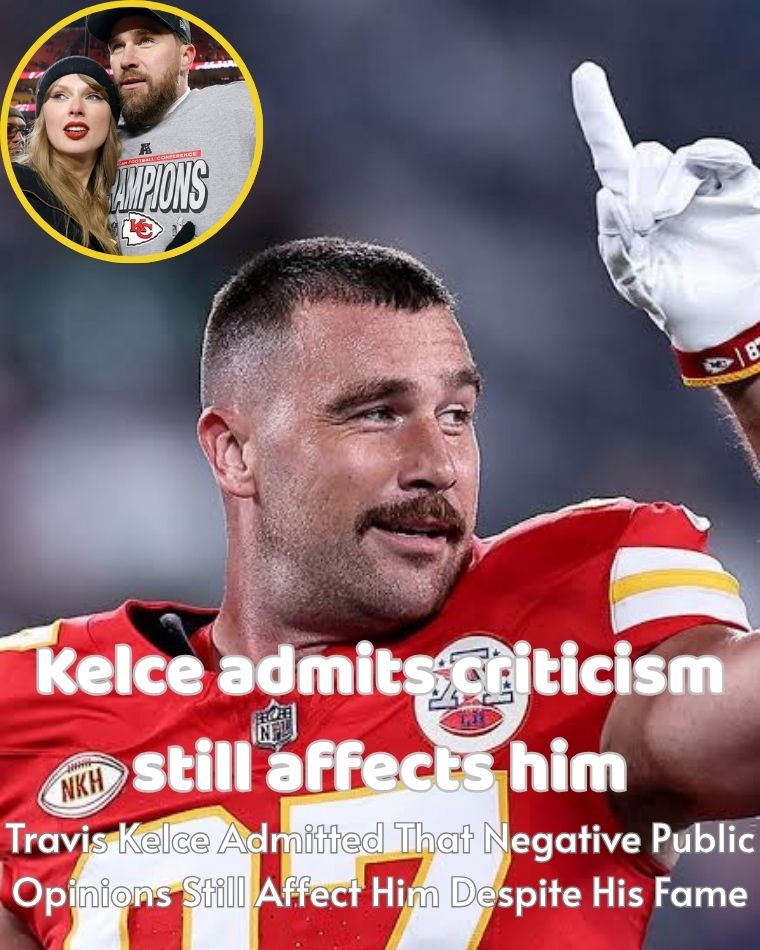
Cre: Wikimedia Commons — All-Pro Reels (Giấy phép CC BY-SA 2.0)
Kelce did not present himself as a stoic superstar living inside an untouchable fortress.
Instead, he admitted that the glare of modern culture penetrates even the thickest skin.
When a person enters that stratosphere of visibility, every move carries outsized weight.
Kelce pointed out that shutting out the noise completely is far harder than people imagine.
The media landscape no longer functions like traditional sports journalism.
Today, a momentary interaction on the sideline can spawn weeks of digital commentary.
Kelce has seen his cheerful, outgoing personality magnified, analyzed, and sometimes criticized.
Yet rather than running from that reality, he chose to speak directly to the emotional burden it creates.
His interview proved that immense athletic success does not automatically eliminate human vulnerability.
“You Can’t Block That Out”: Admitting That Opinions Matter
A prevalent narrative across modern sports culture insists that elite competitors must develop total emotional detachment.
Athletes are routinely coached by media consultants to say that they never read the comments.
They are advised to repeat that they do not care what outsiders think of them.
In his August 2025 interview, Kelce took the opposite stance and offered complete transparency.
“You can’t block that out,” Kelce told GQ directly when asked about media scrutiny.
He expanded on why tuning out public reaction is an unrealistic expectation for someone in his position.
“I’m a guy who doesn’t want anyone to say anything negative about me,” Kelce acknowledged honestly.
“Some people don’t give a f—. I’m someone who does care,” he confessed during the wide-ranging profile.
That admission was particularly striking coming from an athlete known for bravado and physical dominance on Sunday afternoons.
Kelce did not try to pretend that he was bulletproof or indifferent.
He admitted that hearing negative commentary from strangers stings.
This frankness dismantled the stereotype of the uncaring, armored athlete.
For generations, male athletes were expected to maintain a front of emotional invulnerability.
Admitting that you care what people say was long interpreted as a sign of weakness in professional locker rooms.
Kelce, however, framed caring not as insecurity, but as natural human sensitivity.
He acknowledged that most people, deep down, prefer to be appreciated rather than despised.
Pretending that millions of opinions bouncing across social media have zero impact is usually just posturing.
Kelce made it clear that while he cannot prevent every critique, he refuses to pretend they do not register.
By doing so, he gave voice to an experience that many high-profile figures feel but rarely admit aloud.
The conversation resonated with casual observers who often assume that wealth buys immunity from doubt.
Having millions of dollars in career earnings and championship rings does not turn off emotional awareness.
Kelce’s candor showed that success does not alter basic human psychology.
People want to be understood, respected, and welcomed in their communities.
Recognizing that basic truth allowed Kelce to present an unusually grounded portrait of a contemporary icon.
Self-Awareness and the Mechanics of Public Image
Beyond merely admitting that negative commentary affects him, Kelce shared a sophisticated perspective on personal responsibility.
He made sure to clarify that public criticism should not always be dismissed as baseless jealousy.
Instead, he argued that criticism often demands an honest inward examination.
“If someone says something that they don’t like about you, you have to be able to understand how you are portraying yourself for them to say that,” Kelce explained to GQ.
This observation stood out as the intellectual core of his interview.
Many celebrities default to playing the victim whenever adverse headlines appear in the press.
They routinely blame unfair algorithms, biased reporters, or toxic online cultures.
Kelce, by contrast, placed the burden of self-awareness back on the individual standing in the spotlight.
He suggested that how a person behaves in public sends distinct signals that invite specific reactions.
If an action creates confusion or hostility, the individual must evaluate what energy they projected into the room.
That does not mean changing who you are just to please every critic.
Rather, it means possessing enough humility to examine your own conduct objectively.
Kelce recognized that perception and reality exist in a delicate feedback loop.
When an athlete behaves recklessly or speaks carelessly, they cannot expect the public to read their purest intentions.
People react to what they can see and hear.
Kelce described this dynamic as an ongoing discipline that requires conscious reflection.
He explained that he constantly evaluates whether his public appearances align with the person he strives to be.
His older brother, retired Philadelphia Eagles center Jason Kelce, chimed in during the GQ piece to highlight Travis’s natural intellect.
Jason pointed out that Travis has always had an intuitive sharpness and high emotional intelligence that people often overlook.
That emotional intelligence was clearly on display during his conversation about public perception.
Instead of reacting with defensiveness or petulance, Kelce approached public scrutiny as valuable data.
He demonstrated that acknowledging mistakes or misinterpretations is a prerequisite for long-term growth.
It is a rare stance in an era characterized by performative defiance and social media feuding.
Navigating the Responsibilities of Being a Positive Role Model
A key factor motivating Kelce’s attentiveness to his public image is his desire to be an uplifting presence.
Throughout his NFL tenure, Kelce has built a brand centered on exuberance, generosity, and community joy.
“I love being the happiest guy in the world all the f—ing time,” he told the interviewer.
That infectious enthusiasm has helped him build one of the largest personal fanbases across professional American sports.
However, being an aspirational figure comes with heavy cultural baggage.
Young children wear his jersey, copy his end-zone dances, and tune in to his weekly podcast.
Families watch him compete on television every weekend throughout the autumn and winter months.
Kelce takes that role model status seriously rather than treating it as an unwanted burden.
He understands that young supporters absorb how their heroes handle winning, losing, and everyday conflict.
When negative stories circulate, they risk clouding the positive message he wants to send.
Kelce described his approach to public life as an intentional effort to bring joy to those around him.
Whether hosting charity foundations, recording lighthearted podcast episodes, or greeting fans, he works to remain approachable.
His relationship with Swift broadened that audience to include millions of music fans who never previously watched football.
Swift’s fanbase is exceptionally attentive and protective, analyzing public figures with extraordinary thoroughness.
Kelce discussed how this expanded visibility amplified his desire to present himself with honor and good humor.
He spoke about willingly taking a backseat to celebrate his partner’s historic achievements.
“I get to be the plus one,” Kelce explained with genuine joy, describing his visits to international stadium dates on the Eras Tour.
He expressed profound awe for the sheer physical and creative endurance Swift displays on stage for three consecutive hours.
Kelce noted that watching her work ethic helped him appreciate the dedication required to perform under global scrutiny.
He emphasized that being in the public eye is a privilege that warrants continuous respect, not arrogant entitlement.
Separating Valid Criticism from Real Misconduct
Another critical element of Kelce’s commentary is the distinction between constructive critique and actual wrongdoing.
In modern digital culture, minor stylistic missteps are frequently inflated into massive scandals.
Online discourse often struggles to differentiate between bad behavior and an aggressive athletic outburst.
Kelce has experienced that friction firsthand during intense football games.
Passionate sideline debates with coaches and referees have occasionally generated viral clips and harsh commentary.
Kelce’s reflection in GQ made clear that evaluating criticism requires discernment.
An athlete must listen when people point out behaviors that fall short of personal standards.
At the same time, one must avoid internalizing baseless noise that has no foundation in reality.
True misconduct causes tangible harm and violates ethical boundaries.
Public criticism, by contrast, is often subjective and shaped by individual perspectives.
Kelce’s framework encourages athletes to separate personal character from external chatter.
He pointed out that understanding criticism does not mean surrendering to it completely.
Instead, it means using public feedback as a mirror to ensure that actions remain aligned with internal values.
This nuanced approach helps protect mental clarity amidst overwhelming public chatter.
Kelce noted that if a piece of criticism is completely ungrounded, it will eventually evaporate.
However, if repeated critiques point to a genuine blind spot, it is the athlete’s duty to correct course.
He emphasized that self-correction is not an admission of defeat.
Rather, it represents the mark of a mature professional who understands his societal platform.
Kelce’s comments highlighted how important it is for sports stars to resist the urge to turn defensive.
By holding oneself to high ethical standards, an athlete can navigate high-pressure careers without losing perspective.
Why His Candid Words Struck Such a Powerful Chord
The reaction to Kelce’s GQ cover story was immediate and widespread across mainstream outlets.
Commentators across sports radio, fashion magazines, and lifestyle podcasts spent days analyzing his quotes.
The primary reason for this fascination was the striking contrast between Kelce’s reputation and his inner thoughts.
On television, Kelce appears as a towering, fearless athletic force capable of shrugging off colliding defenders.
He is celebrated for boisterous speeches, charismatic celebration dances, and bold fashion choices.
The assumption among casual viewers was that such an individual would naturally disregard outside voices.
Hearing him speak about feeling the sting of negative feedback felt refreshingly real.
It peeled away the artificial veneer that often shields modern sports royalty.
Kelce did not hide behind public relations platitudes or canned corporate slogans.
He spoke as a man wrestling with the massive demands of 21st-century hyper-fame.
His words offered comfort to everyday readers who often struggle with the opinions of coworkers, peers, or neighbors.
If a multi-millionaire champion and cultural icon still cares what people think, then caring is not a personal failure.
It is simply an inherent aspect of navigating human relationships in an interconnected world.
Kelce’s interview reinforced that true strength lies in honest self-evaluation rather than stubborn detachment.
As he continues his historic football career and broadens his cultural presence, that self-awareness will remain his greatest asset.
Để lại một phản hồi