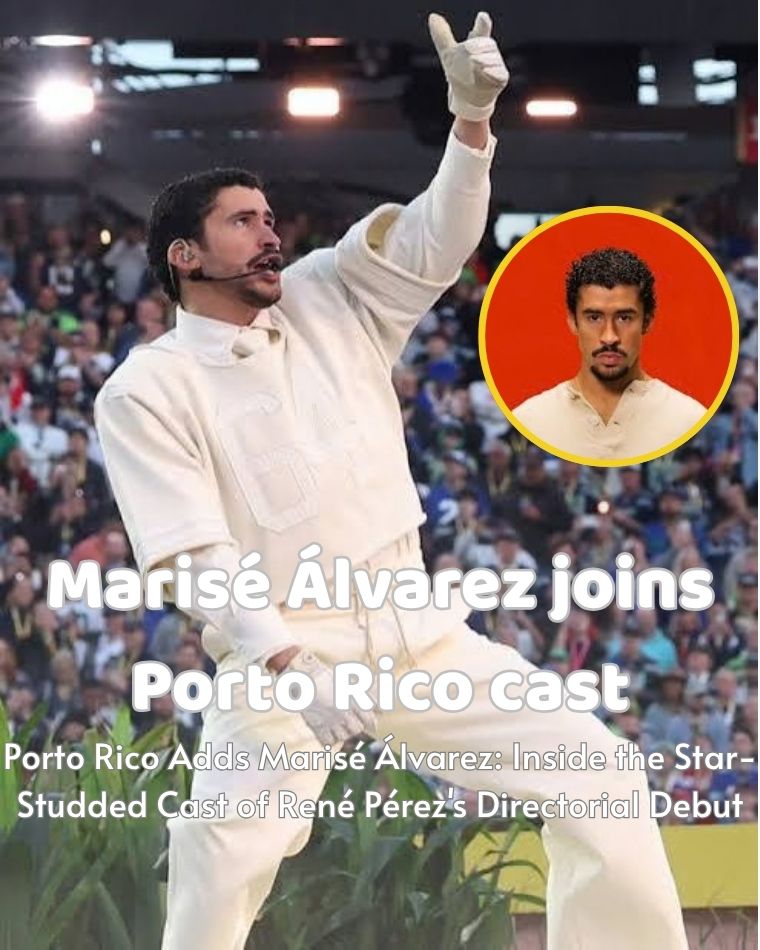
Puerto Rican actress Marisé Álvarez has officially joined the cast of the ambitious upcoming historical drama Porto Rico.
The high-profile film marks the feature directorial debut of Grammy-winning music icon René Pérez Joglar, known internationally as Residente.
With Latin superstar Bad Bunny taking on the central lead alongside an ensemble that includes Scottish breakout star Richard Gadd, the production continues to assemble an extraordinary artistic lineup.
The Caribbean film landscape is currently witnessing one of its most remarkable creative convergences in modern cinematic history.
Acclaimed Puerto Rican actress Marisé Álvarez officially joined the production of Porto Rico in late September 2026.
Her casting adds another layer of artistic authenticity to a project that has already captured global industry attention.
The production represents the long-awaited feature directorial and screenwriting debut of René Pérez Joglar, universally celebrated as Residente.
Porto Rico also serves as the first major leading film vehicle for Benito Martínez Ocasio, the global chart-topper known as Bad Bunny.
The union of these two cultural titans behind and in front of the camera makes the production an unprecedented milestone for Puerto Rican storytelling.
Industry observers have closely monitored the development of Porto Rico since its initial revelation in February 2026.
The production represents a bold, uncompromising vision conceived by Pérez to explore the complex origins and historical identity of Puerto Rico.
Described conceptually as an epic Caribbean western and period drama, the narrative confronts historical turmoil with unflinching cultural honesty.
The arrival of Álvarez into this expanding ensemble further solidifies the production’s dual commitment to international prestige and home-grown pedigree.
Her inclusion bridges elite domestic screen talent with an eclectic cast featuring Hollywood heavyweights and recent Emmy laureates.
The announcement reaffirms that Porto Rico is not merely an experimental side project for musical luminaries, but a calculated, large-scale cinematic endeavor.
Cre: Wikimedia Commons — Photo by Pedro J Pacheco, licensed under CC BY-SA 4.0
Marisé Álvarez brings years of hard-won screen and stage experience to the ensemble of Porto Rico.
Born and raised on the island, Álvarez has long been recognized within Latin American arts circles as a performer of immense emotional nuance.
Theater enthusiasts recognize her as an essential founding member of the influential Puerto Rican theater collective Teatro Breve.
Her foundational background in live ensemble performance cultivated a grounded, naturalistic acting style that quickly transitioned onto the big screen.
Álvarez previously made international waves when she portrayed Cuban revolutionary Vilma Espín in Steven Soderbergh’s two-part biographical epic Che.
Working under Soderbergh’s exacting direction demonstrated her capability to handle historically layered drama alongside world-renowned actors like Benicio Del Toro.
Over the ensuing years, Álvarez consistently expanded her creative footprint across both independent cinema and prominent international television.
Mainstream science fiction audiences encountered her poignant performance as Corran’s mother in the Disney+ Star Wars miniseries Obi-Wan Kenobi.
She also showcased her versatility across television dramas such as NBC’s Crossbones alongside John Malkovich, as well as the dark mystery comedy The Resort.
Her past work reveals a deliberate artistic pattern of choosing complex, character-driven narratives across varying historical and cultural backdrops.
By stepping into Porto Rico in September 2026, Álvarez takes on a project that intersects deeply with her native island’s heritage.
Her addition provides a crucial sense of local dramatic gravitas to an international production navigating delicate regional themes.
Production insiders have consistently noted that Pérez sought performers capable of navigating the raw emotional turbulence required by the historical script.
Álvarez represents precisely that caliber of seasoned artistic discipline, capable of elevating every scene through restrained power and psychological depth.
Her presence ensures that the Puerto Rican characters at the center of the story resonate with authentic regional inflection and lived emotional reality.
The broader cast of Porto Rico presents an extraordinary spectrum of established cinema icons and groundbreaking contemporary talent.
Benito Martínez Ocasio commands center stage in what constitutes his most demanding cinematic challenge to date.
While Martínez previously landed supporting roles in major Hollywood releases like Bullet Train and Caught Stealing, this project places the narrative weight squarely on his shoulders.
Collaborating alongside him is Scottish writer and actor Richard Gadd, whose casting in September 2026 sparked widespread curiosity across the entertainment world.
Gadd skyrocketed to international acclaim following his multi-Emmy-winning phenomenon Baby Reindeer, where he served as creator, writer, and central performer.
Known for examining psychological vulnerability and moral tension with striking intensity, Gadd’s jump into a Caribbean period piece represents an unexpected dramatic detour.
The combination of Bad Bunny’s magnetic screen presence and Gadd’s sharp emotional unpredictability highlights the film’s bold international outlook.
The ensemble surrounding them is further populated by a remarkable cohort of world-class dramatic heavyweights.
Oscar-winning actor Javier Bardem and Academy Award nominees Viggo Mortensen and Edward Norton were among the initial high-profile names attached to the film.
Their early involvement immediately elevated Porto Rico into one of the most anticipated prestige drama packages in global distribution.
The casting momentum continued with the addition of acclaimed German-Spanish actor Daniel Brühl, celebrated for his versatile character work across European and American cinema.
Panamanian salsa titan and seasoned actor Rubén Blades also joined the fold, bridging legendary musical history with veteran screen acting.
Puerto Rican actor Ismael Cruz Córdova and rising performer Rhenzy Feliz have likewise come aboard to complete a multi-generational Latin tapestry.
Every piece of casting news underscores that director René Pérez has built a multi-dimensional cast that defies conventional commercial formulas.
The disparate creative backgrounds of these actors promise an eclectic dramatic texture rare for Caribbean-centered storytelling.
For René Pérez Joglar, stepping into the director’s chair represents the culmination of a lifelong artistic evolution.
Through his groundbreaking work with Calle 13 and his celebrated solo career, Pérez collected a record-setting array of Grammy and Latin Grammy accolades.
His lyricism has long been celebrated for dissecting social inequalities, political corruption, and historical memory throughout Latin America.
Pérez has also directed numerous acclaimed music videos across his career, earning prestigious awards for his distinctive visual style and conceptual daring.
Directing a full-length historical feature film, however, represents an entirely new plateau of storytelling ambition.
Pérez co-wrote the screenplay for Porto Rico with Academy Award-winning screenwriter Alexander Dinelaris Jr., who won an Oscar for co-writing Birdman.
The pairing of Pérez’s visceral political sensibility with Dinelaris’s celebrated narrative structure indicates a screenplay designed with intense dramatic architecture.
Pérez has made no secret of the deep personal reverence he holds for this specific cinematic subject matter.
The filmmaker has stated openly that directing a film about the origins and suppressed struggles of Puerto Rico has been a childhood dream.
He observed that Puerto Rico’s true historical journey has routinely been marginalized or shrouded in controversial outside interpretations.
To realize this ambitious vision, Pérez assembled an elite behind-the-scenes team of celebrated master technicians.
Academy Award-winning cinematographer Anthony Dod Mantle, famed for his groundbreaking visual work on Slumdog Millionaire, handles the film’s photography.
The production is also supported executive creatively by multi-Oscar-winning Mexican director Alejandro G. Iñárritu, adding invaluable prestige mentorship.
The film is produced under Pérez’s own 1868 Studios alongside Edward Norton’s Class 5 Films and backed by Live Nation Studios.
This formidable alliance of creative titans gives Pérez the artistic freedom and logistical scale necessary to achieve an authentic period atmosphere.
The historical canvas of Porto Rico draws directly from the turbulent crossroads of Caribbean history and colonial evolution.
Framed intentionally as a Caribbean western, the production recontextualizes the rugged landscape, maritime clashes, and socio-political friction of the nineteenth century.
The deliberate spelling of the title—utilizing the historic Anglicized name Porto Rico—hints at the ideological conflicts and external governance that shaped the island’s destiny.
Rather than offering a romanticized or simplified snapshot of Caribbean life, the production team aims to illustrate the raw mechanics of survival and resistance.
Pérez explained that the project represents a profound reaffirmation of Puerto Rican cultural resilience told with historical honesty.
Cameras began rolling in the late summer of 2026, with primary photography taking place across scenic locations in the Dominican Republic.
The neighboring Caribbean territory offers the rugged geographical terrain and historic colonial settings essential to recreate nineteenth-century Puerto Rico.
While the exact dramatic arcs of specific characters remain closely guarded by the producers, the scale of location shooting suggests a sprawling epic.
Period weaponry, historical costumes, and detailed frontier settlements have formed the backbone of the physical shoot.
The production avoids relying on soundstages or heavy digital fabrication, leaning into natural light, humid tropical environments, and tactical authenticity.
This grounded practical aesthetic aligns closely with the stylistic traditions established by cinematographer Anthony Dod Mantle and filmmaker Iñárritu.
Cast members like Marisé Álvarez have integrated into this ongoing shoot, participating in what colleagues describe as an intense, physically demanding schedule.
The deliberate secrecy surrounding specific plot revelations has only served to heighten anticipation among film aficionados and cultural historians alike.
The production moves forward steadily, adhering to a rigorous timeline aimed at capturing the unyielding spirit of Caribbean pioneers and revolutionaries.
Industry commentators widely anticipate that the resulting film will challenge traditional conventions regarding how colonial histories are represented on the global screen.
For Bad Bunny, taking on the leading dramatic role in Porto Rico signals a profound turning point in his multi-hyphenate artistic trajectory.
The superstar has repeatedly broken records across music history, selling out global stadium tours and dominating international streaming charts for consecutive years.
His venture into Hollywood acting initially began through small, energetic roles that capitalized on his natural charm and athletic charisma.
His memorable turn as The Wolf in David Leitch’s action spectacle Bullet Train demonstrated his innate screen comfort and timing.
Subsequent roles in festival projects such as Cassandro and upcoming thrillers like Darren Aronofsky’s Caught Stealing reinforced his genuine passion for the medium.
Stepping into the lead role of Porto Rico, however, demands a completely different caliber of sustained emotional and dramatic endurance.
Director Pérez previously disclosed that Bad Bunny initially expressed interest only in taking a modest, minor supporting role in the project.
After developing the narrative further, Pérez realized that Martínez possessed the exact gravitas and visceral identity required for the story’s protagonist.
The character demands a raw, instinctive connection to Puerto Rican soil, pain, and triumph that Martínez embodies naturally.
Carrying a historical drama of this magnitude alongside screen giants like Bardem, Norton, and Álvarez establishes Benito as an earnest dramatic actor.
The decision shows a willingness to step outside commercial comfort zones and embrace the vulnerabilities of period cinema.
Instead of selecting mainstream franchise blockbusters, Martínez has deliberately opted to lend his global star power to an urgent cultural narrative.
His massive international platform will inevitably introduce Puerto Rico’s complex national heritage to millions of young global viewers who might otherwise never encounter it.
This calculated artistic balance between global commercial dominance and indigenous cultural advocacy has defined the singer’s remarkable public persona.
In Porto Rico, his performance stands to permanently alter how global audiences perceive his creative horizons beyond the recording booth.
The collaboration between René Pérez and Bad Bunny on Porto Rico extends far beyond ordinary Hollywood casting chemistry.
It represents a monumental alignment of Puerto Rico’s two most globally prominent modern cultural voices on a singular artistic battlefield.
Both artists previously marched shoulder to shoulder during major socio-political movements on the island, utilizing their visibility to advocate for the Puerto Rican people.
Their shared creative language is steeped in fierce national pride, artistic rebellion, and an unwavering commitment to regional self-determination.
For Caribbean and Latin American cinema, the sheer scale of Porto Rico establishes an unprecedented operational precedent.
Historically, large-budget historical epics set in the Caribbean were primarily helmed by Anglo-American studios, often reducing local populations to background scenery.
Porto Rico inverts that colonial dynamic completely by placing Puerto Rican writers, directors, and headlining actors at the helm of their own narrative.
The addition of respected local figures like Marisé Álvarez ensures that the island’s homegrown acting infrastructure receives proper global recognition.
International distributor attention is already robust, with industry analysts predicting a prime platform across premier global film festivals prior to theatrical rollout.
The backing of major cultural patrons and award-winning international producers proves that indigenous Caribbean stories possess undeniable global market power.
As production continues across Caribbean shores, the artistic world watches closely to see how this ambitious vision materializes.
Porto Rico promises to be more than a gripping period western; it stands poised as a definitive cultural statement regarding memory, sovereignty, and identity.
Through the united strength of its exceptional cast, the film prepares to reclaim an indelible chapter of island history for audiences across the world.
Để lại một phản hồi