Long before Hollywood immortalized him alongside Ginger Rogers, Fred Astaire spent almost three decades defined entirely by his remarkable older sister.
Together, Adele and Fred Astaire grew from relentless child prodigies on grueling vaudeville circuits into the brightest icons of the Jazz Age Broadway stage.
Here is the forgotten story of how Adele’s natural radiance and their extraordinary sibling partnership built the foundation for the greatest dancer in American history.
From Vaudeville Beginnings to Rigorous Childhood Training
The Astaire identity was never conceived as a solo venture.
In the early 1900s, the Astaire name firmly signified a two-person team.
Adele was the elder sibling, born with an effortless instinct for rhythm, mimicry, and comedy.
When their ambitious mother recognized Adele’s innate theatrical spark, she moved the young family away from Nebraska to pursue professional opportunities.
Young Fred was quickly enrolled alongside his sister to serve as her stage partner.
What began as an expedient pairing blossomed into an intensive childhood apprenticeship.
They entered the harsh, unforgiving world of the American vaudeville circuit while still children.
Vaudeville required artists to command attention instantly or face total indifference from rowdy crowds.
For years, the young Astaires toured dusty theaters across American towns, enduring grueling travel and relentless rehearsals.
Their daily existence was governed by continuous practice, rigorous conditioning, and maternal ambition.
This grueling environment forced Fred to develop an extraordinary work ethic very early in life.
While other children attended school and played games, Fred analyzed syncopated footsteps and stage logistics.
Adele’s instinctive theatricality naturally drew the audience’s gaze during these formative road tours.
Her natural warmth allowed Fred to observe how audiences reacted to tempo, posture, and facial expression.
Behind the footlights, the two children learned how to rely completely upon one another.
Every misstep on stage had to be instantly covered by the other partner without hesitation.
This prolonged childhood routine forged a telepathic mutual rhythm between the brother and sister.
By the time they reached their teenage years, they moved through physical space with supernatural synchronicity.
Their early vaudeville acts blended lighthearted slapstick, song, and rapid-fire tap routines.
Yet behind the juvenile charm lay thousands of hours of demanding discipline and calculated repetition.
These grueling years ensured that complex musical time signatures became second nature to Fred Astaire.
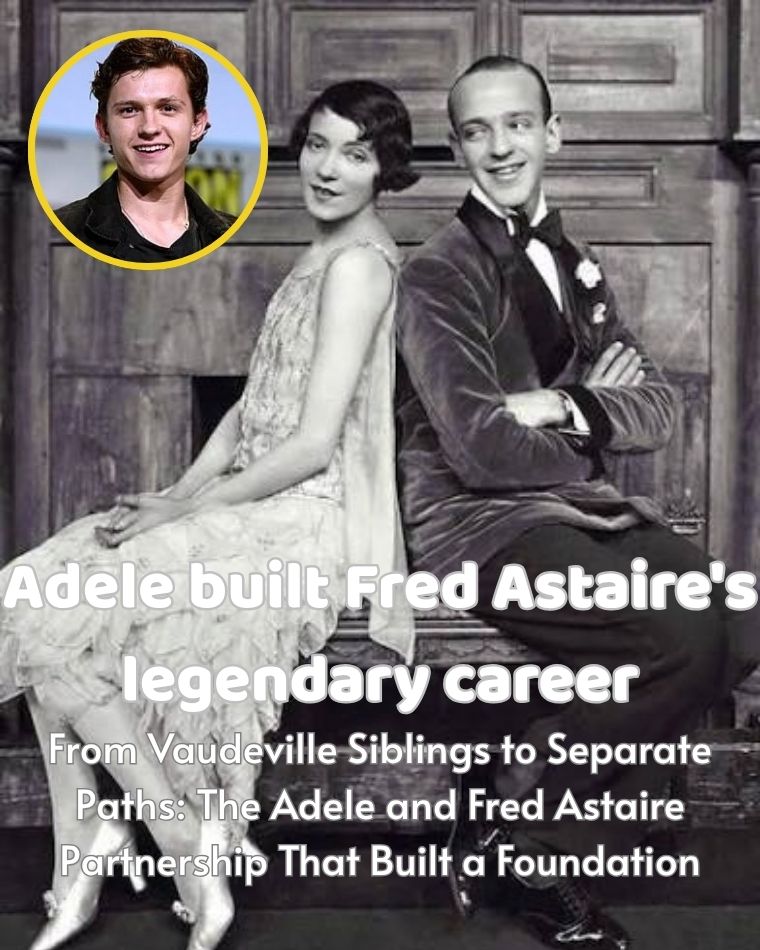
Cre: Wikimedia Commons — George Grantham Bain Collection
Conquering Broadway and Defining the Jazz Age
By the close of the First World War, the siblings had outgrown the dusty novelty of regional vaudeville circuits.
They brought their sharp, sophisticated polish directly to the glittering theaters of New York City.
During the 1920s, Broadway was undergoing an exuberant cultural explosion fueled by syncopated jazz rhythms.
Fred and Adele arrived with a refined urban sensibility that matched the fast-paced energy of Manhattan.
They made an unforgettable impression in musical comedies that captivated both high-society patrons and theater critics.
Their massive commercial breakthrough arrived in 1924 with the landmark production Lady, Be Good!
Featuring an electrifying score composed by George and Ira Gershwin, the show transformed the Astaires into bona fide superstars.
Their showstopping performance of “Fascinating Rhythm” left opening-night audiences spellbound.
The routine featured intricate, interlocking rhythmic patterns that few dancers of the era dared attempt.
Adele and Fred danced shoulder-to-shoulder, matching complex accents with effortless elegance.
The production became such a cultural phenomenon that it transferred triumphantly across the Atlantic to London.
British theatergoers, including members of the royal family, were completely enchanted by their effervescent dynamic.
The siblings returned to Broadway in 1927 to headline another smash Gershwin musical, Funny Face.
It was during this production that Fred began introducing what became his signature aesthetic: evening clothes, cane, and a top hat.
Yet even with Fred’s evolving visual polish, audiences continued to see them as an indivisible unit.
They captured the irreverent, joyful optimism that defined the Jazz Age better than almost anyone else.
Every routine they introduced seemed modern, spontaneous, and impeccably modern.
Their dance numbers were never merely decorative breaks in the storyline.
Instead, their routines served as vital dramatic conversations expressed entirely through physical movement.
The sibling duo demonstrated that popular dance could attain the status of sophisticated art.
By the late 1920s, Broadway producers considered Fred and Adele the premier musical comedy team in the world.
The Critical Spotlight: Adele the Star, Fred the Craftsman
Throughout their triumphant 1920s run, contemporary reviews painted a remarkably consistent portrait of their partnership.
Critics almost universally singled out Adele as the charismatic, incandescent spark of the act.
She possessed a radiant, magnetic presence that lit up every venue she entered.
Her onstage humor was bold, mischievous, and thoroughly disarming.
Adele could win over a skeptical audience with an arched eyebrow, an eccentric shrug, or a wink.
Reviewers frequently described her as a natural clown whose warmth washed over the footlights instantly.
By contrast, Fred was consistently evaluated through the lens of meticulous technical capability.
Newspaper critics noted his peerless precision, his clean footwork, and his reliable staging.
Yet in those early years, Fred was often described as the less showy, more restrained partner.
He was the dependable anchor who enabled his sister’s brilliance to shine at its brightest.
While Adele was heralded as a brilliant natural comedienne, Fred was recognized as the consummate craftsman.
This critical imbalance reflected their differing personalities outside the theater.
Adele was naturally extroverted, comfortable mingling with high society, aristocrats, and reporters.
Fred, conversely, was notoriously reserved, modest, and constantly anxious about the quality of his routines.
He spent sleepless nights obsessing over four-bar musical phrases and refining transitions.
Far from breeding friction, this creative division formed the bedrock of their extraordinary onstage chemistry.
Fred accepted his role as the master architect because he knew Adele’s charisma elevated their collective work.
Their genuine chemistry was rooted in thousands of shared hours onstage and total mutual trust.
They never competed for the spotlight because their timing depended on absolute collaboration.
Audiences adored the playful, bantering sibling dynamic that anchored their routines.
They appeared less like romantic suitors and more like two joyful conspirators sharing a private joke.
That singular, unpretentious camaraderie gave their Broadway work a lightness unmatched by conventional romantic pairings.
The Masterclass: What Fred Absorbed from His Sister
The decades Fred spent beside Adele served as an incomparable conservatory education.
It was during this sibling era that Fred mastered the difficult art of choreographing for a duo.
He gradually took over the responsibility of conceiving and refining their routines.
In doing so, Fred had to solve complex spatial problems on a nightly basis.
He had to craft choreography that highlighted Adele’s spontaneous charm without overshadowing his own intricate rhythm.
This delicate balancing act taught Fred the foundational rule of partnering: make the woman look breathtaking.
He learned that a male dancer’s primary function in a duet was to frame, support, and showcase his partner.
If his female partner looked graceful and triumphant, the entire dance succeeded.
Moreover, working with Adele instilled in Fred an acute understanding of comedic pacing and charm.
Adele never allowed their numbers to devolve into dry displays of technical athleticism.
She insisted on inserting humor, warmth, and expressive character into every routine.
From her, Fred learned that flawless footwork meant nothing if it lacked emotional connection with the audience.
He observed how small gestures—a tilted hat, an ironic glance, a pause—could command a crowded theater.
Their shared movement style eliminated any trace of mechanical stiffness.
Fred absorbed how two bodies could move as a single organic unit without looking rigid.
They pioneered the famous “runaround” exit, scampering offstage with joyous, syncopated urgency.
This playful, breathless movement became a celebrated trademark that audiences demanded at every curtain call.
Fred also developed his uncanny ability to synthesize different dance genres during these years.
He combined classical ballroom posture, energetic tap, African American jazz idioms, and theatrical eccentric steps.
Because he spent so many years tailoring steps to Adele’s unique strengths, his choreography became adaptable.
By the dawn of the 1930s, Fred Astaire was no longer just an exceptional dancer.
He had become a master director of rhythm, emotion, and stagecraft.
Every aesthetic instinct that would later define his cinema career was forged during these years with Adele.
The 1932 Separation and a Career at the Crossroads
In 1931, the siblings starred together in Howard Dietz and Arthur Schwartz’s hit revue, The Band Wagon.
The production was hailed as a masterpiece of modern theatrical sophistication.
Their performance in numbers like “White Heat” and “I Love Louisa” represented the pinnacle of their craft.
Yet behind the scenes, an inevitable transformation was unfolding.
Adele had grown weary of the constant exhaustion, touring schedules, and demands of professional theater.
She famously remarked that life in show business had always been an acquired taste, much like olives.
During their tours in London, Adele had met and fallen in love with Lord Charles Cavendish.
Lord Charles was the second son of the ninth Duke of Devonshire, belonging to one of Britain’s most prominent families.
Adele decided that she was ready to step away from the grueling stage and embrace married life in Ireland.
On March 5, 1932, in Chicago, the curtain came down on The Band Wagon for the final time.
It marked the end of Adele Astaire’s stage career after twenty-seven continuous years of performing.
She officially retired from the stage to marry Lord Charles Cavendish at his family’s historic Lismore Castle.
Adele departed the entertainment world without regret, entering aristocratic society with effortless grace.
For Fred, however, her retirement triggered an immediate professional crisis.
For his entire life, Fred had never performed without his sister by his side.
Every Broadway contract, every publicity photograph, and every piece of choreography had been created for “The Astaires.”
The theatrical industry openly questioned whether Fred possessed the charisma to survive on his own.
Producers and critics wondered if the technical half of the act could entertain audiences without the sparkling half.
Fred found himself standing alone at thirty-three years of age, forced to reinvent his identity from scratch.
Yet Adele had not left him empty-handed; she had left him with a complete theatrical education.
He understood the machinery of stage production better than almost anyone on Broadway.
He had weathered the grueling demands of vaudeville and mastered the sophistication of Gershwin scores.
Though the split was daunting, it liberated Fred to explore his own radical artistic vision.
He soon took the lead in Cole Porter’s musical The Gay Divorce without Adele.
Proving his detractors wrong, Fred carried the production to enormous success, demonstrating his solo viability.
The stage was now set for the next chapter: Hollywood.
How the Sibling Legacy Shaped Hollywood History
When Fred Astaire arrived at RKO Pictures in Hollywood in 1933, studio executives were unsure how to categorize him.
He was not conventionally handsome by standard movie star metrics.
Yet the camera instantly captured something extraordinary whenever he began to dance.
When the studio paired him with Ginger Rogers in Flying Down to Rio, movie history was rewritten overnight.
The public immediately fell in love with the electrifying chemistry between Astaire and Rogers.
Audiences and modern commentators often treat the Astaire-Rogers partnership as an overnight miracle.
In truth, Fred’s cinematic triumph was the direct continuation of the lessons he learned with Adele.
The legendary ease with which Fred guided, elevated, and complemented Ginger Rogers was rooted in his childhood.
Having spent decades harmonizing with Adele, Fred knew precisely how to make his female partner look sublime.
He brought the same tireless perfectionism to Hollywood soundstages that he had honed during Broadway rehearsals.
Fred insisted that full dance routines be filmed in continuous, full-body shots with minimal editing cuts.
He believed the audience needed to experience the unbroken integrity of two people moving in unison.
This cinematic philosophy was directly inherited from the theatrical stage he shared with his sister.
Throughout his legendary film career, Fred danced with extraordinary talents, from Eleanor Powell to Audrey Hepburn.
Yet critics who remembered his Jazz Age years always saw the spirit of Adele lingering in his choreography.
The wit, the rhythmic teasing, and the effortless charm that defined his screen persona were born in the 1920s.
Adele remained Fred’s closest confidante and most cherished fan throughout the rest of their lives.
Whenever Fred doubted a new film routine or struggled with Hollywood pressures, he sought Adele’s honest counsel.
Decades later, both siblings were inducted together into the American Theater Hall of Fame.
Fred Astaire became an immortal cinematic legend, but he never forgot who taught him how to shine.
Before Fred Astaire taught the entire world how to dance, Adele Astaire taught Fred.
Để lại một phản hồi