Fred Astaire transformed movie musicals by establishing a visual philosophy that rejected cinematic trickery in favor of full-body continuous takes. By requiring the camera to preserve uninterrupted physical space from head to toe, he fundamentally changed how movement was captured on screen. His groundbreaking technique challenged early Hollywood conventions and established a gold standard of dance authenticity that continues to resonate across modern cinema.
During the early 1930s, the visual language of Hollywood musical films relied heavily on montage, fragmented editing, and selective close-ups.
Directors routinely broke musical routines into distinct coverage angles to conceal performer exhaustion or mask technical flaws.
Whenever intricate footwork became too demanding for an actor, studios regularly relied on specialized body doubles to substitute during tight shots.
Editors cut rapidly between wide master shots, mid-shots of expressive faces, and overhead geometric patterns popularized by early cinematic choreographers.
This conventional studio method transformed choreography into an editorial assembly rather than an unbroken spatial performance.
Audiences were trained to accept a fractured illusion where editing decisions carried the momentum of the dance.
Fred Astaire entered this studio landscape with a completely contradictory artistic conviction.
Astaire believed that cutting away from a dancer in motion destroyed the fundamental integrity of choreography.
To him, an edit during an active phrase felt like a broken promise to the audience.
He recognized that unnecessary visual fragmentation signaled to viewers that the performer was incapable of executing the routine completely.
Consequently, Astaire formulated an uncompromising operational rule: film the entire body in a single continuous shot.
He insisted that the camera must remain positioned far enough back to frame dancers from head to toe without cropping limbs or truncating gestures.
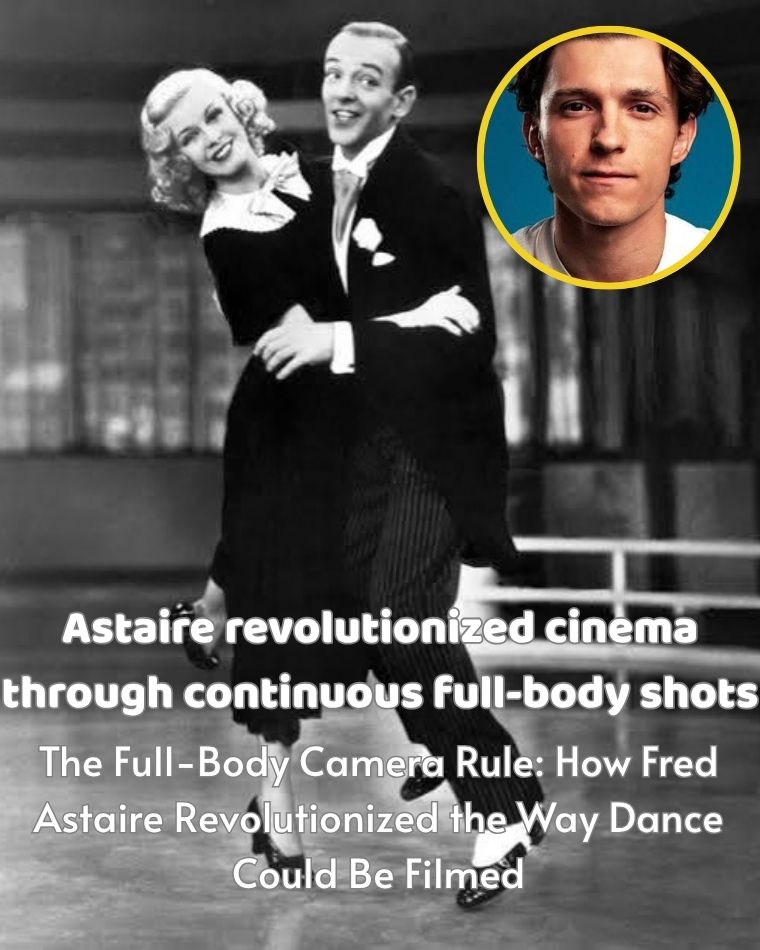
Cre: Wikimedia Commons — Public Domain (Trailer Follow the Fleet, 1936
Astaire explicitly enforced a total rejection of close-ups during dance sequences.
His steadfast rule dictated that either the camera would dance, or he would.
Because he believed two simultaneous movements created visual chaos, he demanded that the camera follow the dancers smoothly without calling attention to itself.
This 1930s filming innovation required directors and cinematographers to radically alter their technical setup on the soundstage.
Cinematographers could no longer hide behind standard three-point coverage setups or quick optical cuts.
Camera operators were forced to maintain strict focal discipline while tracking rapid lateral trajectories across massive sets.
Every panning movement and dolly glide had to match the physical tempo of the dancers down to the millisecond.
If a camera operator missed a cue or drifted slightly out of frame, the entire take was ruined.
Similarly, the technical demands placed on choreography became infinitely more rigorous.
Because continuous takes without cuts eliminated the safety net of post-production fixes, routines could not rely on disjointed segments spliced together in an editing suite.
Choreography had to be conceived, rehearsed, and staged as complete, organic theatrical suites.
Every transition between different dance idioms had to be structurally seamless in real time.
Astaire spent weeks and sometimes months refining routines in rehearsal rooms before stepping in front of the camera.
Every physical impulse, tap cadence, and partner spin was calculated to withstand uninterrupted spatial scrutiny.
This methodology placed immense physical and psychological demands on Astaire and his dance partners.
Executing an intricate four-minute tap and ballroom sequence in one unbroken take required extreme stamina and mental focus.
If a single misstep or rhythmic slip occurred at minute three, the cast and crew had to reset from the very beginning.
Production reports routinely documented routines being performed dozens of times to secure one flawless take.
This unbending standard prioritized authenticity over editing tricks at every stage of production.
Performers could not rely on flattering camera angles to simulate grace that had not been earned through physical labor.
Through this relentless discipline, Astaire elevated filmed dance into a legitimate and respected visual art form.
Before his intervention, film dance was largely treated as visual spectacle or decorative punctuation within a theatrical plot.
Astaire proved that motion captured within unbroken screen geometry possessed its own dramatic tension, narrative depth, and visual poetry.
By allowing audiences to witness continuous physical exertion, his films fostered an unprecedented level of viewer trust.
Audiences understood that what appeared on the silver screen was genuine human capability operating at peak mastery.
The full-body camera shots preserved the subtle dynamics of weight distribution, balance shifts, and posture that define world-class dancing.
Viewers could trace the continuous flow of energy from the dancer’s feet, through the spine, and out to the fingertips.
This preservation of human kinetic energy gave Astaire’s films a timeless visual clarity that outlived the passing trends of studio editing.
The impact of this philosophy resonated deeply throughout the evolution of dance cinematography across subsequent decades.
Major musical innovators of the 1940s and 1950s inherited the baseline expectation that a musical number must retain spatial coherence.
While later directors introduced more mobile cranes and elaborate staging, the core principle of respecting the dancer’s full silhouette remained paramount.
Whenever Hollywood later strayed toward rapid music-video cutting and fragmented close-ups, critics and purists regularly invoked Astaire’s standard as the defining benchmark.
His work established that excessive editing in dance cinema often serves as an apology for inadequate choreography or unprepared performers.
The contrast remains just as stark when examining contemporary productions that struggle to balance visual excitement with spatial integrity.
Modern cinematographers frequently cite Astaire’s restraint as an object lesson in visual humility.
Allowing the performer’s physical craft to command the screen requires directorial confidence and patience.
Modern dancers and choreographers continue to evaluate their own craft through the lens of Astaire’s demanding constraints.
Working within continuous full-body framing removes every contemporary technical shield.
There are no digital cleanups, speed ramps, or alternate angle splices to salvage an off-balance landing.
Contemporary performers often emphasize that continuous takes demand a heightened state of athletic mindfulness.
Every muscle group must remain engaged, as the wide lens captures the slightest sign of hesitation or fatigue.
Choreographers working in live-action film today acknowledge that designing for an unbroken camera view requires superior geometric awareness.
The dance must look balanced from an objective fixed vantage rather than relying on dynamic camera sweeps to manufacture dynamism.
Dancers trained in contemporary, street, and classical disciplines repeatedly return to Astaire’s catalog to study his spatial economy.
His ability to project effortless lightness while performing under severe physical pressure remains a masterclass in kinetic performance.
Even in contemporary digital cinema, the decision to show an uncut routine from head to toe is regarded as the ultimate statement of artistic confidence.
Interest in Astaire’s historic methods has experienced a major resurgence as Hollywood prepares new biographical projects focused on his legacy.
Announced productions highlighting Astaire’s life have drawn widespread attention across entertainment media.
Audiences and industry observers remain curious about how contemporary actors will navigate the rigorous physical expectations Astaire once established.
The enduring fascination with his screen presence proves that true physical virtuosity transcends shifting technologies.
Ultimately, Astaire’s legacy is defined by his profound trust in the expressive power of the human body.
He refused to let the mechanical apparatus of cinema diminish the raw athleticism of dance.
By resisting the temptation of easy optical illusions, he forced the medium of film to adapt to the reality of the stage.
His pioneering insistence on full-body camera shots established an indelible visual grammar for generations of filmmakers.
The principle of authenticity over editing tricks remains as vital and challenging today as it was in the golden age of Hollywood.
Whenever a director chooses an uncut wide shot over a barrage of fast edits, the spirit of Astaire’s philosophy lives on.
Cinema continues to grapple with the delicate balance between technical manipulation and organic performance.
Yet the standard set on 1930s soundstages remains clear and enduring.
True artistry does not require an editor to tell the audience where to look.
It simply asks for an open frame, steady lighting, and an artist capable of commanding the space from head to toe.
Để lại một phản hồi