The legendary phrase claiming Ginger Rogers did everything Fred Astaire did, backward and in high heels, remains one of show business’s sharpest cultural truths. Behind that famous quip lies an overdue reassessment of an artistic partnership that Hollywood historically framed around the masculine genius of Astaire while treating Rogers as fortunate accompaniment. Across ten musical films that defined cinema history, Rogers not only matched Astaire’s uncompromising technical precision, but she also infused their routines with acting depth, impeccable comic timing, and an authentic warmth that elevated athletic choreography into timeless human romance.
The famous cultural aphorism regarding Ginger Rogers dancing backward and in high heels was popularized in modern culture through a celebrated 1982 comic strip.
Yet long before cartoonists distilled the observation into folklore, film crews and studio musicians understood that the phrase described concrete, grueling physical reality.
For decades, popular film lore casually credited Fred Astaire with inventing the cinematic dance syntax while casting Ginger Rogers as his decorative, lucky partner.
That persistent narrative severely diminished what actually unfolded across soundstages during the golden age of American film.
When Fred Astaire stepped in front of motion picture cameras, he required a collaborator capable of matching complex, syncopated rhythms with razor-sharp physical precision.
Astaire was a relentless perfectionist whose standard of execution broke or intimidated numerous prospective dancing partners.
Rogers possessed the rhythmic instinct and stamina necessary to absorb those exacting routines without missing a beat.
She performed every intricate combination while moving in reverse, reacting in split-second increments to her partner’s leads.
She carried out these athletic maneuvers while balanced atop slender heeled evening shoes rather than low-profile dance flats.
Her execution of the material demanded double the bodily balance and immense physical discipline on polished ballroom floors.
Astaire himself was the first to recognize that Rogers offered an irreplaceable dynamic that purely technical ballerinas could never supply.
Her physical presence transformed technical exercises into electrifying cinematic encounters.
The popular cultural joke was therefore never just a piece of witty hyperbole.
It served as an essential reminder of an extraordinary artistic achievement that Hollywood’s publicity machines systematically understated.
Rogers proved that technical excellence in Hollywood dance was never an exclusively male domain.
Her career remains an astonishing testament to physical strength, artistic intuition, and professional poise under intense industrial pressure.
The Ten-Film Partnership: From Flying Down to Rio to The Barkleys of Broadway
The collaborative journey that reshaped musical cinema began quite serendipitously in 1933.
RKO Radio Pictures cast Astaire and Rogers as secondary romantic players supporting Dolores del Río in Flying Down to Rio.
Their sequence performing the “Carioca” electrified audiences and stole the spotlight from the headliners.
Studio executives quickly recognized that the kinetic chemistry between the two performers generated genuine box-office gold.
Between 1933 and 1939, RKO built a legendary run of nine features around the pair.
In 1934, they starred together in The Gay Divorcee, cementing their status as top-tier musical attractions.
The following year brought Roberta and the universally acclaimed triumph Top Hat.
Top Hat established their place in the cultural pantheon with unforgettable musical numbers and breathtaking elegance.
In 1936, the duo delivered two monumental achievements in Follow the Fleet and the legendary Swing Time.
Both pictures showcased sophisticated musical tap numbers alongside sweeping romantic waltzes.
They followed these successes with Shall We Dance in 1937, introducing iconic George and Ira Gershwin compositions.
The year 1938 brought the romantic musical comedy Carefree, featuring innovative dream ballet concepts.
In 1939, they concluded their uninterrupted pre-war RKO tenure with The Story of Vernon and Irene Castle.
The film provided a poignant, biographical tribute to early ballroom pioneers while marking the apparent end of their shared era.
A decade later, in 1949, Metro-Goldwyn-Mayer reunited the pair for their tenth and final collaboration, The Barkleys of Broadway.
Filmed in vibrant Technicolor, the project allowed them to reflect warmly on their own legendary collaboration.
Across sixteen turbulent years, these ten productions revolutionized how motion pictures captured movement, rhythm, and song.
Cre: Wikimedia Commons — Public Domain (RKO Radio Pictures, 1935)
Technical Precision Matching Demanding Standards
Fred Astaire’s choreographic philosophy was notorious for demanding immaculate precision in every frame.
He rejected theatrical cutting and editing tricks, insisting that dance routines be shot in wide framing with minimal cuts.
If a single tap sounded hollow or a foot drifted out of alignment, the camera rolled again from the top.
Astaire held himself to punishing rehearsal standards, working long hours until every gesture became second nature.
To partner Astaire under such strict conditions required an iron will and supreme athletic capability.
Rogers met those extraordinary demands without possessing decades of formal classical ballet training.
She brought instead an astonishing innate musicality and an uncanny ability to absorb complex choreography quickly.
Astaire’s numbers featured rapid syncopations, sudden decelerations, and swift directional shifts that left little room for error.
Rogers learned these complex arrangements at Astaire’s relentless working pace.
She matched his rapid tap patterns beat for beat on dense wooden rehearsal stages.
Her lines in ballroom numbers mirrored his exact arm placement, posture, and weight distribution.
When Astaire executed complex turns across wide floor spaces, Rogers paced his momentum flawlessly.
She anchored their balances during intricate partnering holds and sudden spins.
Her rhythmic sharpness ensured that their dual tap recordings registered with crisp acoustic clarity.
Audiences marveled at the seeming ease of their routines, oblivious to the rigorous labor underlying every step.
Rogers proved herself to be Astaire’s peer on a technical level, sustaining his exacting standard through hundreds of rigorous hours.
She validated the fact that natural virtuosity and intense application could conquer the most challenging choreography in Hollywood history.
Acting Depth and Comic Timing Beyond Dance
While technical precision provided the physical foundation, Rogers brought an invaluable dramatic dimension that made the partnership transcendent.
Astaire had built his early stage reputation in Broadway and London musical revues alongside his sister Adele.
On film, however, the medium demanded authentic character engagement and subtle behavioral nuance.
Rogers was an accomplished dramatic actress who possessed an innate understanding of dramatic stakes.
She grounded their musical narratives in believable, working-class vulnerability, sharp wit, and genuine romantic skepticism.
When Astaire’s characters pursued her onscreen, Rogers never surrendered immediately to facile charm.
She injected healthy skepticism, arch eyebrow arches, and sharp comedic timing into every dialogue scene.
Her witty deliveries transformed potentially superficial romantic plots into spirited battles of the sexes.
Her comedic instincts allowed routines to function as full dramatic extensions of plot rather than isolated spectacles.
When they stepped onto the dance floor, her eyes continued acting the scene with emotional clarity.
A subtle softening of her expression communicated surrender far more effectively than words ever could.
A defiant turn of her shoulders conveyed lingering romantic tension amidst an intricate series of spins.
She turned abstract choreography into an evolving psychological conversation between two distinct human beings.
Audiences fell in love not just with how they danced, but with the human story told through their movement.
Astaire’s technical mastery provided the vehicle, but Rogers’s dramatic depth supplied its beating heart.
Without her expressive acting, their routines would have remained masterclasses in rhythm rather than landmarks of screen romance.
The Physical Toll: Performing in Costume, Feathers, and Heels
The physical demands of golden-age Hollywood dancing were already brutal, but for a female partner, they multiplied exponentially.
Astaire typically performed in perfectly tailored formal suits, silk waistcoats, and supple, flat-heeled dance oxfords.
His garments were specifically structured to grant his joints absolute freedom of motion across every plane.
Rogers, by contrast, had to execute high-velocity athletic maneuvers encased in elaborate studio gowns.
She worked inside tightly corseted bodices, sweeping silk skirts, and delicate trailing trains.
These ornate costumes carried significant physical weight and frequently threatened to entangle feet during rapid steps.
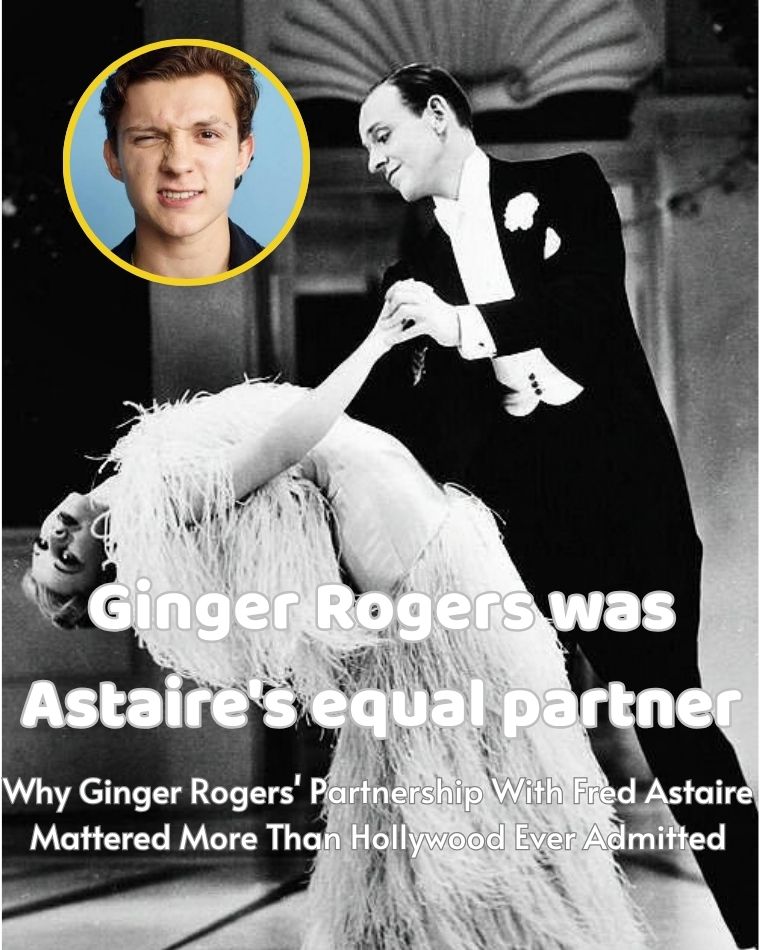
A famous historical example occurred during the filming of the “Cheek to Cheek” sequence for Top Hat.
Rogers selected a magnificent ostrich-feather gown designed by Bernard Newman.
During initial takes, the delicate blue feathers shed profusely under vigorous motion, flying directly into Astaire’s eyes and mouth.
Despite the disruption and the studio friction that ensued, Rogers insisted on the gown because its motion flattered the dance.
Beyond the challenges of heavy costuming, Rogers performed the entire repertoire in high-heeled shoes.
Heels alter body posture drastically, shifting physical weight onto the balls of the feet and straining calves and ankles.
Balancing through rapid rotations and sustaining jumps while wearing heels requires massive leg strength.
Filming these intricate sequences required dozens of grueling takes under blazing studio lights.
Rogers’s feet frequently suffered bleeding and bruising by the end of twelve-hour production days.
She endured these physical hardships without once breaking character or allowing exhaustion to show on camera.
Her smiling demeanor during the final take hid a level of pain and fatigue that few screen performers ever matched.
How Golden-Age Hollywood Framed the Partnership
During the 1930s, the Hollywood publicity machine and entertainment press routinely tilted praise toward Fred Astaire.
Studio marketing campaigns frequently promoted Astaire as the singular choreographic mastermind and creative genius.
Rogers was repeatedly categorized by contemporary columnists as the glamorous starlet who simply followed along.
Writers praised her beauty, her costumes, and her good fortune in securing Hollywood’s most coveted dance partner.
This unequal framing reflected systemic mid-century biases regarding artistic authorship in collaborative mediums.
Male choreographers were viewed as independent auteurs, whereas their female partners were viewed as mere instruments of execution.
Astaire undeniably planned and rehearsed his routines with obsessive dedication alongside associate choreographers like Hermes Pan.
Yet that technical labor produced half-finished blueprints until it met the intuitive artistry of a responsive female partner.
The press often overlooked that Rogers had established a thriving screen career prior to entering the musical partnership.
She was already a bankable star who carried comedic and dramatic vehicles independently across multiple studios.
Her personal star power brought a broad, loyal audience to the RKO musicals from the very start.
Furthermore, Astaire had tested several other dancers who possessed superior formal dance credentials on paper.
None of those technical specialists ever achieved the transcendent screen chemistry that Rogers conjured effortlessly.
The public sensed a unique equality on screen that the studio publicity departments frequently failed to articulate in print.
Even when industry awards and trade articles lauded Astaire’s footwork, moviegoers packed theaters to see Ginger respond.
The enduring myth of the lucky girl being led by the maestro was a convenient narrative that ignored half the artistic equation.
Artistic Independence and Oscar Triumph
Rogers was acutely aware that Hollywood risked consigning her legacy entirely to the shadow of Astaire’s dance shoes.
Rather than remaining comfortably trapped in a lucrative formula, she deliberately pushed for complex dramatic roles.
She proved her dramatic capabilities across diverse genres, excelling in screwball comedies, social dramas, and poignant romances.
In 1940, she took on the title role in the gritty drama Kitty Foyle.
Her nuanced, emotionally harrowing performance resonated deeply with moviegoers and critics alike.
At the 13th Academy Awards, Ginger Rogers won the Oscar for Best Actress, cementing her dramatic credentials at the pinnacle of the industry.
She achieved critical validation on her own merits, independent of musical dance numbers and satin ballgowns.
Astaire himself, while revered throughout the industry, never won a competitive acting Academy Award.
Rogers demonstrated that she was a complete, multi-faceted performing artist who could command cinema screens entirely on her own.
Her triumph proved to studio heads that her intelligence and screen charisma were never merely borrowed from a male partner.
When she eventually returned to partner Astaire in The Barkleys of Broadway in 1949, she did so as a triumphant peer.
Her presence in that Technicolor reunion lent the project a sense of celebration between two acknowledged screen equals.
She negotiated contracts with shrewd business acumen, earning top billing and exceptional salaries throughout her career.
Her independent success underscored the unique strength she had brought to the partnership all along.
She was never an apprentice learning at the feet of a master, but an artist operating at full artistic maturity.
Why Ginger Rogers’s Contribution Deserves Fuller Recognition
Reevaluating the career of Ginger Rogers is essential to understanding the history of classic American cinema.
Dance on film is inherently an art of relationship, energy exchange, and visual dialogue.
A soloist can display extraordinary technique, but a duet requires an invisible, synchronized connection between two distinct artists.
Fred Astaire’s brilliance was undeniably genuine, but it found its most sublime cinematic realization when reflected against Ginger Rogers.
She was the emotional lens through which the audience decoded the romance and joy of their musical numbers.
Her responsive phrasing, joyful laughter, and effortless physical grace made the impossible seem delightfully accessible.
She absorbed the punishing physical strain of the work, maintaining a mask of sparkling glamour under painful conditions.
She carried the emotional weight of ten films, ensuring that every routine felt fresh, dramatic, and purposeful.
Without her theatrical instincts, those legendary black-and-white films would have lacked their timeless human appeal.
She set the standard for what a screen partner could achieve, demonstrating that grace under pressure is an active, powerful virtue.
Modern audiences returning to these classic films see beyond the outdated framing of the past.
They recognize a consummate professional who commanded the camera with radiant authority and formidable skill.
She conquered every rhythmic challenge, triumphed across dramatic genres, and etched her name into cinema immortality.
Ginger Rogers did not simply follow in Fred Astaire’s footsteps; she shared equal ownership of the path they carved together.
Her legacy stands tall, enduring, vibrant—and undeniably achieved backward and in high heels.
Để lại một phản hồi