Before “La La Land” stormed the airwaves and solidified her commercial momentum, Demi Lovato made her definitive solo statement with “Get Back” in August 2008.
The fiery track broke through the saturated teen pop scene by offering an authentic punk-rock edge rarely heard from Hollywood Records’ roster.
This deep retrospective charts the sonic architecture, commercial impact, and artistic courage that turned “Get Back” into the foundational bedrock of Lovato’s debut era.
Breaking Free From the 2008 Disney Mold
The pop music landscape in the summer of 2008 was fiercely competitive and distinctly tailored to youth culture.
Walt Disney Records and Hollywood Records operated as cultural juggernauts, manufacturing polished anthems for global distribution.
Miley Cyrus dominated the Billboard charts with shiny dance-pop and synthesized radio gems.
Vanessa Hudgens and Ashley Tisdale rode the high-gloss wave generated by the High School Musical phenomenon.
Even the Jonas Brothers, who were pioneering teen pop-punk at the time, kept their core tracks meticulously scrubbed for mainstream family audiences.
Entering that bright, polished environment, a sixteen-year-old Demi Lovato faced a critical artistic crossroad.
Her breakthrough role as Mitchie Torres in the television movie Camp Rock had just turned her into a household name alongside Joe Jonas.
The duet “This Is Me” showcased her powerful belt, but it remained squarely within the musical boundaries of an inspirational Disney television soundtrack.
Hollywood Records needed a proper lead single to herald her forthcoming debut studio album, Don’t Forget.
Rather than embracing sugary synths or dancefloor pop, Lovato insisted on pursuing authentic guitar-driven rock.
She envisioned an artistic persona rooted in real garage drums, loud amplifiers, and immediate vocal grit.
When “Get Back” officially arrived via digital retailers on August 12, 2008, it immediately disrupted expectations.
The single refused to emulate the bubblegum conventions of the era, presenting a bold artistic voice right out of the gate.
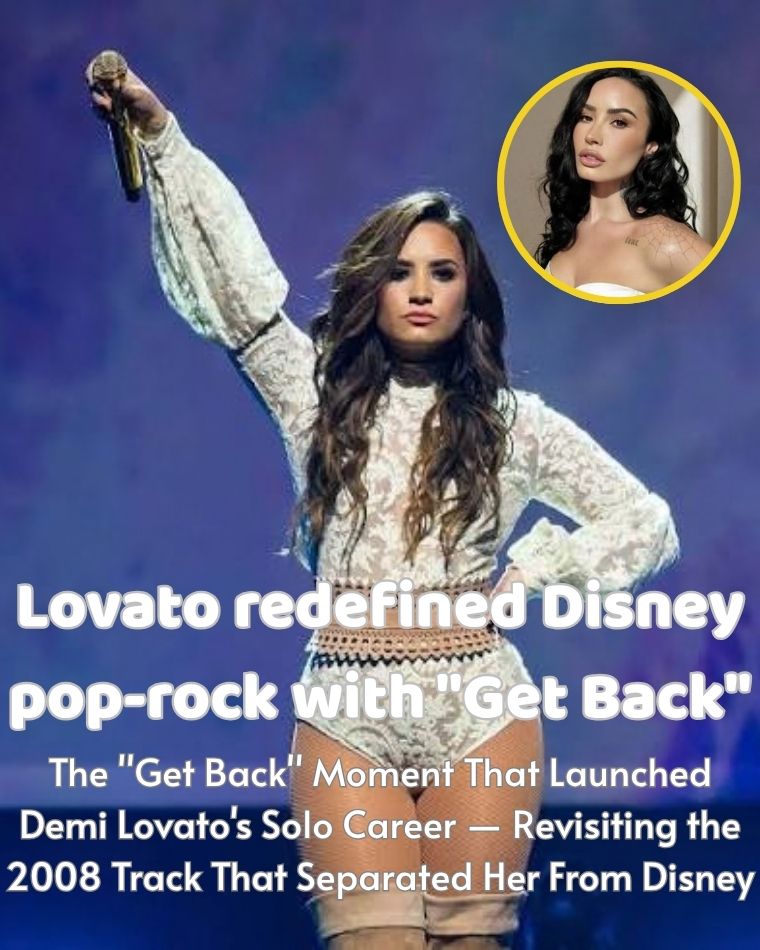
Cre: Wikimedia Commons
The Songwriting Partnership and Production Team
The creative foundation of “Get Back” emerged from a remarkably close musical collaboration between Lovato and the Jonas Brothers.
During the filming of Camp Rock and subsequent tour rehearsals, Lovato bonded with Nick, Joe, and Kevin Jonas over a mutual passion for alternative rock.
The four musicians sat down together with acoustic and electric guitars to craft a track that felt genuinely youthful yet sonically assertive.
Lovato famously explained that she deliberately avoided writing another bitter heartbreak anthem for her solo debut.
She noticed that modern radio was already overloaded with vengeful breakup songs and petty grievances.
Instead, she wanted to capture the earnest nostalgia of trying to rekindle a meaningful romantic connection.
She described the concept as an upbeat, spirited track that was simply enjoyable to sing directly to its subject.
To translate that vision into a master recording, Hollywood Records brought in experienced producer and multi-instrumentalist John Fields.
Fields, who had previously engineered hits for Switchfoot and Rooney, understood how to balance radio accessibility with genuine indie rock punch.
The recording sessions took place inside Wishbone Studio in North Hollywood, California.
The studio environment prioritized live performance energy over digital sequencing and studio trickery.
Nick, Joe, and Kevin Jonas actively contributed driving rhythm guitars and layered vocal harmonies across the chorus.
John Fields took on multiple roles, playing bass guitar, additional electric guitars, and punchy keyboards.
Studio drummer Jack Lawless laid down dynamic, crashing drum patterns that gave the track an authentic garage pulse.
Musician John Taylor also stepped in to provide blistering lead guitar fills and supplementary backing vocals.
The raw tracks were subsequently handed over to legendary audio engineer Chris Lord-Alge for mixing.
Lord-Alge gave the guitars a sharp, biting edge that pushed the song far beyond typical bubblegum boundaries.
The final master was completed by Ted Jensen, cementing a polished production pedigree that rivaled established rock acts.
Dissecting the Upbeat Punk-Rock Architecture
Musically, “Get Back” is built on an aggressive, power-chord foundation that owes as much to nineties pop-punk as it does to classic power pop.
According to official sheet music published by Sony/ATV Music Publishing, the track runs at a brisk tempo of 150 beats per minute.
Set in standard 4/4 common time, the driving rhythm never relents from the opening measure to the final guitar feedback.
The composition is written in the key of G mixolydian, giving the melodic lines an unconventional blues-rock swagger.
Music critics instantly picked up on the song’s distinct vintage rock influences upon its release.
Ed Masley of The Arizona Republic explicitly drew comparisons between “Get Back” and the energetic eighties work of Tommy Tutone.
Other industry commentators noted strong musical parallels to early Avril Lavigne, Ashlee Simpson, and The Donnas.
The song immediately opens with a distorted, overdriven guitar riff that signals its rock intentions before any vocal enters.
When Lovato begins singing, the rhythm section drops into a tight, syncopated groove beneath her voice.
The verses build tension through rapid lyrical delivery and punchy basslines.
The chorus then explodes with massive wall-of-sound electric guitars, crashing cymbals, and infectious vocal harmonies.
Lyrically, the song tackles reconciliation with refreshing vulnerability and defiance.
Lines like “I want to get back to the old days” and “Kiss me like you mean it” resonate with direct teenage honesty.
The narrative does not portray the singer as a helpless victim of circumstance.
Instead, the narrator takes total ownership of her romantic desires, demanding authenticity and genuine emotional commitment.
That proactive emotional stance perfectly matched the charging energy of the electric instrumentation.
Chart Performance and the 2008 Digital Landscape
Releasing a guitar-heavy rock track in August 2008 represented a calculated commercial gamble for a new teen artist.
Mainstream Top 40 radio at the time was heavily skewed toward urban pop, R&B, and synthetic club productions.
Yet the massive momentum of Camp Rock gave Lovato a valuable launchpad on digital retail platforms.
Upon its digital release on iTunes, “Get Back” experienced an immediate surge of downloads from enthusiastic fans.
The single debuted at number forty-three on the prestigious US Billboard Hot 100 chart.
Reaching the top fifty with a debut solo single was an impressive achievement for an artist who had never released an independent album.
The song’s digital sales were particularly robust, eventually surpassing 586,000 paid downloads in the United States alone.
That consistent digital performance ultimately earned “Get Back” an official Gold certification from the Recording Industry Association of America (RIAA).
Beyond the United States, the single also made an impact on key international music markets.
In Canada, the track entered the Canadian Hot 100, peaking at number ninety-three during its initial chart run.
Across the Pacific in Australia, the song found traction on specialty charts, peaking at number ten on the ARIA Hitseekers ranking.
Radio Disney placed the track into heavy rotation, exposing millions of young listeners to crunchy electric guitars daily.
The song proved that young audiences were eager to embrace alternative rock textures when paired with undeniable pop hooks.
It proved Lovato could pull significant numbers based on her musical identity rather than just a film soundtrack.
The Rooftop Aesthetic: Philip Andelman’s Visual Direction
A great debut single requires an equally memorable visual introduction, and “Get Back” received exactly that.
Hollywood Records recruited acclaimed music video director Philip Andelman to helm the project.
Andelman had previously built an impressive portfolio directing atmospheric visuals for artists like Lenny Kravitz, Band of Horses, and John Mayer.
His artistic approach favored grounded realism, cinematic camera work, and gritty urban textures over glossy soundstages.
The music video for “Get Back” was filmed across an intense single-day shoot in New York City.
The primary location chosen was the exposed rooftop of an industrial building situated right near the Manhattan Bridge.
The setting provided a raw, breezy urban backdrop with real sunlight and towering bridge architecture visible in every wide shot.
Lovato stood center-stage with an authentic live backing band, completely eschewing choreographed dancers or backup performers.
Her wardrobe for the video was stylishly unpretentious, featuring dark jeans, layered tops, and rock-inspired accessories.
Throughout the performance scenes, Lovato interacted directly with the microphone stand, jumping, headbanging, and delivering passionate facial expressions.
Andelman cut between dynamic full-band performances and intimate, candid close-ups of Lovato singing into the camera.
The visual language was clear and deliberate: this was a genuine rock frontwoman, not a manufactured teen idol.
The music video made its television world premiere on Disney Channel on August 22, 2008.
Disney strategically broadcast the video immediately following the high-profile television premiere of The Cheetah Girls: One World.
The broadcast delivered an enormous viewing audience, introducing Lovato’s edgy aesthetic to millions of households in a single evening.
The video quickly became a staple on youth video countdowns and accumulated millions of views across online platforms.
Vocal Powerhouse: Early Evidence of Range and Control
Beyond its driving production and stylish music video, “Get Back” served as undeniable proof of Lovato’s rare vocal gifts.
Many teen pop tracks of the late 2000s relied heavily on aggressive pitch correction and layered studio processing.
In contrast, “Get Back” put Lovato’s natural vocal timbre front and center without unnecessary masking.
Her vocal performance on the track spans an impressive range of two full octaves.
The published sheet music notes her range on the recording stretching from a resonant low note of B3 up to a soaring G5.
In the verses, Lovato utilizes a grounded, conversation-like chest voice that brings conversational immediacy to the lyrics.
As the melody climbs into the pre-chorus, her delivery tightens, building kinetic energy with controlled vibrato.
When the explosive chorus hits, she belts notes in her upper chest register with remarkable projection and roundness.
Rather than sounding strained or thin, her voice retains warmth, resonance, and emotional urgency at the top of her range.
She punctuates the vocal lines with playful vocal slides, growls, and subtle rock inflections that showcase natural instincts.
During the song’s climatic bridge and final chorus, Lovato layers powerful ad-libs that float effortlessly above the wall of heavy guitars.
Music educators and vocal analysts have frequently highlighted the recording as an early showcase of her elite belting technique.
Even at sixteen years old, she possessed vocal stamina, breath support, and resonance that far exceeded typical industry standards.
The song announced to the music industry that Lovato was a true vocalist capable of tackling difficult, high-energy material live.
Paving the Way for ‘Don’t Forget’
The immediate creative and commercial success of “Get Back” set the stage for Lovato’s full-length studio debut.
Just six weeks later, on September 23, 2008, Hollywood Records officially released the album Don’t Forget.
Because “Get Back” had already established her sonic identity, the album arrived to widespread critical and commercial anticipation.
Don’t Forget debuted at number two on the US Billboard 200 chart, selling 89,000 copies in its very first week of release.
Critics widely praised the album for maintaining the organic, guitar-driven spirit first unveiled on the lead single.
Tracks like “La La Land,” “Gonna Get Caught,” and the emotional title track “Don’t Forget” built directly upon the musical foundation laid by “Get Back”.
The single gave Lovato artistic credibility, proving she had a distinct creative viewpoint separate from her television acting roles.
It also established a collaborative formula with the Jonas Brothers and John Fields that defined her earliest musical output.
When Lovato joined the Jonas Brothers as the opening act on their massive Burnin’ Up Tour in 2008, “Get Back” served as her energetic signature moment.
She performed the song live every night with a handheld microphone, demonstrating that her studio vocals could be replicated effortlessly in front of arena crowds.
The song gave her a dynamic performance anchor that energized audiences and earned the respect of concertgoers.
Looking back across decades of pop history, “Get Back” stands as one of the boldest debut singles produced by the 2000s Disney star system.
It refused easy trends, embraced the power of live rock instrumentation, and let a generational voice take flight completely unfiltered.
Để lại một phản hồi