On December 23, 1985, Princess Diana orchestrated one of the most astonishing theatrical surprises in modern British history at London’s Royal Opera House.
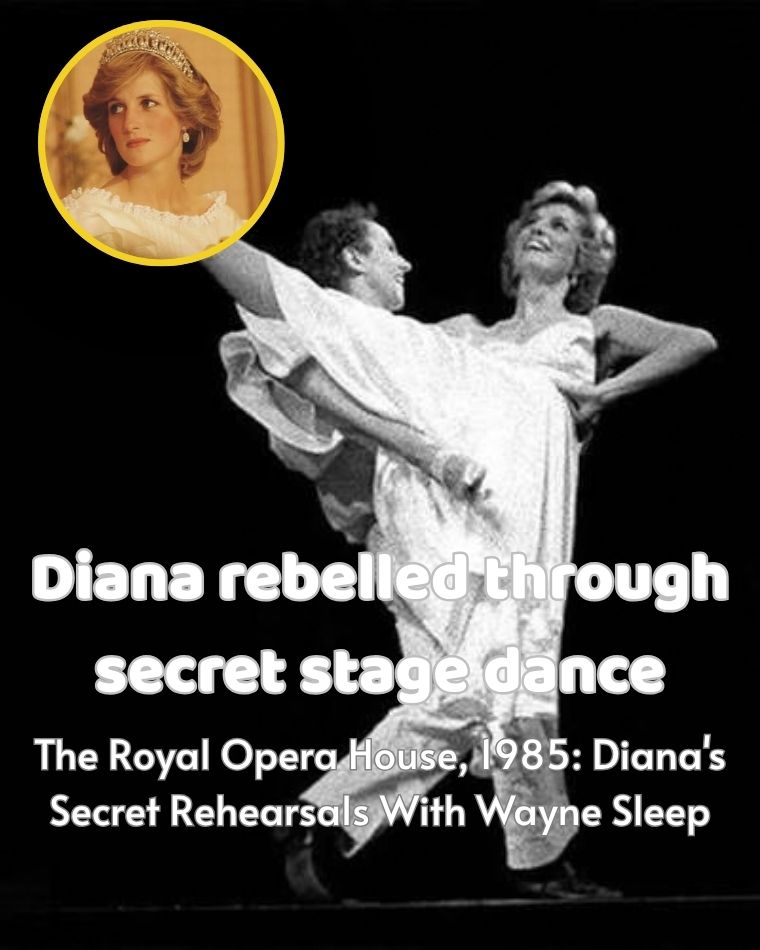
Stepping out onto the stage alongside Royal Ballet star Wayne Sleep, she performed a high-energy routine to Billy Joel’s pop hit “Uptown Girl.”
The eight-minute routine was an extraordinary act of creative expression and personal rebellion that pushed past royal protocol.
A Shocking Winter Evening at Covent Garden
On the evening of December 23, 1985, Prince Charles sat among dignitaries, patrons, and society guests at the Royal Opera House in Covent Garden.
The annual private Christmas gala brought together Britain’s cultural elite for an evening celebrating the performing arts.
Patrons expected an orderly succession of classical showcases and polished entertainment.
No one in the royal box or the stalls anticipated a departure from aristocratic propriety.
During the proceedings, Princess Diana quietly slipped away from her seat beside Prince Charles.
Audience members assumed she had briefly stepped away for personal reasons.
Moments later, the lights dimmed across the grand auditorium.
Dancer Wayne Sleep walked out onto the stage to lead what appeared to be another gala number.
The upbeat tempo of Billy Joel’s chart-topping pop track “Uptown Girl” suddenly rang out through the speakers.
Princess Diana stepped out from the wings into the spotlight, immediately captivating every spectator in the building.
The audience gasped in collective disbelief before erupting into spontaneous applause.
Prince Charles appeared visibly stunned as his wife took command of the historic stage.
The moment dismantled the formal divide between royalty and public performance.
For eight continuous minutes, spectators witnessed an unprecedented display of pop culture inside a temple of high art.
Princess Diana was not merely observing cultural life; she was participating in it directly before an astounded crowd.
📸 [ẢNH: Nhà hát Hoàng gia Royal Opera House tại Covent Garden, London, nơi diễn ra buổi diễn bất ngờ]
Link: https://upload.wikimedia.org/wikipedia/commons/7/77/Royal_Opera_House_inside.jpg
Nguồn: Wikimedia Commons — Bản quyền công cộng / Creative Commons Attribution-ShareAlike

An Unlikely Friendship Born from Artistic Patronage
Princess Diana’s appearance on stage that night was the culmination of a unique artistic friendship.
She had long held a deep love for dance, having studied ballet during her youth before growing too tall for professional training.
Her official royal duties included serving as a devoted patron of the Royal Ballet.
Through this formal patronage, she met Wayne Sleep, one of Britain’s most celebrated dance virtuosos.
Sleep, a renowned principal dancer with the Royal Ballet, was famous for his dynamic stage presence and incredible speed.
Despite their vastly different backgrounds, the princess and the dancer formed an easy, warm rapport.
Diana admired his technical brilliance and infectious energy.
Sleep recognized Diana’s profound appreciation for movement and her desire to remain close to the world of dance.
Their mutual affection allowed Diana to step outside the stifling parameters of her royal schedule.
With Sleep, she was able to converse freely as an enthusiastic student of performance rather than a ceremonial figurehead.
Their creative rapport gradually laid the foundation for an audacious idea.
Diana approached Sleep with a private proposal that would shatter royal decorum.
She wanted to join him on stage during the private charity gala as a special holiday surprise.
Sleep was initially startled by the proposition, knowing the immense scrutiny surrounding any royal activity.
Yet he recognized her sincere dedication to the craft and agreed to bring the daring vision to life.
Weeks of Covert Rehearsals and Demands for Secrecy
The realization of the performance required weeks of rigorous, covert preparation.
Diana was determined that no hint of the plan reach palace officials or the public before the curtain rose.
She insisted on absolute secrecy to protect the element of surprise.
The duo secured time in private dance studios across London away from prying eyes.
Navigating the logistics of royal security while slipping into rehearsal spaces required precise timing.
Diana arrived at these private sessions eager to work through challenging choreography.
Sleep designed the eight-minute routine specifically around Diana’s physical attributes and natural capabilities.
Standing at nearly five feet ten inches, Diana towered over Sleep, who stood at five feet two inches.
Sleep embraced the dramatic height difference, using it to inject humor, wit, and playfulness into the routine.
Diana listened intently to Sleep’s technical guidance, working tirelessly to master the steps.
Although she lacked formal professional dance credentials, she possessed natural rhythm and an instinctive sense of timing.
Every repetition was completed with intense focus, with Diana determined not to look amateurish on stage.
Sleep later recounted that beneath her outward confidence, she experienced significant nervousness about performing.
Nevertheless, her determination to see the project through was unwavering throughout the grueling weeks of rehearsals.
The studio served as a sanctuary where she could shed the heavy mantle of royalty.
Cre: Wikimedia Commons — Creative Commons Attribution-ShareAlike 3.0 Unported
Eight Minutes of Pure Freedom to Billy Joel’s Beat
When the stage lights illuminated Diana on December 23, the weeks of clandestine training came to fruition.
Clad in a shimmering, flowing silk dress, she commanded the expansive stage with remarkable fluidity.
The routine seamlessly blended contemporary musical theater movement with classical ballet lines.
Diana executed high leg extensions, pirouettes, and theatrical spins alongside one of Britain’s greatest dancers.
She playfully tossed her head, teased her partner, and leaned into the cheeky lyrics of Billy Joel’s hit song.
Every move matched the brisk rhythm of the music with precision and charm.
Sleep’s choreography framed her elegance without exposing her lack of classical training.
The crowd watched in awe as Diana was lifted into the air by Sleep during a series of dynamic leaps.
She glided across the floorboards with unmistakable joy, radiating genuine warmth across the footlights.
For eight breathless minutes, she was not performing the duty of a royal patron.
She was an authentic performer fully immersed in the rhythm and physical demands of the stage.
Her movement revealed a vibrant, expressive personality that formal court appearances rarely permitted.
Every turn and flourish served as non-verbal communication of her inner vibrancy.
The Covent Garden audience was spellbound by the sheer audacity and technical success of the sequence.
When the music reached its final crescendo, the entire hall rose in an ecstatic standing ovation.
Diana and Sleep took multiple curtain calls to thunderous applause that reverberated throughout the theater.
Stunned Reactions and a Divided Public Response
While the audience inside the theater reacted with wild enthusiasm, reactions beyond the stage were far more complex.
Prince Charles remained visibly taken aback by the spectacle unfolding from the royal box.
The performance had completely bypassed traditional channels of royal approval and consultation.
The day following the gala, word of Diana’s secret dance rapidly made its way through public and royal circles.
Reviews of the unscripted performance were immediately polarized across Britain.
Many commentators and admirers found the dance deeply endearing, praiseworthy, and undeniably charming.
They commended Diana for her warmth, her willingness to entertain, and her astonishing natural talent.
Conversely, conservative observers and traditionalists viewed the performance with open skepticism and disapproval.
Critics argued that dancing to a modern pop song before a public gathering was fundamentally undignified for a royal princess.
Some palace insiders felt that royal dignity required formal distance rather than theatrical exhibitionism.
The public debate highlighted the growing divide between modern celebrity culture and centuries-old royal expectations.
Palace courtiers were notoriously uncomfortable with actions that placed personal spontaneity ahead of institutional protocol.
Yet for Diana, the technical reception from critics mattered far less than the lived experience of the dance itself.
She had proven to herself that she could command the stage on her own artistic merits.
The mixed public reaction only amplified the legendary status of the event in contemporary popular lore
Wayne Sleep’s Insights into Diana’s Motivation
In subsequent years, Wayne Sleep offered invaluable first-hand recollections of the historic performance.
Sleep emphasized that Diana approached the entire venture with profound artistic seriousness.
He observed that while she carried immense nervousness before walking out, her determination never wavered.
To Sleep, the dance represented Diana’s profound psychological need to break free from rigid expectations.
Within royal institutions, life was mapped out with precise schedules and strictly controlled behaviors.
The dance studio offered her complete autonomy, where the only master was the tempo of the music.
Sleep explained that the physical discipline required for the routine gave Diana a rare sense of accomplishment.
On stage, no one could read a prepared speech for her or dictate her physical posture.
Her body had to deliver every beat, every step, and every landing with independent accuracy.
Sleep recalled her unrestrained delight whenever they successfully executed a complex sequence during rehearsals.
He characterized the performance as an authentic manifestation of her buoyant, playful spirit.
It allowed her to share a side of her character that official portraits and formal walkabouts obscured.
Sleep noted that Diana cherished the memory of the evening, viewing it as a deeply personal triumph.
Her artistic bravery formed a bond between the two performers that endured long after the music ended.
Their collaboration demonstrated how deeply Diana gravitated toward individuals who embraced nonconformity and creative passion.
Reclaiming the Narrative Through Movement
The 1985 Royal Opera House dance stands as a defining chapter in the mythology of Princess Diana.
Throughout her life in the public eye, her public image was continuously shaped by photographers and officials.
Speeches and public appearances were thoroughly vetted, scripted, and managed by palace aides.
Yet on that December evening, Diana claimed total and absolute control over her personal narrative.
She communicated using movement and physical grace to express an authentic identity that words could not capture.
The performance served as an undeniable declaration of creative autonomy.
It showcased her willingness to take calculated risks that made traditional royal officials uncomfortable.
Her spontaneity was not an accident; it was an intentional choice to assert her individuality.
The image of Diana dancing freely to “Uptown Girl” remains an enduring symbol of resistance to institutional rigidity.
It offered the public a rare glimpse of who Diana was beneath the overwhelming weight of the crown.
Decades later, the eight-minute dance continues to be celebrated by historians, biographers, and cultural critics worldwide.
It proved that Diana was capable of reinventing the modern perception of royalty through sheer personal charisma.
The event permanently cemented her status as a cultural icon who refused to be completely domesticated by tradition.
Ultimately, the routine remains an extraordinary milestone of creative courage on the world’s most prestigious stage.
Để lại một phản hồi