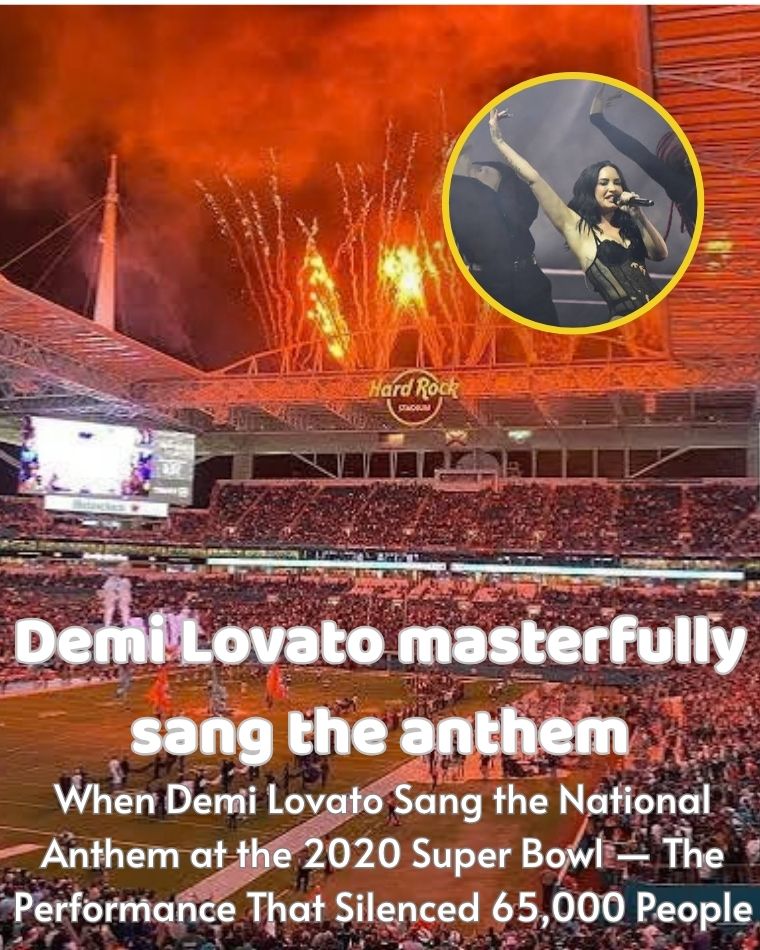
Demi Lovato delivered a masterclass in vocal control and emotional command during her performance of the national anthem at Super Bowl LIV on February 2, 2020.
Standing before more than 60,000 spectators at Hard Rock Stadium in Miami Gardens, Florida, and an international television audience exceeding 100 million viewers, the 27-year-old vocalist faced one of the highest-pressure performance platforms in modern live television.
Through deliberate tempo calibration, breath management, dynamic escalation, and disciplined vocal ornamentation, Lovato transformed an unforgiving ceremonial standard into a definitive career triumph.
The Silence Before the First Note at Hard Rock Stadium
Moments before kickoff, an intense hush swept across the stands of Hard Rock Stadium as players, coaches, and spectators fixed their attention on the center of the field.
Super Bowl LIV pitted the San Francisco 49ers against the Kansas City Chiefs in an electric championship atmosphere.
Yet the pregame atmosphere shifted instantly from sporting anticipation to pure theatrical stillness when the public address announcer introduced Lovato.
Dressed in an immaculate all-white pantsuit, the vocalist walked toward the microphone with steady poise and understated focus.
The stadium monitors magnified her calm expression as she waited for the downbeat of the backing arrangement.
Singing “The Star-Spangled Banner” is widely regarded among vocal coaches as one of the most perilous assignments in contemporary live broadcasting.
The anthem features an octave-and-a-half range spanning an interval of a minor tenth, challenging both the lower chest register and upper head voice.
Moreover, the notorious open-air acoustics of a major football stadium produce disorienting delays that can derail an inexperienced performer within seconds.
Lovato took her opening breath, met the gaze of the front camera, and launched into the first phrase with crystalline clarity.
Cre: Wikimedia Commons — Creative Commons Attribution-ShareAlike 2.0 Generic (CC BY-SA 2.0)
Context of a High-Stakes Comeback
The road leading to Hard Rock Stadium was characterized by a prolonged hiatus from public live singing.
For well over a year, Lovato had stepped away from the relentless touring schedule and media spotlight to focus on personal wellness and recovery.
Her return to major performance began only one week earlier at the 62nd Annual Grammy Awards on January 26, 2020.
At the Grammys, she had debuted her deeply vulnerable piano ballad “Anyone,” an emotionally raw performance that earned a sustained standing ovation.
While the Grammy appearance re-established her artistic presence, the Super Bowl demanded an entirely different psychological and vocal orientation.
A national anthem broadcast at the Super Bowl does not permit self-indulgent pacing or prolonged emotional pauses.
It requires athletic vocal stamina, rigorous pitch precision, and universal public appeal.
Ten years prior, on February 7, 2010, an 18-year-old Lovato had presciently tweeted: “One day, I’m gonna sing the national anthem at a super bowl. Onnndayyy.”
Stepping onto the turf exactly a decade later transformed an ambitious social media wish into a fully realized milestone.
The stakes could hardly have been higher, yet her posture radiated complete technical readiness.
Dissecting the Vocal Architecture: Phrasing, Breath, and Tone
Lovato commenced “O say can you see” in a controlled, rich lower register that avoided any breathiness or false vibrato.
Her initial approach was remarkably conversational, emphasizing lyrical legibility over premature vocal gymnastics.
Rather than attacking the opening intervals with aggressive volume, she relied on diaphragmatic support to produce a round, warm resonance.
The line “by the dawn’s early light” showcased her impeccable pitch placement in the mid-range.
Her phrasing across the first eight bars was clean and legato, ensuring that each consonant articulated clearly without sacrificing rhythmic momentum.
Breath control during the opening stanza dictated the entire flow of the performance.
Super Bowl anthems often suffer when performers deplete their lung volume during mid-tempo phrases, forcing audible gasps before pivotal ascending intervals.
Lovato mitigated this common pitfall by utilizing brief, silent intercostal breaths between key syntactic clauses.
On “what so proudly we hailed at the twilight’s last gleaming,” she kept her neck muscles entirely relaxed, producing a steady, forward-placed tone.
Her dynamic level remained at a measured mezzo-forte, intentionally withholding maximal volume for the demanding closing section.
This structural restraint built subconscious anticipation throughout the stadium.
Technical Escalation: Navigating the Octave Leap
As the composition moved past the halfway mark, Lovato initiated a systematic escalation in dynamics and belt power.
When she arrived at “And the rockets’ red glare,” she transitioned seamlessly from her blended mid-mix into full, supported chest-dominant belt.
Her placement on the high notes was resonant and resonant, avoiding nasal constriction or forced glottal attacks.
The sustained syllable on “bombs bursting in air” displayed a wide, rapid vibrato that gave the sustained pitch immense stability.
Rather than lingering excessively on every syllable, she maintained a brisk 6/8 rhythmic feel that honored the song’s martial cadence while leaving room for personal inflection.
Her execution of “gave proof through the night that our flag was still there” demonstrated total mastery over vocal registration.
She navigated the shift between her lower and upper registers without the audible break that catches so many pop vocalists off guard.
The phrasing remained urgent and connected, carrying the emotional energy forward into the anthem’s critical climax.
Audience members and sideline camera operators could see her total physical stability: feet planted shoulder-width apart, spine aligned, and jaw tension non-existent.
This disciplined athletic foundation gave her the physical support necessary to project across the immense open stadium bowl.
The Climax: Reimagining the Final Cadence
The definitive moment of any Super Bowl anthem lies in the final lines: “O say does that star-spangled banner yet wave / O’er the land of the free and the home of the brave.”
Performers frequently stumble here by over-modulating or straining beyond their comfortable tessitura in an attempt to impress the audience.
Lovato, however, formulated a precise harmonic roadmap for this concluding phrase.
Approaching the word “free,” she executed a deliberate melodic substitution that differed subtly from the traditional notation.
Instead of an immediate jump to an over-belted high note, she utilized an ascending melisma that landed squarely on a resonant, clarion high note.
The sustained note on “free” was held for multiple seconds with consistent acoustic brilliance, zero vocal fatigue, and a blooming vibrato.
As her sound reverberated through the stadium’s overhead acoustic canopy, the crowd erupted into widespread cheers.
She then descended cleanly through a tasteful vocal run, demonstrating agility and microtonal accuracy before landing on “brave.”
Her concluding pitch on “brave” was definitive, grounded, and sustained with impressive breath reserves.
The military jet flyover thundered across the open sky at the exact instant her final note ceased, capping an airtight display of timing.
Comparison with Iconic Super Bowl Anthems
To evaluate the significance of Lovato’s performance, one must measure it against the high historical benchmark of Super Bowl anthem renditions.
Whitney Houston’s 1991 performance at Super Bowl XXV in Tampa during the Gulf War remains the gold standard against which all future renditions are judged.
Houston, backed by The Florida Orchestra, reimagined the anthem in 4/4 time, imbuing it with soaring gospel optimism and monumental vocal warmth.
In 2004, Beyoncé delivered a disciplined, operatic rendition in her hometown of Houston at Super Bowl XXXVIII, highlighting pinpoint pitch control.
Conversely, Super Bowl XLV in 2011 served as a stark reminder of the anthem’s risks when Christina Aguilera famously fumbled the lyrics to “o’er the ramparts we watched.”
In 2016, Lady Gaga earned universal critical acclaim at Super Bowl 50 with a theatrical, Broadway-inspired performance marked by sustained chest belts.
Lovato’s 2020 interpretation did not attempt to replicate Houston’s gospel groove or Lady Gaga’s theatrical vibrato.
Instead, Lovato positioned her version directly at the intersection of contemporary pop belting and disciplined vocal technique.
Clocking in at roughly one minute and forty-nine seconds, her rendition avoided unnecessary vocal bloat.
By prioritizing harmonic cohesion over excessive ornamentation, Lovato produced a modern classic that ranks alongside the elite performances in the game’s six-decade chronicle.
The Sign Language Performance and Visual Harmony
An equally compelling dimension of the Super Bowl LIV anthem was the accompanying visual performance by Christine Sun Kim.
Representing the National Association of the Deaf, Kim provided an American Sign Language (ASL) interpretation that matched Lovato’s vocal dynamics beat for beat.
Kim used expansive, expressive gestural artistry to translate not only the literal lyrics of Francis Scott Key’s text, but also Lovato’s rhythmic cadences and rising pitch contour.
While broadcast networks have historically faced criticism for failing to air the full ASL performance, online platforms widely shared Kim’s interpretation alongside Lovato’s vocals.
The visual synergy between Lovato’s focused vocal delivery and Kim’s expressive signing heightened the celebratory dignity of the pregame ceremonies.
It reflected a modern Super Bowl production where accessibility and artistic excellence coexisted harmoniously on a global platform.
Immediate Reactions from Peers and the Public
The digital response to Lovato’s vocal display was instantaneous and overwhelmingly positive across social networks.
Within seconds of her final note, fellow musicians and industry peers published glowing reviews on X, Instagram, and entertainment forums.
Lady Gaga publicly commended Lovato on social media, praising her bravery, technical precision, and stunning vocal delivery.
Pop star Pink, who had performed the anthem at Super Bowl LII while battling the flu, also offered public congratulations.
Prominent vocal coaches on YouTube and independent music analysts immediately began releasing detailed breakdown videos analyzing Lovato’s formant tuning and laryngeal height.
Professional vocal pedagogues highlighted the fact that Lovato never pushed her chest voice past its healthy physiological breaking point.
Instead, she utilized a well-trained pharyngeal mix on the climactic sustained high notes, preserving vocal health while achieving maximum volume.
Viewers across the country noted the genuine smile that broke across Lovato’s face the moment she finished the song.
That brief, candid moment of relief and joy resonated just as deeply as the technical notes that preceded it.
The Symbolism of Artistic and Personal Resilience
Beyond the mechanical mechanics of voice production, Lovato’s performance functioned as a profound cultural statement.
Singing the national anthem on a broadcast viewed by over 100 million people leaves no room to hide.
For an artist emerging from an intense period of self-reconstruction, accepting that challenge was an act of raw courage.
Lovato did not approach the stage with defensive timidity or overcompensating bravado.
Instead, she offered an authentic, grounded demonstration of what long-term discipline and vocal preservation can achieve.
Her clean aesthetic—from the sharp white tailoring to the unadorned stage staging—signaled a new chapter defined by artistic maturity.
She let the instrument itself do all the talking.
The emotional resonance felt by the audience stemmed from the undeniable reality of her journey back to that exact microphone.
The performance demonstrated that technical skill and personal vulnerability are not mutually exclusive.
In Lovato’s hands, they reinforced one another, transforming a standard pregame patriotic requirement into an unforgettable statement of survival and triumph.
A Defining Chapter in a Diverse Career
Looking back, the February 2, 2020 national anthem represents a turning point in Demi Lovato’s musical legacy.
Before that evening, public discourse often prioritized sensationalized headlines over her artistic craft.
Her performance at Super Bowl LIV refocused the narrative squarely on her generational talent as a powerhouse vocalist.
It reminded the global entertainment industry that beneath the celebrity culture lies a trained, formidable musician capable of commanding the world’s most stressful stage without a safety net.
The rendition continues to be cited in retrospective rankings of top Super Bowl moments alongside performances by Prince, Bruce Springsteen, and Whitney Houston.
It proved that an artist does not need elaborate backup dancers, pyrotechnics, or extravagant choreography to steal the show at an event known for overwhelming sensory excess.
A single microphone, impeccable technique, and unwavering emotional sincerity proved more than sufficient.
As Lovato concluded her performance and saluted the crowd at Hard Rock Stadium, she did more than fulfill a decade-old tweet.
She etched her name permanently into the history of modern American live television, delivering a textbook standard for vocal excellence that will be studied and admired for decades to come.
Để lại một phản hồi