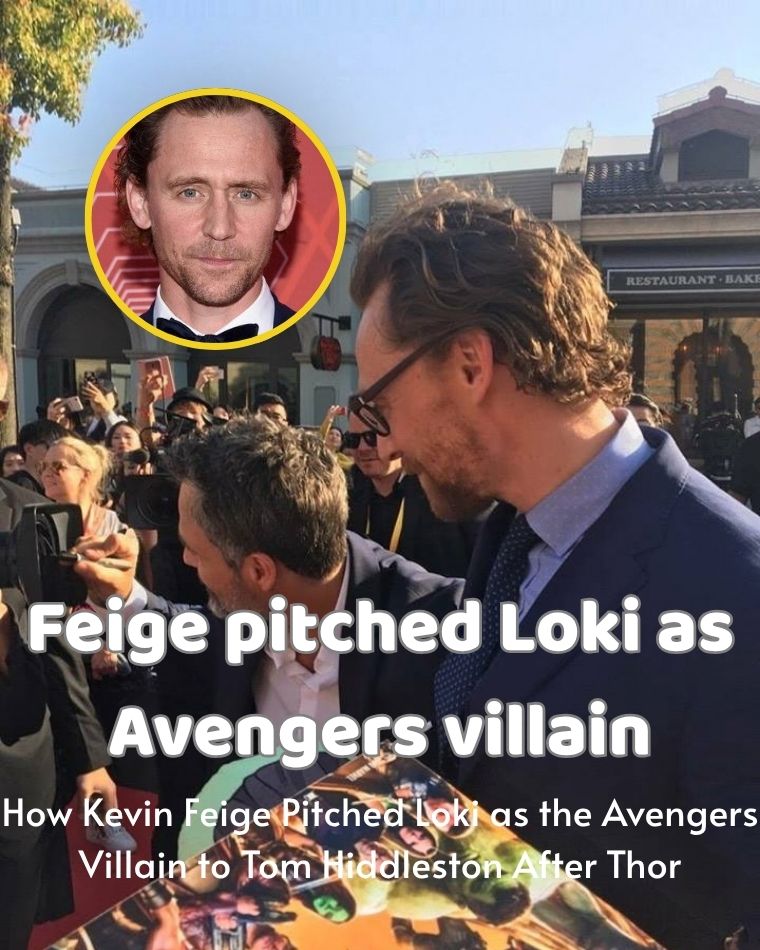
British actor Tom Hiddleston recently revealed how Marvel Studios president Kevin Feige personally pitched him the concept of playing the primary antagonist in The Avengers.
The career-defining conversation took place shortly after the production of Kenneth Branagh’s Thor, fundamentally altering the trajectory of Hiddleston’s Hollywood career.
By establishing that the Asgardian God of Mischief was meant for far greater narrative stakes, Marvel Studios set into motion a decade-long cinematic revolution.
The Secret Pitch That Changed Marvel History
Every long-running cinematic empire traces its origins back to a handful of quiet, high-stakes conversations behind closed doors.
For Tom Hiddleston, that moment arrived during the earliest days of Marvel Studios’ ambitious Hollywood takeover.
Speaking at the Zurich Film Festival, where he was honored with the Golden Eye Award, Hiddleston looked back on the beginning of his journey.
At the time, Marvel Studios was taking an unprecedented gamble by linking distinct superhero films into a single cohesive continuity.
Few outside the studio believed that an ensemble crossover involving multiple headlining superheroes could actually succeed on the silver screen.
Hiddleston had originally auditioned to play the mighty hero Thor before being cast by director Kenneth Branagh as the conflicted younger brother, Loki.
When production on the initial 2011 film wrapped, the young British stage actor expected his time in the superhero realm to conclude naturally.
At that moment in franchise history, major blockbuster villains rarely survived their initial storylines to appear in subsequent installments.
Hollywood conventions routinely dictated that superhero antagonists served single-film narrative arcs before exiting the franchise permanently.
However, Marvel Studios president Kevin Feige possessed an entirely different vision for both the character and the studio’s broader slate.
Shortly after working on Thor, Feige approached Hiddleston with a startling revelation about the future of his character.
Feige explicitly informed Hiddleston that Thor was definitely not going to be the only film he would make as Loki.
Instead, the studio executive pitched the actor on returning to headline a monumental team-up project that was still in development.
Feige anchored the entire pitch directly in classic comic book lore from the golden age of Marvel publishing.
He pointed out that in the debut issue of The Avengers back in 1963, Loki was the exact catalyst that forced Earth’s heroes to assemble.
Feige told the actor that Marvel Studios wanted to honor that foundational history by having Loki serve as the central villain.
Cre: Wikimedia Commons — vagueonthehow (Creative Commons Attribution 2.0 Generic)
Discovering the Blueprint for the Marvel Cinematic Universe
Hearing Feige outline plans for a multi-character crossover gave Hiddleston an extraordinary glimpse into an evolving creative strategy.
During that formative period, the phrase Marvel Cinematic Universe was far from being a household term around the world.
Robert Downey Jr. had established Iron Man as a surprise blockbuster sensation, but the broader superhero slate was still largely unproven.
Characters like Captain America and Thor had not yet demonstrated their standalone box-office viability to global audiences.
Committing to an ensemble feature that brought different cinematic worlds together was viewed by many industry insiders as an enormous financial hazard.
Feige’s unwavering confidence in bringing Earth’s Mightiest Heroes together under one marquee was striking to everyone involved.
For Hiddleston, learning about this blueprint required him to completely reevaluate his understanding of the entertainment industry.
He realized that Marvel Studios was not simply producing isolated sequels, but orchestrating a serialized narrative unseen in modern filmmaking.
Feige envisioned an interconnected universe where characters preserved ongoing psychological growth across different film franchises.
Loki was not being conceived as a disposable antagonist meant to be defeated and forgotten before the final credits rolled.
He was intended to serve as the narrative connective tissue that bridged the cosmic majesty of Asgard with contemporary modern Earth.
Hiddleston was deeply moved to learn that the studio valued his interpretation enough to place such enormous narrative responsibility upon him.
The pitch represented a massive leap of faith from studio leadership in an actor who had limited international profile at that time.
Rather than hiring an established Hollywood heavyweight to headline the crossover, Feige doubled down on an emerging British talent.
This pivotal decision reaffirmed the philosophy of placing character development ahead of conventional commercial celebrity casting.
Hiddleston understood that his upcoming portrayal of the trickster deity would need to sustain an entire blockbuster crossover.
The revelation transformed what felt like an exciting acting gig into an overarching creative journey spanning multiple years.
Layering the God of Mischief Beyond Conventional Villainy
Armed with the knowledge that Loki was destined to challenge the assembled Avengers, Hiddleston altered his artistic approach significantly.
He recognized that a villain capable of threatening an entire planet required far more than superficial theatrical malevolence.
If Loki was going to stand toe-to-toe with Iron Man, Captain America, Thor, and the Incredible Hulk, his motivations needed emotional weight.
Hiddleston set out to construct a performance rooted in profound familial neglect, emotional abandonment, and existential crisis.
In Kenneth Branagh’s original film, Loki learns that he is not a biological prince of Asgard, but the orphaned offspring of Frost Giants.
That devastating revelation broke the character’s internal sense of self-worth and left him desperate for validation from King Odin.
Hiddleston worked tirelessly to preserve that heartbreaking domestic tragedy even as Loki acquired darker cosmic ambitions.
He collaborated with the late screenwriter Don Payne to build out layered emotional complexities that informed every devious scheme.
Rather than portraying a one-dimensional evil overlord, Hiddleston wanted audiences to witness a wounded soul lashing out at the cosmos.
Every cruel gesture and grandiose speech about destiny became an elaborate psychological mask hiding profound internal grief.
This nuanced emotional foundation prevented Loki from turning into an absurd, cartoonish supervillain when wielding alien armies.
When director Joss Whedon stepped in to develop the script for The Avengers, Hiddleston carried that depth into pre-production discussions.
Whedon was eager to explore what drove the character’s internal nightmares and what shaped his desperate search for identity.
The result was an antagonist whose menacing bravado was constantly undercut by glimpses of a lonely, broken young prince.
Hiddleston balanced immense intellectual charisma with flashes of terrifying volatility that kept the superhero team permanently on edge.
Audiences responded not just to Loki’s stylish theatricality, but to the palpable emotional wound that drove his destructive choices.
This rich dramatic architecture ensured that Loki remained fascinating even when committing unforgivable acts of planetary aggression.
From Asgardian Threat to Universal Anti-Hero
The release of The Avengers in the summer of 2012 propelled Tom Hiddleston into absolute global superstardom.
Audiences were utterly transfixed by his electrifying performance, elevating Loki into a genuine cultural phenomenon almost overnight.
Lines such as being burdened with glorious purpose entered the international cinematic lexicon and established an enduring fandom.
Instead of facing complete audience rejection for his villainous misdeeds, Loki captured the public imagination in unexpected ways.
His remarkable popularity presented Marvel Studios with a delightful creative challenge that upended standard comic book conventions.
Fans demanded the return of the Asgardian schemer, forcing writers to integrate him into the wider tapestry of upcoming Marvel storylines.
In 2013’s Thor: The Dark World, Loki evolved from an isolated adversary into a reluctant, razor-sharp ally to his heroic brother.
The dynamic between Tom Hiddleston and Chris Hemsworth blossomed into one of the most beloved screen pairings in recent cinema history.
Their on-screen chemistry mixed genuine fraternal tenderness with razor-edged mutual betrayal, giving each encounter dramatic resonance.
By the time Taika Waititi directed 2017’s Thor: Ragnarok, Loki had morphed into a brilliant, unpredictable comedic anti-hero.
Audiences rooted for his redemption even as they anticipated the inevitable double-cross lurking beneath his charming Asgardian smiles.
His tragic sacrifice at the hands of the mad titan Thanos in Avengers: Infinity War offered a heartbreaking resolution to his story.
Yet the sheer magnetic power of Hiddleston’s performance proved impossible for the Marvel creative brain trust to abandon.
The subsequent introduction of alternate timelines in Avengers: Endgame provided a fresh narrative springboard for the character.
This narrative opening led directly to the critically acclaimed standalone Disney+ series, which expanded the lore of the multiverse.
Over two seasons, Loki transitioned from a self-obsessed narcissist into a selfless cosmic guardian holding realities together.
This stunning multi-year character journey stands as an unprecedented triumph of long-form dramatic television and cinematic storytelling.
What Loki’s Trajectory Reveals About Hollywood World-Building
Looking back at Kevin Feige’s early pitch to Tom Hiddleston provides valuable lessons about modern franchise construction.
The triumph of the Marvel Cinematic Universe did not occur through sterile corporate mandates or algorithmic storytelling.
It flourished because creative executives demonstrated an instinctive willingness to adapt master plans around exceptional creative talent.
Feige possessed the strategic foresight to recognize that long-term serialized storytelling demanded compelling, multi-dimensional antagonists.
Without a villain capable of commanding immense respect and dramatic tension, the formation of the Avengers would have felt hollow.
Feige understood that an ensemble superhero team is only as convincing as the existential threat that demands their unity.
By establishing Loki as the central catalyst, the filmmakers provided their disparate heroes with a deeply personal adversary to confront.
Thor possessed an intimate, heartbreaking family stake in stopping his brother from unleashing planetary catastrophe upon mankind.
That emotional connection gave the clash between Earth’s defenders and extraterrestrial invaders a distinctly human and resonant core.
Furthermore, Marvel Studios showed immense flexibility by nurturing character arcs that resonated deeply with general moviegoers.
When audiences showed overwhelming affection for Loki, the studio leaned into that enthusiasm rather than rigidly following comic canons.
They allowed the character to age, transform, suffer genuine consequences, and eventually find profound, heartbreaking spiritual redemption.
Hiddleston recently reflected on this journey, noting that he never anticipated portraying the God of Mischief across fifteen years.
He credited the late screenwriter Don Payne, his colleagues, and the character’s extraordinary mythological complexity for that sustained longevity.
As the Marvel Cinematic Universe prepares for its next era with upcoming ensemble blockbusters, that legacy remains vital.
Loki’s transformation from an insecure Asgardian prince into the protector of the multiverse represents the pinnacle of long-form character writing.
It all started with a quiet conversation between an ambitious producer and a young, dedicated British stage actor.
That single studio pitch changed the landscape of modern Hollywood blockbusters and redefined what comic book cinema could achieve.
Để lại một phản hồi