Apple TV Plus has officially unveiled the dramatic first trailer for Tenzing, chronicling the momentous 1953 expedition that culminated in humanity reaching the highest point on Earth.
The film stars newcomer Genden Phuntsok as Nepali-Tibetan mountaineer Tenzing Norgay alongside Tom Hiddleston as New Zealand climber Sir Edmund Hillary.
Directed by Jennifer Peedom, the prestige historical drama re-examines the historic achievement by placing Tenzing Norgay’s personal journey and cultural viewpoint firmly at the core of the story.
The newly released footage highlights the crushing physical demands of the Himalayas and the profound emotional bond forged between two men who stood on top of the world.
Apple Original Films has positioned the production as a centerpiece dramatic offering, capturing both the lethal hostility of Mount Everest and the human spirit required to navigate its ridges.
Audiences are treated to expansive vistas of high-altitude glaciers alongside intimate, frost-bitten portraits of mutual survival.
The trailer establishes a delicate tension between the imperial ambitions of the British expedition and the intimate, spiritual relationship Tenzing held with the peak known locally as Chomolungma.
Phuntsok delivers a compelling screen presence that balances humility, quiet defiance, and unmatched technical mastery across treacherous ice walls.
Hiddleston portrays Hillary not as an untouchable icon, but as an exhausted, resolute partner who recognized that the summit could never be attained alone.
The preview opens with sweeping landscape compositions showcasing the vastness of the Himalayan range, setting an immediate tone of isolation and mortal peril.
Every frame underscores the severe cold and the unrelenting winds that punished the 1953 expedition team at every camp.
Through careful pacing, the trailer introduces the immense weight carried by Tenzing, whose prior attempts on the mountain had already established him as an exceptional high-altitude climber.
His motivation is shown running far deeper than national glory or geographical conquest.
Viewers see Tenzing confronting both the harsh elements and the silent prejudices of an expedition structured around colonial hierarchy.
The cinematic tone shifts seamlessly between grand mountain photography and intensely claustrophobic tent interiors where vital decisions were made under fading light.
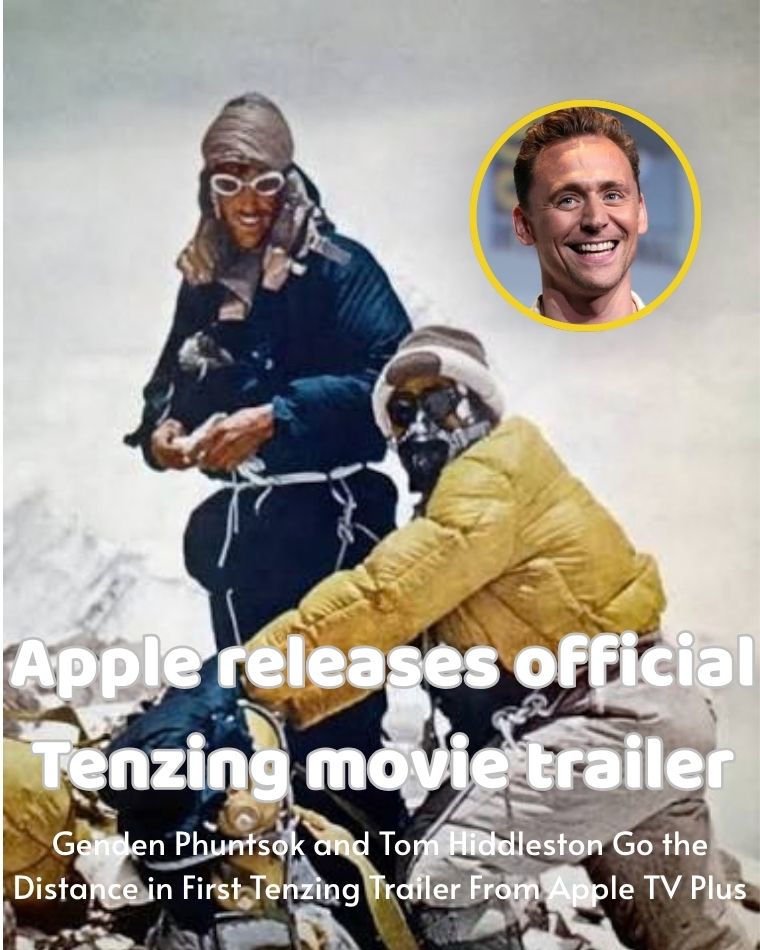
Cre: Wikimedia Commons — Public Domain / Historic Press Photograph
The dynamic between Genden Phuntsok and Tom Hiddleston serves as the narrative anchor throughout the promotional footage.
Their on-screen dialogue emphasizes the unvarnished reality that social hierarchy and racial boundaries vanish when two climbers share a single nylon safety line.
Hiddleston’s Hillary appears stripped of cinematic glamour, coated in grime and frostbite as he battles altitude sickness.
Phuntsok conveys Tenzing’s acute awareness that his community’s contribution has historically been relegated to the background of Western exploration lore.
In one pivotal exchange hinted at in the footage, the two men exchange silent acknowledgments of the lethal void beneath their crampons.
The chemistry reflects a hard-earned mutual respect built through shared oxygen starvation rather than easy camaraderie.
Rather than portraying Hillary as a singular conquering hero, the film clearly establishes Hillary and Tenzing as complementary forces navigating an impossible vertical labyrinth.
The trailer demonstrates how their trust had to be absolute during every step across the jagged crevasses of the Khumbu Icefall.
A single slip by either climber would have spelled instantaneous catastrophe for the entire British expedition.
The footage captures the palpable terror of navigating fragile snow bridges suspended over bottomless chasms.
Sound design in the trailer plays a significant role in conveying this psychological weight, featuring the heavy rhythmic rasp of early closed-circuit oxygen equipment.
The whistling gale cuts through spoken dialogue, reminding the viewer that human voices are utterly dwarfed by the natural landscape.
Visual contrasts are drawn between the warmth of traditional Sherpa settlements and the barren, windswept rock above eight thousand meters.
Phuntsok’s face frequently fills the lens, registering both religious reverie and the excruciating physical toll of high-altitude exertion.
The emotional stakes are elevated by showing Tenzing’s family and community, who understood all too well the mountain’s lethal reputation.
Previous expeditions had claimed numerous lives, and the 1953 journey was undertaken with the heavy knowledge of past failures.
What distinguishes Tenzing from prior cinematic treatments of Everest is its deliberate centering of the indigenous Sherpa experience.
For decades, popular Western accounts focused primarily on the British organizers and Hillary’s post-climb quip about knocking the summit off.
This adaptation directly confronts that historical imbalance by exploring Tenzing’s lifelong devotion to the mountain.
The trailer introduces Tenzing recalling his youthful conviction that the sacred peak called to him personally.
The production acknowledges the profound religious significance the Sherpa people hold for the mountain, viewing it not as an enemy to be subjugated, but as a sacred deity deserving veneration.
This spiritual dimension infuses the ascent with a resonance absent from conventional survival thrillers.
Director Jennifer Peedom brings extensive documentary experience in the Himalayas to the project, ensuring cultural authenticity across costume, dialect, and environmental behavior.
Her direction avoids exoticizing the local participants, presenting them instead as world-class athletes and logistical masterminds.
The footage shows Tenzing negotiating complex expedition dynamics with equal parts diplomacy and unyielding self-respect.
Willem Dafoe also appears in the supporting cast, lending veteran gravity to the expedition’s leadership cadre.
Dafoe’s character embodies the intense geopolitical pressure on the expedition, which was organized under the auspices of the Royal Geographical Society and the Alpine Club.
With Queen Elizabeth II’s coronation approaching in the summer of 1953, the team faced enormous pressure from London to reach the summit before rival international teams succeeded.
The trailer captures this ticking clock without turning the human drama into cheap melodrama.
The political stakes of the era provide a sharp counterpoint to the quiet solitude experienced by the two lead climbers near the crest.
While governments and newspapers scrambled for national triumphs, the men on the ridge were preoccupied solely with the next swing of an ice axe.
This thematic contrast gives the trailer its narrative tension and philosophical depth.
The physical production values highlighted in the teaser showcase a refusal to rely entirely on studio soundstages and digital green screens.
Real mountain footage captured at extreme locations provides an unmistakable sense of scale and authentic danger.
The camera operator tracks the climbers along wind-scoured knife edges where the curvature of the Earth begins to reveal itself.
Snow flurries hit the camera lens directly, emphasizing the raw, documentary-style approach applied to a prestige period piece.
The production design meticulously recreates vintage mid-century mountaineering equipment, from woolen layers and heavy leather boots to cumbersome oxygen cylinders.
These historical details highlight the sheer audacity of the 1953 climb compared to modern commercial expeditions equipped with synthetic textiles and satellite forecasting.
Climbing with archaic gear meant that weather windows had to be judged entirely by instinct and basic barometers.
The physical exhaustion depicted on Hiddleston and Phuntsok feels thoroughly genuine and tactile.
The actors spent months training to replicate the heavy, deliberate gait required when moving through the Death Zone above eight thousand meters.
In several key trailer sequences, the audience is plunged into the dizzying perspective looking down the sheer Lhotse Face.
The cinematography uses wide-angle framing to demonstrate how completely the mountain dwarfs the human figures traversing its flank.
The audio landscape strips away musical scoring during critical climbing sequences, leaving only the terrifying howl of wind and the crack of shifting glacial ice.
This sensory design heightens the stakes and grounds the narrative in relentless physical reality.
The sheer drop-offs visible in every outdoor shot serve as a constant reminder that any mistake would prove instantly fatal.
The teaser effectively conveys why the 1953 ascent captured the global imagination like few other physical feats of the twentieth century.
Apple TV Plus has designed a strategic rollout for Tenzing, signaling immense confidence in the film’s artistic execution and broad appeal.
The film is slated to receive a selective theatrical run before landing globally on Apple’s digital platform.
This dual-distribution model allows cinema enthusiasts to experience the visual magnitude of the Himalayas on the largest screens possible.
At the same time, the worldwide streaming release ensures that global audiences can access Tenzing’s underrepresented narrative directly from home.
Apple has consistently pursued prestige feature films that blend expansive historical storytelling with character-driven emotional core narratives.
Tenzing fits neatly into this institutional programming strategy by exploring an iconic historical event through a fresh, inclusive cinematic lens.
The trailer’s debut has generated widespread enthusiasm among mountaineering historians, cinema lovers, and cultural observers alike.
Industry watchers have noted that casting Genden Phuntsok represents a pivotal moment for authentic casting in mainstream international productions.
By giving Tenzing Norgay equal billing and narrative priority, the film challenges long-standing cinematic tropes that centered Western figures while leaving indigenous pioneers in the shadows.
The footage clearly signals that the movie will not shy away from the complex social debates that erupted after the summit was achieved.
In the aftermath of the 1953 climb, global media engaged in fierce arguments over which man stepped onto the summit first.
Both Hillary and Tenzing maintained an enduring pact that they reached the highest point together as partners.
The trailer honors this historic pact of solidarity while making sure Tenzing’s individual courage and leadership receive the recognition they deserve.
Hiddleston’s performance appears purposefully calibrated to support and elevate Phuntsok’s central arc rather than overshadowing it.
This collaborative dynamic between the actors mirrors the partnership between the real mountaineers seventy-three years ago.
The film portrays their journey as an alliance forged by necessity, tempered by adversity, and solidified by triumphant survival.
As the trailer builds toward its conclusion, the imagery shifts toward the final summit push along the perilous Southeast Ridge.
The iconic rock obstacle later christened the Hillary Step is glimpsed in heart-stopping clarity as the two men labor for every upward inch.
Every breath depicted on screen conveys the agonizing scarcity of oxygen at the roof of the world.
The tension becomes unbearable as the climbers inch closer to the summit ridge amidst swirling spindrift.
The teaser deliberately withholds the actual moment of standing on the summit, preserving the emotional release for the full film.
Instead, it leaves viewers suspended on the precipice, captivated by the raw ambition and spiritual resolve of two men daring to touch the sky.
The promotional rollout makes clear that Tenzing is not merely a survival drama about conquering nature.
It is a profound study in cross-cultural trust, endurance, and historical equity set against the most breathtaking backdrop on the planet.
With its powerhouse performances, stunning camera work, and nuanced thematic approach, the film is poised to redefine how the 1953 Everest ascent is remembered by modern audiences.
Apple TV Plus has set the stage for an unforgettable cinematic journey that honors the mountain, the culture, and the extraordinary human beings who dared to climb it.
Để lại một phản hồi