Daniel Radcliffe spent over a decade embodying literature’s most famous modern wizard, yet the reading habits of the actor himself bear little resemblance to the mainstream fantasy shelves that made him a household name.
While millions of moviegoers worldwide naturally associate his creative identity with wand duels, flying broomsticks, and British boarding school lore, Radcliffe has spent his adult life curating an intensely personal, intellectually adventurous, and often darkly humorous private library.
Through extensive, unvarnished interviews across more than a decade, the British stage and screen star has consistently revealed that his creative compass is guided not by fantasy epics, but by Russian magical realism, rigorous Victorian and modern verse, mid-century American poetry, and gritty existentialist prose.
Cre: Wikimedia Commons
For an actor who catapulted to global prominence at the age of eleven, discovering literature was surprisingly not an immediate childhood instinct.
Radcliffe has openly admitted in public discussions that prior to winning the life-altering role of Harry Potter, he rarely read for pleasure and possessed little natural inclination toward printed books.
The sheer discipline of working on a blockbuster film adaptation surrounded by legendary classically trained British actors transformed his relationship with the written word.
Over the years spent on soundstages, literature ceased to be schoolwork and blossomed into a profound intellectual sanctuary.
Radcliffe has since described himself as an absolutely voracious reader, even while candidly confessing that he considers himself a remarkably slow reader who prefers digesting text with deliberate care.
His awakening to literature rapidly outgrew standard youth fiction and propelled him straight into the realm of complex twentieth-century literary philosophy.
The cornerstone of Radcliffe’s documented reading life arrived not through an academic syllabus, but through an algorithmic recommendation on Amazon.
As he later recounted in an extensive interview with the American Library Association, an automated digital suggestion introduced him to Mikhail Bulgakov’s legendary satirical masterpiece, The Master and Margarita.
That single reading experience ignited an enduring artistic fascination with Russian literature and magical realism.
Written in the Soviet Union during the oppressive zenith of Joseph Stalin’s regime, The Master and Margarita weaves together the arrival of the Devil and his entourage—complete with a giant talking vodka-drinking cat—into bureaucratic Moscow alongside a poignant retelling of Pontius Pilate and Yeshua Ha-Nozri.
Radcliffe immediately identified Bulgakov’s work as his all-time favorite novel, praising its daring philosophical ambition and boundless creative liberty.
He described magical realism as an exhilarating and inspiring narrative domain where a writer’s imagination can run wildly untethered from mundane realism while speaking profound truths to power.
The novel captivated Radcliffe so deeply that when the American Library Association invited him to pose for their celebrated national “READ” promotional campaign, he bypassed mainstream bestsellers to pose holding a paperback copy of Bulgakov’s masterpiece.
His devotion to Mikhail Bulgakov went well beyond personal bookshelf pride and directly influenced his professional choices on screen.
When the opportunity emerged to adapt Bulgakov’s semi-autobiographical medical writings into the television series A Young Doctor’s Notebook, Radcliffe pursued the role of Dr. Vladimir Bomgard with immense passion alongside co-star Jon Hamm.
Set against the frigid isolation of rural revolutionary Russia in 1917, the pitch-black comedic miniseries showcased the protagonist battling medical ignorance, professional inadequacy, and a spiral into morphine addiction while engaging in psychological debates with his older self.
Radcliffe famously characterized Bulgakov’s storytelling as a brilliant meditation on memory, human absurdity, and youthful vulnerability.
Playing a chaotic, dysfunctional physician in snowbound Russia offered a thrilling counterpoint to tidy cinematic heroics, directly actualizing his literary passions on screen.
Beyond Russian satire, Radcliffe’s literary worldview has been shaped profoundly by poetry, an art form he approaches with genuine technical seriousness.
As a teenager on the sets of the later Potter films, Radcliffe immersed himself in reading and writing verse, discovering that meter and rhyme gave structure to his interior emotional world.
At the age of seventeen, four of his original poems were published in the underground British arts and fashion publication Rubbish Magazine.
To ensure that the writing would be judged purely on its own artistic merits rather than his celebrity pedigree, Radcliffe insisted on publishing under the pseudonym Jacob Gershon.
The chosen pen name was deeply personal, combining his own middle name, Jacob, with Gershon, the ancestral Jewish surname of his maternal family before it was Anglicized to Gresham.
The four poems published in the journal tackled surprisingly mature, cynical themes, examining adultery, celebrity culture, and modern urban detachment.
Radcliffe’s views on the craft of poetry are uncompromisingly disciplined, often clashing with popular contemporary tastes.
In candid interviews with British literary journalists, he revealed that he generally finds undisciplined free verse frustrating and irritating.
Echoing the famous sentiment of American poet Robert Frost, Radcliffe noted that writing without traditional structure feels like playing tennis with the net down.
He observed that whenever he personally abandoned formal metric boundaries, his own writing risked becoming excessively self-indulgent.
Consequently, he developed deep reverence for British poets who exhibit rigorous technical mastery over rhythm and rhyme, specifically citing contemporary master Simon Armitage.
Radcliffe explained that when a poet possesses an immaculate grasp of formal meter, any creative divergence carries deliberate weight and power.
This intense personal relationship with the rhythm of language seamlessly informed his pursuit of complex historical literary figures on screen.
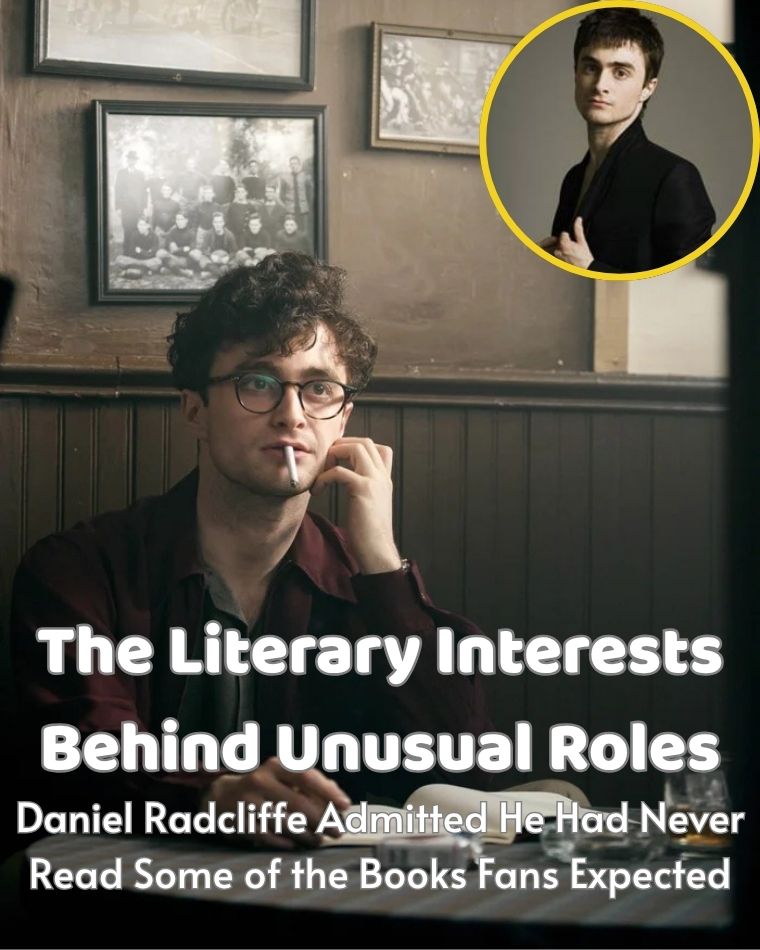
In the 2013 biographical drama Kill Your Darlings, Radcliffe stepped into the shoes of the iconic Beat Generation poet Allen Ginsberg during his formative years at Columbia University.
Preparing for the portrayal demanded far more than superficial stylistic imitation; it required immersing himself directly in Ginsberg’s early student journals, letters, and rhythms.
Radcliffe spoke admiringly of how Ginsberg possessed a deep internal intellectual self-assurance even while navigating extreme awkwardness and uncertainty in his everyday social life.
Radcliffe identified that the raw, uncompromising energy of mid-century verse shared an intrinsic DNA with modern linguistic expression, even comparing the intricate wordplay of contemporary underground lyricists to the breakthrough cadences of Ginsberg’s groundbreaking masterpiece Howl.
In addition to formal poetry and magical realism, Radcliffe’s reading selections routinely emphasize concise, emotionally precise prose.
He has repeatedly voiced immense admiration for American short story master Raymond Carver and Russian dramatist Anton Chekhov.
Radcliffe has highlighted the sheer difficulty of the short story format, noting that distilling complex human grief and quiet tragedy into a handful of pages represents the pinnacle of literary craftsmanship.
Other titles that have appeared on his public reading record include Ernest Hemingway’s stark novella The Old Man and the Sea, Hunter S. Thompson’s gonzo journalism, Madeline Miller’s lyrical mythic retelling The Song of Achilles, Simon Winchester’s linguistic exploration The Surgeon of Crowthorne, and Daniel Immerwahr’s historical treatise How to Hide an Empire.
What ties this ostensibly diverse collection of authors together is a shared preoccupation with outsiders, obsessive seekers, and people wrestling with the immense weight of personal or societal mythologies.
Understanding Radcliffe’s documented reading preferences provides an indispensable lens through which to evaluate his post-franchise cinematic career.
Rather than parlaying his immense childhood recognition into formulaic Hollywood studio tentpoles, Radcliffe spent his twenties and thirties pursuing fiercely unconventional, idiosyncratic scripts.
He portrayed a tormented man sprouting demonic horns in Alexandre Aja’s adaptation of Joe Hill’s novel Horns, an eccentric billionaire in The Lost City, and a flatulent, multipurpose sentient corpse in the critically lauded indie marvel Swiss Army Man.
In his illuminating Reader Interview with The Guardian, Radcliffe demystified why he gravitated toward material that conventional producers labeled thoroughly bizarre.
He explained that using an outwardly absurd premise allows an artist to bypass an audience’s emotional defenses and explore deep human questions without becoming preachily dry.
If a filmmaker stands on a soapbox to deliver a lecture on how shame and isolation prevent humans from connecting, the audience naturally withdraws.
However, when those exact existential themes of vulnerability, mortality, and companionship are filtered through a talking corpse used as a human watercraft, it sparks an unforgettable and genuine conversation with the viewer.
Radcliffe noted that he does not view his own artistic sensibilities as weird for the sake of shock value, but rather views eccentric storytelling as a profoundly honest way to connect with contemporary audiences.
The same artistic philosophy underpinned his decision to dive into demanding live stage productions, from Stephen Sondheim’s complex musical Merrily We Roll Along to dark existential dramas on the West End and Broadway.
Equally revealing is the clear boundary Radcliffe maintains between sensationalized internet mythology and his actual, lived relationship with books.
Rumors have occasionally circulated online suggesting that the actor disdained or never finished reading J.K. Rowling’s original fantasy series.
Radcliffe has consistently refuted such claims, speaking with lasting affection, gratitude, and respect for the wizarding world that defined his childhood and launched his career.
Simultaneously, he refuses to perform a synthetic version of nostalgia purely for public consumption.
As he told The Guardian, he does not spend his off days re-watching the films or visiting commercial theme parks, recognizing that authentic adult growth requires cultivating one’s own voice and intellect.
Daniel Radcliffe’s journey from a young boy who rarely picked up a paperback to a published metric poet, passionate Bulgakov champion, and fearless character actor exemplifies the quiet, transformative power of reading.
His literary universe has never been defined by the commercial expectations of his early fame, but by a lifelong appetite for sharp language, human vulnerability, and fearless imaginative wonder.
Để lại một phản hồi