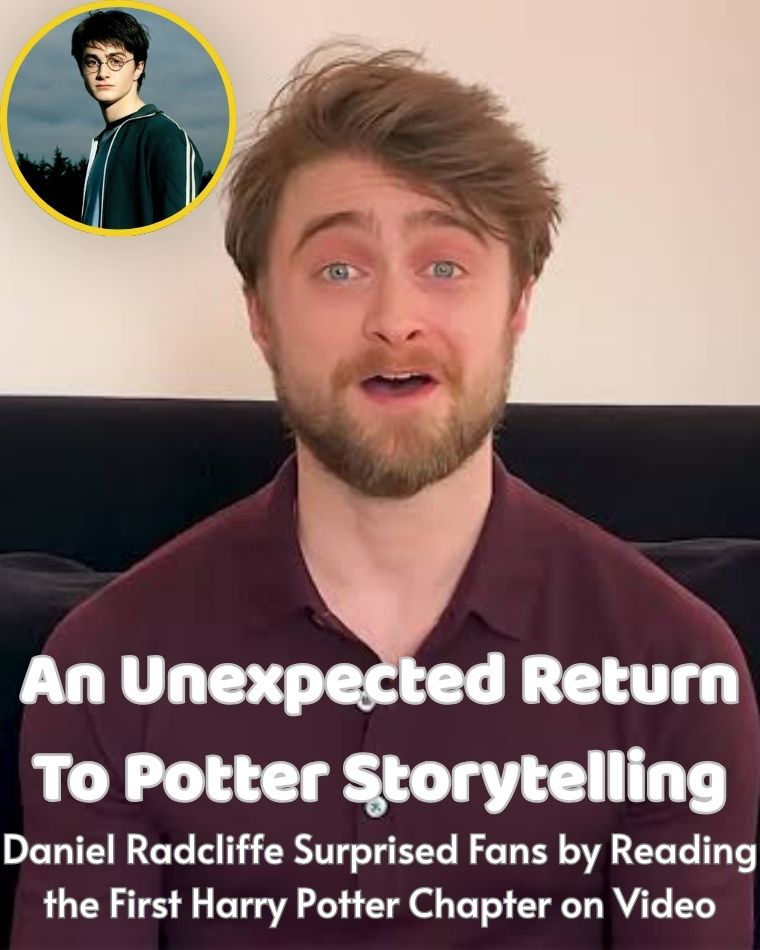
Daniel Radcliffe surprised fans across the globe in 2020 by returning to the story that launched his international career. Rather than stepping into a film set or putting on costume glasses, the actor recorded a video reading of the opening chapter of Harry Potter and the Philosopher’s Stone. His contribution marked the official launch of the “Harry Potter at Home” digital initiative, offering audiences a comforting literary connection during unprecedented worldwide lockdowns.
The global landscape changed dramatically in early 2020 as families, students, and workers found themselves confined to their homes.
Everyday routines vanished overnight, leaving millions searching for creative and soothing ways to spend their time indoors.
Recognizing the need for accessible entertainment and emotional comfort, the Wizarding World platform introduced the “Harry Potter at Home” digital hub.
The overarching goal of the project was to bring the magic of reading into living rooms around the planet.
Organizers wanted to support parents, teachers, and children who were suddenly navigating remote learning and quarantine isolation.
Among the various educational activities, puzzles, and interactive quizzes launched under this banner, a special reading series took center stage.
The creators announced that the entire first novel, Harry Potter and the Philosopher’s Stone, would be read aloud chapter by chapter.
To the delight of readers worldwide, the person selected to read the very first chapter was none other than Daniel Radcliffe.
Nguồn: Wikimedia Commons
Radcliffe’s participation immediately sent waves of nostalgia across international fandom communities.
For an entire generation, Radcliffe’s face and voice were intrinsically tied to the fictional young wizard.
Seeing the actor sit down in front of a camera to read chapter one felt like an intimate, full-circle moment.
The chapter he delivered was titled “The Boy Who Lived.”
It is the foundational entry point of the entire seven-book fantasy epic written by J.K. Rowling.
The chapter introduces readers to the mundane, rigid life of the Dursley household on Privet Drive before magic enters their reality.
Rather than delivering a dramatic theatrical monologue, Radcliffe approached the material as a classic oral storyteller.
The video captured him seated in a relaxed indoor setting, speaking directly into a webcam or domestic recording device.
The visual aesthetic was deliberately understated, matching the homebound environment shared by viewers everywhere.
Viewers could see him turning the pages, smiling at familiar phrases, and giving distinct subtle voices to various characters.
He shifted seamlessly between the pompous tone of Mr. Dursley and the gentle, eccentric wisdom of Professor Albus Dumbledore.
This home-style video recording proved that high-budget visual effects were completely unnecessary to captivate an audience.
The simple sound of a familiar voice reading written prose was enough to evoke powerful memories for millions of listeners.
Radcliffe’s decision to participate carried significant cultural weight due to his career trajectory over the previous decade.
Since concluding Harry Potter and the Deathly Hallows – Part 2 in 2011, Radcliffe had deliberately chosen unconventional acting roles.
He spent years performing in independent films, stage dramas, dark comedies, and surrealist projects.
He had often resisted projects that sought to capitalize purely on Harry Potter nostalgia or cheap commercial reunions.
His artistic choices were widely respected for establishing him as a versatile, fearless character actor outside of the fantasy genre.
Consequently, his appearance in the 2020 video series was never an attempt to reprise the role of Harry Potter on screen.
He did not wear character makeup, round spectacles, or Gryffindor robes.
He was not acting inside a cinematic continuation, nor was he participating in a newly announced movie spin-off.
Instead, Radcliffe appeared strictly as a literary narrator and an appreciative custodian of the written work.
By reading the opening chapter, he found a meaningful way to honor the story’s cultural significance without compromising his artistic independence.
It was an authentic public acknowledgment of the universe that shaped his early life and career.
Fans universally appreciated that he engaged with the source material simply as a fellow reader sharing a beloved book.
The release of Radcliffe’s video kicked off a larger weekly series featuring an eclectic lineup of celebrated performers.
The organizers recruited numerous notable figures from theater, cinema, sports, and entertainment.
Subsequent chapters featured contributions from actors such as Stephen Fry, who famously narrated the official British audiobooks.
Other contributors included international stars like David Beckham, Dakota Fanning, Eddie Redmayne, and Claudia Kim.
Several of these readers had existing ties to the franchise, including actors who starred in the Fantastic Beasts prequel series.
Others were simply celebrated public figures who grew up reading the novels alongside their own children.
It is important to emphasize that each participant recorded their designated chapter independently from their own residence.
Because of strict lockdown protocols, the contributors did not assemble in a studio or appear together in a single broadcast.
The project was structured as a serialized relay, with each reader passing the literary baton to the next contributor.
This modular structure highlighted how isolated individuals around the world could still collaborate on a shared artistic effort.
The visual format also incorporated animated fan artwork submitted by young readers from different continents.
As Radcliffe read descriptions of Privet Drive and strange cloaked figures, colorful digital illustrations flashed across the screen.
This inclusive artistic feature gave young artists an opportunity to see their work featured alongside a global film star.
The initiative effectively bridged professional storytelling with grassroots community participation.
In addition to the video stream on the Wizarding World website, an audio-only track was made available on Spotify.
This dual distribution allowed listeners to enjoy the chapters as a traditional podcast or bedtime story.
Parents praised the accessibility of the audio, often using Radcliffe’s recording to soothe young children during tense quarantine evenings.
The project served as an introduction for younger readers who had never encountered the physical novels before.
At the same time, it provided veteran adult fans with an emotional anchor to their own childhoods.
The year 2020 was characterized by widespread disruption, anxiety, and separation from loved ones.
In such a challenging historical climate, storytelling served its oldest and most vital societal purpose.
Books have long provided shelter and reassurance during periods of severe historical stress.
The opening lines of The Philosopher’s Stone are fundamentally about survival, hope, and hidden wonder waiting just beneath the surface.
Radcliffe’s delivery captured that underlying optimism without becoming melodramatic or theatrical.
His straightforward reading respected the rhythm and clarity of the prose.
Media outlets around the world covered the launch within hours of the initial broadcast.
Major news publications and television networks highlighted Radcliffe’s involvement as a bright cultural spot during a dark period.
Social media feeds filled with emotional reactions from fans who were moved by hearing his voice speak the opening sentences.
Many noted that hearing the original chapter read aloud reminded them of the sheer power of printed words.
It reinforced the reality that great film franchises originate from the quiet, imaginative craft of literature.
The success of Radcliffe’s chapter reading helped solidify the Harry Potter at Home hub as a vital educational resource throughout that summer.
It inspired schools, libraries, and families to conduct their own virtual reading clubs across digital platforms.
The initiative proved that digital media could encourage mindful literacy rather than mindless screen scrolling.
Even years later, the recording remains a distinctive artifact from the quarantine era.
It captured an artist at peace with his monumental early legacy, using his platform solely to bring comfort to others.
Radcliffe did not need to step back onto a movie set to make an impact on the audience that supported him for decades.
All he needed was an open book, a simple camera, and the words that changed his life forever.
The 2020 reading remains a testament to the enduring relationship between an actor, a story, and a global readership.
It demonstrated that no matter how much time passes, a well-told story always has the power to bring people home.
Để lại một phản hồi