Daniel Radcliffe spent ten formative years playing the boy wizard on the big screen, yet the mementos he chose to keep after production wrapped were surprisingly far removed from typical movie magic.
While millions of moviegoers worldwide instantly associate the legendary cinematic universe with enchanted flying brooms, invisibility cloaks, and handcrafted wands, the British actor quietly prioritized items that told an intimately personal story of his own adolescence.
Rather than chasing after mythical stage artifacts or valuable studio treasures, Radcliffe anchored his post-Hogwarts memories in two ordinary pairs of round spectacles and a remarkably bizarre prosthetic replica arm.
Growing Up Behind the Famous Round Lenses
Playing the title hero across eight blockbuster feature films required Daniel Radcliffe to spend almost his entire childhood and teenage years under the bright studio lights of Leavesden.
From 2001’s Harry Potter and the Sorcerer’s Stone to 2011’s Harry Potter and the Deathly Hallows – Part 2, the young Londoner grew up directly in front of a global audience.
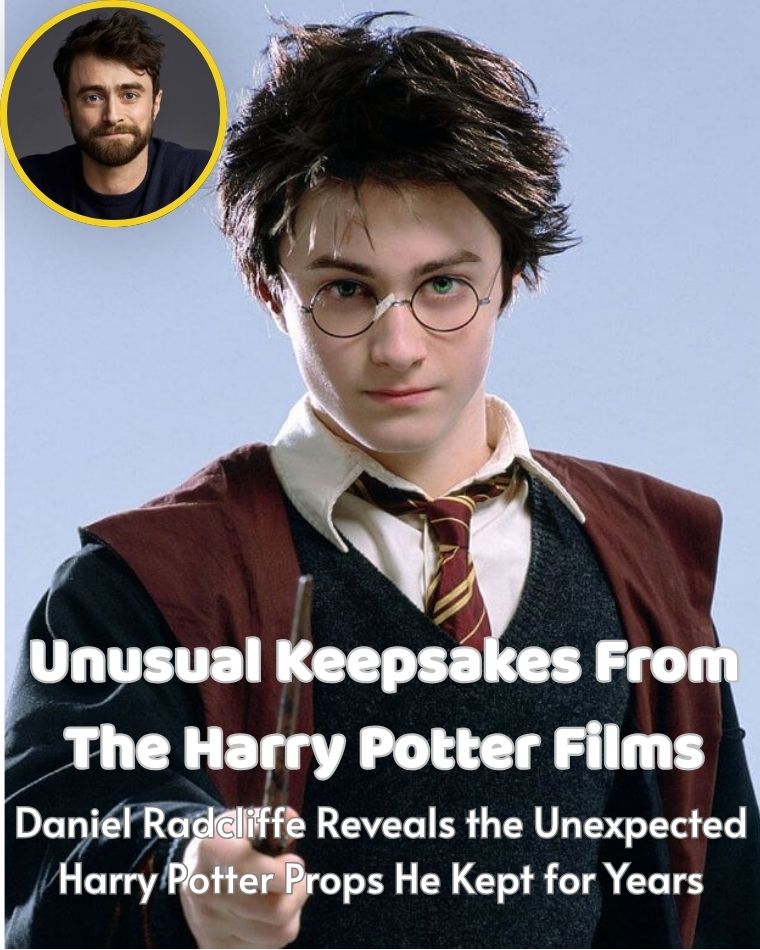
Throughout that monumental journey, the character’s round, wire-rimmed glasses served as the definitive visual anchor for the boy who lived.
Behind the scenes, the prop department produced dozens of identical frames to withstand demanding action sequences, Quidditch matches, and routine wear during principal photography.
When the final film finished shooting and the sets were dismantled, Radcliffe was offered the opportunity to take home meaningful mementos from his unprecedented decade-long tenure.
Instead of selecting an assortment of iconic hero wands or bespoke magical devices, he intentionally requested two distinct pairs of Harry’s signature glasses.
The first pair came directly from the earliest days of filming on the very first movie, when Radcliffe was an eleven-year-old child stepping onto a massive film set for the first time.
The second pair was chosen from the climactic final installment of the franchise, representing the conclusion of his journey as a twenty-one-year-old young man.
Held side by side, the two pairs of costume spectacles revealed a striking visual contrast that captured his physical maturation far better than any production photograph could.
Radcliffe noted in retrospective discussions that the first set appeared astonishingly small when compared to the adult-sized frames he wore during the battle of Hogwarts.
That size difference transformed a standard costume accessory into a deeply sentimental timeline of his childhood.
While cinema lovers saw the circular frames as an enchanted trademark of J.K. Rowling’s universe, the actor perceived them as tangible bookmarks separating the beginning and the end of his youth.
Cre: Wikimedia Commons — Gage Skidmore / CC BY-SA 2.
The Emotional Distinction Between Movie Props and Wizarding Artifacts
For fans of fantasy cinema, movie memorabilia often carries the romantic illusion of the fictional world it depicts on screen.
Audiences frequently imagine film stars living among enchanted wands, house banners, and ornate spellbooks after the cameras stop rolling.
Yet for actors who spend long fourteen-hour days working on practical studio soundstages, props are primarily physical tools of a demanding craft.
A wizard’s wand on set is essentially a lathed piece of painted resin or carved wood designed to be gripped comfortably during stunt choreography.
A broomstick mounted against a blue screen is an uncomfortable mechanical rig built to simulate flight through hydraulic movement.
Because Radcliffe spent years handling these tools every single day, their surface novelty naturally faded into the routine rhythm of filmmaking.
The glasses, however, occupied a completely unique space in his daily life as an actor.
They were not merely handheld props drawn during dramatic duels; they were worn directly on his face throughout thousands of takes.
Looking through those circular frames was the exact physical trigger that allowed Radcliffe to transition into character every morning in the makeup chair.
Consequently, keeping the glasses was never about owning a piece of fictional wizard lore.
It was about preserving a personal physical artifact that bore witness to his education, friendships, and evolution as a performing artist.
In multiple interviews reflecting on his time with the franchise, Radcliffe emphasized that he felt zero urge to amass a grand museum of Hogwarts treasures.
He recognized early on that an overload of cinematic souvenirs would turn his personal living space into an artificial film archive.
By choosing only two sets of glasses, he preserved an elegant, understated representation of an era that defined his public identity.
The Curious Case of the Chamber of Secrets Prosthetic
While the spectacles represent the poetic and emotional side of his archive, Radcliffe also holds on to an entirely unexpected piece of cinematic history.
In a widely circulated February 2026 media report and recent retrospective interviews, the actor delighted fans by revisiting one of the oddest physical props in his possession: a replica human arm.
The prop dates back to 2002 during the production of the franchise’s second film, Harry Potter and the Chamber of Secrets.
Devoted fans remember the famous scene in the Hogwarts hospital wing following a brutal Quidditch match against Slytherin house.
After Harry suffers a fractured arm from a rogue Bludger, the vain and incompetent Defense Against the Dark Arts teacher, Professor Gilderoy Lockhart, attempts a healing spell.
Rather than mending the broken bone, Lockhart’s disastrous magical attempt accidentally vanishes every single bone from Harry’s limb.
The resulting sequence required a practical special-effects solution to show Harry holding up a completely limp, rubbery, boneless arm before undergoing overnight treatment with Skele-Gro.
To achieve the grotesque comic effect convincingly on camera, the creature and makeup effects crew created a lifelike rubber prosthetic cast directly from Radcliffe’s own arm.
The specialized silicone appendage was designed without internal skeletal armature, allowing it to flop convincingly in the hands of the medical staff.
When filming wrapped on the second movie, the bizarre prosthetic was preserved rather than discarded into studio storage.
Radcliffe has humorously confessed over the years that the floppy rubber arm ended up being stashed away in his family’s attic space.
He noted how genuinely surreal it is to imagine someone stumbling across an unlabeled box in a dusty attic, only to discover a detached, boneless rubber arm resting inside.
The prop stands as an extraordinary contrast to typical movie collectibles like sleek superhero helmets or glittering jewelry.
Instead, it celebrates the ingenuity of old-school practical movie craftsmanship during an era when computer-generated imagery was not the sole answer to physical comedy.
Navigating a Decade in the Public Eye
Understanding why Radcliffe chose these specific items requires looking back at the intense environment that surrounded the young British cast.
When Chris Columbus directed the first film, none of the filmmakers could have fully anticipated the unprecedented cultural tsunami that would follow.
Radcliffe, Emma Watson, and Rupert Grint were suddenly thrust into international superstardom while still dealing with standard childhood development.
The studio soundstages outside London effectively became a private boarding school, workplace, and protective sanctuary for the young leads.
Tutors taught school lessons between camera setups, while veteran British actors like Maggie Smith, Alan Rickman, and Richard Griffiths offered informal masterclasses in acting discipline.
Because fame developed so quickly outside the studio gates, the everyday physical objects inside the set carried deep comfort and stability.
The glasses Radcliffe wore shielded him behind a character while simultaneously serving as the mask the entire planet recognized.
When an actor wears an identical prop style through primary school, adolescence, and early adulthood, the object stops feeling like a costume.
It becomes a secondary skin that marks physiological milestones such as growth spurts, changing facial structures, and maturing expressions.
The pair from the first film mirrors the wide-eyed innocence of an unknown child suddenly cast in the biggest adaptation in literary history.
The final pair carries the weight of a seasoned screen professional who successfully carried a billion-dollar enterprise across the finish line.
Radcliffe’s choice to retain both bookends shows an artist who was acutely aware of his unique personal history.
He did not need to keep every wand or cape because the transformation was etched directly into the frame sizes of his eyewear.
The Real Worth of Celebrity Souvenirs
In contemporary Hollywood, film memorabilia has exploded into an ultra-lucrative multi-million-dollar global auction industry.
Original costumes, iconic movie vehicles, and screen-used weapon replicas routinely fetch astronomical sums from private collectors and international institutions.
A screen-matched wand or complete school uniform from the Harry Potter film series would easily command staggering sums at high-profile entertainment auctions.
Yet for the performers who actually brought those fictional worlds to life, monetary appraisal holds remarkably little relevance.
The true value of production memorabilia lives entirely in its psychological ability to trigger authentic human memories.
When Radcliffe looks at the small frames from his first year on set, he is not seeing an asset with commercial auction value.
He is remembering the nervous excitement of stepping onto the Great Hall set for the first feast, surrounded by hundreds of floating candles.
When he reflects on the absurd boneless prosthetic arm from Chamber of Secrets, he is remembering the laughter on set with co-stars and crew members trying to keep straight faces during rehearsals.
These unconventional items reveal a grounded humility that has defined Radcliffe’s broader post-Potter acting career.
Following the conclusion of the fantasy franchise, he deliberately avoided comfortable franchise typecasting in favor of daring stage plays and eccentric independent films.
His career choices in bold projects like Equus, Swiss Army Man, and Weird: The Al Yankovic Story demonstrated a performer interested in artistic risk rather than safe commercial prestige.
The unassuming nature of his personal memorabilia perfectly matches that artistic philosophy.
A superstar clinging to an oversized ego might demand to keep the hero sword of Godric Gryffindor or a gold-trimmed costume display.
Radcliffe walked away from a decade of unprecedented blockbuster fame content with two pairs of reading glasses and a rubber gag arm from a hospital scene.
A Legacy Preserved in Ordinary Objects
More than two decades after the franchise first debuted in theaters, audience fascination with behind-the-scenes Harry Potter secrets shows no sign of diminishing.
Generations of readers and viewers continue to rewatch the eight films every holiday season, discovering subtle details in background sets and character costumes.
The revelations about Daniel Radcliffe’s personal prop collection offer fans a comforting dose of reality behind the heavy curtain of Hollywood special effects.
They serve as a gentle reminder that behind every massive cinematic empire, real human beings spent their youths growing, laughing, and working together.
Movie magic is not manufactured by magical spells, but by meticulous set carpenters, costume designers, prosthetic molders, and dedicated performers.
Radcliffe’s decision to keep items that celebrate practical effects and personal growth over fictional wizard power honors that collaborative reality.
His attic may hold a rather bizarre piece of rubber anatomy, and his private drawers may shelter two modest sets of wire spectacles.
Together, those three simple production artifacts encapsulate an extraordinary decade that turned an ordinary British schoolboy into a cinematic legend.
Để lại một phản hồi