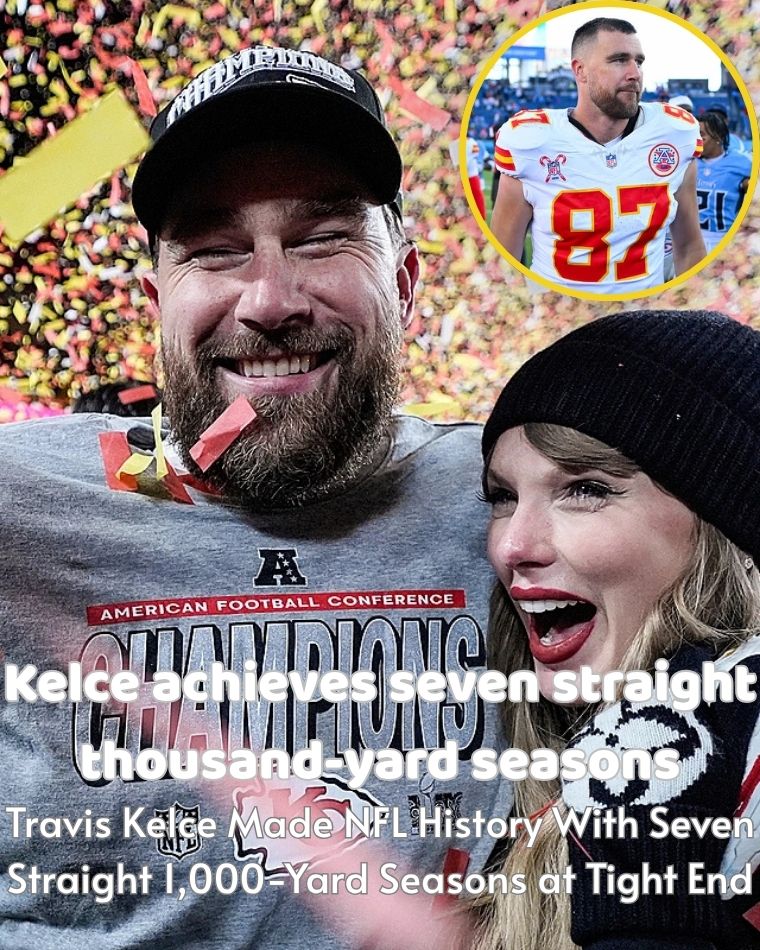
Travis Kelce established a historic standard for tight end production by recording seven consecutive 1,000-yard receiving seasons with the Kansas City Chiefs between 2016 and 2022. Operating at the core of head coach Andy Reid’s offense alongside quarterback Patrick Mahomes, Kelce evolved beyond traditional positional responsibilities into an indispensable primary receiving weapon. His statistical consistency and record-setting 2020 campaign provide a measurable blueprint of how offensive schemes can maximize tight ends in the modern NFL.
For decades, the standard profile of a tight end centered around balanced duties on the offensive line of scrimmage.
Traditional offensive systems required players at the position to serve predominantly as in-line run blockers and pass protectors.
When tight ends did release into the passing tree, they typically operated as short-yardage safety valves or secondary check-down targets.
Offensive coordinators designed route concepts primarily to free outside wide receivers down the boundaries, leaving tight ends to contest congested spaces across the middle.
While physical blocking remains an essential component of professional football, modern personnel groupings began exploring different athletic archetypes.
Teams gradually recognized that finding tight ends with wide-receiver movement skills could exploit favorable mismatches against heavier inside linebackers and smaller defensive backs.
Coaches began creating formation variations that detached the tight end from the tackle’s hip, deploying them across the slot and perimeter.
Yet, sustained aerial production at a premier wide receiver volume remained an elusive feat for tight ends across NFL history.
Grueling physical collisions along the line of scrimmage, paired with conventional schematic roles, frequently capped season receiving totals.
Most accomplished tight ends throughout the sport’s history assembled sporadic 1,000-yard campaigns punctuated by injury setbacks and fluctuating offensive usage.
Against this historical backdrop, Travis Kelce’s offensive emergence in Kansas City represented a paradigm shift in execution and durability.
Cre: All-Pro Reels / Wikimedia Commons — Creative Commons Attribution-Share Alike 2.0 Generic
Kelce arrived in Kansas City as a third-round selection in the 2013 NFL Draft out of the University of Cincinnati.
After missing the majority of his rookie season due to a knee injury, he quickly established a commanding presence within the Chiefs’ passing attack.
His breakout milestone arrived in 2016, when he posted 1,125 receiving yards on 85 receptions with four touchdowns across 16 regular-season games.
Surpassing the 1,000-yard threshold in 2016 marked his first Pro Bowl starting nod and his first selection as a First-Team All-Pro.
That 2016 campaign proved to be the opening chapter of a seven-year streak of aerial efficiency never before witnessed at the position.
In 2017, Kelce verified his baseline production by catching 83 passes for 1,038 yards and eight touchdowns while commanding double teams across the secondary.
Achieving consecutive 1,000-yard seasons established Kelce as an elite playmaker, yet few anticipated the extended streak that would unfold.
The arrival of Patrick Mahomes as Kansas City’s full-time starting quarterback in 2018 permanently altered the ceiling of the Chiefs’ offensive unit.
Mahomes possessed extraordinary arm talent, creative pocket mobility, and the confidence to attack tight passing windows downfield.
Kelce complemented Mahomes’ improvisational style by displaying an instinctive mastery of finding vacancies against zone coverage.
When defensive plays broke down, Kelce intuitively adjusted his route stems to mirror Mahomes’ scramble angles.
During their first full year starting together in 2018, Kelce hauled in 103 receptions for 1,336 yards and 10 receiving touchdowns.
The 2018 campaign shattered existing team marks and placed Kelce squarely at the center of the league’s highest-scoring passing attack.
Defensive coordinators frequently deployed bracket coverages and press-man schemes specifically designed to neutralize Kelce at the snap.
Despite concentrated defensive game plans, Kelce continued his output in 2019 by registering 97 receptions for 1,229 yards and five scores.
That consistent yardage total anchored Kansas City’s drive toward capturing the franchise’s first Super Bowl title in five decades during Super Bowl LIV.
The pinnacle of Kelce’s individual regular-season production arrived during the pandemic-impacted 2020 NFL season.
Playing in just 15 games, Kelce delivered the single most productive receiving season by a tight end in NFL history.
He finished the 2020 regular season with 1,416 receiving yards and 11 touchdowns on 105 receptions.
His 1,416-yard total set the NFL single-season receiving yardage record for a tight end, breaking the previous record of 1,377 yards set by George Kittle in 2018.
Kelce finished second among all NFL pass-catchers in receiving yards in 2020, trailing only wide receiver Stefon Diggs.
His average of 94.4 receiving yards per game demonstrated how thoroughly Kansas City utilized him as their focal passing option.
Kelce achieved these totals while averaging 13.5 yards per reception, showcasing an ability to stretch defenses vertically down the seam.
Head coach Andy Reid frequently aligned Kelce in split-wide alignments, trips sets, and isolated boundary formations to exploit defensive personnel.
Opposing defenses found themselves unable to match his physical 6-foot-5 frame with cornerbacks or his agility with safeties and linebackers.
The 2020 record verified that tight ends could match the per-game yardage volume of the league’s top wide receivers over a full season.
Even as the league expanded its regular-season schedule to 17 games in 2021, Kelce continued his streak without interruption.
He closed the 2021 regular season with 92 receptions for 1,125 yards and nine touchdowns across 16 games.
Prior to Kelce’s career, no tight end in NFL history had assembled more than three consecutive 1,000-yard receiving seasons.
Greg Olsen had previously made history by posting three straight 1,000-yard seasons for the Carolina Panthers from 2014 to 2016.
By pushing his own streak to six consecutive seasons through 2021, Kelce doubled the previous all-time benchmark.
The 2022 season represented another crucial evaluation point for Kansas City’s offensive architecture.
Following the offseason departure of All-Pro wide receiver Tyreek Hill, questions surfaced regarding how defenses would shade coverage toward Kelce.
Without Hill’s perimeter speed threatening deep safeties, opposing defenses focused their attention directly on Kelce’s intermediate routes.
Rather than experiencing a decline in numbers, Kelce delivered another dominant statistical campaign.
In 2022, he caught a career-high 110 passes for 1,338 receiving yards and 12 touchdowns across 17 regular-season games.
Those 110 receptions ranked third in the entire NFL for the 2022 season, while his 1,338 receiving yards ranked eighth overall.
The season marked his seventh consecutive year surpassing 1,000 receiving yards, securing an unbroken run from 2016 through 2022.
The official seasonal statistics from Pro Football Reference illustrate the exact trajectory of this remarkable seven-year window:
- 2016: 85 receptions, 1,125 yards, 4 touchdowns
- 2017: 83 receptions, 1,038 yards, 8 touchdowns
- 2018: 103 receptions, 1,336 yards, 10 touchdowns
- 2019: 97 receptions, 1,229 yards, 5 touchdowns
- 2020: 105 receptions, 1,416 yards, 11 touchdowns
- 2021: 92 receptions, 1,125 yards, 9 touchdowns
- 2022: 110 receptions, 1,338 yards, 12 touchdowns
Across those seven seasons, Kelce compiled 675 receptions for 8,607 receiving yards and 59 receiving touchdowns.
He maintained an average of 1,229.6 receiving yards per year over a seven-season span, numbers rivaling Hall of Fame wide receivers.
His health and physical durability served as the backbone of this offensive achievement.
During the seven-year run from 2016 through 2022, Kelce missed only three regular-season contests, two of which were rest games in Week 17 when playoff seeding was secured.
Sustaining that level of availability while enduring collision-heavy blocking assignments at the line of scrimmage remains extraordinary.
Kelce’s achievements did not emerge in isolation; they reflected an evolutionary progression across professional football.
Pioneers like Kellen Winslow Sr., Ozzie Newsome, and Shannon Sharpe demonstrated the offensive value of pass-catching tight ends in earlier eras.
Later, Tony Gonzalez, Antonio Gates, and Rob Gronkowski set records for career receptions, touchdowns, and single-season dominance.
Kelce did not invent the receiving tight end role, but he maximized its volume and consistency over consecutive calendar years.
His production demonstrated that a tight end could function as the clear number-one passing option in a championship-caliber offense.
Chiefs head coach Andy Reid designed concepts that weaponized Kelce’s spatial awareness against match-quarters and Cover-2 coverage schemes.
Kelce routinely leveraged option routes, where his post-snap read of linebacker leverage dictated whether he broke inward, outward, or settled in open grass.
The chemistry developed between Kelce and Mahomes converted third-down passing into high-percentage situational football.
In clutch situations, Mahomes consistently looked toward Kelce, trusting his reach, ball security, and contested-catch tracking.
This symbiotic quarterback-receiver connection formed the offensive nucleus of Kansas City’s multiple championship runs.
The streak concluded in 2023, when Kelce finished just shy of the threshold with 984 receiving yards after sitting out two regular-season games.
Yet the seven-year benchmark stands as one of the most resilient statistical streaks in NFL history.
Evaluating Kelce’s seven-year run underscores how tactical football design continues to shift toward versatility and positional flexibility.
Modern NFL front offices now actively search for hybrid prospects capable of replicating Kelce’s spatial intelligence and route-running polish.
Defensive schemes have likewise adapted, utilizing lighter nickel safeties and hybrid hybrid-linebackers specifically tasked with covering tight ends.
Kelce’s statistical output from 2016 to 2022 provides an objective benchmark for tight end performance against which future generations will be measured.
By combining elite durability, route refinement, and dynamic chemistry with Patrick Mahomes, Kelce reshaped how modern offenses construct their aerial passing attacks.
Để lại một phản hồi