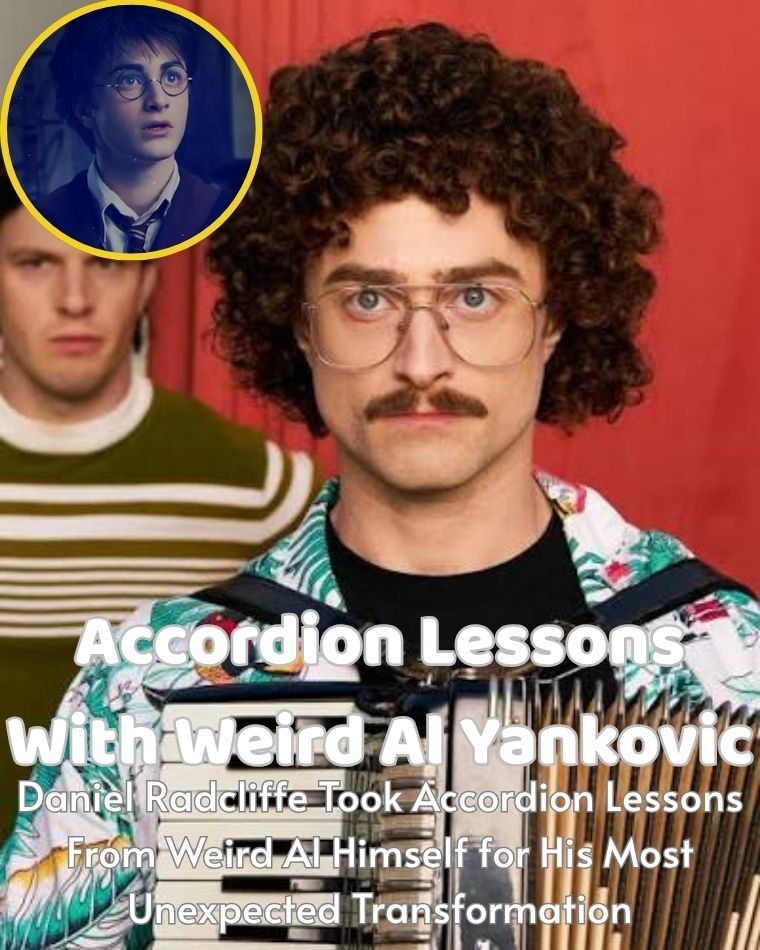
Daniel Radcliffe embraced one of the most unexpected roles of his career when portraying musical satirist “Weird Al” Yankovic in the 2022 film Weird: The Al Yankovic Story. The satirical biographical comedy intentionally departed from traditional biopic conventions to deliver an exaggerated and comedic narrative of Yankovic’s rise to stardom. To bring physical authenticity to an overtly absurd parody, Radcliffe underwent rigorous accordion preparation under the direct guidance of Yankovic himself.
When the casting of Daniel Radcliffe was first announced for Weird: The Al Yankovic Story, it prompted widespread curiosity across the entertainment world.
Radcliffe had spent his adolescence portraying the world’s most recognizable boy wizard in the globally celebrated Harry Potter franchise.
Following the conclusion of that fantasy saga, Radcliffe deliberately pursued idiosyncratic, bold, and distinctively challenging character roles across independent cinema and stage productions.
Playing the curly-haired, Hawaiian-shirt-wearing, accordion-playing parody genius represented an entirely unprecedented creative territory for the British actor.
Radcliffe did not bear an immediate natural physical resemblance to “Weird Al” Yankovic.
However, the creative vision behind the production rendered strict photographic mimicry entirely unnecessary.
The feature film was never designed to operate as a conventional, self-serious biographical drama.
Instead, the production served as a thorough parody of the biopic genre itself.
The storyline deliberately escalated into wild exaggerations, entirely fictionalized milestones, and absurd dramatic scenarios.
Because the script favored comedic exaggeration over strict documentary realism, Radcliffe was encouraged to capture Yankovic’s spirit and stage energy rather than reproduce an exact physical replica.
Yankovic personally co-wrote the screenplay alongside director Eric Appel.
The concept originated as a mock trailer produced years earlier for the comedy website Funny Or Die.
When the decision was made to expand that concept into a full-length feature film for the Roku Channel, casting the central role was critical.
Yankovic personally hand-selected Radcliffe to portray him on screen.
The musician noted in interviews that an early talk-show appearance by Radcliffe had caught his attention years prior.
During that television segment, Radcliffe demonstrated an impressive ability to sing Tom Lehrer’s rapid-fire novelty song “The Elements.”
Yankovic recognized that anyone capable of memorizing and delivering such tongue-twisting musical comedy possessed the exact rhythmic discipline needed for the role.
Cre: Wikimedia Commons — Creative Commons Attribution-Share Alike 2.0 Generi
Radcliffe recalled feeling both deeply flattered and initially surprised when he received the script offer.
He recognized immediately that the script made no attempt to document real life with dry accuracy.
The narrative portrayed Yankovic as an unruly, rebellious rock star who enters volatile fictional relationships and faces impossible dramatic stakes.
Rather than portraying the gentle, real-life vegetarian musician, the movie imagined an intense parody figure.
Radcliffe appreciated the cleverness of using traditional Hollywood cinematic tropes to parody Hollywood’s own storytelling conventions.
To make the comedic scenes land effectively, Radcliffe understood that the physical portrayal needed genuine conviction.
If an actor plays an absurd premise with an ironic wink, the comedic tension frequently dissolves.
Radcliffe decided that playing the character with utter, deadpan sincerity would make the parody substantially funnier.
That dedication extended directly into his musical and physical preparation.
A central element of Yankovic’s musical identity has always been the accordion.
Radcliffe had never previously handled or played an accordion in his life.
The instrument is notoriously complex, requiring independent hand coordination, finger movement, and rhythmic bellows control.
Radcliffe was aware that the film would feature Yankovic’s authentic recorded vocal tracks for the major musical performances.
Audiences watching the movie would hear the genuine recordings rather than Radcliffe singing the parodies.
Nevertheless, Radcliffe was determined that his finger placements and bellows actions would look plausible to real musicians.
He did not want his on-screen performance to appear disconnected from the music heard by the audience.
Radcliffe understood that faking an instrument poorly can distract viewers and pull them out of a film.
Yankovic offered to assist Radcliffe directly by providing foundational accordion lessons.
Yankovic loaned Radcliffe his personal accordion so the actor could practice during the pre-production period.
Receiving lessons directly from the subject he was preparing to portray on camera proved to be a surreal experience for the actor.
Yankovic walked Radcliffe through the mechanics of holding the heavy instrument securely against the chest.
Radcliffe learned the basic operations of the keyboard on the right side and the bass buttons on the left.
The actor quickly discovered that operating the bellows while simultaneously finding the correct keys required intense concentration.
Radcliffe described the instrument as heavy, unwieldy, and deceptively difficult to balance while remaining expressive.
Because pre-production schedules were compressed, Radcliffe knew he needed additional practice beyond the introductory sessions.
He took the instrument home to New York City to continue his daily practice regimen.
While in New York, Radcliffe enlisted the assistance of a musician friend who understood accordion technique.
The two spent hours breaking down the specific songs featured in the film’s concert sequences.
Radcliffe drilled the hand movements repeatedly until muscle memory began to take over.
His primary objective was ensuring that his fingers landed near the appropriate keys at the exact tempo of the playback tracks.
He practiced compressing and expanding the bellows in rhythmic synchronization with the tempo of the music.
Radcliffe openly admitted in interviews that he did not master the instrument to a level of genuine virtuosity.
He was transparent about the fact that he could not perform full, polished accordion arrangements from scratch.
However, the concentrated preparation enabled him to position his hands accurately during complex musical phrases.
When the camera captured close-up angles of his hands moving along the keys, the motion matched the soundtrack’s rhythm.
Radcliffe noted that learning the instrument gave him a profound respect for Yankovic’s technical musicianship.
Many casual listeners view comedy music primarily through the lens of humorous lyricism.
In reality, Yankovic’s parody songs require intricate musicianship to recreate the styles of legendary rock and pop tracks accurately.
Radcliffe noted that mastering even basic accordion patterns required an immense amount of precision.
The physical training allowed Radcliffe to inhabit the stage persona of Yankovic with complete physical confidence.
Beyond the instrument itself, Radcliffe had to undergo a notable physical transformation for the camera.
The actor donned Yankovic’s iconic mop of curly brown hair and characteristic mustache.
Radcliffe also spent significant time in physical conditioning to embody the movie’s exaggerated, shirtless rock-star action sequences.
The film humorously depicted Yankovic as an action-hero archetype fighting off cartel members and commanding arena stages.
Radcliffe embraced the bizarre physical demands of these comedic sequences with enthusiasm.
Director Eric Appel commended Radcliffe for bringing an uncompromising dramatic intensity to scenes that were completely ridiculous on paper.
During production, Yankovic was frequently present on the film set.
Yankovic took on a cameo role in the film as a skeptical record executive who rejects his own real-world musical style.
Having the real-life subject standing just a few feet away from the monitor could have generated significant performance pressure.
However, Radcliffe found Yankovic’s presence on set to be consistently warm, supportive, and creatively liberating.
Yankovic encouraged Radcliffe to explore bold comedic choices and never restricted his interpretation.
The set atmosphere reflected the lighthearted nature of the screenplay.
The production schedule was remarkably tight, requiring the cast and crew to shoot the entire feature film in under three weeks.
Because time was strictly limited, Radcliffe’s pre-production accordion drilling proved vital for maintaining the shooting pace.
The crew did not need to waste valuable production hours troubleshooting finger positions or restaging angles to hide awkward hands.
Radcliffe arrived on set prepared to mimic the instrumental sequences on cue.
Co-stars including Evan Rachel Wood, who portrayed an exaggerated version of pop superstar Madonna, matched Radcliffe’s comedic energy.
The interactions between Radcliffe and Wood formed the narrative core of the movie’s most unhinged storylines.
The film treated the fictional romance between Yankovic and Madonna as a dramatic crime thriller narrative.
Radcliffe approached those dramatic confrontations with the solemnity of a high-stakes Hollywood melodrama.
Critics highlighted that very sincerity as the foundation of the movie’s critical success.
Weird: The Al Yankovic Story premiered at the Toronto International Film Festival in September 2022 to enthusiastic audience reactions.
Reviewers singled out Radcliffe’s spirited performance as one of the standout comedic turns of the year.
The film successfully navigated the fine line between loving tribute and sharp industry satire.
Audiences recognized that while the events depicted on screen were thoroughly fabricated, the celebration of Yankovic’s cultural legacy was authentic.
Radcliffe’s dedication to the accordion was frequently highlighted in promotional interviews following the film’s release.
Journalists repeatedly asked the actor whether he intended to continue playing the instrument after the film wrapped.
Radcliffe candidly admitted that maintaining accordion proficiency requires constant practice that is difficult to sustain alongside other projects.
However, he expressed genuine pride in having tackled an instrument that initially seemed completely intimidating.
The experience added another memorable chapter to Radcliffe’s post-franchise filmography.
Rather than remaining confined to standard leading-man roles, Radcliffe has continually chosen projects that defy conventional expectations.
His turn as Weird Al Yankovic demonstrated his appetite for creative risk-taking and physical transformation.
The project also highlighted how biographical films can reinvent themselves in an era saturated with formulaic musician biopics.
Many conventional music biopics follow identical storytelling beats of discovery, excess, conflict, and redemption.
Weird: The Al Yankovic Story subverted every single one of those standard tropes by turning them into deliberate punchlines.
Radcliffe was the ideal collaborator for such an endeavor because of his willingness to fully commit without vanity.
His willingness to learn a complex musical instrument for a film that openly mocked reality exemplifies his professional ethos.
The collaborative dynamic between Radcliffe and Yankovic served as an example of creative mutual trust.
Yankovic entrusted his persona and legacy to an actor who approached the parody with complete professional seriousness.
In return, Radcliffe received the creative freedom to deliver one of the most energetic performances of his post-Potter career.
The film earned numerous accolades during the subsequent awards season, highlighting its sharp writing and energetic acting.
The project reinforced the notion that comedy demands the same level of discipline and preparation as traditional drama.
Even in an absurd movie where the storyline breaks every rule of factual history, genuine physical effort remains visible on screen.
Radcliffe’s accordion playing may not have replaced Yankovic’s professional recording output, but it grounded the film’s wild comedy in physical reality.
Reflecting on the production in subsequent retrospective interviews, Radcliffe emphasized the joy of working on material that prioritizes pure entertainment.
He acknowledged that stepping out of one’s comfort zone is the most effective way for an actor to grow creatively.
The actor’s journey from receiving introductory pointers from Yankovic to filming high-energy stage performances remains a compelling production story.
For fans of Weird Al Yankovic, the movie provided a fittingly eccentric celebration of four decades of musical comedy.
For fans of Daniel Radcliffe, it offered further confirmation that the actor remains one of the most versatile and adventurous talents working in cinema today.
The film ultimately stands as a testament to the enduring appeal of intelligent, well-crafted parody.
By committing fully to the music, the instrument, and the character’s unyielding passion, Radcliffe honored the spirit of Yankovic’s life work.
The role proved that an actor does not need to resemble a real-life figure to capture the essence of what makes them beloved.
Audiences who revisit the 2022 film can appreciate both the comedic absurdity of the story and the authentic craftsmanship behind its execution.
Radcliffe’s turn as the legendary accordion-wielding satirist remains an inspiring example of artistic daring in modern film.
Để lại một phản hồi