Travis Kelce stands today as one of the most productive and decorated tight ends in the history of professional football. His Hall of Fame trajectory, however, was nearly derailed before it ever truly began due to a severe physical setback during his first year in the National Football League. By examining his difficult 2013 rookie campaign, his demanding microfracture knee procedure, and his explosive 2014 breakout, football historians gain a deep appreciation for the resolve behind his enduring greatness.
The Promise of the 2013 NFL Draft
Before he rewrote league record books with the Kansas City Chiefs, Travis Kelce was an intriguing collegiate prospect out of the University of Cincinnati.
During his college career with the Bearcats, Kelce demonstrated rare athletic traits for a player possessing his physical frame.
He combined fluid route-running capabilities with punishing run-after-catch physicality that caught the attention of professional scouts across the country.
The Kansas City Chiefs, led by head coach Andy Reid, identified Kelce as an ideal offensive weapon to modernize their aerial attack.
During the 2013 NFL Draft, Kansas City selected Kelce in the third round with the 63rd overall pick.
Team executives envisioned using Kelce as an all-around chess piece capable of exploiting defensive mismatches against linebackers and safeties.
His arrival in Kansas City generated immediate enthusiasm among team analysts and loyal Chiefs Kingdom fans.
During offseason training sessions, coaches praised his quick burst off the line of scrimmage and soft hands.
Expectations pointed toward an immediate role inside Kansas City’s revamped West Coast passing offense.
Yet professional football rarely unfolds in a perfectly linear manner.
The harsh physical demands of the sport emerged almost immediately to test the young rookie’s resilience.
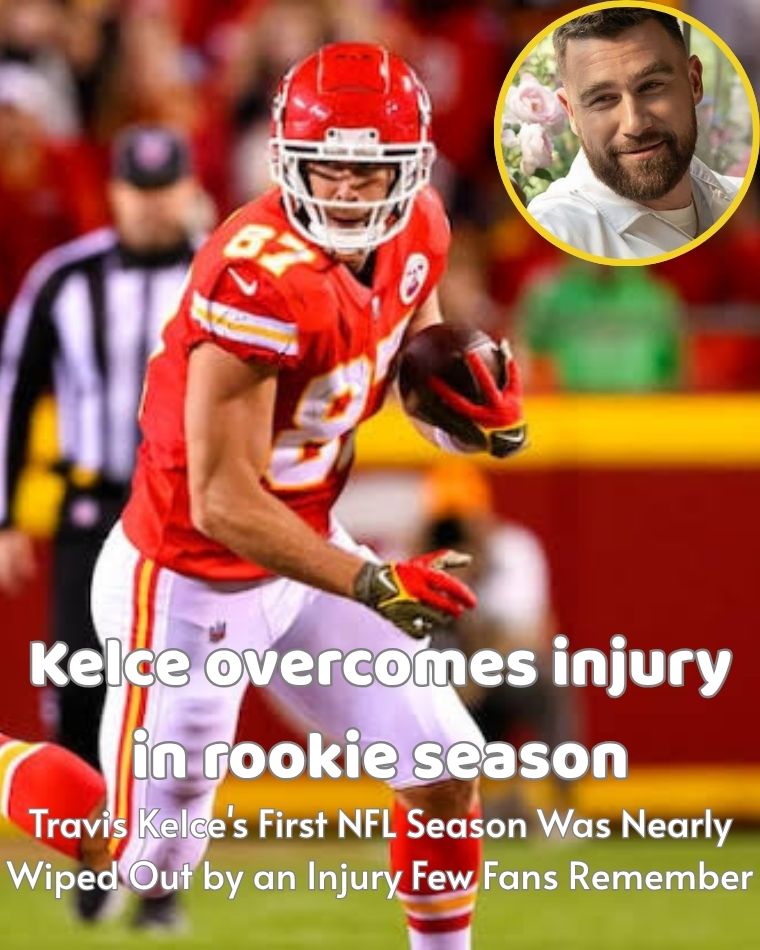
Cre: Wikimedia Commons
The Abrupt Halt: A Rookie Campaign Derailed
Kelce’s professional transition hit an unexpected obstacle almost as soon as the 2013 regular season commenced.
Persistent discomfort and swelling in his knee began restricting his mobility during team practices.
Medical staff closely monitored the joint as the coaching staff attempted to manage his daily workload.
Despite the escalating physical limitations, Kelce made his official NFL regular-season debut in Week 2 against the Dallas Cowboys.
His playing time in that contest was strictly confined to special teams duty.
According to official game records, he logged just a single special teams snap before departing the contest.
That solitary play would ultimately stand as his entire on-field contribution for the entire 2013 NFL season.
As the days progressed, the knee failed to respond adequately to standard non-surgical treatments.
The swelling persisted, impairing the explosiveness that defined his athletic profile.
Both the medical staff and the organization realized that conservative management could not resolve the underlying structural defect.
The Chiefs faced a difficult organizational choice regarding the long-term well-being of their third-round investment.
The Harsh Reality of Microfracture Knee Surgery
In early October 2013, Kansas City’s medical team determined that surgical intervention was unavoidable.
The specific procedure required was microfracture surgery on his affected knee.
Microfracture is an orthopedic surgical technique designed to repair damaged articular cartilage inside the joint.
Surgeons create tiny perforations in the underlying bone beneath the damaged cartilage layer.
This deliberate micro-trauma stimulates the release of bone marrow and blood cells into the defect.
Over several months, the body responds by forming a fibrocartilage repair tissue to cushion the joint surface.
For high-impact athletes whose sport demands rapid deceleration and explosive cuts, microfracture surgery represents a formidable challenge.
History contains numerous examples of professional skill players whose burst and agility were permanently altered following this operation.
On October 12, 2013, the Chiefs officially placed Kelce on their injured reserve list.
The roster designation definitively concluded his rookie season after appearing in just one contest.
Instead of catching passes under the bright stadium lights of Arrowhead Stadium, Kelce faced months of solitary physical rehabilitation.
The Grinding Months of Rehabilitation
The rehabilitation protocol following microfracture surgery is famously deliberate and mentally taxing.
Patients frequently spend several weeks on crutches without bearing weight on the affected limb to protect the fragile healing clot.
Kelce spent late 2013 and early 2014 undergoing intensive daily physical therapy.
Every stage of rehabilitation required absolute patience and rigid adherence to orthopedic protocols.
He worked closely with the Chiefs’ athletic training staff to restore full passive and active range of motion.
Once joint mobility was established, the program shifted toward gradual quadriceps and hamstring muscle reactivation.
Rebuilding the musculature around the knee joint was vital to absorbing the high forces generated during route running.
Kelce spent countless hours in the weight room performing low-impact resistance exercises.
Cardiovascular endurance had to be maintained without placing unnecessary compressive loads on the recovering knee cartilage.
Pool workouts, stationary cycling, and zero-gravity treadmill work became daily staples of his recovery regimen.
Throughout this isolated rehabilitation period, the young tight end remained committed to studying playbook film.
He mastered the mental complexities of Andy Reid’s playbook even while unable to execute the concepts physically on the turf.
By the time the spring minicamps arrived in 2014, medical evaluations indicated the cartilage repair had solidified.
Kelce was cleared to participate in on-field running progressions and change-of-direction drills.
The initial testing showed encouraging signs that his native speed and change-of-direction fluidness remained fully intact.
Entering 2014 as an Untested Second-Year Player
When the Chiefs opened training camp in July 2014, Kelce entered the complex with an unusual athletic status.
On paper, he was in his second year as an NFL professional.
In practical reality, he possessed the on-field experience of an untested rookie.
He had never caught an NFL pass, never run an offensive route in a regular-season game, and never faced starting NFL defensive coverages.
Critics and external analysts wondered whether his knee could handle the relentless weekly punishment of professional contact.
Inside the organization, however, confidence in his athletic recovery never wavered.
Head coach Andy Reid and offensive coordinator Doug Pederson immediately integrated Kelce into primary formation packages.
Kelce showcased his recovered burst during preseason contests, creating significant buzz around Kansas City.
His route tree was expanded, utilizing him both in-line next to the tackle and flexed wide as a slot receiver.
His physical size presented an imposing target for quarterback Alex Smith.
The team prepared to unleash their long-awaited offensive weapon when the 2014 regular season officially kicked off.
The 2014 Breakout: Becoming an Offensive Focal Point
Kelce wasted little time demonstrating that his knee injury was firmly in the past once the 2014 campaign commenced.
He recorded his first official career NFL reception in Week 1 against the Tennessee Titans.
Two weeks later, against the Miami Dolphins, Kelce registered his first career touchdown reception on a 20-yard strike.
Defensive coordinators struggled to find suitable personnel matchups to slow down his multifaceted skill set.
He possessed the sheer power to out-muscle defensive backs while exhibiting the open-field speed to outrun linebackers.
Kelce quickly developed into Alex Smith’s most dependable third-down target across the middle of the field.
His exceptional run-after-catch instincts transformed routine short completions into explosive downfield gains.
By midseason, Kelce was playing the majority of offensive snaps and serving as the focal point of the passing scheme.
His exuberant energy and passionate celebration style also injected infectious confidence into the entire locker room.
The former third-round draft choice had successfully validated the front office’s long-term patience and medical investment.
Analyzing the Verified 2014 Statistics
The numbers compiled by Travis Kelce across the 2014 NFL regular season established him immediately among the league’s elite tight ends.
He appeared in all 16 regular-season games, completely silencing any lingering concerns regarding durability.
Kelce concluded the 2014 campaign with 67 receptions for a total of 862 receiving yards.
He found the end zone five times through the air, tying for the team lead in touchdown receptions.
His 862 receiving yards paced all Kansas City pass-catchers for the season.
Furthermore, he averaged an impressive 12.9 yards per reception, demonstrating consistent vertical threat capabilities.
Kelce ranked near the top of the entire NFL in yards after the catch among tight ends, averaging over seven yards after each grab.
His 67 catches ranked within the top ten among all NFL tight ends that season.
For a player coming off major knee surgery with zero prior career catches, the statistical accomplishment was extraordinary.
The 2014 campaign established the statistical foundation upon which one of the greatest tight end careers would be constructed.
The Sharp Contrast: Early Setback Versus Unprecedented Durability
When viewed across the complete timeline of modern NFL history, Kelce’s early knee injury creates a striking paradox.
Microfracture surgery has historically shortened playing careers or permanently degraded explosive speed for elite skill athletes.
Yet for Travis Kelce, that early medical adversity served as the sole significant structural hurdle of his extended career.
Following his return in 2014, Kelce embarked upon a decade of unprecedented durability and record-breaking offensive consistency.
He achieved an NFL-record seven consecutive 1,000-yard receiving seasons by a tight end between 2016 and 2022.
No other tight end in the history of the league had ever assembled more than three consecutive 1,000-yard campaigns.
Year after year, while enduring collisions over the middle of the gridiron, Kelce routinely suited up for nearly every contest.
Between 2014 and the conclusion of the 2022 regular season, Kelce missed only a handful of games due to injury.
His durability enabled him to become the fastest tight end in NFL history to surpass 10,000 career receiving yards.
He developed into a perennial first-team All-Pro and a core pillar of three Kansas City Super Bowl championship teams.
The contrast between the lost 2013 rookie season and his subsequent durability underscores a remarkable physical rehabilitation achievement.
Evolutionary Impact on the Modern Tight End Position
Kelce’s successful 2014 resurgence helped accelerate a fundamental transformation in how NFL offenses utilize the tight end position.
Before his arrival, traditional tight ends were frequently evaluated primarily on their in-line blocking capacity.
Under the innovative guidance of Andy Reid, Kelce illustrated how an athletic tight end could function as an offense’s primary target.
His ability to align out wide, isolate in the slot, or operate out of the backfield changed defensive preparation across the league.
Defenses were forced to deploy hybrid safety-linebacker defenders specifically designed to match his movement skills.
Kelce’s dominance after microfracture surgery also offered valuable clinical insights to sports medicine professionals.
His rehabilitation proved that elite lateral agility and explosive cutting ability could be fully restored after cartilage repair.
Younger tight ends entering the league now openly model their route running, leverage techniques, and training methods after Kelce’s blueprint.
His historical impact transcends mere individual statistics to encompass systematic schematic innovation across football.
The Legacy of Overcoming Early Career Adversity
The story of Travis Kelce’s career cannot be told completely without honoring the struggle of his lost rookie season.
It is easy to focus exclusively on the championship rings, Pro Bowl honors, and highlight-reel postseason catches.
However, the foundation of his mental toughness was forged during long, lonely rehabilitation sessions in the winter of 2013.
He faced the daunting uncertainty of an invasive knee operation before he had ever proven himself at the professional level.
Instead of allowing physical adversity to define his football journey, Kelce used the setback to build disciplined physical habits.
His 2014 return proved that athletic talent coupled with rigorous rehabilitation can conquer significant orthopedic hurdles.
Today, sports historians recognize his rookie injury as a pivotal opening chapter in a legendary sports biography.
The one solitary snap in 2013 gave way to thousands of championship snaps that reshaped the National Football League forever.
His career remains an inspiring masterclass in athletic perseverance, professional resilience, and unmatched sustained excellence.
Để lại một phản hồi