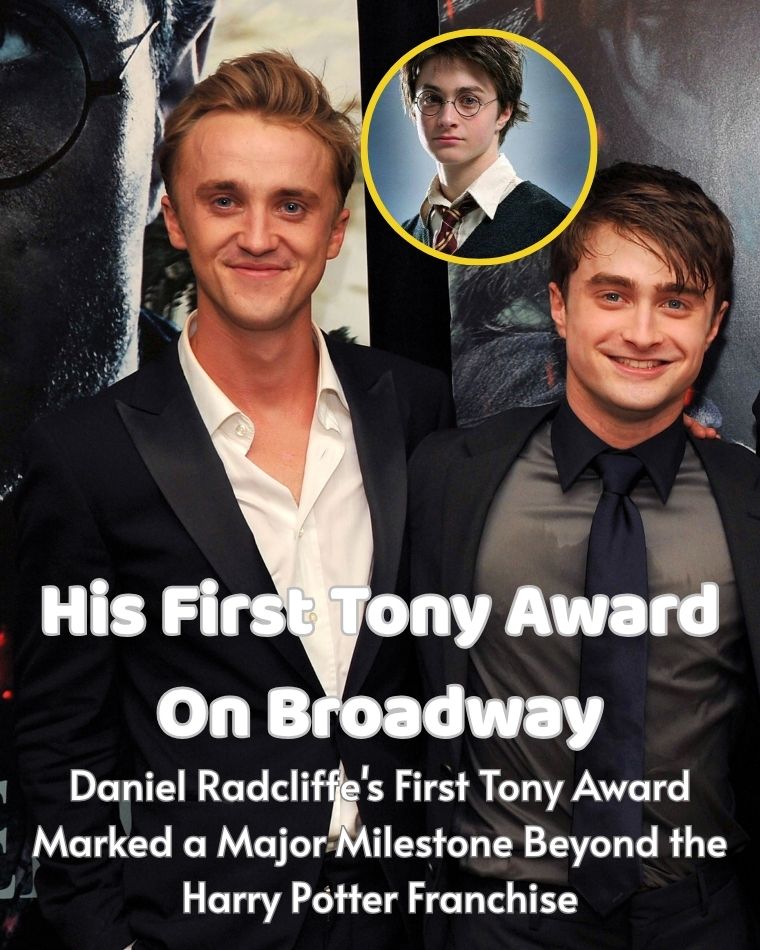
British actor Daniel Radcliffe earned his first Tony Award on June 16, 2024, for his acclaimed performance in the Broadway revival of Stephen Sondheim’s Merrily We Roll Along. The victory marks a monumental milestone in Radcliffe’s long artistic evolution, demonstrating his mastery of musical theater more than two decades after achieving international fame as Harry Potter. Radcliffe took home the trophy for Best Performance by an Actor in a Featured Role in a Musical, honoring his intricate portrayal of lyricist Charley Kringas.
A Historic Milestone on Broadway’s Biggest Night
The 77th annual Tony Awards took place on Sunday, June 16, 2024, celebrating the finest theatrical achievements of the Broadway season.
Among the evening’s most anticipated moments was the recognition of Daniel Radcliffe for his standout stage role.
Radcliffe officially took home his first Tony Award in the category of Best Performance by an Actor in a Featured Role in a Musical.
The honor recognized his compelling turn as lyricist and playwright Charley Kringas in the hit Broadway revival of Merrily We Roll Along.
The production was staged at the Hudson Theatre on Broadway, where it quickly became one of the most celebrated tickets in New York.
The musical was composed by the legendary Stephen Sondheim, featuring a book written by George Furth.
British director Maria Friedman helmed the critically lauded revival, unlocking emotional depth in a notoriously challenging musical piece.
Radcliffe shared the stage with a tight-knit principal trio that included acclaimed Broadway stars Jonathan Groff and Lindsay Mendez.
The production scored major honors across the board on Broadway’s biggest night, securing four competitive Tony Awards in total.
In addition to Radcliffe’s individual victory, Merrily We Roll Along captured the prestigious award for Best Revival of a Musical.
Jonathan Groff was also honored at the ceremony, winning the Tony Award for Best Performance by an Actor in a Leading Role in a Musical.
The production additionally claimed the Tony Award for Best Orchestrations, which was awarded to Jonathan Tunick.
These four major wins firmly cemented the revival as a defining critical and commercial triumph of the modern Broadway era.
For Radcliffe, the trophy served as an extraordinary validation of his sustained dedication to live theatrical performance over the past two decades.
Cre: Wikimedia Commons — CC BY-SA 2.0
From Child Stardom to Disciplined Stagecraft
Daniel Radcliffe originally rocketed to global prominence as a child when he was cast as the titular wizard in the Harry Potter film franchise.
Across eight blockbuster films produced between 2001 and 2011, Radcliffe grew up in front of millions of moviegoers worldwide.
The monumental commercial success of the cinematic franchise made him one of the most recognizable faces in modern popular culture.
Yet rather than resting solely on mainstream screen stardom, Radcliffe deliberately chose to challenge himself through rigorous stage acting.
His ambition to prove himself outside the boundaries of blockbuster cinema led him directly toward legitimate live theater.
In 2007, Radcliffe took a daring artistic leap by starring in a major West End revival of Peter Shaffer’s psychological drama Equus.
Directed by Thea Sharrock, Equus demanded intense emotional vulnerability, physical rigor, and relentless discipline from the young actor.
Radcliffe tackled the demanding role of Alan Strang, a deeply troubled teenage stable hand obsessed with horses.
His performance in the London production silenced skeptics who wondered whether a screen sensation could hold command over a live audience.
Radcliffe subsequently reprised his dramatic turn in Equus on Broadway in 2008 at the Broadhurst Theatre, earning widespread critical respect.
The Broadway engagement proved that Radcliffe possess the raw focus, stage presence, and stamina required for live theater.
It also established a clear pattern for his career, defined by bold theatrical risks and an absolute refusal to be typecast.
Following his dramatic Broadway debut, Radcliffe made another brave professional pivot by diving headfirst into musical theater.
In 2011, he returned to Broadway to headline the 50th-anniversary revival of Frank Loesser’s How to Succeed in Business Without Really Trying.
Radcliffe took on the lead role of J. Pierrepont Finch, an ambitious window washer scheming his way to the corporate boardroom.
The role required exhaustive song-and-dance numbers, pushing Radcliffe to undergo months of rigorous vocal coaching and dance training.
His energetic performance at the Al Hirschfeld Theatre ran for nearly a year and established his comedic timing and musical agility.
By balancing intricate choreography with vocal precision, Radcliffe proved that his early success on stage was no passing novelty.
The Journey of Merrily We Roll Along
Stephen Sondheim and George Furth’s musical Merrily We Roll Along holds a unique place in the history of American musical theater.
Based on the 1934 play of the same title by George S. Kaufman and Moss Hart, the musical tells its story in reverse chronological order.
The narrative traces the souring of a decades-long friendship among three close artistic collaborators: Franklin Shepard, Charley Kringas, and Mary Flynn.
The story begins in 1976 with the characters disillusioned, estranged, and broken by the compromises of commercial success.
It then travels backward through time, ending in 1957 when the three young dreamers first bonded on a rooftop under the stars.
When the original Broadway production opened in 1981, directed by Harold Prince, it suffered a disastrous initial reception.
Plagued by structural confusion and harsh critical reviews, the 1981 original closed after playing just 16 regular performances.
Despite the initial commercial failure, Sondheim’s magnificent score quickly earned legendary status among theater lovers and historians.
Songs like “Not a Day Goes By,” “Old Friends,” and “Good Thing Going” became enduring staples of the American musical theater canon.
Over the ensuing decades, numerous directors attempted to revise, refine, and unlock the rich potential of Furth’s book and Sondheim’s music.
Director Maria Friedman first found the emotional key to the material when she staged an acclaimed production in London in 2012.
Friedman’s staging focused deeply on the authentic human bonds, emotional vulnerability, and tragic costs of artistic ambition.
A decade later, Friedman brought her definitive vision to New York, opening an off-Broadway run at New York Theatre Workshop in late 2022.
The off-Broadway run generated overwhelming critical acclaim and immediate sellouts, driven by the electric chemistry of its three leads.
Radcliffe, Groff, and Mendez forged an undeniable onstage chemistry that captured the tragic arc of lifelong companionship.
Recognizing the rare artistic momentum, producers quickly announced plans to transfer the complete production to Broadway.
The revival opened on Broadway at the Hudson Theatre in the autumn of 2023, instantly becoming an artistic landmark.
Audiences and critics marveled at how Friedman’s direction finally realized the brilliance that Sondheim had envisioned decades earlier.
Portraying Charley Kringas: Technique, Tension, and Truth
In Merrily We Roll Along, the character of Charley Kringas serves as the moral conscience of the narrative.
Charley is a dedicated playwright and lyricist who values artistic integrity, friendship, and truth far above commercial riches.
Throughout the reverse narrative, the audience observes the devastating consequences when Charley’s creative partner, Franklin Shepard, sells out.
Franklin increasingly abandons serious theatrical composition in favor of lucrative commercial Hollywood film producing.
This profound philosophical divide eventually causes Charley to explode publicly during a live television broadcast.
That explosion culminates in one of the most notoriously difficult tour-de-force solo numbers in all of musical theater: “Franklin Shepard, Inc.”
The song is a high-speed, manic, and emotionally harrowing patter routine that requires extraordinary breath control and rhythmic precision.
During the number, Charley suffers an on-air nervous breakdown while frantically mimicking typewriters, telephones, and ticking clocks.
Radcliffe’s execution of “Franklin Shepard, Inc.” quickly became the undisputed highlight of the entire Broadway revival.
He delivered the tongue-twisting Sondheim lyrics with breathless velocity, flawless diction, and unmistakable emotional agony.
Theater critics widely praised Radcliffe for making the technical marathon feel like an organic eruption of heartbreak and frustration.
Rather than treating the song as a showy technical showcase, Radcliffe grounded every lyric in Charley’s desperate grief over lost friendship.
His performance showcased how deeply he understood Sondheim’s intricate compositional structure and psychological nuance.
Beyond the frantic comedic virtuosity of the solo, Radcliffe brought tenderness and warmth to Charley’s quieter moments.
In numbers like “Old Friends” and “Opening Doors,” he captured the youthful joy of creative collaboration in mid-century Manhattan.
His portrayal charted Charley’s journey from a bright-eyed young dramatist to an embittered, heartbroken former partner.
The depth of his performance earned him uniform praise from reviewers and fellow Broadway professionals alike.
By the time the Tony Award nominations were announced in spring 2024, Radcliffe was widely considered the front-runner in his category.
A Night of Triumphs at the 2024 Tony Awards
When the envelope for Best Featured Actor in a Musical was opened on June 16, 2024, Radcliffe’s name was officially called.
The room erupted into prolonged applause from his theatrical peers, celebrating a working actor who had thoroughly earned his stripes.
The win marked Radcliffe’s very first Tony Award nomination and his very first competitive victory on Broadway.
During his recognition at the ceremony, Radcliffe expressed profound appreciation for his colleagues, particularly Groff and Mendez.
The trio’s genuine bond offstage had translated into one of the most moving portrayals of camaraderie ever captured on a Broadway stage.
The victory also held symbolic resonance for the Broadway community, honoring an actor who chose the theater out of pure artistic love.
With considerable financial independence from his early film work, Radcliffe has consistently chosen projects purely on artistic merit.
His dedication to mastering the difficult crafts of singing, live scene work, and stage movement earned universal admiration across the industry.
The broad success of Merrily We Roll Along at the 2024 Tony Awards underscored the show’s remarkable historical vindication.
Forty-three years after its catastrophic 1981 premiere, Sondheim’s misunderstood masterpiece had finally claimed its rightful crown.
The revival collected four major Tony trophies, cementing its status as the definitive interpretation of the Furth-Sondheim collaboration.
Jonathan Groff’s win for Best Leading Actor in a Musical complemented Radcliffe’s honor, celebrating their dynamic partnership.
The prestigious award for Best Revival of a Musical recognized the producers and director Maria Friedman for their persistence.
Additionally, Jonathan Tunick’s win for Best Orchestrations honored the rich acoustic palette that brought Sondheim’s score to life.
Radcliffe’s achievement stood out as the emotional centerpiece of this historic theatrical redemption story.
It solidified his standing as a versatile performer capable of headlining both Hollywood blockbusters and complex Sondheim revivals.
The Broader Impact on Radcliffe’s Enduring Legacy
Daniel Radcliffe’s journey from film prodigy to Broadway Tony Award winner offers a compelling model for artistic longevity.
Child actors frequently struggle to transition into respected adult careers after spending their formative years in massive franchises.
Many performers find themselves constrained by the iconic roles that initially defined them in childhood.
Radcliffe deliberately dismantled those constraints by pursuing eccentric independent films, television comedies, and demanding stage plays.
His theatrical work has never been treated as a glamorous hobby, but rather as an essential workshop for personal and professional growth.
Through productions like Equus, How to Succeed in Business Without Really Trying, and Merrily We Roll Along, he steadily built his skills.
He embraced the vulnerability of live performance, where there are no multiple camera takes, safety nets, or visual effects.
Winning a Tony Award on June 16, 2024, represents the formal recognition of that decades-long artistic commitment.
It demonstrates that an actor known globally as Harry Potter can also stand as an elite interpreter of Stephen Sondheim.
The four Tony Awards won by Merrily We Roll Along confirmed that the revival was not merely a celebrity vehicle, but a theatrical triumph.
Radcliffe’s portrayal of Charley Kringas will be remembered as one of the definitive musical theater performances of the decade.
His work demonstrated how technical rigor, comic timing, and emotional vulnerability can transform a notoriously difficult role into pure magic.
As the Broadway production concluded its historic run, Radcliffe stepped forward with an undisputed place in American theater history.
His triumph on Broadway stands as an inspiring testament to discipline, curiosity, and an enduring devotion to the theatrical arts.
Để lại một phản hồi