Before Emilia Clarke achieved worldwide acclaim as the Mother of Dragons, another British actress was originally chosen to bring Daenerys Targaryen to life on screen. The untold story of HBO’s unaired 2009 pilot reveals how major creative revisions fundamentally reshaped the trajectory of modern television history.
Few casting decisions in prestige television have carried greater long-term significance than the evolution of Daenerys Targaryen.
In the contemporary cultural imagination, the silver-haired exile from George R. R. Martin’s fantasy saga is virtually inseparable from the performance of Emilia Clarke.
Yet, the history of HBO’s flagship epic looked considerably different during its initial development phase.
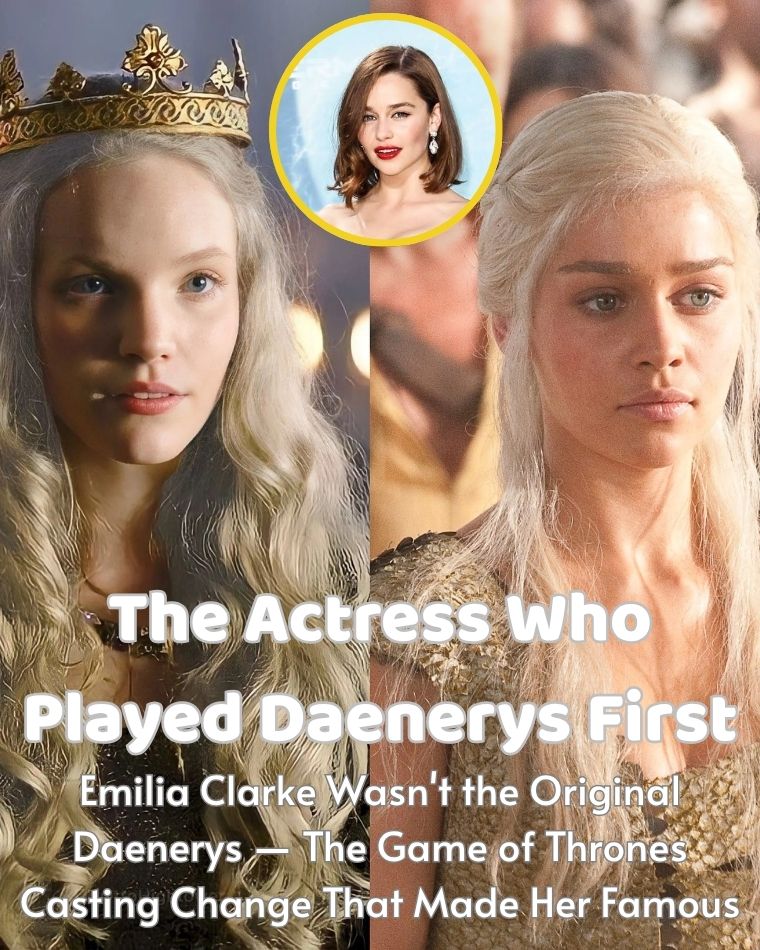
British actress Tamzin Merchant was the original talent signed and filmed as Daenerys in the series’ legendary, unaired 2009 pilot.
Her casting stood as one of the fundamental pillars of the original production plan orchestrated by showrunners David Benioff and D.B. Weiss.
The subsequent replacement of Merchant with Clarke marked a monumental turning point for the entire franchise.
Understanding how that transformation occurred provides a fascinating window into the high-stakes mechanics of premium cable development.
The journey toward bringing A Song of Ice and Fire to television screens began long before the world knew the names of Westeros or Winterfell.
HBO ordered the initial pilot episode to test whether the dense political intrigue and high fantasy could translate into viable prestige television.
Production teams gathered across locations in late 2009 to shoot the crucial foundational chapter.
At the center of the Essos storyline stood Daenerys, an exiled princess navigating intense emotional vulnerability and royal coercion.
Merchant was cast in the role after drawing notable praise for her previous work in historical television.
She possessed a striking screen presence and had demonstrated strong dramatic capabilities in period dramas.
When cameras began rolling in 2009, Merchant took on the full emotional weight of Daenerys’ early narrative arc.
However, the production of that first pilot proved to be famously challenging from both a narrative and technical perspective.
Those involved in early private screenings later acknowledged that the pilot struggled with fundamental storytelling clarity.
Crucial family relationships, such as the sibling bond between Jaime and Cersei Lannister, were reportedly unclear to viewers unfamiliar with the novels.
The tone of various scenes felt uneven, and multiple creative elements required substantial reconsideration.
Rather than abandoning the ambitious property entirely, HBO executives made the rare decision to finance extensive reshoots.
The network recognized the immense world-building potential inherent in the source material.
To realize that potential, the creators knew they needed to overhaul multiple creative aspects from the ground up.
Among the most significant creative decisions reconsidered during this overhaul was the central casting of Daenerys Targaryen.
Both Merchant and the production team eventually parted ways before the cameras rolled for the extensive revisions.
Merchant would later reflect publicly on the experience, offering valuable insight into the demanding realities of early television production.
In subsequent interviews, Merchant shared that she had felt deep reservations during the filming process.
She acknowledged that her instincts had signaled that the project and the character might not be the right artistic fit for her.
Her public reflections were characterized by remarkable candor and professional grace.
She expressed admiration for the series and specifically praised Emilia Clarke’s commanding realization of the role.
Merchant’s honest appraisal brought renewed public attention to the fragile, unpredictable nature of pilot season decisions.
Her commentary illustrated how a major creative split can ultimately serve the best artistic interests of everyone involved.
Cre: Wikimedia Commons — IncoherentScream (CC BY-SA 3.0)
With the pivotal role vacant, the casting department initiated an urgent search for a new lead actress.
They needed an artist capable of capturing both fragile vulnerability and fierce authority.
At the time, Emilia Clarke was an emerging talent fresh out of Drama Centre London.
Her professional resume was extraordinarily modest compared to the immense scale of an HBO flagship drama.
Her prior screen experience was largely confined to small guest appearances and student theater.
She was working multiple odd jobs to support herself while attending auditions across London.
When the opportunity to audition for the revised pilot arrived, Clarke faced an intimidating challenge.
The role required an actor to transition seamlessly from a frightened political pawn into a charismatic leader of warriors.
Clarke’s audition successfully conveyed that exact dual nature.
She brought an intrinsic warmth and resilient inner strength that resonated immediately with the showrunners.
Securing the role of Daenerys transformed her life overnight.
She was suddenly thrust into the center of a massive international production with enormous creative stakes.
The team returned to the set in 2010 to reshoot the pilot with Clarke leading the eastern narrative thread.
Director Tim Van Patten joined the project to helm the revised premiere, bringing refined visual coherence to the complex story.
Significant narrative beats were re-filmed to clarify the stakes and sharpen the character dynamics.
Clarke re-recorded all of Daenerys’ crucial early encounters, establishing a distinct emotional rhythm.
Her on-screen chemistry with Jason Momoa, who played Khal Drogo, anchored the foreign landscape of the Dothraki sea.
Every scene was meticulously calibrated to ensure the audience could track her psychological awakening.
When Game of Thrones officially premiered on HBO in April 2011, audiences were immediately captivated.
The premiere delivered a polished, immersive introduction to the Seven Kingdoms and beyond.
Viewers who watched that first broadcast witnessed the start of an extraordinary television phenomenon.
Crucially, Clarke’s screen debut as Daenerys became one of the most widely discussed elements of the series premiere.
Critics immediately noted her ability to convey complex emotional states through quiet, non-verbal expressions.
Her early scenes required her to communicate terror, isolation, and quiet defiance without extensive exposition.
Clarke’s subtle performance ensured that audiences invested deeply in her character’s survival from the opening episodes.
As the first season progressed, Daenerys underwent one of the most dramatic character arcs in contemporary television.
The narrative demanded that she transform from an intimidated young woman into an assertive dynastic contender.
The culminating moment of the inaugural season—emerging unburnt from the ashes with three newborn dragons—became an iconic cultural image.
Clarke handled this profound character evolution with exceptional dramatic weight.
The success of that sequence cemented Game of Thrones as an undeniable pop culture juggernaut.
It also established Clarke as one of the most exciting young performers in the international entertainment industry.
Behind the scenes, the showrunners recognized that the painful decision to reshoot the pilot had been entirely vindicated.
The creative revisions had salvaged a project that might otherwise have stalled in development.
Had HBO aired the original 2009 cut without adjustments, the entire fate of the franchise could have diverged dramatically.
The casting change became recognized as one of the single most consequential course corrections in television history.
Over the ensuing decade, Game of Thrones expanded into a global cultural empire spanning eight massive seasons.
The series dominated international viewership ratings, sparked widespread academic analysis, and set Emmy Award records.
AtHow Emilia Clarke Replaced Tamzin Merchant as Daenerys Targaryen in Game of Thrones
Before Emilia Clarke achieved worldwide fame across eight seasons of television history, another actress stood in front of the cameras as Daenerys Targaryen. The original 2009 pilot episode underwent extensive creative revisions that ultimately reshaped HBO’s flagship fantasy series. This detailed account examines the recast of Daenerys, Tamzin Merchant’s perspective on the unaired pilot, and Clarke’s transformative rise to critical acclaim.
The Secret Origins of the Unaired 2009 Pilot
Television history often hinges on choices that viewers never see on their home screens.
In 2009, HBO financed the production of an ambitious pilot episode based on George R.R. Martin’s epic novel series.
The production team traveled to multiple international locations to capture the vast scope of the fantasy realm.
At the time, the project represented an unprecedented financial and creative gamble for premium cable television.
Adapting dense literary worldbuilding into a coherent one-hour introduction presented immediate narrative hurdles for the creative team.
The initial version of the pilot featured several key cast members who would not appear in the eventual broadcast version.
Among the central figures in this early version was British actress Tamzin Merchant.
Merchant had already established herself with prominent roles in historical television dramas, including her portrayal of Catherine Howard in The Tudors.
Her profile in British period pieces made her an appealing choice for the delicate young exile living across the Narrow Sea.
Filming took place across difficult terrain, requiring intense physical and emotional commitments from the entire cast.
Behind the scenes, the production team struggled to balance character development with the vast geographical scale of the setting.
When executives and trusted industry peers viewed the raw cut of the pilot, the general reaction was far from enthusiastic.
Critical story beats remained confusing to viewers unfamiliar with the intricate politics of Westeros.
Key character motivations failed to resonate clearly on screen, leaving the creative leadership with difficult operational choices.
Faced with a flawed initial presentation, HBO leadership recognized that substantial interventions were necessary.
The network took the unusual step of ordering major reshoots rather than shelving the expensive undertaking completely.
This decision initiated an extensive period of creative restructuring behind closed doors.
Major elements of the script required rewrites to clarify the central conflicts and personal stakes.
The entire team understood that salvage operations required absolute precision to justify additional production budgets.
Reevaluating the Role of Daenerys Targaryen
The creative overhaul prompted a thorough reevaluation of several primary character arcs.
Daenerys Targaryen represented one of the most critical narrative journeys in the entire story.
The character had to begin as an isolated, intimidated pawn controlled by her ambitious older brother.
At the same time, the performer needed an underlying presence that could believably command legions in subsequent story chapters.
Balancing fragile vulnerability with innate regal authority proved to be a difficult casting challenge.
The creative team determined that a new artistic direction was required for Daenerys before moving forward with full series production.
Merchant’s departure became one of the defining turning points of the entire development phase.
Recasting a core character after completing a full pilot episode represents an enormous logistical setback.
Costumes designed for the original production required modification or complete replacement.
Scenes involving interactions with key supporting actors had to be staged and scheduled once again from scratch.
Despite the mounting operational costs, the showrunners prioritized long-term casting alignment over short-term expediency.
The search for an alternate actress began under conditions of strict professional secrecy.
Casting directors evaluated numerous emerging performers across the United Kingdom and internationally.
They sought someone capable of carrying the visual and emotional weight of an unprecedented fantasy production.
The prospective performer needed to convince audiences of an extraordinary inner evolution.
Every candidate faced the challenge of taking over a part that had already been filmed by an established colleague.
The stakes were remarkably high, as HBO prepared to commit millions of dollars to the expanded order.
Without the right emotional core for the Targaryen storyline, the cross-continental narrative risked falling completely apart.
The production could not afford a second miscalculation with its central figures.
Every audition tape was scrutinized to ensure absolute fidelity to the overarching thematic arc.
The Arrival of Emilia Clarke
During the intense recast search, casting directors discovered Emilia Clarke, a relatively unknown British actress.
Clarke had graduated from the Drama Centre London only a short time prior to auditioning.
Her professional screen resume prior to the audition was remarkably brief.
She had secured a guest appearance in a British daytime medical soap opera and a role in a television film.
Clarke possessed very little mainstream television experience when she walked into the audition room.
Her lack of widespread celebrity, however, allowed her to approach the role without preconceived public expectations.
During her auditions, Clarke demonstrated the expressive range that the revised production desperately required.
She conveyed profound timidity alongside an unmistakable undercurrent of steely determination.
The creative team recognized that she could handle the stark transition from oppressed youth to formidable leader.
Her physical presence and emotive capacity aligned closely with the reimagined vision of the character.
HBO quickly finalized negotiations to bring the young actress into the principal cast.
The announcement marked an extraordinary leap forward in Clarke’s nascent professional career.
Almost immediately, she was transported to international sets to begin preparation for the extensive reshoots.
She had to immerse herself in complex character lore, dialect training, and intensive physical filming routines.
Working alongside seasoned international actors, she confronted immense creative pressure from her very first day.
Her early scenes required complete vulnerability in remote, challenging outdoor environments.
Colleagues and directors noted her rapid adaptation to the demands of large-scale cinematic television.
She brought an earnest, grounded humanity to scenes that could easily have felt detached from reality.
Her commitment gave the production team renewed confidence in the rewritten Targaryen storyline.
With Clarke firmly in place, the production moved forward toward its long-delayed broadcast unveiling.
The 2011 Premiere and a Transformed Production
In April 2011, Game of Thrones officially made its broadcast premiere on HBO.
The final broadcast version of the premiere episode differed significantly from the troubled 2009 pilot.
Approximately ninety percent of the original pilot footage had been entirely discarded or reshot.
New scenes had been incorporated to clarify character allegiances and ancestral history.
The opening introduction of Daenerys Targaryen established her instantly as a figure of deep sympathy.
Audiences observed her displacement, her isolation, and the cruelty she suffered at the hands of her brother.
Clarke’s nuanced performance allowed viewers to connect immediately with her perilous personal circumstances.
Her expressive reactions communicated internal defiance even when her character remained verbally silenced.
Television critics singled out her performance as one of the standout elements of the debut season.
The chemistry between Clarke and her co-stars anchored the Essos storyline firmly within the broader narrative mosaic.
Viewers who had never read the underlying books found themselves deeply invested in her survival.
As the debut season progressed, her character underwent a dramatic, irreversible transformation.
The concluding moments of the first season cemented Daenerys Targaryen as a defining cultural icon of modern television.
Clarke handled this mythic ascension with an authentic balance of grief, majesty, and resolve.
The successful launch validated HBO’s difficult and costly decision to scrap the original pilot.
Had the network proceeded with the initial cut, the entire trajectory of the show might have differed drastically.
The creative adjustments turned a potential production disaster into a worldwide television phenomenon.
Ratings expanded rapidly as word-of-mouth praise spread across global television markets.
Clarke’s sudden elevation to global prominence began in earnest following that landmark debut run.
The series had successfully navigated its early existential crisis to establish a dominant cultural footprint.
Tamzin Merchant Reflects on the Experience
Years after the recast occurred, Tamzin Merchant spoke publicly about her experience with the project.
Her reflections provided rare and candid insight into the complicated realities of high-stakes television production.
Merchant explained that her heart had not truly been in the story during the initial filming process.
She recalled feeling uncomfortable with various artistic aspects of the production while working on the 2009 pilot.
Her instinctual reservations made it challenging to connect fully with the creative material.
She described arriving at the filming locations and realizing that the creative vision did not align with her personal artistic values.
The actress expressed that she had tried to pull out of the project earlier during the casting process.
However, experienced industry advisors had persuaded her to accept the prestigious opportunity at the time.
Being released from the contract following the pilot ultimately felt like a profound personal relief.
Merchant noted that continuing in a role without authentic passion would have done a disservice to both herself and the production.
She maintained a remarkably gracious and balanced perspective on the subsequent success of the series.
Merchant emphasized that an actor must genuinely believe in the world they are inhabiting on screen.
She praised Emilia Clarke for bringing the exact energy, devotion, and conviction the role required.
Her openness demystified the often-secretive nature of pilot recastings in the entertainment industry.
In Hollywood, losing a role is frequently perceived as a devastating career failure.
Merchant’s thoughtful comments showed that parting ways can frequently represent the best outcome for all creative parties.
She continued her artistic career across numerous television and film projects, maintaining a diverse professional portfolio.
Her honesty highlighted how personal intuition remains vital when choosing creative endeavors.
The public discussion brought renewed focus to the intricate behind-the-scenes dynamics of historical television adaptations.
Viewers gained a much deeper appreciation for the complex human variables involved in building an iconic character.
The Eight-Season Narrative Arc
Emilia Clarke’s tenure as Daenerys Targaryen ultimately spanned eight demanding seasons of television.
Her character’s journey formed one of the central thematic pillars of the entire episodic run.
Viewers watched Daenerys evolve from an exploited political exile into an uncompromising conqueror.
She liberated subjugated populations, built vast military coalitions, and commanded mythical beasts.
Clarke carefully modulated her performance as the character accumulated power and faced devastating betrayals.
The role required immense stamina, involving grueling filming schedules across multiple continents.
Clarke performed extensive dialogue in fictional constructed languages, maintaining emotional truth under extreme conditions.
She acted opposite complex digital effects, frequently delivering deeply intimate scenes against bare green screens.
Her ability to convey fierce authority alongside lingering trauma kept the character grounded throughout escalating spectacle.
As the narrative approached its conclusion, Daenerys became an increasingly polarizing and tragic figure.
Her pursuit of hereditary rule culminated in ruthless choices that divided the global audience.
Clarke embraced the difficult narrative trajectory, portraying her character’s descent with profound emotional commitment.
The controversial final chapters placed immense physical and psychological demands on the leading performer.
Despite intense debate over narrative pacing, Clarke’s technical performance received consistent acclaim from industry critics.
She remained devoted to exploring the internal logic of a leader consumed by messianic conviction.
Her eight-season tenure transformed Daenerys into one of the most recognizable archetypes in screen storytelling.
The visual iconography of the character entered global pop culture, inspiring widespread merchandise, parody, and tribute.
Very few dramatic roles in television history have demanded such sustained, high-profile visibility.
Clarke carried that immense operational responsibility from her very first reshot scene to the concluding finale.
The entire arc demonstrated the extraordinary creative dividend yielded by that initial casting correction.
Critical Recognition and Emmy Nominations
The industry thoroughly acknowledged Clarke’s sustained dedication to the demanding fantasy role.
Over the course of the eight-season run, she secured four Primetime Emmy Award nominations.
The Television Academy recognized her for Outstanding Supporting Actress in a Drama Series in 2013, 2015, and 2016.
These multiple honors reflected her vital contribution to the ensemble drama during its creative peak.
In 2019, following the show’s concluding season, she earned a nomination for Outstanding Lead Actress in a Drama Series.
Competing in the lead actress category highlighted how central her performance had become to the series’ identity.
Securing four Emmy nominations for a genre performance represents an exceptionally rare feat in television history.
Academy voters traditionally favored contemporary realism over large-scale fantasy storytelling.
Clarke broke through established genre biases by emphasizing the raw psychological truth of her character.
Her nominations validated the emotional authenticity she brought to fantastical circumstances.
The industry accolades served as formal peer recognition of her remarkable artistic evolution.
She stood alongside the most accomplished dramatic actresses in modern American television.
Each nomination brought renewed attention to the sheer technical difficulty of her performance.
Her peers recognized the immense discipline required to anchor massive action sequences with subtle emotional nuances.
The critical acclaim firmly established her standing as a leading dramatic talent on the world stage.
Her achievements also reflected the broader collective triumph of the show’s entire creative ensemble.
The recognition proved that fantasy productions could deliver performances of profound dramatic weight.
For an actress who entered the production with minimal television credits, the honors marked an astonishing achievement.
The Emmy history of the series remains inextricably tied to her presence as the Targaryen monarch.
Her four individual nominations stand as permanent testaments to her sustained artistic impact.
The Reality of Television Casting Decisions
The recast of Daenerys Targaryen underscores a universal truth about the entertainment industry.
Television casting choices possess the power to reshape entire creative productions and individual careers.
A single administrative adjustment can mean the difference between an unreleased pilot and an international media empire.
For HBO, making the decision to discard completed footage required immense creative bravery and financial resilience.
Networks frequently cancel troubled productions outright rather than investing further capital into repairs.
The leadership behind the series recognized the latent potential in the source material and took decisive action.
Their willingness to acknowledge early creative shortcomings set a benchmark for rigorous production standards.
For Tamzin Merchant, the departure allowed her to pursue creative work that aligned naturally with her artistic sensibilities.
Her professional journey proves that stepping away from a high-profile vehicle can protect personal integrity.
For Emilia Clarke, the audition opportunity offered an unexpected pathway from obscurity into global cultural history.
She seized the opening with unwavering professional focus, working tirelessly to realize the character’s vast narrative potential.
Her trajectory demonstrates how talent and opportunity can converge in sudden, life-changing ways.
The story behind the unaired 2009 pilot continues to fascinate entertainment analysts and television audiences alike.
It serves as a case study in screen development, adaptation hurdles, and executive decision-making.
Viewers are reminded that the polished productions they enjoy on screen represent the product of continuous trial and revision.
Masterpieces are rarely created seamlessly on the first attempt without painful reassessments.
The evolution of Daenerys Targaryen illustrates the collaborative nature of episodic television storytelling.
Directors, writers, casting executives, and performers must align completely to create enduring cultural art.
When that delicate balance is achieved, the results can capture the imagination of millions around the globe.
The history of Westeros on screen will forever be defined by the quiet casting turning point of 2009.
Để lại một phản hồi