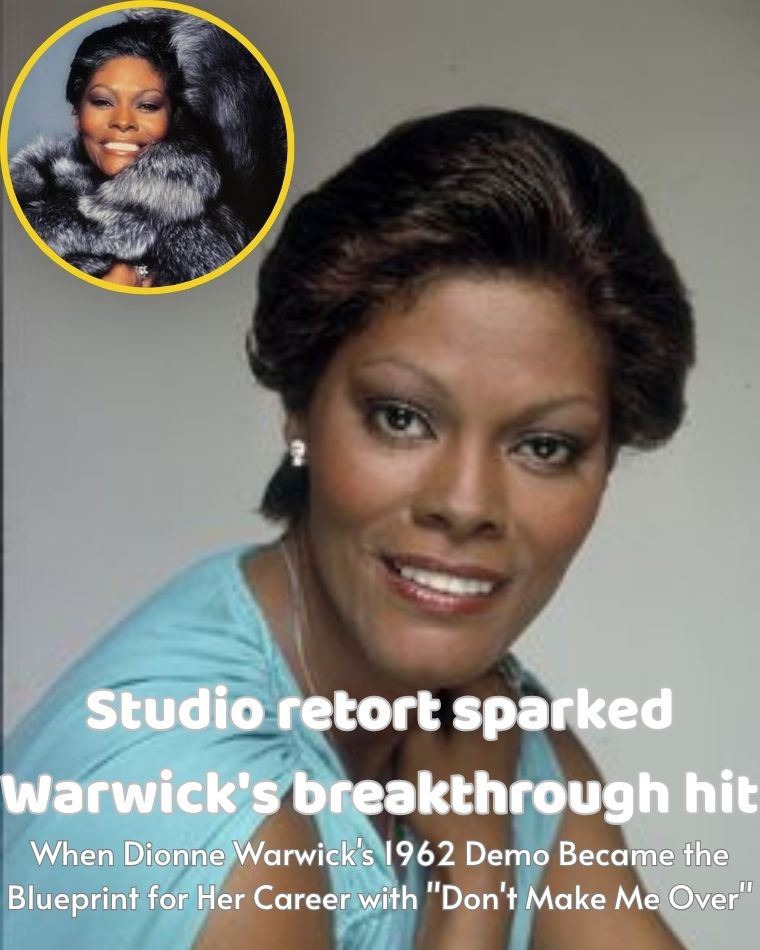
Before she became an international icon, Dionne Warwick was a twenty-one-year-old background vocalist cutting demo tracks in a New York recording studio. An offhand remark to songwriter Hal David transformed an ordinary session into “Don’t Make Me Over,” launching an enduring musical partnership with Burt Bacharach. The resulting breakthrough single climbed the charts and permanently altered the landscape of twentieth-century popular music.
In 1962, the American pop music industry operated with the rapid efficiency of an assembly line.
Songwriters gathered in bustling Midtown Manhattan offices to craft melodies designed for commercial radio.
Singers frequently arrived at recording studios merely to lay down quick guide vocals for other artists.
Dionne Warwick stepped into this whirlwind environment as an exceptionally gifted twenty-one-year-old vocalist.
She brought with her a profound musical pedigree rooted in the Drinkard family gospel tradition.
Warwick worked regularly alongside fellow session vocalists, supplying harmonies behind established headliners.
Her assignment that day was straightforward and routine.
She had been hired to record demonstration tracks for composer Burt Bacharach and lyricist Hal David.
Demo recordings were intended purely as reference guides for record labels and prospective performers.
No one in the studio anticipated that this routine rehearsal would alter the course of modern soul and pop.
Warwick approached the microphone with the discipline instilled by years of dedicated gospel singing.
Her voice possessed an uncommon purity and immaculate pitch control.
Even in the casual atmosphere of a demo run, her emotional delivery resonated across the control room.
Bacharach listened intently from behind the mixing console.
The young composer immediately detected something far beyond standard background vocal proficiency.
Warwick displayed an effortless command of syncopated rhythms and shifting time signatures.
Most commercial vocalists of the era struggled with Bacharach’s intricate, non-traditional meters.
Warwick, however, navigated the melodic intervals with poise and natural grace.
Her phrasing revealed both vulnerability and formidable technical strength.
Bacharach recognized that he had encountered an ideal interpreter for his ambitious arrangements.
Cre: Wikimedia Commons — Public Domain
The recording session, however, was not entirely free of creative friction.
During the vocal run-through, the production team began offering suggestions on how Warwick should deliver the lines.
They urged her to modify her vocal approach to better suit standard industry conventions.
Warwick was a young artist of fierce artistic integrity and unmistakable self-possession.
She felt the proposed alterations threatened to strip away the authenticity of her natural voice.
Frustrated by the persistent critiques, Warwick delivered a spontaneous retort to the writing team.
“Don’t make me over, man,” she stated firmly in the studio.
The room fell quiet as the weight of her words registered with the production crew.
Warwick had simply intended to defend her personal vocal identity and resist unnecessary homogenization.
Yet to the keen ear of lyricist Hal David, the sharp retort held profound poetic potential.
David recognized that the colloquial phrase captured an intensely relatable human truth.
It spoke to the universal desire to be accepted precisely as one is.
He immediately seized upon the phrase and retreated to develop it into a complete lyric.
David envisioned a song about dignity, unyielding personal worth, and romantic boundaries.
The resulting composition turned Warwick’s studio retort into a sweeping anthem of self-acceptance.
Rather than taking offense at the young singer’s defiance, David transformed her candid words into art.
The lyric captured the tension between romantic devotion and the preservation of one’s core self.
It challenged the listener to embrace an individual without demanding painful compromises.
Warwick’s impromptu protest had unwittingly supplied the thematic core of a masterpiece.
Bacharach went to work crafting a rich harmonic landscape around David’s fresh lyrics.
He understood that Warwick’s voice possessed the exact emotional range needed to sell the message.
Her delivery blended classical control with the raw conviction of the church choir.
She could whisper an intimate phrase and immediately rise into an impassioned declaration.
Bacharach and David knew the song could not be handed off to another performer.
Bacharach made the decisive choice to push for an official commercial release.
He refused to allow the demo to languish in tape archives or be given to another artist.
Convincing record executives to gamble on an unknown background vocalist was no simple task.
The music industry in 1962 remained cautious about investing promotional budgets in unproven talent.
Nevertheless, Bacharach remained steadfast in his belief in Warwick’s star power.
He brought the completed recording directly to Florence Greenberg, the founder of Scepter Records.
Greenberg ran an independent label known for breaking vibrant rhythm and blues acts.
Upon hearing the track, the label recognized the singular power vibrating through Warwick’s vocals.
Scepter Records agreed to issue “Don’t Make Me Over” as Warwick’s debut solo single.
The label pressed the vinyl discs and distributed promotional copies to radio stations nationwide.
When disc jockeys placed the needle on the record, listeners were immediately captivated.
The song sounded unlike anything else dominating the airwaves in late 1962.
It bridged the emotional grit of urban rhythm and blues with the sophistication of modern orchestral pop.
Listeners called radio stations in droves to ask about the identity of the dynamic new singer.
Warwick’s name quickly circulated through industry trade publications and retail shops.
Record stores faced sudden demand from customers eager to purchase the dramatic ballad.
The single steadily gathered national momentum, entering the mainstream pop and R&B charts.
It climbed into the coveted Top 40, announcing Warwick as a formidable new presence in American music.
The song demonstrated that a female artist could project strength and vulnerability in equal measure.
Audiences recognized that Warwick was not merely singing notes; she was conveying lived emotional truth.
The success of “Don’t Make Me Over” permanently transformed Warwick’s professional trajectory.
Only weeks earlier, she had been an anonymous session worker supporting other performers.
Now, she stood firmly in the spotlight as a nationally recognized recording artist.
The single proved that her vocal style possessed immense commercial vitality.
Her gospel foundations provided her with a dynamic breath control that fascinated fellow musicians.
She could hold sustained notes with crystalline clarity while sustaining intricate melodic lines.
Radio programmers recognized that Warwick brought a fresh sophistication to the airwaves.
Her voice resisted easy categorization, effortlessly crossing racial and stylistic barriers.
She resonated equally with youth audiences and seasoned connoisseurs of adult standards.
Music critics praised the emotional authenticity that underpinned every measure of the track.
The release set a new benchmark for vocal performance within popular music production.
It demonstrated that complex musicianship could achieve widespread commercial appeal.
Warwick had demanded to be accepted on her own terms in the studio.
The record-buying public enthusiastically endorsed that exact stance.
The debut single established an immediate artistic benchmark that would guide her entire catalog.
For Bacharach and David, the release proved equally monumental.
Prior to working with Warwick, their innovative compositions were frequently smoothed out by other producers.
Many contemporary vocalists could not execute the shifting time signatures that Bacharach favored.
In Warwick, the songwriting duo found their ultimate muse and most trusted collaborator.
She gave Bacharach the freedom to explore complex harmonic structures without commercial compromise.
David found in her voice the perfect emotional instrument to convey his nuanced lyrics.
The triumphant chart run of “Don’t Make Me Over” established an iconic trio.
The Warwick-Bacharach-David partnership became an unstoppable creative engine throughout the 1960s.
Their collaborative process was rooted in mutual artistic respect and creative synergy.
Bacharach composed with Warwick’s distinct tonal range and expressive phrasing in mind.
David penned lines that mirrored her natural cadence and sophisticated delivery.
Warwick inhabited their songs with an elegance that made every story feel personal and authentic.
Together, they produced an extraordinary string of timeless pop and soul recordings.
Their catalog came to define the sophisticated cosmopolitan sound of the decade.
The partnership yielded masterworks that effortlessly navigated soul, adult contemporary, and mainstream pop.
Each subsequent recording built directly upon the foundation laid during that initial 1962 session.
Their shared work established a standard of musical craftsmanship that few competitors could match.
The synergy among singer, composer, and lyricist created a distinct sonic signature.
It proved that popular radio could support intellectual arrangements alongside emotional urgency.
The collaboration elevated commercial pop songwriting to the level of serious art.
Musicians and arrangers studied their recordings to decipher their sophisticated architectural design.
Yet behind the technical complexity lay pure human feeling and accessible melodies.
That balance was struck for the first time during the recording of “Don’t Make Me Over.”
The trio operated not as employer and employee, but as an integrated creative unit.
Their chemistry demonstrated what became possible when extraordinary talents aligned with complete trust.
The recording studio transformed into an experimental workshop where boundaries were continually pushed.
Looking back at the history of American popular music, pivotal moments often hinge on chance.
A routine afternoon demo session in 1962 could easily have ended without fanfare.
Had Warwick remained silent when pressed to alter her vocal style, music history might look different.
Had Hal David ignored her blunt remark, a classic lyric would never have taken shape.
Had Burt Bacharach allowed the recording to remain a shelved demo, a legendary career could have stalled.
Instead, an instinctive demand for self-determination gave birth to a legendary pop anthem.
“Don’t Make Me Over” stands as an enduring monument to artistic integrity and serendipity.
The song reminded listeners that true artistry requires staying faithful to one’s core identity.
It marked the arrival of Dionne Warwick as an irrepressible force in twentieth-century music.
It solidified the creative brotherhood between Burt Bacharach and Hal David.
A single recording session managed to redefine the sonic landscape of an entire generation.
The echoes of that defiant studio retort continue to reverberate across the history of modern music.
Để lại một phản hồi