The collaboration between composer Burt Bacharach and vocalist Dionne Warwick represents one of the most intellectually sophisticated chapters in American popular music. While conventional industry narratives often depict Bacharach as the brilliant architect and Warwick merely as the vessel delivering his intricate melodies, their historical studio documentation reveals a profoundly reciprocal dynamic. Bacharach consistently noted across multiple retrospective accounts that his writing evolved precisely because Warwick’s technical instrument offered capabilities virtually unprecedented in the commercial pop landscape of the early 1960s.
Warwick’s extraordinary vocal range, pitch precision, rhythmic intuition, and nuanced phrasing directly influenced Bacharach’s arranging decisions and melodic architecture. Rather than forcing her into conventional verse-chorus forms, Bacharach felt structurally liberated to write wide interval leaps, shifting time signatures, and asymmetrical phrasing that would challenge even seasoned conservatory vocalists. Their studio sessions became laboratory environments where vocal timbre and orchestral arranging developed in simultaneous dialogue.
1. The Early 1960s Discovery: From Session Backing to Melodic Muse
The origins of this historic collaboration trace back to a 1961 recording session for The Drifters’ song “Mexican Divorce”.
Warwick, then a student at The Hartt School of Music in Connecticut, was performing background vocal duties as a member of The Gospelaires.
Bacharach, who was conducting the recording date and arranging the track, immediately recognized an uncommon clarity and strength in the vocal mix.
Warwick’s vocal tone cut through the studio ensemble without requiring unnatural push or physical strain.
Bacharach later recalled that Warwick was projecting with a crystalline control that separated her entirely from typical studio session singers.
Warwick possessed a rigorous foundation formed by years of church choir performance alongside formal academic training in music theory and voice.
This dual background gave her an acute ear for pitch centers and harmonic resolution that typical pop singers lacked.
Bacharach quickly invited Warwick to sing on demo recordings for songs he and lyricist Hal David were pitching to established recording artists.
During these early demo dates, Bacharach noticed that Warwick effortlessly executed phrases that other singers routinely found unsingable.
Her ability to navigate complex chromatic movements and wide intervallic distances quickly changed Bacharach’s entire creative perspective.
Instead of writing standard commercial pop melodies and seeking an artist to sing them, Bacharach began composing specifically around the contours of Warwick’s vocal instrument.
When Florence Greenberg of Scepter Records heard Warwick’s distinctive demo vocal on “Don’t Make Me Over,” the decision was made to launch Warwick as a featured solo artist.
This transition marked the birth of a bespoke writing partnership that would yield dozens of historic recordings over the following decade.
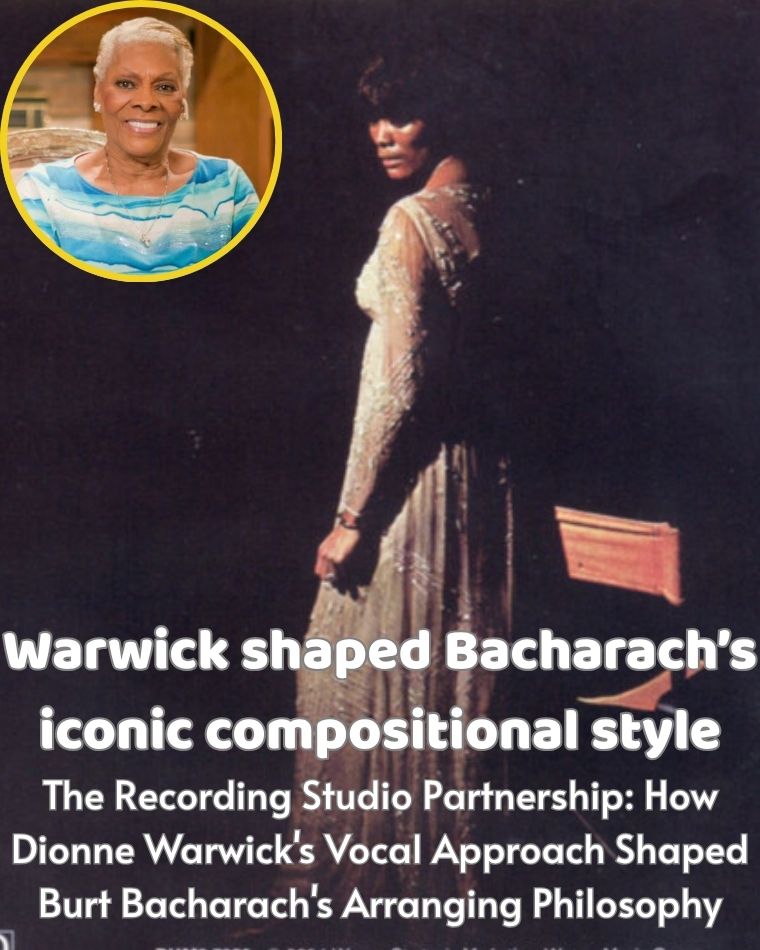
Cre: Wikimedia Commons — Scepter Records / Public Domain
2. Technical Anatomy: Expanding Intervals, Syncopation, and Meter
The technical hallmark of Bacharach’s composing philosophy was the disruption of traditional pop symmetry.
Mainstream American radio in the early 1960s relied heavily on predictable 4/4 structures, standard eight-bar sections, and diatonic stepwise melodic motion.
Bacharach broke these conventions systematically, using Warwick’s vocal stability as his harmonic anchor.
One primary element was the deployment of wide and disjunct intervals within the primary vocal melody.
Pop vocal lines typically avoid major sevenths, minor ninths, and abrupt octave leaps because they can easily destabilize intonation.
Warwick, however, possessed perfect relative pitch and a seamless transition between her chest resonance and head voice.
Bacharach exploited this flexibility by writing lines that ascended quickly into higher registers before descending across unusual modal steps.
Her breath support allowed her to sustain long, extended melodic arches without losing dynamic consistency across the bar lines.
Furthermore, Bacharach integrated frequent and sudden time signature shifts within a single musical stanza.
A composition might move from 4/4 time into isolated bars of 3/4, 7/4, or 5/4 simply to follow the natural inflection of Hal David’s lyrics.
Most vocalists struggle to maintain natural rhythmic phrasing when measures drop or add single beats.
Warwick’s deep background in gospel syncopation and polymetric church music gave her an effortless internal pulse.
She did not count beats mechanically in the studio; she felt the shifting meters as expressive extensions of speech.
Her vocal control ensured that Bacharach’s asymmetrical phrases felt conversational rather than mathematically rigid.
Her light vibrato, placed precisely at the tail end of long phrases rather than throughout, gave Bacharach’s lush orchestrations acoustic room to breathe.
3. Real-Time Arrangement: The Dialectic of the 1960s Recording Studio
The 1960s recording process differed sharply from modern multitrack digital production.
At Bell Sound Studios and A&R Studios in New York City, rhythm sections, full orchestral ensembles, and lead vocalists often recorded simultaneously in the same room.
Because multitrack isolation was rudimentary, live vocal execution required absolute technical command on every single take.
Bacharach operated as a meticulous perfectionist on the studio floor, conducting the orchestra while monitoring every nuance from the piano bench.
Warwick was not a passive recipient of written sheet music during these intense multi-hour dates.
As Warwick sang through early takes, Bacharach actively modified the orchestral voicings to complement her real-time interpretive decisions.
If Warwick chose to understate a syllable or float a note in half-voice, Bacharach immediately pared back the brass or string counter-lines.
If she leaned into a resonant lower tone, he adjusted keyboard or cello voicings to prevent frequency masking.
Warwick possessed an uncanny ability to suggest dynamic shapes purely through micro-adjustments in vocal delivery.
Bacharach routinely noted that Warwick gave his melodies their definitive emotional weight by avoiding histrionic oversinging.
Where other vocalists might push into aggressive belting to demonstrate emotional strain, Warwick adopted a restrained, poignant delivery.
This cool aesthetic restraint allowed Bacharach to write orchestrations of symphonic complexity without drowning out the central emotional narrative.
The mutual trust between them was such that dozens of takes were routinely performed to capture an unbroken, seamless performance.
Their sessions were collaborative sculpting sessions where arrangement and vocalization were refined in tandem until the balance was flawless.
4. Masterworks in Microcosm: “Walk On By” and “I Say a Little Prayer”
The architectural brilliance of the Bacharach-Warwick partnership is illustrated vividly in “Walk On By,” recorded in late 1963.
The song’s emotional core explores the painful public facade of private heartbreak.
To convey this tension, Bacharach designed an arrangement built around two grand pianos playing interlocking polyrhythmic figures.
Warwick’s vocal entry floats over this dense rhythmic foundation with stoic melancholy.
Her vocal line requires exceptional dynamic control, shifting from intimate whisper-like tones to clear, projected proclamations.
She navigates descending harmonic progressions and syncopated pauses with pinpoint accuracy.
Rather than dramatizing the grief through explosive vocal runs, Warwick lets the restraint of her voice reflect the lyrics’ theme of foolish pride and concealed sorrow.
A few years later, in 1967, the duo created an even more complex technical milestone with “I Say a Little Prayer”.
The track remains celebrated among music theorists for its relentless and intricate meter changes.
The verses alternate between two bars of 4/4 and one measure of 2/4 before shifting through rapid rhythmic permutations in the chorus.
For most popular singers, singing across an unexpected 2/4 or 3/4 bar creates hesitation or disruption in vocal momentum.
Warwick delivers the melody with such buoyant swing that ordinary listeners barely perceive the mathematical shifts occurring underneath.
Her rapid-fire diction and precise placement of consonants ensure that every lyric lands in perfect synchronicity with the rhythm section.
Bacharach admitted that the tempo of the song was challenging to settle on, but Warwick’s rhythmic elasticity made the demanding phrasing flow naturally.
These recordings stand as definitive proofs of a vocal technique constructed to master avant-garde pop composition.
5. A Revolutionary Model: Beyond Tin Pan Alley and the Assembly Line
To appreciate the historic significance of their partnership, one must examine the dominant production paradigms of the 1960s.
The traditional Tin Pan Alley model operated on strict, factory-like division of labor.
Professional songwriters sat at upright pianos writing sheet music, which was then passed to publishers and commercial arrangers.
A contracted studio singer was eventually assigned to interpret the chart, having zero input into the melodic shape or harmonic voice-leading.
Similarly, the groundbreaking Motown assembly line in Detroit depended on a highly centralized production hierarchy.
Motown’s songwriting units wrote rhythmic tracks that were recorded by the house band before vocalists were rotated onto the master tapes.
If a particular singer struggled with a key or arrangement, the producer often reassigned the track to a different group or soloist on the roster.
The Bacharach-Warwick-David triumvirate rejected both models in favor of a personalized creative trinity.
Warwick was never treated as an interchangeable vocal asset.
Bacharach composed with Warwick’s vocal envelope permanently etched into his creative consciousness.
He knew precisely which pitches sat in her sweetest upper chest register and how fast her vibrato bloomed on specific vowels.
This symbiosis established a new creative template where composer and interpreter functioned as co-architects of the final sonic product.
Warwick was Bacharach’s living laboratory, permitting him to transcend commercial formulas and venture into harmonic territory previously reserved for jazz and modern classical music.
6. Lasting Influence on Modern Studio Production
The collaborative methodology pioneered by Burt Bacharach and Dionne Warwick permanently altered the standards of popular music production.
Their body of work proved to record labels that radio audiences possessed the sophistication to embrace complex chord structures, asymmetric time signatures, and understated vocal delivery.
Prior to their historic run, pop producers assumed that commercial success required rigid formulaic simplicity.
Bacharach and Warwick systematically shattered that belief by turning complex music theory into platinum-selling pop standards.
Their studio partnership directly influenced subsequent generations of auteur producers and vocalists who sought deeper integration in the recording booth.
The artistic lineage connecting their work can be heard in the intricate collaborative arrangements of Brian Wilson and The Beach Boys.
It echoed later through the 1970s studio experiments of Stevie Wonder, who merged complex modal jazz chords with pop songcraft.
In later decades, writing partnerships across pop, soul, and contemporary R&B drew direct inspiration from Warwick’s masterclass in phrasing and vocal dynamics.
Artists covering the Bacharach catalog quickly discovered that his compositions could rarely be duplicated without Warwick’s precise blend of discipline and soul.
Her performances demonstrated that vocal virtuosity is not defined by vocal gymnastics or volume, but by surgical precision, rhythmic agility, and emotional clarity.
Decades after their initial recording sessions, the partnership between Burt Bacharach and Dionne Warwick remains an enduring gold standard of American popular music craft.
Để lại một phản hồi