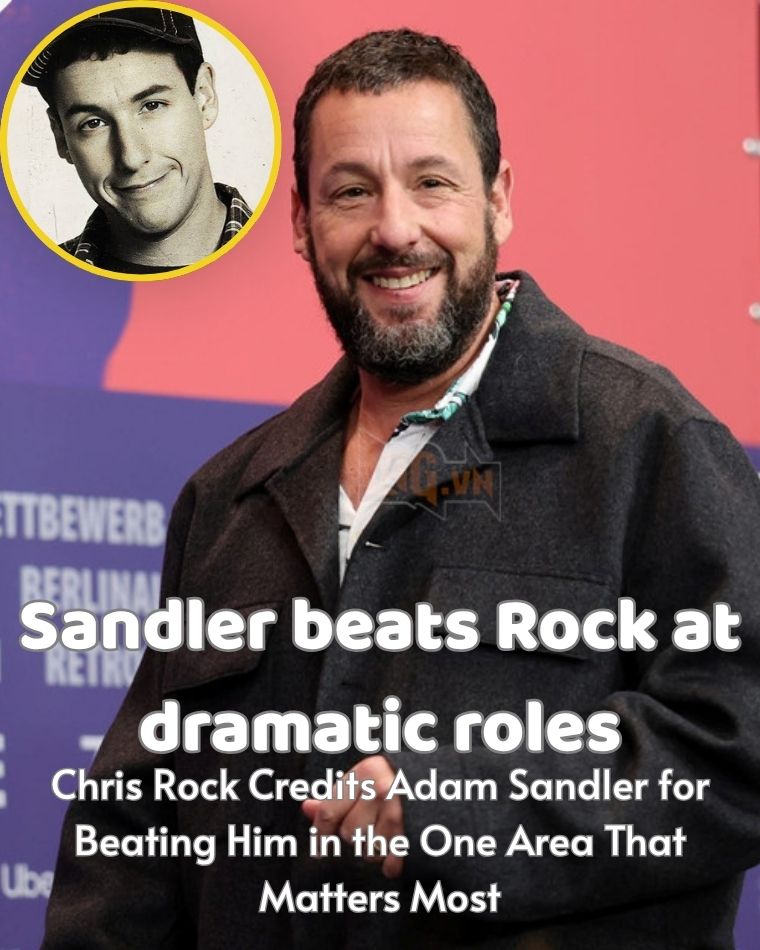
Chris Rock has candidly admitted that longtime friend Adam Sandler has outpaced him in successfully transitioning from broad comedy to serious dramatic cinema.
The stand-up legend explained that Sandler took creative chances far earlier and established a benchmark in prestigious film roles that few peers have matched.
Their enduring bond spans more than three decades, defined by mutual professional respect rather than bitter competition.
The conversation surrounding comedy heavyweights taking on dramatic material has sparked debate for decades across Hollywood.
Few artists have navigated the delicate boundary between mainstream laughs and intense dramatic acclaim as effectively as Adam Sandler.
During an insightful career reflection, Chris Rock pointed out that Sandler had already ventured much deeper into dramatic acting than he had ever managed to do.
Rock noted that watching Sandler secure challenging roles and deliver critically acclaimed dramatic work set a high standard for comedians seeking reinvention.
Rather than expressing envy, Rock delivered his observations with genuine admiration for a fellow performer who entered the industry alongside him.
Both performers first rose to national prominence as breakout cast members on Saturday Night Live during the early 1990s.
They shared modest dressing rooms and navigated high-pressure live television broadcasts while developing their distinct comedic personas.
Over the ensuing decades, each artist followed a remarkably different trajectory in the entertainment landscape.
Rock revolutionized modern stand-up comedy through razor-sharp social satire and fearless political commentary.
Sandler built an unrivaled box-office empire grounded in approachable physical comedy, music, and sentimental humor.
Yet when it came to branching out into high-stakes dramatic acting, Sandler made artistic leaps that permanently altered how audiences perceive his talents.
Cre: Wikimedia Commons — David Shankbone, CC BY 3.0
The Origins of a Decades-Long Creative Bond
Chris Rock and Adam Sandler first forged their creative camaraderie in the legendary halls of Studio 8H in New York City.
They were part of a tight-knit cohort that also featured Chris Farley, David Spade, and Rob Schneider.
Audiences dubbed the group the bad boys of Saturday Night Live due to their rebellious energy and unconventional humor.
While on the show, Sandler crafted beloved eccentric characters such as Opera Man and performed whimsical musical segments on Weekend Update.
Rock brought an incisive edge to the program, addressing complex cultural topics with unflinching directness.
Even during those formative years, both performers recognized each other’s distinct strengths and complementary styles.
Sandler once admitted in an interview that he felt early professional envy when comedy idol Eddie Murphy publicly praised Rock’s stand-up talents.
That competitive spark quickly dissolved into a steadfast brotherhood as they supported each other through professional upheavals.
When their tenures at Saturday Night Live came to an end, both men were forced to redefine their careers in Hollywood.
Sandler quickly launched a string of blockbuster studio comedies, including Billy Madison, Happy Gilmore, and The Waterboy.
Rock focused on touring the comedy club circuit, ultimately producing legendary HBO specials like Bring the Pain and Bigger & Blacker.
Despite diverging career paths, their personal relationship remained rock solid across multiple decades.
They frequently checked in on each other’s personal lives and provided candid creative feedback on scripts and projects.
That foundational friendship laid the groundwork for honest appraisals between two titans of the industry.
The Courageous Shift Toward High-Stakes Dramatic Roles
The pivotal divergence in their filmographies occurred when Adam Sandler took deliberate risks with auteur directors.
In 2002, visionary filmmaker Paul Thomas Anderson cast Sandler as the troubled novelty salesman Barry Egan in Punch-Drunk Love.
The role subverted Sandler’s trademark cinematic rage into deep vulnerability and psychological isolation.
The performance surprised film critics worldwide and earned Sandler a Golden Globe nomination for Best Actor.
Rock closely monitored Sandler’s transition, admiring the daring required to dismantle a multimillion-dollar comedy brand for art.
Sandler followed that initial dramatic triumph with compelling work in Reign Over Me and Noah Baumbach’s The Meyerowitz Stories.
Each dramatic performance reinforced that Sandler possessed genuine range far beyond juvenile slapstick.
The pinnacle of Sandler’s dramatic career arrived in 2019 with the Josh and Benny Safdie thriller Uncut Gems.
Sandler portrayed Howard Ratner, a manic diamond merchant spiraling through addiction, debt, and relentless ambition in New York.
The performance earned unanimous critical praise and secured Sandler the Independent Spirit Award for Best Male Lead.
Rock openly marveled at what Sandler accomplished in Uncut Gems, acknowledging how difficult it is for a comedian to achieve that level of dramatic authenticity.
Rock reflected on how difficult it is to secure material of that caliber and execute it with such terrifying intensity.
“You see what Sandler did with Uncut Gems,” Rock observed when discussing the elusive quest for transformative dramatic projects.
Rock remarked that an actor must actively prepare for when that specific opportunity presents itself.
He conceded that Sandler had crossed that artistic threshold long before many of his comedic contemporaries dared to try.
Contrasting Approaches to Artistic Reinvention
While Sandler ventured into intense indie dramas, Chris Rock chose to develop his dramatic chops through television, theater, and directing.
Rock stepped outside his traditional comfort zone by starring in Stephen Adly Guirgis’s acclaimed Broadway play The Motherfucker with the Hat.
The stage production earned Rock glowing notices for his emotional vulnerability and discipline as an ensemble player.
Behind the camera, Rock wrote, directed, and starred in Top Five, a sophisticated film examining celebrity culture and artistic integrity.
He later embraced a major dramatic challenge by leading the fourth season of the anthology series Fargo.
Rock portrayed Loy Cannon, a ruthless 1950s crime boss navigating racial tension and gang warfare in Kansas City.
The role required a stoic gravitas vastly different from Rock’s explosive stand-up stage persona.
Rock frequently joked in public appearances that he took on dramatic parts simply trying to emulate Sandler’s artistic path.
“And now I’m doing a dramatic role ’cause I copy everything he does,” Rock quipped during a prominent speaking appearance.
Beneath the self-deprecating humor lay an honest admission about Sandler’s status as a pioneer for comedic actors.
Rock has often noted that dramatic directors look at comedians with initial skepticism when casting serious projects.
Sandler succeeded in convincing major directors to look past his comedic reputation and trust his raw instinct.
That institutional trust is something Rock recognized as exceptionally rare in Hollywood.
Mutual Defense and Loyalty in the Public Eye
The deep respect between Rock and Sandler extends far beyond artistic comparisons and box-office resumes.
Throughout their careers, both men have consistently defended each other during moments of intense public controversy.
When Adam Sandler received the Mark Twain Prize for American Humor at the Kennedy Center, Rock took the stage to celebrate his friend.
Rock delivered heartfelt remarks praising Sandler’s loyalty to his friends, family, and creative collaborators.
Rock pointed out that Sandler built a production ecosystem that ensured his longtime companions remained employed for decades.
In turn, Sandler has been an unwavering supporter of Rock during difficult personal and professional chapters.
Following the high-profile incident at the 94th Academy Awards, Sandler publicly demonstrated solidarity with Rock.
When reporters questioned whether Rock had gone too far during subsequent comedy routines, Sandler firmly defended his lifelong friend.
Sandler emphasized that Rock stayed true to himself as an artist and possessed an unmatched comedic integrity.
This protective dynamic illustrates that their competitive spirit never turned toxic or adversarial.
They view each other’s individual triumphs as shared milestones for the entire generation of comedians who emerged alongside them.
Their collaborative efforts in ensemble blockbusters like Grown Ups and The Week Of highlighted their natural chemistry on screen.
Those commercial projects allowed them to enjoy the financial rewards of mainstream filmmaking without losing their creative identity.
Yet both artists have always known that dramatic credibility represents a distinctly solitary mountain to climb.
The Unique Hollywood Position of Adam Sandler
Adam Sandler occupies a singular niche in the modern entertainment industry.
Through his Happy Madison Productions banner, Sandler retains complete autonomy over his commercial output.
He maintains lucrative multi-picture distribution agreements that allow him to make broad crowd-pleasers with his close circle.
Simultaneously, top-tier independent filmmakers continue to seek him out for nuanced, demanding dramatic character studies.
Directors like Paul Thomas Anderson, the Safdie brothers, and Noah Baumbach see in Sandler a deeply human, unvarnished presence.
Comedians understand that delivering comedy requires relentless timing, rhythm, and precision.
Those exact mechanical instincts often translate seamlessly into raw dramatic performances when channeled properly.
However, many comedy stars struggle to strip away the reflex to seek immediate validation through laughter.
Sandler demonstrated the rare discipline to inhabit uncomfortable silence and unresolved tension on camera.
That willingness to be vulnerable without a punchline is the precise trait Chris Rock singled out for praise.
Rock recognized that conquering drama requires an actor to relinquish the psychological armor of humor.
By successfully achieving that balance, Sandler established a blueprint that continues to inspire his peers.
Rock’s frank evaluation demystifies the Hollywood narrative that artists must remain confined to a single creative lane.
It highlights how mutual respect between legends can illuminate the craft behind both laughter and tears.
What Rock’s Admission Reveals About the Art of Comedy
Chris Rock’s willingness to acknowledge Sandler’s dramatic superiority reflects rare humility from an iconic performer.
In an industry often dominated by carefully curated egos, candid self-assessment stands out as genuine and refreshing.
Rock remains widely considered by critics and peers as one of the greatest stand-up comedians in history.
His specials serve as cultural masterclasses in rhetoric, social commentary, and comedic construction.
He does not need dramatic accolades to validate his status as an American cultural institution.
Yet his transparent commentary regarding Sandler proves that artists constantly seek unexplored creative territory.
Rock’s ambition to tackle richer dramatic scripts remains vibrant and ongoing.
He continues to seek out collaborative opportunities that test his emotional limits as an actor.
By celebrating Sandler’s accomplishments in drama, Rock reinforces that true mastery involves admiring excellence in others.
Their enduring friendship serves as an enduring reminder that sustained artistic longevity requires both courage and community.
As both icons continue to produce work across genres, audiences benefit from their ongoing creative evolution.
Their shared journey from late-night sketch television to cinematic history remains one of Hollywood’s most remarkable narratives.
Sandler may hold the dramatic edge in Rock’s candid estimation, but both performers have reshaped modern entertainment on their own terms.
Để lại một phản hồi