Three decades after hitting theaters in September 1996, the action comedy Bulletproof remains an infamous misfire in Adam Sandler’s Hollywood rise. Starring alongside Damon Wayans under the direction of Ernest R. Dickerson, the high-concept project failed both critically and commercially, exposing the precarious growing pains of Sandler’s transition from sketch television to leading man status. Here is an in-depth retrospective on why this miscalculated buddy cop effort collapsed, how Sandler managed to recover, and where the film stands today.
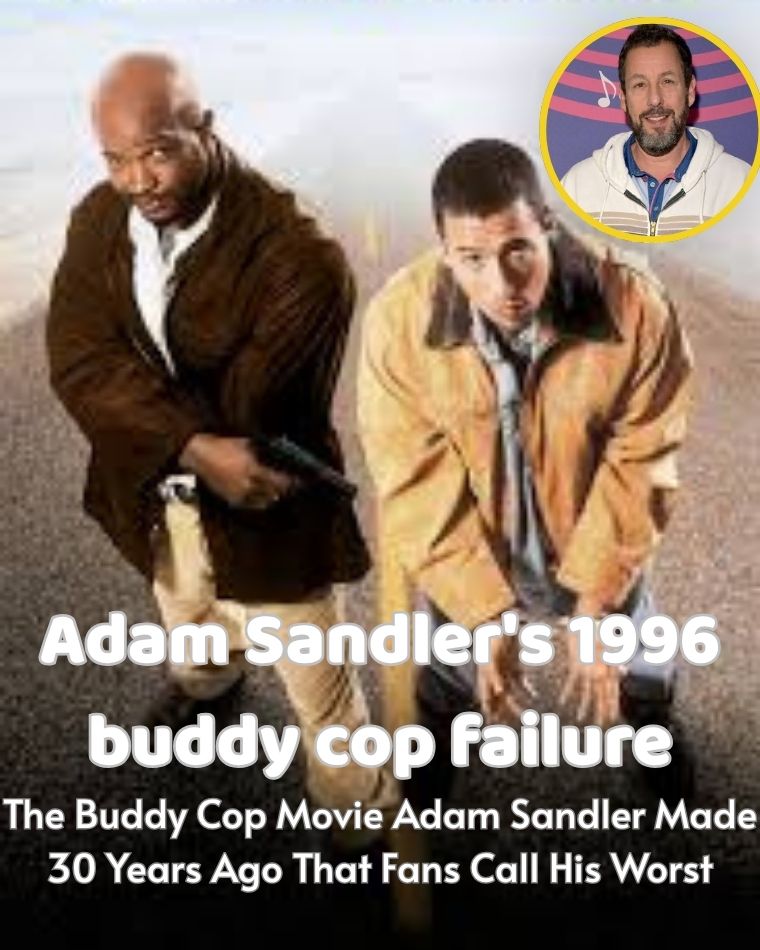
Cre: Universal Pictures — Wikimedia Commons / Fair Use
The year 1996 was a pivotal moment in modern American cinematic comedy.
Adam Sandler was actively attempting to prove that his breakout sketch success on Saturday Night Live could sustain a durable career as a major film actor.
Only months earlier, Sandler had cemented his idiosyncratic comedic voice with the sports comedy Happy Gilmore.
That film followed on the heels of 1995’s Billy Madison, establishing an unapologetic brand of man-child absurdity that resonated deeply with young audiences.
Those initial hits demonstrated that Sandler’s unpredictable tantrums and goofy musical interludes could reliably pack theaters.
However, studio executives in the mid-1990s remained determined to test whether Sandler could fit into established Hollywood genres outside of his own self-contained star vehicles.
The buddy cop action comedy represented the absolute gold standard of commercial Hollywood filmmaking throughout the late 1980s and 1990s.
Films like 48 Hrs., Beverly Hills Cop, and Lethal Weapon had created a lucrative formula pairing mismatched personalities against high-stakes criminal conspiracies.
Universal Pictures envisioned Bulletproof as a surefire vehicle to pair two of the decade’s sharpest comedy voices into that proven framework.
Sandler was cast as Archie Moses, a small-time criminal and car thief embedded inside a sprawling narcotics ring.
Opposite him was Damon Wayans, a comedy icon from Fox’s sketch series In Living Color who had also logged time on Saturday Night Live.
Wayans portrayed Rock Keats, a charismatic hustler who is secretly Detective Jack Carter of the Los Angeles Police Department.
The dramatic hook of the premise hinges on deep betrayal between close friends.
Carter befriends Moses specifically to infiltrate an operation led by ruthless drug kingpin Frank Colton, portrayed by screen veteran James Caan.
Carter genuinely grows fond of Moses during the sting and hopes to bring him into custody without harm.
Unfortunately, Carter’s undercover identity unravels during a chaotic warehouse raid.
A catastrophic accident involving an industrial crane causes Moses to inadvertently shoot Carter in the head.
Against all medical odds, Carter survives the trauma and undergoes extensive physical rehabilitation.
Upon his recovery, Carter is assigned the grueling task of extraditing a captured Moses across the country so Moses can testify against Colton.
On paper, this dynamic contained all the core ingredients required for a sharp, hostile-witness road movie.
Yet when Bulletproof debuted in American cinemas on September 6, 1996, the resulting film proved to be an awkward disaster.
The comedic chemistry between Sandler and Wayans failed completely to ignite on screen.
Instead of the electric, competitive banter seen in classic buddy films, the pairing felt strained and painfully uncomfortable.
Every scene featuring the duo appeared weighed down by conflicting comedic frequencies.
Wayans played his lawman role with an aggressive grimness that rarely yielded any laughs.
Meanwhile, Sandler relied on high-pitched shrieks and petulant whining that clashed jarringly with the violent tone of the action sequences.
The fundamental tonal dissonance stemmed largely from an incompatible pairing of director and material.
The production was helmed by Ernest R. Dickerson, an acclaimed filmmaker with deep roots in gritty urban cinema.
Dickerson had established a legendary career as the primary cinematographer for Spike Lee, shooting classics like Do the Right Thing and Malcolm X.
As a director, Dickerson proved his visual mastery with the celebrated 1992 Harlem crime tragedy Juice.
He had also directed the 1994 action thriller Surviving the Game and the 1995 horror hit Tales from the Crypt Presents: Demon Knight.
Despite his immense technical talent behind the camera, Dickerson was completely out of his element navigating an R-rated vehicle for Sandler and Wayans.
Dickerson’s directing style emphasized visceral atmosphere, heavy shadows, and authentic physical peril.
Injecting juvenile slapstick and toilet humor into that serious visual landscape resulted in total tonal confusion.
The film’s screenplay, penned by Lewis Colick and Joe Gayton, offered remarkably few clever jokes to bridge the gap.
Instead of sharp character-driven wit, the narrative leaned heavily into crude, low-effort gags that tested viewer patience.
One of the movie’s most notorious scenes involves Moses desperately needing to use the restroom while handcuffed to Carter.
When Carter finally permits him to relieve himself, he maliciously yanks the chain mid-stream, culminating in Sandler screaming about getting urine on himself.
Rather than generating genuine laughs, the sequences felt derivative and uninspired.
Years later, Dickerson would express profound regret regarding his involvement in the production.
In an interview with DVD Talk, the director acknowledged that he wished he could erase the entire experience from his resume.
Dickerson admitted that while he took pride in many of his cinematic achievements, Bulletproof involved decisions he would handle entirely differently in retrospect.
When critics screened the film in late summer 1996, the critical reaction was merciless.
Reviewers universally condemned the film for its narrative incoherence, grating performances, and mean-spirited undertones.
Bulletproof registered an abysmal approval rating of just 8% on Rotten Tomatoes.
Prominent critics pointed out the sheer lack of charm binding the two lead actors together.
Writing for Film.com, critic Keith Simanton openly characterized the picture as unfunny, preposterous, and homophobic in its casual hostility.
The film was not simply dismissed as a mediocre studio production; it was singled out as an endurance test for moviegoers.
Audiences proved equally unenthusiastic when the box office numbers rolled in.
Produced on a substantial production budget estimated at roughly $25 million, Bulletproof struggled to generate any sustained theatrical momentum.
The film stalled at a domestic box office total of just $21.6 million during its North American run.
Falling far short of recouping its investment through ticket sales, the movie became an undeniable commercial disappointment for Universal Pictures.
The commercial fallout landed on both leading men in markedly different ways.
For Damon Wayans, the failure of Bulletproof was a severe blow to his trajectory as a prospective big-screen action-comedy star.
While Wayans had enjoyed major success on television, his leading roles in Hollywood features steadily cooled off following 1996.
Wayans eventually pivoted his creative energies back toward television, achieving massive acclaim in the early 2000s with the family sitcom My Wife and Kids.
On that series, his warm comedic presence and natural charm flourished in a way that Bulletproof never allowed.
For Sandler, the stumble arrived at a moment when his entire career trajectory could have derailed.
If Hollywood executives had viewed Bulletproof as proof of Sandler’s limitations, his rise to the A-list might have ceased immediately.
Instead, Sandler treated the misadventure as an invaluable lesson about creative control and brand alignment.
Sandler quickly recognized that shoehorning himself into traditional studio scripts written by other writers was a recipe for artistic disaster.
He made a calculated decision to return to developing his own distinct projects alongside his trusted circle of collaborators.
Just two years later, in 1998, Sandler staged one of the most remarkable commercial comebacks in modern box office history.
He kicked off the year with The Wedding Singer, starring alongside Drew Barrymore in a charming, nostalgic romantic comedy.
The Wedding Singer revealed an entirely new facet of Sandler’s screen persona, showcasing genuine vulnerability, romantic chemistry, and accessible warmth.
The film grossed over $123 million worldwide, winning over critics who had previously written Sandler off as a one-note clown.
Later that same year, Sandler followed up with the smash sports comedy The Waterboy.
The Waterboy became a colossal financial phenomenon, generating more than $185 million against a modest budget and solidifying Sandler as a premier box office draw.
Sandler maintained that incredible momentum into 1999 with Big Daddy, which pulled in over $234 million globally.
Through this run of consecutive hits, Sandler successfully insulated himself from the stink of his 1996 stumble.
He subsequently formed Happy Madison Productions, securing autonomous creative oversight over nearly every film he made moving forward.
Even with that unprecedented streak of financial dominance, Sandler was never entirely immune to critical catastrophes.
His 2000 fantasy comedy Little Nicky flopped hard, grossing just $58.3 million against an exorbitant $85 million production budget.
Decades later, his multi-picture distribution partnership with Netflix, inked in 2014, produced critically loathed titles such as The Ridiculous 6 and The Do-Over.
Sandler also produced 2002’s The Master of Disguise, starring Dana Carvey, which sits at a virtually unheard-of 1% on Rotten Tomatoes.
Yet even against those modern misfires, Bulletproof holds a unique place in the broader narrative of Sandler’s career.
It represents the rare instance where Sandler was not the master of his own creative domain.
In Bulletproof, audiences saw what happened when a studio tried to dilute Sandler’s voice into an assembly-line product.
Revisiting the film thirty years after its initial premiere confirms that time has not softened its rough edges.
Many bad 1990s comedies eventually cultivate ironic nostalgia or find second lives as cult favorites among midnight movie crowds.
Bulletproof, however, offers very little genuine entertainment value beneath its glossy surface.
The storytelling feels persistently mean-spirited and disjointed.
The third act degenerates into an uninspired barrage of shootouts that fail to deliver any real action thrills.
Veteran actor James Caan appears thoroughly detached from the proceedings, sleepwalking through his villainous duties as Frank Colton.
Even Elmer Bernstein’s orchestral musical score sounds bizarrely out of place alongside the film’s R&B soundtrack cuts.
Every creative choice throughout the 84-minute runtime feels like the product of conflicting studio mandates.
Yet the movie provides an invaluable cultural time capsule of the mid-1990s Hollywood studio system.
It captures an industry caught in a clumsy transitional phase, desperately seeking the next Eddie Murphy while fundamentally misunderstanding Adam Sandler’s appeal.
Looking back at Bulletproof after thirty years allows fans to fully appreciate the extraordinary longevity of Sandler’s Hollywood journey.
Sandler would eventually deliver universally acclaimed dramatic turns in Paul Thomas Anderson’s Punch-Drunk Love, the Safdie brothers’ Uncut Gems, and Jeremiah Zagar’s Hustle.
He achieved the rare status of an entertainer who can earn Academy Award buzz while continuing to headline lucrative family comedies.
Had Bulletproof succeeded in 1996, Sandler might have been trapped in a continuous cycle of interchangeable studio action comedies throughout the rest of the decade.
The movie’s comprehensive failure forced the actor to take ownership of his narrative voice, paving the way for the creation of Happy Madison Productions.
It demonstrated conclusively that audiences were not interested in seeing Adam Sandler pretend to be an ordinary action hero.
They wanted the unhinged energy, eccentric songs, and raw silliness that only he and his close friends could deliver.
Thirty years after its quiet theatrical death, Bulletproof stands as a definitive cautionary tale of mid-90s Hollywood miscasting.
It was an early warning sign that star power alone cannot rescue an inherently broken concept.
Fortunately for comedy history, the disaster of 1996 was merely a temporary detour on Sandler’s path toward entertainment immortality.
Để lại một phản hồi