Hollywood casting stories often involve grueling audition rooms, endless screen tests, and fierce industry competition.
However, the collaboration between veteran actor Henry Winkler and comedy superstar Adam Sandler began with a completely unexpected musical tribute on late-night television.
Decades after cementing his status as television royalty, Winkler discovered that a simple telephone call to express gratitude could spark one of modern comedy’s most beloved on-screen partnerships.
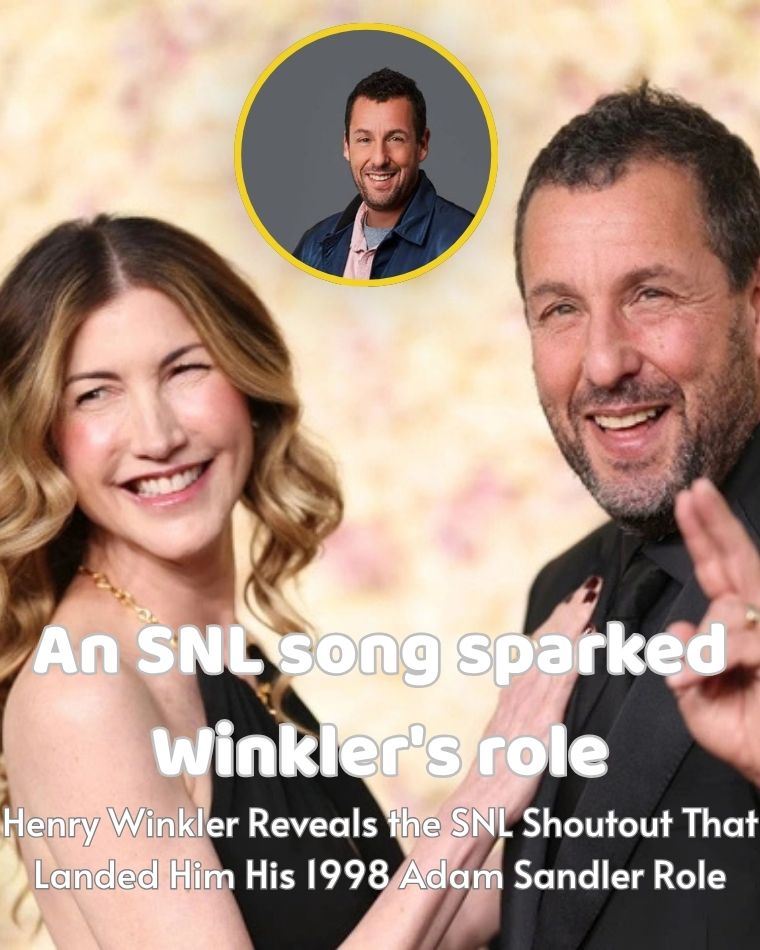
The origin of Winkler’s memorable performance as Coach Klein in the 1998 box-office smash The Waterboy traces directly back to a legendary Saturday Night Live sketch.
During a December 1994 episode of NBC’s long-running sketch comedy series, Sandler introduced a holiday novelty tune that quickly evolved into a cultural phenomenon.
Performing on Weekend Update, Sandler debuted “The Chanukah Song,” a lighthearted tribute celebrating famous Jewish figures and pop culture icons.
Among the celebrated names featured in the catchy track was Winkler’s defining television persona, Arthur “The Fonz” Fonzarelli from the classic sitcom Happy Days.
The shoutout was neither requested nor pre-cleared, catching Winkler entirely by surprise when it aired to millions of households across the country.
Rather than simply ignoring the mention or viewing it as passing pop culture flattery, Winkler felt genuine appreciation for the nod.
The veteran star decided to reach out directly to the young comic to say thank you.
Cre: Wikimedia Commons
Winkler later recounted the chain of events that transformed a brief television gag into a lasting Hollywood friendship.
Speaking on PeopleTV’s Couch Surfing, the actor reflected on how simple courtesy altered the trajectory of his late-nineties career.
“So I call Adam because I’m in ‘The Chanukah Song,'” Winkler explained when discussing how their connection originally started.
“And I thank him for putting me in ‘The Chanukah Song,'” Winkler recalled regarding the appreciative phone conversation.
Sandler, who grew up watching television icons like The Fonz, was deeply honored to hear directly from Winkler.
At that stage of his career, Sandler was transitioning from television star to bankable Hollywood heavyweight through his production company Happy Madison.
A few years after their initial phone interaction, Sandler began assembling the creative elements for a new sports-comedy project focused on college football.
That script would eventually become The Waterboy, directed by Frank Coraci.
When casting the crucial role of Coach Klein, Sandler did not hold conventional open auditions for Hollywood veterans.
Instead, the young filmmaker remembered the gracious actor who had called him years earlier to thank him for a musical lyric.
Winkler detailed the remarkably frictionless casting experience in a 2019 interview with Forbes.
“I called Adam a few years before to thank him for putting me in ‘The Chanukah Song,'” Winkler told the publication.
“And then, all of a sudden, I got picked to be the coach,” Winkler said of the unexpected job offer.
“And I didn’t have to audition,” the actor emphasized regarding the offer landing on his desk without industry friction.
“So the man is brilliant,” Winkler added with genuine admiration for Sandler’s loyalty and decisive production style.
In The Waterboy, Winkler stepped into the shoes of Coach Klein, the anxious and emotionally scarred mentor of the South Central Louisiana State University Mud Dogs.
The character suffered from deep psychological trauma inflicted decades earlier by rival coach Red Beaulieu, played with menacing relish by Jerry Reed.
Winkler’s neurotic energy served as an ideal counterweight to Sandler’s depiction of Bobby Boucher Jr., a socially isolated water distribution technician turned devastating defensive tackler.
The dynamic between Coach Klein and Bobby Boucher injected heart into an otherwise absurd and irreverent slapstick narrative.
Sandler recognized that Winkler’s natural warmth and comedic timing could elevate what might have been a one-dimensional caricature into a lovable mentor figure.
Winkler embraced the role completely, leaning into physical comedy, panic attacks, and sudden bursts of bizarre coaching tactics.
The collaboration created an instant bond between two performers representing distinctly different generations of American comedy.
While Winkler had defined network sitcom television in the 1970s and 1980s, Sandler was rewriting cinematic comedy rules for nineties youth culture.
Their shared respect fostered an easygoing and spontaneous work environment on set.
Sandler has maintained a lifelong reputation in the film business for working repeatedly with artists he genuinely likes and respects.
By calling to express appreciation for The Chanukah Song, Winkler had unknowingly cemented his place in that trusted inner circle.
Their creative chemistry became apparent not only in scripted scenes but also across improvisational moments throughout production.
Winkler frequently praised Sandler’s genuine love for athletics and filmmaking craftsmanship.
“Adam loves sports, he loves football,” Winkler observed when reflecting on the actor’s intense personal investment in the project.
Winkler also noted the pride Sandler carried regarding the finished feature.
“[The Waterboy] is one of his favorite movies, I think, that he’s ever made,” Winkler remarked.
Winkler discovered firsthand that joining a Happy Madison ensemble meant answering the call whenever the production required an extra effort.
During an appearance on the Let’s Talk Off-Camera with Kelly Ripa podcast, Winkler shared a humorous behind-the-scenes memory that illustrated Sandler’s informal creative rhythm.
The veteran performer recalled an unexpected phone call that arrived well past normal working hours during the shooting schedule.
“I did [The] Waterboy,” Winkler told host Kelly Ripa.
“[Sandler] called me up in the middle of the night,” the actor recounted regarding the midnight summons.
“He said, ‘Henry, I need a favor. My actor didn’t show up. I need you to drive right now to the park,'” Winkler quoted Sandler as saying.
The production was filming on location in Los Angeles at approximately 11:30 at night.
Despite his status as an industry veteran with decades of fame, Winkler did not hesitate to help his collaborator.
“It’s in L.A.; it is now 11:30 at night,” Winkler explained of the chaotic timeline.
“I go, and I say, ‘Okay,'” Winkler continued.
“I shave. I drive. I go. I sit. I get makeup until 3:30 in the morning,” the actor humorously described.
When Ripa inquired about the compensation for such sudden midnight dedication, Winkler delivered a deadpan punchline.
“Do you know what I got?” Winkler quipped during the podcast interview.
“A cookie,” Winkler joked.
“I didn’t even get to keep my wardrobe,” he added with a smile.
The late-night hustle paid off handsomely when The Waterboy arrived in theaters in November 1998.
Audiences flocked to theaters, propelling the comedy to an extraordinary commercial run.
The sports comedy generated over $161 million at the domestic box office alone and easily crossed $185 million worldwide against an estimated production budget of approximately $23 million.
It became the highest-grossing comedy release of 1998 in North America.
For Sandler, the smash triumph validated his formula of combining unhinged slapstick with heartfelt underdog narratives.
For Winkler, the project served as an introduction to an entirely new demographic of moviegoers.
Younger audiences who had missed the original network broadcast run of Happy Days now recognized him primarily as Coach Klein.
The film’s impact resonated powerfully within collegiate and professional athletics communities across the United States.
Over the subsequent decades, Winkler was repeatedly approached by real-world football players who cited the movie as a foundational ritual.
“It is also one of his most popular,” Winkler stated when reflecting on the enduring cultural footprint of the film.
“So many college football players have told me that as they’re going to the game on the bus, the coach plays The Waterboy for them,” Winkler revealed.
The tradition of screening the comedy before games highlights how thoroughly the Mud Dogs story embedded itself into athletic team culture.
The legacy of Coach Klein also marked an important turning point in Winkler’s later acting career.
It proved that his comedic timing remained razor-sharp, demonstrating his unique skill in portraying eccentric, vulnerable authority figures.
That character energy foreshadowed later critically acclaimed roles, such as the inept attorney Barry Zuckerkorn in Arrested Development.
Years later, Winkler would capture an Emmy Award for his role as Gene Cousineau on the HBO dark comedy series Barry.
The creative bond formed between Winkler and Sandler during The Waterboy did not dissolve when production wrapped.
Sandler continued to recruit Winkler for subsequent Happy Madison productions, including a memorable turn in the 2006 fantasy comedy Click.
Their friendship demonstrated how genuine camaraderie often fuels long-lasting creative partnerships in an industry frequently characterized by transactional relationships.
Winkler often credits his long tenure in show business to basic principles of kindness, curiosity, and expressing thanks to fellow artists.
His decision to make a courteous phone call after hearing The Chanukah Song remains a textbook example of how small gestures can yield enormous professional rewards.
Decades after Sandler sang the first lyrics on the Saturday Night Live stage, the laughter sparked by Coach Klein continues to entertain sports teams and comedy enthusiasts alike.
Để lại một phản hồi