In 1988, director John McTiernan unleashed Die Hard, an explosive thriller that forever reshaped American action cinema and catapulted television star Bruce Willis into global superstardom.
Decades after its theatrical debut, the holiday action classic has officially been ranked as the best action movie of all time by major publications and cinema critics worldwide.
Yet, in a fascinating creative twist that has become Hollywood lore, Willis initially pushed back aggressively against the sarcastic one-liners and witty quips that would eventually come to define his legendary career.
An Unlikely Hero Rewrites Hollywood Action History
Before the summer of 1988, Hollywood action movies were dominated by superhuman physical specimens who showed little vulnerability on screen.
Audiences had grown accustomed to unstoppable cinematic juggernauts portrayed by titans such as Arnold Schwarzenegger and Sylvester Stallone.
In those traditional blockbusters, heroes took heavy gunfire without flinching and annihilated legions of enemies without uttering a single doubt.
Die Hard disrupted that established formula completely by placing an ordinary street cop into an extraordinary hostage nightmare.
Bruce Willis stepped into the shoes of NYPD detective John McClane, a regular guy caught in an impossible predicament.
Unlike the era’s invincible commandos, McClane suffered real physical punishment, bled from jagged shards of broken glass, and experienced palpable fear throughout his ordeal.
That groundbreaking everyman approach revolutionized modern cinematic storytelling by introducing genuine emotional stakes to the high-octane thriller genre.
Viewers were no longer watching an untouchable machine execute tactical operations.
Instead, they watched a flawed, tired father and husband desperately trying to survive against ruthless adversaries.
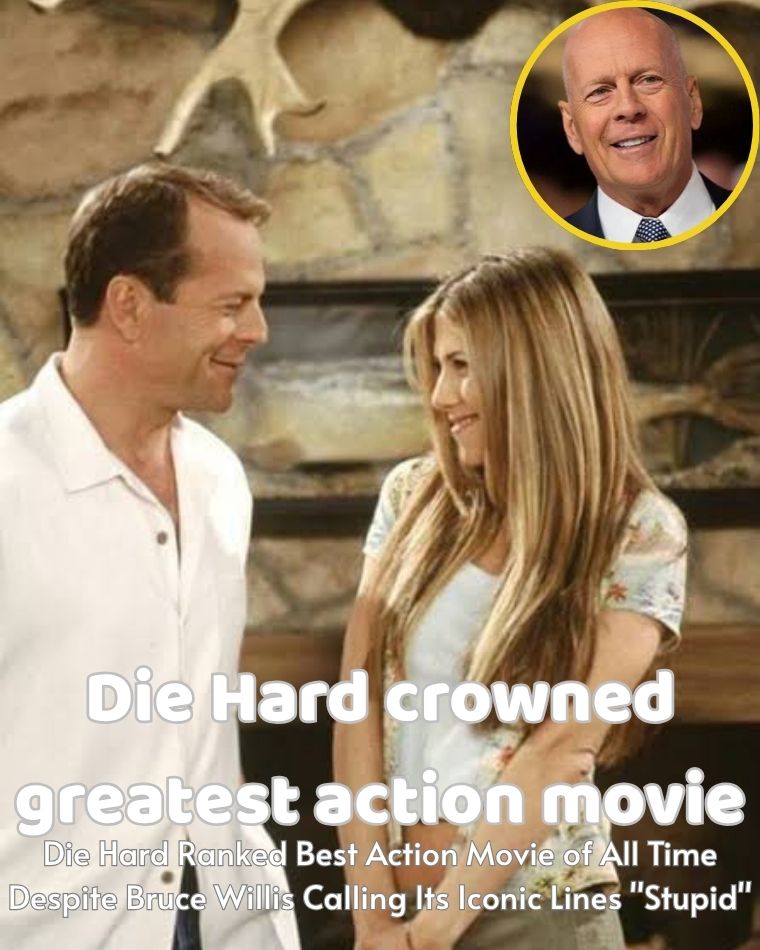
Cre: Wikimedia Commons — Public Domain (Photo by Tenji / Tom Bernard)
The Unforgettable Quotes That Defined a Generation
Beyond its revolutionary stunts and claustrophobic setting inside Los Angeles’s Nakatomi Plaza, Die Hard stood apart because of its extraordinarily sharp dialogue.
The screenplay delivered a constant barrage of memorable one-liners that immediately embedded themselves in modern pop culture.
Lines like “Come out to the coast, we’ll get together, have a few laughs…” captured the bitter absurdity of McClane’s desperate survival situation.
When the rogue detective intercepted a terrorist radio frequency, he famously sent down a grim holiday greeting: “Now I have a machine gun. Ho-ho-ho.”
He muttered dark comedic observations to himself while crawling through ventilation shafts, complaining that among nine million terrorists worldwide, he managed to cross paths with one possessing feet smaller than his sister.
His sharp farewell to villain Hans Gruber, “Happy trails, Hans,” perfectly captured the character’s blue-collar defiance.
Most iconic of all was McClane’s thunderous war cry, “Yippee-ki-yay, motherf***er!”, a phrase that instantly transcended cinema to become a worldwide cultural touchstone.
Those witty expressions transformed gritty gun battles into electrifying character interactions.
Audiences quoted the lines leaving theaters in 1988, and fans continue to repeat them across social media decades later.
Bruce Willis’s Surprising Rejection of McClane’s Humor
Despite the universal adoration those comedic lines received from audiences, Willis initially harbored deep reservations about McClane’s humor.
The unexpected revelation emerged through behind-the-scenes accounts from director Renny Harlin, who took over the directorial reins for the 1990 sequel, Die Hard 2.
Following the massive box office triumph of the first movie, Willis entered preparations for the sequel determined to discard the humor that had elevated the original.
Harlin revealed that Willis sat down with him and bluntly criticized the quips, smirks, and jokes that had propelled McClane into an international icon.
The actor reportedly informed the filmmaker that he was finished with what he dismissed as “stupid comedy bullst.”
Having established himself as a legitimate box-office draw, Willis wanted to abandon the playful irony and portray McClane entirely straight-faced.
Willis argued that when innocent human lives are hanging in the balance, a real person would never utter sarcastic jokes or crack funny one-liners under heavy fire.
The actor’s dramatic pivot caught the creative team completely off guard.
Willis had spent years starring on the hit television series Moonlighting alongside Cybill Shepherd, where his snappy comedic timing had initially caught Hollywood’s attention.
Having successfully transitioned away from television comedy into dramatic cinema, Willis feared that quipping during deadly combat diminished the gravity of the film’s violence.
The Clash Over the Soul of John McClane
Willis’s sudden desire to strip away McClane’s levity created an immediate creative dispute with the production team.
Director Renny Harlin understood that McClane’s sarcastic humor was not an arbitrary decorative flourish, but rather the beating emotional heart of the entire franchise.
Harlin reminded Willis that moviegoers did not fall in love with McClane because he was an emotionless killing machine.
Audiences connected with the beleaguered cop because his biting humor made him feel like an accessible, authentic friend under tremendous pressure.
The Finnish director argued passionately that McClane’s quips served as psychological armor against overwhelming terror.
“It doesn’t matter if we’re blowing up a building or an airport,” Harlin explained during their discussions.
The director pointed out that the entire audience investment rested on McClane’s relatability, his troubled marriage, and his instinctive disrespect toward pompous authority figures.
When Willis remained reluctant to deliver comedic dialogue on set, producer Joel Silver was brought in to mediate the high-stakes creative standoff.
To break the deadlock, the filmmakers formulated a meticulous compromise to protect both Willis’s artistic integrity and the film’s commercial spirit.
Willis was granted permission to shoot as many serious, dramatic takes as he wanted to capture his personal vision of McClane.
In return, the actor agreed to give Harlin just one single take of every scene utilizing sarcastic wit, witty retorts, and comedic reactions.
When studio executives later viewed the early cuts of the movie, their immediate response validated the director’s instincts completely.
Executives instantly requested more comedic beats, forcing Harlin to confess that he had already put every single humorous take onto the screen.
Deconstructing the Masterpiece: Why Die Hard Reigns Supreme
The critical legacy of Die Hard has only grown more formidable with each passing decade.
Major entertainment authorities, including Empire Magazine—which ranked the film at No. 23 on its comprehensive list of the greatest movies of all time—routinely crown Die Hard as the ultimate peak of action filmmaking.
Several defining cinematic pillars explain why this 1988 production continues to outperform modern computer-generated blockbusters.
First and foremost is the airtight screenplay engineered by writers Jeb Stuart and Steven E. de Souza, adapted from Roderick Thorp’s 1979 novel Nothing Lasts Forever.
Every single narrative setup in the opening thirty minutes pays off with mathematical precision during the explosive third act.
Details as seemingly minor as McClane making “fists with your toes” in a hotel room directly dictate the hero’s agonizing physical challenges later on.
The spatial geography established inside Fox Plaza provided an unparalleled masterclass in suspense and visual coherence.
Audiences always understood exactly where the protagonist was located relative to the hostages on the thirtieth floor and the SWAT teams on the ground.
Furthermore, Die Hard gifted cinema one of the most charismatic and calculating antagonists ever written in Hans Gruber.
British stage actor Alan Rickman made his spectacular feature film debut, portraying Gruber with refined intellect and theatrical sophistication.
Gruber was not a raving ideological fanatic, but an educated thief masquerading as a political revolutionary to orchestrate an audacious financial robbery.
The intellectual chess match between Rickman’s suave villain and Willis’s blue-collar cop elevated the stakes beyond standard gunfire.
Jan de Bont’s sleek cinematography and Michael Kamen’s brilliant musical score blended Beethoven’s “Ode to Joy” into orchestral tension, creating a sensory experience that remains unmatched.
The Christmas Setting Debate That Sparked an Annual Tradition
No retrospective on Die Hard is complete without addressing its unique status as the world’s most debated holiday film.
Taking place exclusively on Christmas Eve against the backdrop of an extravagant corporate party, the holiday theme permeates every visual frame.
Festive wrapping paper, holiday music, Santa hats, and ironic Christmas greetings serve as counterpoints to brutal guerrilla combat inside the skyscraper.
While critics and fans debated for decades whether Die Hard qualifies as an authentic Christmas movie, audiences turned it into an annual holiday viewing tradition.
The stark juxtaposition of holiday warmth against cold corporate steel reinforced McClane’s fundamental motivation throughout the crisis.
He was not fighting to defend national security or salvage corporate bonds.
He was enduring torture and danger simply to reconcile with his estranged wife, Holly Gennaro, and get home to his children for Christmas morning.
That domestic, personal objective grounded the colossal explosions in genuine human heart.
How McClane’s Reluctant Charm Built a Three-Decade Empire
The enduring brilliance of Die Hard ultimately rests upon the delicate balance between high-stakes danger and sarcastic levity that Willis initially questioned.
Had the actor succeeded in stripping away John McClane’s biting dialogue, the film likely would have drifted into the forgotten catalog of interchangeable 1980s shoot-em-ups.
Instead, the witty persona crafted by McTiernan, reinforced by Harlin, and immortalized by Willis launched an expansive media franchise spanning five films and more than three decades.
The original film earned more than $140 million worldwide against a modest production budget, transforming Willis into one of Hollywood’s most bankable leading men.
Its 1990 sequel, Die Hard 2, grossed over $240 million globally, proving that moviegoers around the globe craved McClane’s sarcastic defiance.
In 1995, director John McTiernan returned to helm Die Hard with a Vengeance, pairing Willis with Samuel L. Jackson across the bustling streets of New York City.
That third installment generated $366.1 million worldwide, solidifying the saga as one of the most commercially lucrative action series in cinematic history.
Later installments, including Live Free or Die Hard in 2007 and A Good Day to Die Hard in 2013, continued to draw worldwide audiences to theaters.
More importantly, Die Hard fundamentally redefined the vocabulary of the action genre itself.
For the next two decades, Hollywood pitch meetings were defined by high-concept premises modeled directly on the 1988 classic.
Blockbusters like Under Siege were described as “Die Hard on a battleship,” Speed became “Die Hard on a bus,” and Air Force One was branded as “Die Hard on an airplane.”
Yet none of its cinematic imitators managed to capture the lightning-in-a-bottle alchemy achieved by the original.
The Timeless Victory of Creative Vision
Looking back at the historical legacy of Die Hard, Willis’s early resistance to McClane’s humor serves as a fascinating testament to the collaborative nature of filmmaking.
Great movie stars possess an instinctive drive to evolve and test dramatic boundaries.
Yet the greatest directors and producers recognize the intangible qualities that connect directly with an audience’s collective soul.
By challenging Willis to embrace McClane’s sarcastic wit, the filmmakers ensured that their working-class hero felt authentic, resilient, and human.
McClane did not laugh because danger was trivial; he cracked jokes because humor was his only defense mechanism against despair.
That vulnerability transformed an ordinary police detective into cinema’s ultimate underdog.
As Die Hard continues to occupy the absolute pinnacle of action cinema rankings worldwide, its status remains untouchable.
The explosive stunts still thrill, the pacing remains flawless, and the gunfire echoes with visceral power.
Above all, John McClane’s immortal one-liners continue to bring genuine joy to millions of film enthusiasts around the globe.
Those quotes were never merely dialogue on a page; they were the defining spirit of an irreplaceable cinematic masterpiece.
Để lại một phản hồi