Director M. Night Shyamalan opens up in an extensive conversation about the high-stakes world of self-financing his movies, reflecting on three decades in cinema ahead of his major Beyond Fest retrospective.
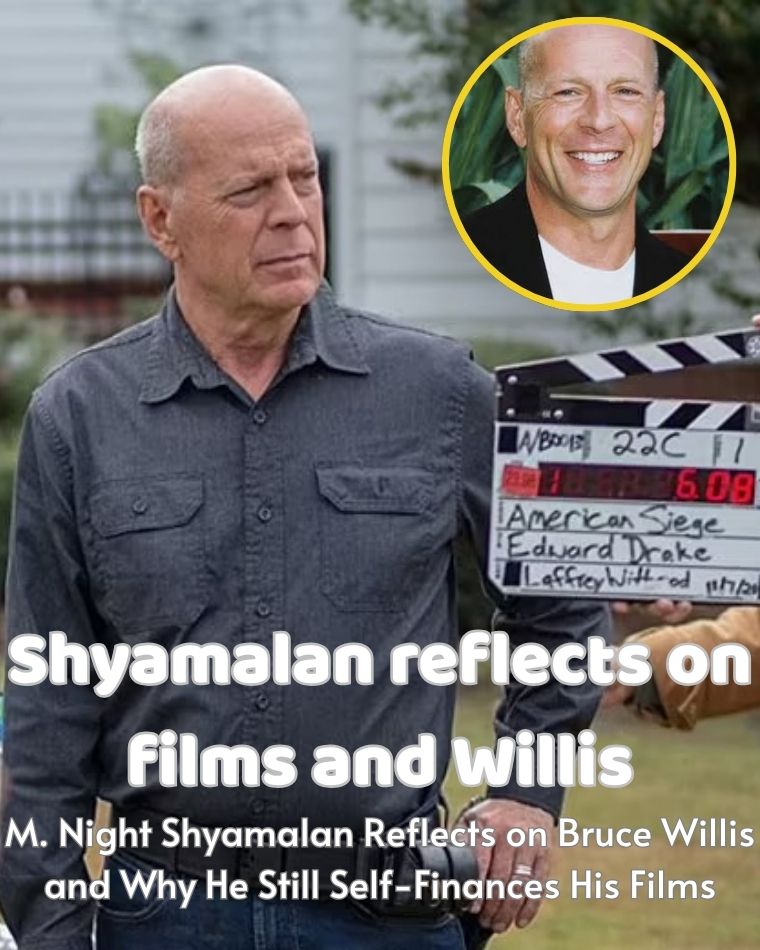
The visionary filmmaker also reflects fondly on his career-defining partnership with Bruce Willis, whom he describes as his true “guardian angel” across Hollywood.
From his private compound museum to the Egyptian Theatre in Hollywood, Shyamalan details why creative independence matters far more to him than massive studio budgets.
M. Night Shyamalan has spent three decades navigating one of the most unconventional career paths in modern Hollywood history.
He is a filmmaker who experienced dizzying global acclaim early in his twenties and navigated sharp public pushback years later.
Yet, rather than retreating into the comfortable safety of corporate IP or conforming to traditional Hollywood expectations, he took absolute control of his destiny.
In an extensive interview with The Wrap conducted by senior film reporter Drew Taylor in late September 2026, Shyamalan peeled back the layers of his creative philosophy.
The discussion arrived on the eve of Beyond Fest’s 13-movie retrospective honoring his storied catalog across Los Angeles.
From his sprawling compound outside of Philadelphia, the 56-year-old director surveyed a private museum packed with ephemera, props, and costumes representing his entire body of work.
The moment marked a rare pause for an artist famously focused on his next project rather than dwelling on the past.
His reflections spanned the liberation of self-financing, his complicated relationship with Los Angeles, and the indelible legacy of his collaboration with Bruce Willis.
Together, those conversations illuminate how a fiercely original storyteller continues to outmaneuver the mainstream Hollywood machine on his own terms.
Cre: Gage Skidmore / Wikimedia Commons
Walking Through Three Decades of Cinematic Memory
At his estate outside of Philadelphia, Shyamalan maintains a dedicated personal museum.
The space is filled with memorabilia, costumes, and physical set pieces collected across his seventeen completed feature films.
Walking through the corridors of that museum, even the director himself finds the sheer weight of history startling.
“When I go in there, I go, ‘Whoa,’ and I see other people’s faces when they go in there, and they’re surrounded by all these 17 movies,” Shyamalan admitted to The Wrap.
He quickly added that a persistent sense of artistic precarity has driven his work ethic since the very start.
“I am beyond lucky, and I really believe every movie is my last movie,” he revealed.
That intense paranoia is not a recent byproduct of industry instability; he felt the exact same fear upon completing The Sixth Sense in 1999.
He remembered worrying back then whether Hollywood decision-makers would ever permit him to direct again once the film arrived in theaters.
That perpetual hunger has kept him constantly looking ahead, a habit he self-deprecatingly diagnosed as an “unhealthy way” to stay motivated.
His eighteenth feature film, titled Remain and distributed by Warner Bros., is scheduled to arrive in theaters in February.
Yet within his Philadelphia compound, surrounded by memories, he finally allowed himself a fleeting moment to absorb the scope of what he has achieved.
He pointed out an old photograph resting on his desk of his daughters when they were young girls.
Today, those daughters have grown into adulthood, with partners, marriages, and independent careers of their own.
Shyamalan quoted a book he recently read that emphasized surrounding oneself with beauty, good people, and positive environments to protect creative energy.
“I’m so lucky that I’ve had to do this,” he said, expressing gratitude for an artistic life spent predominantly far from the Hollywood bubble.
Beyond Fest and the Complex Relationship with Los Angeles
Despite producing films that capture the global cultural zeitgeist, Shyamalan has deliberately maintained his creative headquarters on the East Coast.
He does not hide his instinctive wariness toward the epicenter of the American film industry.
For him, Los Angeles carries an intimidating aura of institutional scrutiny and harsh executive decrees.
“Los Angeles represents judgment and a yes/no thing, and it’s so culturally significant,” Shyamalan explained during the interview.
“I’m scared of it as a place,” he added matter-of-factly.
He quipped that in his own mind, he still sees himself as “the nerdy Indian kid,” while Los Angeles feels like an intimidating school yard full of popular “lacrosse players.”
Yet, in late September 2026, he boarded a flight to Southern California to be celebrated by the very community he kept at arm’s length.
The American Cinematheque’s Beyond Fest organized a comprehensive 13-movie screening program honoring his creative output.
The screenings were mapped across two of Los Angeles’s most revered cinematic venues: the historic Egyptian Theatre in Hollywood and the Los Feliz 3.
Evrim Ersoy, Head of Programming at Beyond Fest, issued a glowing tribute highlighting Shyamalan’s unique place in contemporary film.
Ersoy praised him as “one of the defining filmmakers of modern cinema—a fearless artist whose precision, conviction, and command of an audience are entirely his own.”
He noted that for almost three decades, Shyamalan had pursued a deeply personal cinematic vision on the grandest possible scale.
Reacting to the enthusiastic tribute with characteristic humor, Shyamalan remarked: “The lacrosse players want to celebrate you.”
Curating Paranoia, Apocalypses, and Personal Allegories
The Beyond Fest retrospective was structured into thematic programming blocks that highlighted recurring obsessions in Shyamalan’s storytelling.
The “End of the World” double bill paired his 2002 alien invasion thriller Signs with his tense 2023 cabin drama Knock at the Cabin.
Another curated evening, titled “Power of Paranoia,” combined his breakthrough self-financed indie The Visit with his 2024 arena thriller Trap.
For hardcore fans, the festival scheduled a marathon screening of the complete Eastrail 177 trilogy: Unbreakable, Split, and Glass.
Although Shyamalan did not organize the slate himself, he committed to appearing in person for multiple post-screening Q&As and intros.
He highlighted the trio of films selected to screen specifically at the Los Feliz 3: The Village, Old, and Lady in the Water.
He singled those three titles out as deeply personal expressions of his psyche that capture his nuances in meaningful ways.
During the interview, he paused to jot down an explicit note reminding himself to lobby Disney to finally release a 4K restoration disc of The Village.
When asked about the film in his catalog he most wishes would receive a thorough critical reappraisal, Shyamalan chose Lady in the Water.
Released in 2006 following an acrimonious split from Disney, the fairy-tale feature was widely attacked by mainstream critics at the time.
“It has such a wacky color and heart to it,” Shyamalan reflected affectionately two decades later.
“There’s a family film side of me and then there’s the thriller side of me, and that’s the closest to both of them that exists,” he explained.
The festival program underscored how his movies possess longevity that consistently outlives their opening-weekend critical reception.
The Art of Detaching from Cultural “Ingestion”
Throughout the interview, Shyamalan articulated a clear dividing line between the craft of filmmaking and its subsequent reception.
He described how an artist’s relationship to a piece of work evolves in isolation from public commentary.
“There’s my relationship to the art form, the craft of it, and that would be x, y, z movie I had to rush to hit the date,” Shyamalan said.
He recalled projects where he desperately wished for three more months of post-production or struggled for months to resolve an elusive story beat.
“And then there’s the complicated relationship to its ingestion into culture, which is a separate thing altogether,” he emphasized.
He stressed that how the culture absorbs a movie has no direct bearing on what he tried to accomplish as a craftsman.
Over the course of his thirty-year career, learning to tune out the external noise of reviews and viral chatter proved vital.
“Over the years, I’ve come to really diminish that part of it in my experience, which has allowed me to be free and do really anything in the loveliest ways,” he noted.
The director remains largely detached from modern online discourse and the viral memes spawned by his films.
For example, he noted that he does not follow widespread social media jokes like the enduring “beach that makes you old” meme from his 2021 thriller Old.
By disconnecting his ego from the immediate cultural ingestion of his stories, Shyamalan preserved the artistic bravery needed to pursue polarizing ideas.
Bruce Willis: The Guardian Angel Who Changed Everything
No retrospective of Shyamalan’s career would be complete without examining his transformative collaboration with Bruce Willis.
The duo first linked up on The Sixth Sense, a film that shocked the world with its twist ending and grossed over $670 million globally.
At that stage of his career, Willis was an established international action superstar looking to stretch his dramatic capabilities.
Shyamalan, meanwhile, was a young filmmaker trying to convince a skeptical studio system that his slow-burn psychological tension worked.
Willis trusted the young director’s uncompromising vision and grounded the narrative with a quiet, melancholic performance.
That collaboration deepened significantly with Unbreakable in 2000, creating an understated, deconstructive blueprint for the grounded superhero genre.
Willis returned seventeen years later for a thrilling post-credits cameo in Split, tying that 2016 hit back to the world of Unbreakable.
The narrative threads culminated in 2019’s Glass, which brought Willis, Samuel L. Jackson, and James McAvoy together in a subversive showdown.
Reflecting on that journey with Willis, Shyamalan spoke with heartfelt emotion about the star’s role in his life.
“Everyone needs a guardian angel, and he was mine,” Shyamalan stated unequivocally.
“He’s very important to me—always been, will always be,” he affirmed.
The director expressed deep appreciation for the chance to unite with Willis on Glass, describing it as Willis’s last major feature film performance of substance.
“I was lucky that I got to make Glass with him—in many ways, his last movie,” Shyamalan said.
“It was complicated, but it was so beautiful. I can’t say enough about him,” the director shared.
Reflecting back on his youth, Shyamalan remembered seeing the charismatic action star on theater screens as a larger-than-life figure.
“When I was a kid, he was like a superhero to me,” Shyamalan remembered.
“To have our two fates together so inextricably bound is so lovely,” he concluded.
Walking Away from Big Budgets and the Studio Machine
A central pillar of Shyamalan’s creative evolution has been his bold rejection of traditional studio financing.
Following massive studio productions like the $60 million environmental thriller The Happening and the $130 million sci-fi spectacle After Earth, he hit an artistic wall.
He recognized that his idiosyncratic creative impulses did not thrive inside highly corporatized executive committees.
He admitted to The Wrap that working on After Earth in 2013 made him chafe against the mechanical nature of big-budget Hollywood.
“I started to chafe against projects that are much more systematized by nature in the way they’re built,” he confessed.
“I’m not the best in that,” Shyamalan stated candidly.
“I’m better when I’m to the right of everyone a little bit. I love that freeform feeling that nobody’s expecting, especially if no one believes in it. I’m built for that.”
When asked whether he missed the endless cash reserves and expensive technical toys of studio filmmaking, his answer was direct.
“Not necessarily,” Shyamalan answered.
“I don’t feel a loss there,” he emphasized.
Instead of mourning the loss of nine-figure budgets, he embraced the creative purity of self-funding.
Beginning with 2015’s The Visit, Shyamalan began taking his own personal money to finance his film productions.
By keeping budgets disciplined and schedules tight, he freed himself entirely from executive notes and test-screening interference.
Proving the Thesis: Creative Autonomy and Risk
Self-financing is not simply a business mechanism for Shyamalan; it is a philosophy that allows him to challenge industry dogma.
He pointed to The Visit as an early proof-of-concept for an unconventional blend of tonal extremes.
“For example, no one had done comedy and horror together and said, ‘Well, that’s not going to work,’” Shyamalan explained.
“Because it hadn’t been proven that I can go there with The Visit, where it’s equal comedy, equal horror, which I love,” he noted.
While blending scares and genuine comedy is commonplace today, the studios viewed it as an unmarketable hybrid at the time.
“Those are all instinctual things that I’m doing that I want to see, that I believe 500 people in a movie theater would enjoy watching together,” Shyamalan told The Wrap.
“This self-financing has allowed me to follow those instincts so that I don’t have to fit into whatever mores of the time in the industry,” he explained.
“I don’t have to. I can be the one that proves the thesis. That’s my hope.”
He retains the power to experiment because he assumes all the financial risk upfront.
When a project works, as Split did by grossing nearly $300 million worldwide against a modest $9 million production cost, the returns are extraordinary.
Yet even when a film performs moderately, the lean cost structure shields the production from catastrophic financial loss.
His 2024 thriller Trap, starring Josh Hartnett as a serial killer caught in a concert arena dragnet, grossed $83 million against an estimated $30 million budget.
While those figures fell below initial studio hopes, Shyamalan assessed the box office outcome with realism.
He noted that nobody could have anticipated the sheer cultural momentum of Deadpool & Wolverine or the viral phenomenon of It Ends With Us dominating movie theaters that same month.
“These are all wonderful things for them,” Shyamalan said gracefully.
“If I had to do it again, I would have slid it away from all that noise,” he admitted.
“For original movies, it’s a delicate conversation we’re having: ‘Hey, this is a new story with new colors and a new feeling, so I need you guys to live with it for a second before Avengers comes in.’”
A Model That Studio Executives Respect
Although Shyamalan finances his productions independently, he has not abandoned the studio system entirely.
Instead, he partners with major legacy studios, including Universal and Warner Bros., to handle global distribution and marketing.
He described his operational structure as a unique hybrid that very few directors in the world could replicate.
“I have a great relationship with the studios, and my current business model is unique,” Shyamalan pointed out.
“There’s not many people that they would have this relationship with,” he added.
This setup provides him the best of both worlds: total artistic freedom on set and global marketing muscle in theaters.
He develops scripts in complete privacy, scouts locations around Pennsylvania, and finishes filming without submitting rough cuts to studio executives.
Only when the picture is locked and polished does he bring it to studio partners to organize a worldwide theatrical rollout.
“These movies require you to let go completely,” Shyamalan observed.
“They’re very independent movies, then released as a global movie because they have the muscles of a tentpole movie, meaning their universality, but their inception is very small.”
His productions move swiftly on set with meticulous pre-production planning.
This disciplined discipline ensures that lower budgets never result in compromised visual grandeur on the big screen.
Looking Ahead to Remain and the Horizon of Cinema
Even as audiences filled the Egyptian Theatre to celebrate his past masterpieces, Shyamalan remained intensely focused on the future.
His eighteenth directorial feature, Remain, promises to take audiences in another unexpected thematic direction.
Co-written with bestselling author Nicholas Sparks, the psychological thriller stars Jake Gyllenhaal and is slated for release in February.
The story follows a man residing in an isolated Cape Cod home who must contend with a mysterious woman who may or may not be real.
Shyamalan described the project as a marriage between gripping cinematic scale and idiosyncratic indie charm.
“You’re both getting the infrastructure of the ride, but also the idiosyncratic beauty of an independent movie,” Shyamalan teased.
That balancing act embodies what has made Shyamalan an enduring force for over three decades.
At a time when Hollywood relies on familiar sequels, pre-existing intellectual property, and focus-group formulas, he stands apart.
He continues to bet his own fortune on original narratives, unpredictable plot twists, and bold genre hybrids.
His Beyond Fest retrospective offered more than an affectionate walk down memory lane.
It served as a celebration of an auteur who refused to be domesticated by the studio machine.
By leaning into instinct, betting on himself, and remembering the creative courage modeled by partners like Bruce Willis, M. Night Shyamalan continues to chart his own course in world cinema.
Để lại một phản hồi