Two of Britain’s most celebrated performers are stepping away from the cinematic universe and onto the Broadway stage for a dazzling Shakespearean revival.
Tom Hiddleston and Hayley Atwell have officially reunited under the visionary direction of Jamie Lloyd to lead William Shakespeare’s Much Ado About Nothing at the historic Winter Garden Theatre.
The high-profile production marks a significant theatrical milestone, pairing two actors who share a rich Marvel Cinematic Universe heritage and deep classical theater roots.
From Marvel Titans To Shakespearean Sparring Partners
Audiences around the world instantly recognize Tom Hiddleston as the charismatic God of Mischief, Loki, across more than a decade of blockbuster Marvel films and standalone television series.
Hayley Atwell achieved international acclaim as the resolute Peggy Carter, establishing an enduring cinematic and television legacy within the exact same cinematic universe.
While their characters moved within the same interconnected Marvel timeline, their paths rarely shared prolonged dramatic intimacy on the silver screen.
Their shared journey in high-stakes franchise filmmaking nonetheless laid the foundation for an enduring mutual respect and professional rapport.
Both actors navigated the pressures of global fame while continuously seeking artistic nourishment in demanding live stage productions.
Their longstanding camaraderie now serves as the vital comedic spark for one of the greatest battles of wits in dramatic literature.
In William Shakespeare’s celebrated romantic comedy Much Ado About Nothing, Hiddleston assumes the role of Benedick, a soldier stubbornly sworn against the concept of matrimony.
Atwell portrays Beatrice, a woman whose razor-sharp intellect and blistering humor challenge every assumption Benedick holds about love and independence.
Their onstage union provides an electrifying arena where decades of professional trust translate into magnetic comedic sparring.
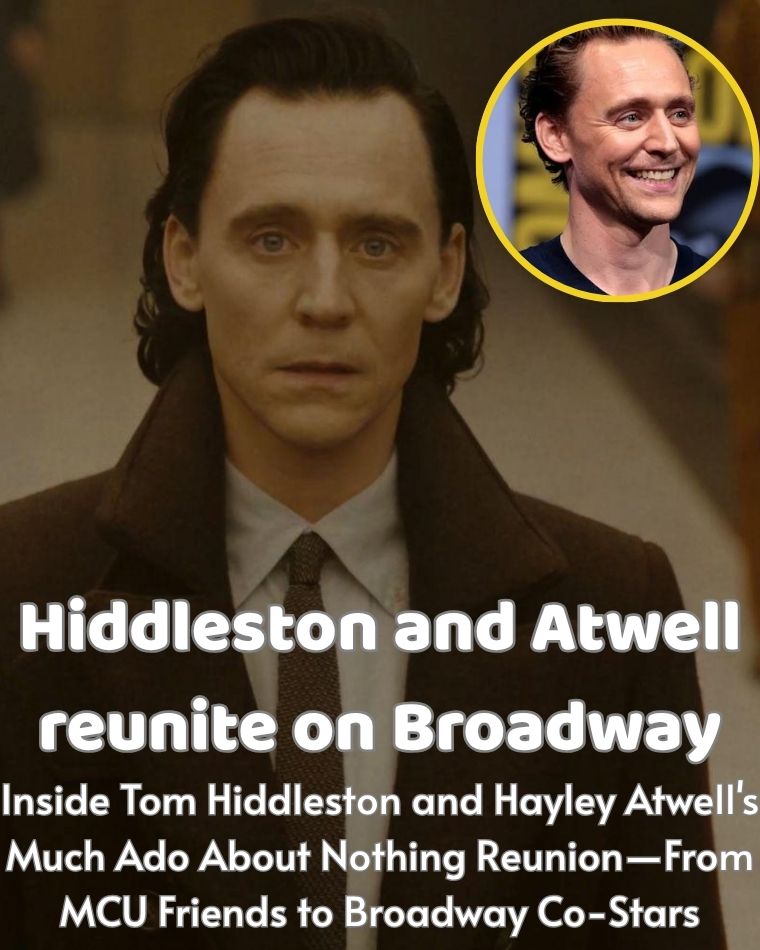
Cre: Gage Skidmore via Wikimedia Commons — CC BY-SA 3.0
Jamie Lloyd’s Bold Directorial Vision
British director Jamie Lloyd has earned international acclaim for dismantling theatrical conventions and reimagining classic drama for modern generations.
Known for radical, stripped-down interpretations of Harold Pinter, Henrik Ibsen, and Andrew Lloyd Webber, Lloyd approaches theatrical texts with uncompromising clarity.
His direction of Much Ado About Nothing reimagines the play as a vibrant, high-energy spectacle filled with celebratory music, modern staging, and surprising kinetic intimacy.
Rather than entombing Shakespeare in antique costumes and archaic cadence, Lloyd invites the audience directly into a pulsating social universe.
The staging strips away ornate Elizabethan scenery in favor of dynamic space, precise choreography by Fabian Aloise, and striking atmospheric shifts.
The text editor Jon Glew worked alongside Lloyd to ensure every iambic line lands with immediate, visceral clarity for contemporary listeners.
Lloyd’s conceptual vision transforms the play’s traditional Sicilian setting into a contemporary celebration of human vulnerability, rumor, and pride.
By framing the comedic deception of Beatrice and Benedick through an energetic theatrical lens, the director amplifies both the humor and the poignant tenderness of the narrative.
Lloyd understands that beneath the verbal skirmishes of the lead characters lies a profound terror of emotional exposure.
His direction challenges both actors to mine the rapid-fire dialogue for modern psychological truth.
The result is a production that feels less like a distant academic recitation and more like an immersive emotional encounter.
Behind The Scenes: Rehearsal Dynamics And Electric Chemistry
Recent behind-the-scenes photography and creative team reflections reveal an exceptionally playful and rigorous rehearsal atmosphere.
In the rehearsal studio, Hiddleston and Atwell spent weeks deconstructing Shakespeare’s verse word by word to unlock fresh comic timing.
Photographs from the creative process highlight the sheer physical joy and animated discussions shared between the two lead performers and their director.
Both actors bring a remarkable combination of verbal dexterity and physical agility to the rehearsal floor.
Their genuine off-stage friendship allows them to take bold improvisational risks without fear of losing dramatic control.
When Benedick and Beatrice exchange insults, the dialogue demands lightning-fast reflexes, complete active listening, and total vulnerability.
Hiddleston’s rehearsal process involves rigorous physical conditioning, reflecting the athletic demands of Lloyd’s energetic staging.
Atwell infuses Beatrice with an intoxicating mixture of defiant humor, emotional resilience, and sudden vulnerability that anchors the entire company.
In rehearsal discussions, the performers emphasized that the comedy in Much Ado About Nothing only succeeds when the underlying stakes feel genuine and dangerous.
The characters are not merely exchanging playful banter; they are actively guarding their bruised hearts from the devastating risk of intimacy.
This mutual understanding between Hiddleston and Atwell turns every verbal duel into an exhilarating high-wire act of theatrical precision.
The creative team noted that the energy between the two leads set an infectious tone across the entire ensemble, including featured co-stars like Mason Alexander Park.
Bridging The Gulf Between Blockbusters And Live Shakespeare
Transitioning from giant soundstages to the immediate scrutiny of live theater requires an extraordinary caliber of dramatic discipline.
In massive cinematic franchises, actors work in fragmented segments, frequently performing against green screens, digital proxies, and post-production effects.
On a Broadway stage, performers possess only their voices, their bodies, and their fellow actors to hold several thousand audience members captivated for over two hours.
Both Hiddleston and Atwell were rigorously trained in classical British dramatic institutions long before achieving Hollywood stardom.
Hiddleston trained at the Royal Academy of Dramatic Art (RADA) and the University of Cambridge, building a formidable classical foundation early in his career.
His previous stage credits include commanding portrayals of Coriolanus at the Donmar Warehouse, Hamlet, and his acclaimed Broadway appearance in Jamie Lloyd’s revival of Betrayal.
Atwell trained at the prestigious Guildhall School of Music and Drama, establishing her stage prowess in productions like A View from the Bridge and Rosmersholm.
She previously tackled Shakespeare with distinction, demonstrating an innate mastery of iambic verse at Shakespeare’s Globe and the National Theatre.
Returning to Shakespeare on Broadway allows both actors to flex classical muscles that cinematic roles rarely exercise to the fullest extent.
Live theater demands vocal projection, immaculate breath control, and the stamina to sustain an uninterrupted dramatic arc eight times a week.
Both performers have expressed profound reverence for the collective energy that exists exclusively in a shared room between actor and audience.
They view classical stage work not as a departure from their modern screen achievements, but as the essential core of their dramatic identities.
The Broadway Transfer: A Landmark Theatrical Milestone
The Broadway transfer of Much Ado About Nothing follows an acclaimed, sold-out engagement at London’s Theatre Royal Drury Lane.
In London, critics hailed the production as an exhilarating reinvention that turned the Bard’s classic into an infectious, joyful celebration.
The transfer to the Winter Garden Theatre on Broadway represents one of the most eagerly anticipated theatrical events of the autumn season.
The production begins previews on October 31, with an official opening set for November 19, playing a strictly limited engagement through January 10.
Bringing British classical revivals across the Atlantic is a storied tradition, but this particular staging carries unique cultural resonance.
Broadway audiences are rarely treated to romantic Shakespearean comedies headlined by performers who carry such vast international screen followings.
The presence of Hiddleston and Atwell bridges two distinct cultural worlds: die-hard theater purists and passionate pop culture enthusiasts.
The production demonstrates that Shakespeare remains vibrant, accessible, and thrillingly relevant when stripped of archaic pretension.
The Jamie Lloyd Company, alongside production managers 101 Productions, Ltd., has designed an experience calibrated to engage both seasoned playgoers and first-time attendees.
The run time of two hours and twenty minutes, complete with one intermission, moves at an energetic, modern pace.
Every production element works toward breaking down the fourth wall, ensuring the audience feels like active participants in the revelry.
By uniting two generational screen icons in a dazzling celebration of language and wit, the transfer promises to redefine classical comedy for the modern Broadway stage.
Fan Anticipation And The Endurance Of Classical Comedy
The announcement of the Hiddleston-Atwell Broadway reunion ignited immediate excitement across the international theater community and online fan networks.
Devotees of the Marvel universe have long admired the mutual camaraderie and professional respect shared between the two actors.
Seeing their chemistry channeled directly into Shakespeare’s most beloved romantic duel offers an irresistible creative hook.
Classical theater enthusiasts are equally thrilled to witness two accomplished performers tackle roles that have challenged generations of legendary British actors.
From John Gielgud and Peggy Ashcroft to Kenneth Branagh and Emma Thompson, Benedick and Beatrice have always demanded extraordinary mutual trust and comedic flair.
Hiddleston and Atwell step into these legendary roles with their own distinct, modern sensibilities.
Their production stands as a powerful testament to the timeless adaptability of Shakespearean text.
Written more than four centuries ago, Much Ado About Nothing remains an uncanny dissection of human pride, misunderstandings, and emotional defense mechanisms.
In an era dominated by digital communication, the direct human connection offered by the theater resonates more powerfully than ever.
As rehearsals conclude and the marquee illuminates at the Winter Garden Theatre, Broadway prepares to welcome a truly singular theatrical reunion.
Tom Hiddleston and Hayley Atwell have proven their dramatic command across film, television, and classical theater.
Together under Jamie Lloyd’s daring direction, they are poised to deliver an unforgettable theatrical triumph that will echo through Broadway history.
Để lại một phản hồi