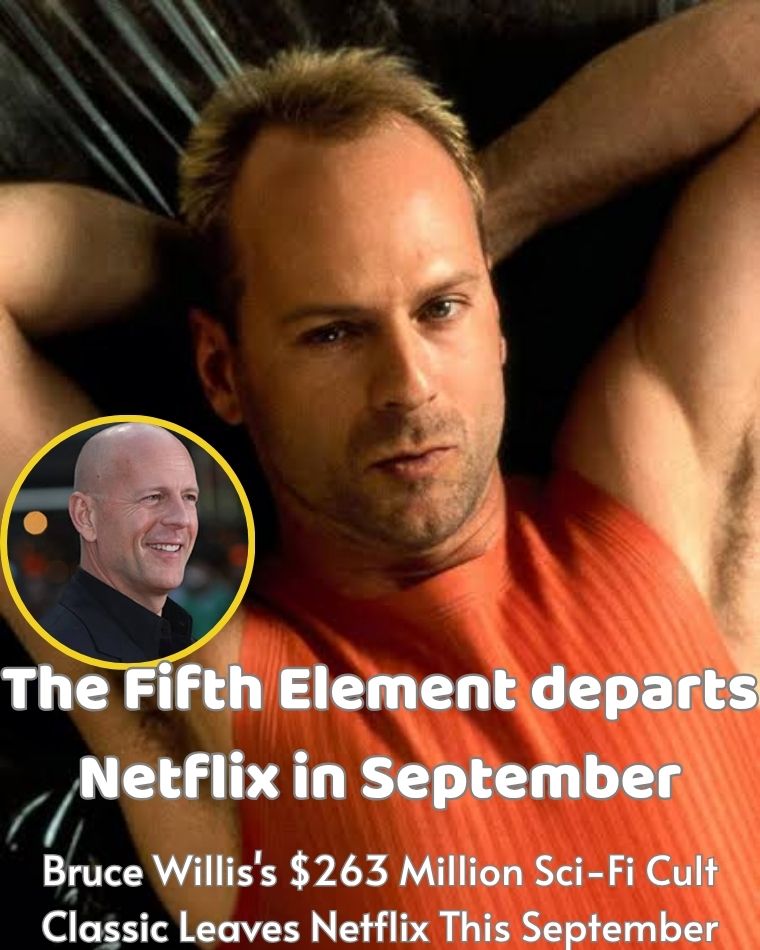
Bruce Willis’s 1997 science fiction blockbuster The Fifth Element is officially scheduled to depart Netflix in select regions on September 30, 2026.
Directed by Luc Besson, the vibrant action epic earned $263 million worldwide and established itself as one of the most distinctive entries in modern sci-fi cinema.
Subscribers now have only a limited window remaining to revisit this beloved cult favorite before the licensing window closes.
A Landmark 1990s Sci-Fi Epic Departs Netflix
Digital streaming libraries operate on rolling licensing contracts that frequently cycle major studio catalogs.
According to reporting from Collider, Luc Besson’s celebrated 1997 release The Fifth Element will officially exit Netflix at the close of September 2026.
Subscribers in select streaming territories have until September 30 to stream the production before it is removed from the catalog.
The departure highlights the temporary nature of video-on-demand platform rights.
Viewers who have kept the colorful cinematic adventure on their digital watchlist now face an immediate deadline.
Streaming platforms routinely evaluate their monthly catalogs to balance distribution agreements and subscriber viewing patterns.
When studio licensing deals reach their conclusion, titles either shift to rival subscription outlets, move to video-on-demand digital storefronts, or return temporarily to studio vaults.
For sci-fi aficionados, the removal of The Fifth Element marks the loss of a truly singular blockbuster experience on the world’s largest streaming platform.
The film holds a run time of 126 minutes, packed from start to finish with flamboyant world-building, kinetic action, and visionary production design.
Cre: Wikimedia Commons — Gage Skidmore (CC BY-SA 3.0)
The Worldwide Box Office Phenomenon of The Fifth Element
When The Fifth Element opened in theaters in May 1997, it represented an extraordinary financial gamble for European cinema.
Spearheaded by French director Luc Besson, the high-concept space venture required a massive production budget that rivaled dominant Hollywood studio releases.
The investment paid off with immense global success at the theatrical box office.
The film pulled in approximately $63 million across the domestic North American market.
International audiences embraced the visually audacious adventure even more passionately, propelling foreign box office receipts to $200 million.
Together, those ticket sales produced an impressive worldwide total of $263 million.
At the time of its release, The Fifth Element stood as the highest-grossing French production at the global box office in film history.
It proved decisively that European directors could helm lavish, English-language genre blockbusters capable of competing on the international stage.
The film’s international dominance underscored how strongly its visual language, humor, and cosmic scale resonated with audiences across different cultures.
While some contemporary American critics were initially bewildered by its European sensibilities and campy aesthetic, global audiences flocked to theaters in droves.
That enthusiastic global reception secured its commercial triumph and laid the foundation for decades of devoted fandom.
Over the years, continued home video releases, television syndication, and digital streaming rotations have allowed new generations to discover the project.
Even decades later, box office analysts still reference The Fifth Element as a benchmark for international genre cross-over appeal.
Why The Fifth Element Remains a Certified Cult Classic
A film rarely combines hundreds of millions of dollars in theatrical earnings with the enduring underground devotion of a cult classic.
Yet The Fifth Element effortlessly bridges that gap between mainstream blockbuster and eccentric cult oddity.
Much of its cult status stems from its vibrant, kaleidoscopic visual identity.
During the late 1990s, Hollywood science fiction leaned heavily into grim, monochromatic dystopias dominated by rain-soaked alleyways, industrial rust, and murky shadows.
Luc Besson inverted those conventions completely by delivering a dazzling, sun-drenched future bursting with bright primary colors.
The visual universe drew deeply from the visionary minds of renowned French comic book illustrators Jean Giraud (better known as Mœbius) and Jean-Claude Mézières.
Their signature comic art influenced the towering vertical skylines, hovering magnetic traffic lanes, and intricate alien creatures seen across the screen.
The production’s costume design was entrusted to high-fashion icon Jean-Paul Gaultier.
Gaultier crafted more than a thousand audacious, hyper-stylized outfits for the cast and background extras.
From neon orange suspenders and futuristic flight attendant uniforms to leopard-print bodysuits, the wardrobe remains instantly recognizable in modern pop culture.
Beyond the visuals, the movie’s musical tapestry created a singular sensory experience.
Composer Éric Serra blended classical orchestrations, electronic synthesizer pulses, and world music textures into an electric score.
The centerpiece operatic sequence featuring the alien Diva Plavalaguna performing the aria Il dolce suono transitioned seamlessly into an exhilarating breakbeat action sequence.
That moment stands as one of the most memorable sequences in modern sci-fi filmmaking.
Quotes from the film, such as “Multipass” and “Big badaboom,” have permanently cemented themselves in the cultural lexicon of fandom.
The movie’s uninhibited mix of high-stakes melodrama, surreal humor, and spectacular combat ensured it would never fade into obscurity.
It remains a film that defies standard genre classification, standing alone as an eccentric, fully realized labor of love.
Bruce Willis as the Quintessential Reluctant Action Hero
At the beating heart of The Fifth Element is an unforgettable performance by Bruce Willis as Korben Dallas.
In 1997, Willis was already one of the biggest movie stars on the planet thanks to the massive success of the Die Hard franchise.
Yet in The Fifth Element, he brought a distinctly grounded, sardonic charm to an otherwise outrageous science fiction realm.
Korben Dallas is a retired special forces major working a mundane job as a flying taxicab driver in 23rd-century New York.
He is exhausted, down on his luck, living in a cramped micro-apartment, and trying desperately to avoid trouble.
Willis plays the character with an understated everyman weariness that grounds the surreal madness happening around him.
When Leeloo falls directly through the roof of his cab, Dallas is involuntarily thrust into a cosmic quest to save the universe.
His deadpan reactions to alien warriors, bureaucratic chaos, and futuristic technology provide the film with much of its comedic backbone.
Willis never plays the role with self-important seriousness.
Instead, he leans into Dallas’s world-weary frustration, giving audiences a relatable human anchor amidst explosive space warfare.
It stands as one of the most beloved entries in Willis’s extensive sci-fi portfolio.
His work in the genre has regularly shown an eagerness to embrace bold directors and unorthodox storytelling concepts.
In The Fifth Element, Willis proved that an action superstar could elevate an experimental European art-house blockbuster into a mainstream spectacle.
An Exceptional Ensemble Cast Across the Galaxy
While Willis anchors the movie with gruff heroism, the surrounding ensemble cast delivers unforgettable supporting performances.
Milla Jovovich delivered a breakout turn as Leeloo, the supreme being genetically reconstructed to save humanity.
Jovovich developed a unique fictional language alongside Luc Besson specifically for the role.
Her combination of childlike vulnerability, fierce physical prowess, and expressive emotional depth made Leeloo an immediate sci-fi icon.
Gary Oldman took on the role of the eccentric antagonist Jean-Baptiste Emanuel Zorg.
Sporting an asymmetrical haircut, a southern drawl, and a plastic cranial plate, Zorg remains one of cinema’s most eccentric industrial villains.
Curiously, Willis’s Korben Dallas and Oldman’s Zorg never share a single line of dialogue or a scene together throughout the entire film.
The parallel storytelling keeps their paths narrowly intersecting without ever bringing them face to face.
Chris Tucker delivered an explosive, high-energy performance as talk-show host Ruby Rhod.
Ruby Rhod’s hyper-stylized banter and flamboyant personality divided critics upon release but went on to achieve iconic status among viewers.
Ian Holm offered gravitas and comedic timing as Father Vito Cornelius, the nervous priest dedicated to the ancient prophecy.
Together, this colorful roster of talent imbued the narrative with an infectious, chaotic energy unmatched in conventional Hollywood blockbusters
The Narrative Core: Ancient Prophecies and Cosmic Evil
The plot of The Fifth Element centers on an ancient apocalyptic confrontation between cosmic forces.
Every five thousand years, a massive living entity representing pure evil awakens with the intent of destroying all life in the universe.
The only weapon capable of stopping the Great Evil is a divine combination of five elements.
Four of the elements represent the fundamental forces of nature: Earth, Air, Fire, and Water, stored within ancient carved stones.
The fifth element is the ultimate supreme being, a humanoid entity incarnated to channel the elemental power into a weapon of divine light.
When ancient alien protectors known as the Mondoshawan attempt to deliver the stones to Earth, their transport vessel is ambushed and destroyed.
Using the surviving genetic fragments, scientists in 23rd-century New York reconstruct Leeloo inside a laboratory chamber.
Frightened and confused by her new surroundings, Leeloo escapes the high-tech facility and leaps into the bustling city below.
She crashes straight into the backseat of Korben Dallas’s hovering cab.
Recognizing that she is in grave danger, Dallas chooses to protect her, sparking a breathless race against time across the stars.
Meanwhile, the shadowy entity orchestrating the destruction employs Zorg, a corrupt human arms merchant, to track down and secure the elemental stones.
The narrative weaves through luxury space cruisers at the resort planet Fhloston Paradise, high-stakes gunfights, and ancient Egyptian temples.
At its core, the film explores poignant human themes of compassion, war, and the resilience of life.
Leeloo must decide whether human civilization is genuinely worth saving after she discovers the horrors of modern human history.
In the climactic conclusion, it is love and basic human decency that unlock the true power of the final element.
The Standalone Nature of Luc Besson’s Sci-Fi Universe
In today’s film industry landscape, a $263 million box office gross would immediately trigger a sprawling cinematic universe and multiple sequels.
Yet The Fifth Element remains entirely standalone.
Luc Besson has reiterated in various interviews over the decades that the story was designed as a complete, self-contained journey.
According to Besson, the story simply does not carry the narrative DNA required for a traditional continuation.
This artistic restraint has arguably preserved the project’s reputation over time.
Without unnecessary sequels or diluted spin-offs, the movie remains an untarnished, singular creative achievement.
Fans can appreciate the complete world without feeling fatigued by endless franchise lore.
Its self-contained structure allows the narrative to begin, escalate, and conclude with satisfying emotional finality.
The film serves as a snapshot of a fearless period in 1990s filmmaking when original creative visions could secure vast budgets without franchise safety nets.
The Shifting Landscape of Digital Streaming Libraries
The removal of The Fifth Element from Netflix highlights broader trends across the streaming entertainment sector.
In recent years, subscription video platforms have faced rising content licensing expenses and shifting studio partnerships.
Titles from Columbia Pictures and Sony Pictures frequently rotate across different digital services throughout their lifecycle.
As September 2026 comes to an end, subscribers will witness multiple high-profile titles departing Netflix alongside the Willis epic.
Other notable departures during this seasonal rotation include Deadwind, Gossip Girl, Hotel Transylvania 3: Summer Vacation, and After.
Network television series like NCIS and Halo also face licensing expirations as the calendar turns.
Streaming consumers have had to adapt to this dynamic cycle of digital media availability.
A movie that is easily accessible today may disappear behind a different subscription paywall tomorrow.
Because digital rights shift so frequently, tracking departure dates has become an essential habit for home theater enthusiasts.
Where Viewers Can Watch The Fifth Element Next
Viewers who miss the September 30 deadline on Netflix still have multiple pathways to enjoy the sci-fi adventure.
Once a studio catalog title exits a major subscription streaming platform, it regularly transitions to digital transactional storefronts.
Fans can rent or purchase the film in high definition and 4K Ultra HD formats across major digital platforms.
Services such as Amazon Prime Video, Apple TV, Google TV, Fandango at Home, and YouTube Movies reliably maintain the title for digital rental and digital locker purchase.
Physical media also continues to offer the most permanent, compression-free presentation of Besson’s colorful masterpiece.
Sony Pictures Home Entertainment has issued several physical editions, including an acclaimed 4K Ultra HD Blu-ray release.
The 4K physical transfer features High Dynamic Range that brings out every ounce of Jean-Paul Gaultier’s vibrant color grading and Éric Serra’s dynamic Dolby Atmos sound mix.
Furthermore, theatrical event distributors like Fathom Entertainment have periodically brought The Fifth Element back to select cinema screens for anniversary celebrations.
Experiencing the movie on the big screen remains the definitive way to appreciate its immense visual scope.
Whether on 4K disc, through digital rental storefronts, or during future theatrical retrospectives, the film’s legacy will continue long after its Netflix run concludes.
For current subscribers, however, the easiest and most convenient way to watch remains streaming it before midnight on September 30.
Để lại một phản hồi