Director Paul McGuigan delivered an unconventional reimagining of Mary Shelley’s timeless gothic masterpiece when Victor Frankenstein debuted in cinemas in 2015.
The ambitious film transformed the traditional dynamic of the legendary horror narrative by reframing the tale through the eyes of Igor.
Led by James McAvoy and Daniel Radcliffe, this inventive adaptation prioritized intellectual kinship and emotional obsession over conventional monster mayhem.
An Unforgettable First Look: The Trailer That Shocked Fans
The initial promotional campaign for Victor Frankenstein seized global attention long before the film officially arrived in theaters.
Film enthusiasts received their first taste of the project through an entertaining online trailer introduction featuring its two charismatic headliners.
Viewers tuning into the promotional reveal were immediately greeted by startling real-life physical transformations from both leading actors.
James McAvoy appeared completely bald on screen, sporting a shaved head for his concurrent filming commitments.
Beside him sat Daniel Radcliffe, sporting an impressive, full facial beard that surprised long-time followers of the British star.
The humorous banter between the bald McAvoy and bearded Radcliffe set a vibrant, energetic tone for the production.
Rather than projecting gloomy morbidity, their charming introduction signaled a lively and unexpected cinematic ride.
The footage promised an unconventional visual feast steeped in stylized kinetic energy.
It revealed an ornate aesthetic reminiscent of high-octane period mysteries while retaining an undercurrent of dark science.
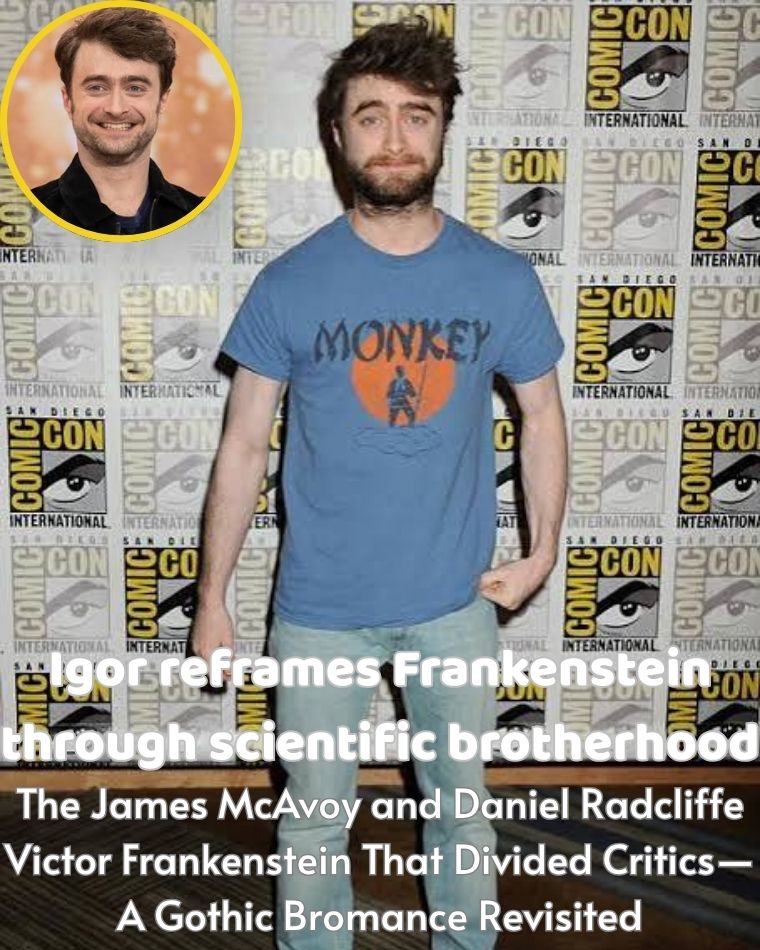
Cre: Gage Skidmore / Wikimedia Commons — Creative Commons Attribution-ShareAlike 2.0 Generic
Fans immediately speculated about how this spirited creative pairing would handle such revered source material.
The trailer established that the classic narrative had undergone a fundamental overhaul.
Audiences were urged to prepare for a fresh interpretation of history’s most notorious medical experiment.
Reimagining Igor: From Subservient Caricature to Brilliant Anatomist
For nearly a century of cinema, pop culture remembered Igor merely as a groveling, shadowy henchman lurking in rainy castle corridors.
Mary Shelley never included an assistant named Igor in her seminal 1818 novel.
The character instead coalesced through decades of Universal and Hammer horror adaptations, solidifying into a generic pop-culture archetype.
Director Paul McGuigan and his creative team decided to completely dismantle that simplistic trope.
In their 2015 reimagining, Igor is no longer a brainless or passive accessory to mad science.
The story introduces Radcliffe’s character as an unnamed, hunchbacked circus performer trapped in wretched conditions.
Forced to endure physical degradation and mockery under the circus big top, he privately harbors a prodigious scientific mind.
Between humiliating performances, the nameless outcast reads every medical textbook he can find.
He secretly masters complex surgical knowledge and human anatomy through solitary study.
His fortunes shift radically when the charismatic, manic Victor Frankenstein witnesses his surgical brilliance firsthand.
Recognizing a kindred intellect beneath a miserable exterior, Victor orchestrates a dramatic escape from circus servitude.
Victor swiftly diagnoses the outcast’s physical condition as an extreme, treatable fluid buildup along the spine rather than a permanent skeletal deformation.
Through a painful and decisive clinical procedure, Victor drains the affliction and fits him with an orthopedic brace.
He bestows upon him a new wardrobe, a dignified identity, and the name Igor.
This pivotal transformation changes the fundamental balance of power within the Frankenstein legend.
Igor emerges not as a subservient pawn, but as a fully capable intellectual partner.
His profound expertise in anatomy serves as the essential counterpart to Victor’s mastery of electricity and engineering.
Together, the two men form an unprecedented medical partnership founded on mutual respect and shared curiosity.
The Bromance Dynamic: Crafting an Unorthodox Emotional Core
At its heart, the 2015 adaptation deliberately diverges from conventional monster-centric cinema.
Paul McGuigan chose to establish the intricate male friendship between Victor and Igor as the primary driving engine of the film.
Their intense bond forms the narrative’s central emotional axis.
Victor Frankenstein is characterized as a brilliant visionary propelled by manic energy, deep personal trauma, and unresolved grief.
His ferocious ambition blinds him to moral caution and societal condemnation.
James McAvoy portrays Victor with theatrical intensity, boundless passion, and erratic determination.
Daniel Radcliffe balances that wild intensity with a tender, grounded, and empathetic performance.
Igor feels a profound, almost boundless gratitude toward Victor for rescuing him from a lifetime of misery and loneliness.
Yet as Victor’s experiments grow bolder and more perilous, Igor’s devotion is tested to its breaking point.
The relationship gradually evolves into a complicated study of scientific codependency.
Igor finds himself constantly walking a dangerous tightrope between unwavering loyalty and urgent ethical intervention.
He acts as the vital human conscience that Victor desperately needs yet frequently ignores.
Whenever Victor races toward reckless obsession, Igor attempts to pull his friend back from the brink of psychological ruin.
The script infuses their interactions with brisk dialogue, dark wit, and palpable emotional tension.
This interpersonal chemistry turns their laboratory into an intimate arena of conflicting worldviews.
Victor represents relentless, unchecked ambition determined to conquer death at any cost.
Igor represents compassionate intellect, acutely aware of the human soul and the boundaries of nature.
Their dynamic is distinctly framed around the concept of brotherhood forged in shared isolation.
Both men are outcasts who have never felt truly understood by civilized society.
Their mutual work offers each of them a sense of validation they could never achieve alone.
The tragedy of the narrative lies not merely in what they stitch together, but in how their friendship fractures under the weight of Victor’s madness.
Radcliffe’s Transformation: A Masterclass in Physical Awakening
Daniel Radcliffe’s compelling performance stands out as one of the most remarkable strengths of the 2015 production.
The actor faced the challenging task of portraying both an extreme physical evolution and an internal intellectual awakening.
In the film’s opening sequence, Radcliffe completely commits to the grueling physical reality of a severely disabled outcast.
He moves with labored, contorted movements that evoke immediate sympathy from the viewer.
Yet even while contorted on the circus floor, his expressive eyes convey fierce intellectual clarity.
He never allows the character’s physical limitations to overshadow his innate genius.
When Victor straightens his spine, the transformation is as much psychological as it is physiological.
Radcliffe captures the disorienting wonder of a man learning to stand upright for the first time in his adult life.
His performance traces every stage of Igor’s physical rehabilitation with authentic vulnerability.
The audience witnesses Igor learning how to walk with confidence, how to breathe freely, and how to command space in a room.
Equally compelling is Radcliffe’s depiction of Igor’s social emergence.
Having known only cruelty and ridicule, Igor must suddenly navigate polite society and intellectual discourse.
Radcliffe imbues the character with a delicate balance of newfound confidence and lingering insecurity.
When presented with fine tailoring and advanced laboratory instruments, Igor marvels at a world he previously only dreamed about.
His surgical scenes showcase methodical precision and fierce concentration.
Radcliffe plays Igor as a man who genuinely reveres anatomy as high art and sacred science.
The contrast between his quiet dignity and McAvoy’s explosive energy generates immense dramatic tension.
Radcliffe makes Igor’s moral dilemma deeply heartbreaking.
Every time Victor crosses another line, the pain registering across Radcliffe’s face highlights the cost of their partnership.
He is not merely worried about legal retribution; he is terrified of losing the savior who gave him his life.
Through meticulous physical choices, Radcliffe successfully redefined a historic pop-culture figure.
He turned a legendary caricature into an earnest, multifaceted hero of tragic science.
Navigating the Legacy of Gothic Literature and Horror
Mary Shelley’s 1818 novel permanently transformed Western literature by birthing the genre of modern science fiction.
Her cautionary narrative cautioned against the perils of playing God without accepting parental responsibility for creation.
Over two centuries, storytellers have returned repeatedly to her brooding philosophical framework.
Most cinematic retellings choose to focus primarily on Victor’s psychological breakdown or the profound tragedy of the creature.
Hollywood history has frequently treated the assistant as comic relief or a grotesque distraction.
By choosing to view Victor’s world through Igor’s eyes, the 2015 film provided a rare vantage point on Shelley’s core themes.
The perspective forces the viewer to observe the famous scientist from an external, critical standpoint.
Through Igor, the audience experiences both the intoxicating allure of Victor’s genius and the horrifying vanity of his quest.
Paul McGuigan wrapped this thematic reinterpretation in a distinct visual environment.
The Victorian London of the film is not a stagnant museum of fog and cobblestones.
It is presented as an electric, industrial battleground where modern science clashes violently with conservative tradition.
The sets buzz with copper pipes, sparking generators, and intricate anatomical illustrations.
This stylized steampunk aesthetic distinguishes the production from traditional gothic horror.
Inspector Turpin, played with steely resolve by Andrew Scott, provides a relentless ideological foil to the two scientists.
Turpin embodies rigid religious orthodoxy and moral law enforcement, hunting the duo as blasphemers.
His relentless investigation amplifies the pressure on Victor and Igor’s fragile alliance.
Yet the film steadfastly keeps its focus trained on the laboratory where two minds dare to defy nature.
By prioritizing human ambition over sheer supernatural dread, McGuigan attempted to bridge classical gothic tragedy with modern blockbuster sensibilities.
The approach paid homage to Shelley’s warning while giving the narrative a radically different rhythmic pulse.
Divided Critical Reception and Box-Office Struggles
When Victor Frankenstein debuted in late 2015, it was greeted by sharp divisions among film critics and audiences alike.
The ambitious production struggled to find a cohesive consensus among reviewers.
A portion of the critical community enthusiastically championed the film’s bold originality and daring tonal shifts.
Advocates praised the daring decision to turn Igor into a sympathetic, intellectual equal.
Reviewers consistently celebrated the electric screen dynamic between James McAvoy and Daniel Radcliffe.
Their magnetic camaraderie and fiery debates provided genuine cinematic pleasure.
McAvoy was applauded for throwing himself fearlessly into Victor’s unhinged manic episodes.
Radcliffe received glowing notices for his emotional authenticity, expressive acting, and physical discipline.
Several critics noted that the film’s witty, fast-paced dialogue brought welcome energy to a familiar gothic fable.
However, other reviewers found the movie’s eccentric genre-blending frustratingly uneven.
Detractors argued that the script shifted awkwardly between somber psychological drama, steampunk action, and historical pastiche.
Some felt the hyperactive directing style occasionally undermined the emotional depth of the friendship.
Purists questioned whether Mary Shelley’s tragic meditation on hubris was well-served by buddy-comedy banter.
The film encountered severe obstacles at the global box office upon its release.
Arriving in theaters alongside towering franchise competitors, the movie failed to capture widespread mainstream momentum.
It ended up stranded between two opposing demographic groups.
Traditional horror fans seeking bone-chilling terror found the film too comedic and action-oriented.
Meanwhile, casual moviegoers seeking a standard blockbuster adventure were unsettled by its macabre, body-horror elements.
Despite its commercial difficulties, Victor Frankenstein remains a fascinating creative experiment in modern genre cinema.
It dared to take massive creative risks with iconic characters rather than safely recycling well-worn cinematic formulas.
Why the Bromance Angle Sets the 2015 Film Apart
Looking back, the enduring significance of Victor Frankenstein lies directly in its radical narrative prioritization.
Virtually every other major adaptation of Shelley’s tale focuses overwhelmingly on the doomed creator and his wretched creation.
In those traditional narratives, the psychological center of gravity belongs squarely to the creature’s existential agony.
Paul McGuigan recognized that this territory had already been thoroughly explored across decades of cinema.
By choosing to emphasize the emotional bond between the two men, he gave the narrative an entirely fresh heartbeat.
Their intense companionship provides the film with an immediate human warmth rarely found in classical horror.
Victor is not an isolated genius working in total solitude in an ivory tower.
He is an unstable visionary whose grand ideas only become practical reality through his friend’s steady hands.
Igor is not an abused servant seeking cruel delight in suffering.
He is a grateful outcast whose devotion to his rescuer repeatedly collides with his fundamental moral principles.
This unique dynamic introduces rich psychological questions about influence, debt, and enabling behavior.
How far should a loyal friend go in supporting someone whose obsessions are spiraling out of control?
When does unwavering gratitude transform into dangerous moral complicity?
These compelling questions elevate Victor Frankenstein above a mere monster spectacle.
McAvoy and Radcliffe breathed vibrant life into these ethical dilemmas through their magnetic performances.
They made the laboratory sequences feel like thrilling intellectual combat between two extraordinary brothers.
Even when the cinematic machinery around them grew chaotic, their shared bond anchored the narrative’s heart.
The 2015 production reminds viewers that the most potent monsters are not always stitched together from lifeless tissue.
Sometimes, the true danger arises from brilliant minds whose shared passions lose all connection to moral restraint.
Để lại một phản hồi