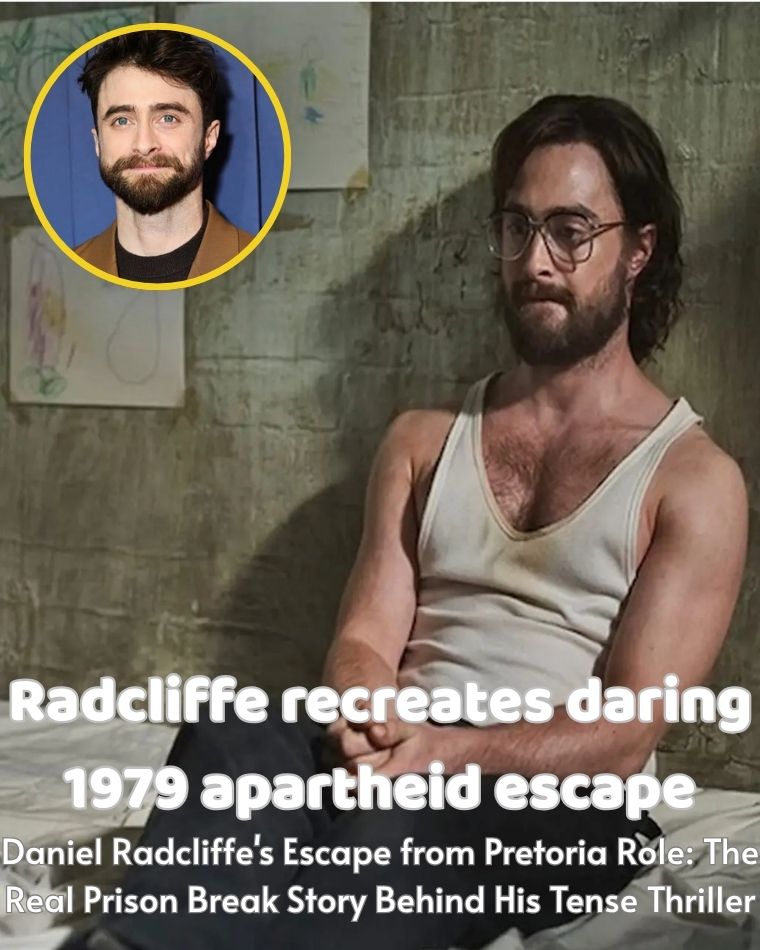
Daniel Radcliffe delivers a masterclass in quiet intensity in the 2020 historical thriller Escape from Pretoria, directed by Francis Annan.
The film recounts the astonishing real-life breakout engineered by white South African anti-apartheid activists Tim Jenkin and Stephen Lee in 1979.
Through hand-carved wooden keys and unrelenting concentration, the production explores resistance against institutional injustice with breathtaking suspense.
The Real 1979 Breakout from Apartheid Detention
The tension inside Pretoria Central Prison was palpable during the closing months of 1979.
Tim Jenkin and Stephen Lee were not ordinary criminals serving conventional sentences behind maximum-security bars.
They were dedicated anti-apartheid campaigners who chose active resistance over silent complicity in a brutally divided nation.
Their incarceration followed severe charges brought by the white-minority government under oppressive state security statutes.
Both men had been apprehended after distributing forbidden literature supporting the African National Congress across urban centres.
The state categorized these nonviolent pamphleteering actions as acts of treason and terrorism.
Jenkin received a daunting twelve-year prison sentence designed to crush his spirit and extinguish his political defiance.
Lee was sentenced to eight years in the same high-security compound meant to isolate dissident voices permanently.
Pretoria Central Prison operated under ruthless administrative control and continuous warder surveillance.
The fortress was engineered specifically to prevent any political detainee from ever reaching the outer streets alive.
Yet from the immediate moment their iron cell doors slammed shut, neither activist resigned himself to waiting out his sentence.
Instead, they viewed sustained imprisonment as an unacceptable concession to an illegitimate government.
Jenkin quickly realized that submitting to captivity meant abandoning the broader liberation campaign underway across South Africa.
Escape was therefore not merely a personal desire for physical freedom, but an urgent operational imperative.
The two comrades immediately began analyzing the daily routines, structural layouts, and human vulnerabilities of the complex.
Every single door separating their cells from the outside world became a mechanical problem demanding a scientific solution.
Cre: Wikimedia Commons — Dennis van Zuijlekom, CC BY-SA 4.0
Political Context and the Perils of Resistance in 1970s South Africa
To understand the immense gravity of the escape, one must comprehend South Africa during the late 1970s.
The apartheid regime enforced total racial segregation and brutal legal subordination upon the country’s non-white majority.
Every facet of everyday life, from residential zoning to transit access, was dictated by rigid racial hierarchies.
Following the 1976 Soweto Uprising, state authorities cracked down with unprecedented ferocity against any perceived opposition.
The African National Congress operated entirely underground after being outlawed by the state.
Public dissent was met with indefinite detention without trial, systematic torture, and severe prison terms.
White South Africans who openly opposed the apartheid state were viewed by the establishment as unforgivable traitors.
Jenkin and Lee recognized their immense racial privilege but consciously chose to place themselves on the frontline of the struggle.
They developed ingenious leaflet-distribution devices known colloquially as pamphlet bombs.
These delayed-action canisters used small gunpowder charges to launch hundreds of ANC flyers into crowded public squares without causing bodily harm.
The flyers delivered news of the anti-apartheid struggle directly to regular citizens commuting through city streets.
For months, their underground cell managed to broadcast revolutionary messages while evading state security police.
Inevitably, the regime’s extensive intelligence apparatus closed in, resulting in their dramatic arrest in 1978.
The trial that followed was a public spectacle staged to warn other white citizens against challenging white supremacy.
Sentencing both men to maximum security was intended to serve as an unequivocal deterrent.
Inside Pretoria Local Prison, warders treated political dissidents with profound hostility and relentless psychological pressure.
Surrounded by armed guards and thick masonry, Jenkin and Lee knew that a failed escape attempt would likely result in extended solitary confinement or fatal retaliation.
The Wooden Key Technique: Engineering Liberty from Scraps
The centerpiece of Jenkin’s astonishing plan was an ingenious technical method that sounded utterly impossible on paper.
Pretoria Central Prison relied on massive steel gates secured by complex mechanical locks.
The prison guards carried large metal keys on heavy rings, frequently keeping them in full view during rounds.
Jenkin possessed a sharp analytical mind, a keen spatial eye, and remarkable observational discipline.
He realized that if he could memorize the precise dimensions of a key, he could theoretically replicate its functional profile.
Whenever a warder walked past or unlocked a nearby gate, Jenkin stared intently at the warder’s key ring.
He trained his mind to record the tiny notches, cuts, blade thickness, and overall profile of individual keys within seconds.
Back inside his cramped cell, he immediately sketched the dimensions onto scraps of paper using estimated millimeter measurements.
Fabricating keys out of metal was out of the question because grinding metal would produce recognizable noise and attract immediate attention.
Instead, Jenkin turned to wood scavenged from the prison workshop and broken broom handles.
Wood was soft enough to carve quietly with small tools, yet dense enough to turn a stiff lock cylinder if crafted with exact tolerances.
He worked late into the night under dim lighting, carving timber blocks with surgical precision.
Each wooden key had to match the corresponding lock warding exactly without breaking off inside the keyway.
A snapped key stuck inside an iron lock would expose the conspiracy instantly and seal their fate forever.
To reach keyholes on the outer side of iron doors, Jenkin built ingenious articulated extension rods out of wooden dowels and coat hangers.
He practiced turning locks by remote leverage, listening with his ear pressed against the iron to detect the click of internal tumblers.
Over several agonizing months, he designed and produced an entire collection of functioning wooden replicas.
Ten separate locked doors stood between their solitary cells and the perimeter gateway of the prison complex.
Jenkin painstakingly crafted working wooden keys for every single one of those ten formidable barriers.
Radcliffe’s Approach: Methodical Intelligence Over Heroics
When Francis Annan cast Daniel Radcliffe as Tim Jenkin, the actor faced an uncommon dramatic challenge.
The role offered no opportunities for conventional cinematic heroics or theatrical physical bravado.
Jenkin’s genuine historical weapon was not physical strength, but extraordinary cerebral discipline and internal stillness.
Radcliffe immersed himself in understanding the quiet psychology of an intellectual revolutionary operating under constant mortal danger.
His performance is defined by silent concentration, hyper-focused gaze, and deliberate physical economy.
Viewers can see the calculations running through his mind whenever guards approach his cell.
Radcliffe conveys extreme psychological tension using barely perceptible shifts in breathing and posture.
He spent considerable time studying the real Tim Jenkin’s detailed memoirs and mechanical drawings.
The actor learned how to manipulate woodworking tools convincingly so that Jenkin’s craftsmanship felt entirely genuine on screen.
Instead of playing an idealized action figure, Radcliffe portrayed an ordinary man carrying the crushing weight of an impossible mission.
The physical exhaustion of holding completely still while a key turned in a lock is etched across his features in every sequence.
His chemistry with co-star Daniel Webber, who portrays Stephen Lee, underscores the quiet camaraderie born of shared danger.
Lee provides crucial emotional grounding, serving as lookout, partner, and sounding board throughout the agonizing preparation.
Radcliffe allows the camera to witness the paralyzing terror that accompanies every close encounter with prison guards.
Yet beneath that terror lies an unyielding moral stubbornness that refuses to surrender to tyranny.
This restraint proves to be one of the strongest dramatic decisions in Radcliffe’s post-franchise cinematic career.
He deliberately strips away theatrical vanity to honour the reality of a modest, determined craftsman.
Francis Annan’s Direction: Building Suspense Through Patience
Director Francis Annan crafted Escape from Pretoria with the rigorous discipline of an artisanal timepiece.
Released worldwide in 2020, the film stands out for its uncompromising focus on procedural accuracy.
Rather than relying on melodramatic dialogue or stylized gunfights, Annan locates terror in mundane physical details.
The scraping of wood shavings onto a paper sheet sounds like an explosion in the dead of night.
A falling ring of keys hitting the cold concrete floor reverberates with heart-stopping urgency.
Annan employs extreme close-ups to draw audiences into the microscopic world of Jenkin’s craftsmanship.
The camera lingers on the fibrous grain of timber entering the dark gullet of an iron lock.
We watch sweat drip onto trembling knuckles while a guard’s boots echo down the distant stone corridor.
The editing maintains a relentless, slow-burning rhythm that mirrors the agonizing passage of time in confinement.
Patience becomes the film’s chief storytelling instrument, forcing viewers to hold their breath alongside the protagonists.
The execution of the breakout in December 1979 is depicted with nail-biting precision.
Jenkin, Lee, and fellow political prisoner Alex Moumbaris navigated past darkened guard stations using their hand-carved implements.
Each successive door represented a potential failure where a single jammed wood splint could trap them forever.
When the final gate opened and the men stepped into the quiet night air of Pretoria, the emotional release felt completely earned.
Annan’s directorial vision proved that pure mechanical realism can produce tension as gripping as any fictional spectacle.
The film serves as a compelling tribute to human ingenuity applied in service of liberation.
Critical Reception and Radcliffe’s Artistic Evolution
Upon its 2020 debut, Escape from Pretoria garnered widespread praise for its taut execution and compelling central performance.
Critics highlighted the film’s refusal to succumb to conventional Hollywood sensationalism.
Reviewers particularly praised Radcliffe for anchoring the drama with grounded realism and unvarnished intensity.
The role represents a significant milestone in Radcliffe’s conscious effort to pursue complex independent features.
Since stepping away from global blockbusters, the actor has consistently gravitated toward daring, character-focused storytelling.
He has repeatedly chosen projects based on true historical narratives that challenge his dramatic range.
In Escape from Pretoria, he found a story where heroism is measured in fractions of a millimeter rather than flashy rhetoric.
Radcliffe’s commitment brought international attention back to an extraordinary chapter of anti-apartheid history.
Many international viewers were previously unaware of Jenkin and Lee’s daring technical feat.
The film successfully reintroduced Jenkin’s 1987 memoir to a new generation of readers around the globe.
It reminded audiences that dismantling oppression required diverse forms of courage across multiple fronts.
By focusing on political prisoners who used intellect to defeat an authoritarian fortress, the movie provides an inspiring study of resistance.
Radcliffe’s thoughtful portrayal ensures that Tim Jenkin’s remarkable ingenuity will not be forgotten.
The film endures as a powerful testament to what determined individuals can accomplish against overwhelming institutional odds.
Để lại một phản hồi