Reports have re-emerged suggesting that a cinematic adaptation of the hit stage play Harry Potter and the Cursed Child could be moving forward with the original cast.
However, neither Warner Bros. nor stars Daniel Radcliffe, Emma Watson, and Rupert Grint have issued any formal confirmation regarding the project.
The persistent speculation highlights Hollywood’s enduring fascination with the Wizarding World alongside the profound creative hurdles of coaxing its original stars back to Hogwarts.
Persistent Whispers of a Big-Screen Adaptation
Fresh rumors circulating across entertainment media suggest that Warner Bros. might be exploring a feature film adaptation of Harry Potter and the Cursed Child.
These reports indicate that the studio envisions a cinematic event reuniting Daniel Radcliffe, Emma Watson, and Rupert Grint in their legendary roles.
Despite the excitement ignited among fans across social platforms, industry insiders urge immediate caution regarding the claims.
No official greenlight has been announced by Warner Bros. Discovery leadership or any executive producers.
No screenwriters or directors have been publicly hired to translate the theatrical production into a screenplay.
Representatives for Radcliffe, Watson, and Grint have offered no verification that active negotiations or contractual talks have taken place.
Similar rumors have surfaced periodically since the play first captivated audiences, yet each cycle has faded without studio verification.
The lack of contractual commitments indicates that, for now, the project remains firmly in the realm of unverified Hollywood speculation.
Studio executives recognize the immense commercial power of the franchise, but transforming rumors into a multi-million-dollar production requires formal talent agreements that do not currently exist.
The current buzz appears to reflect industry wishful thinking rather than an active production schedule on the Warner Bros. lot.
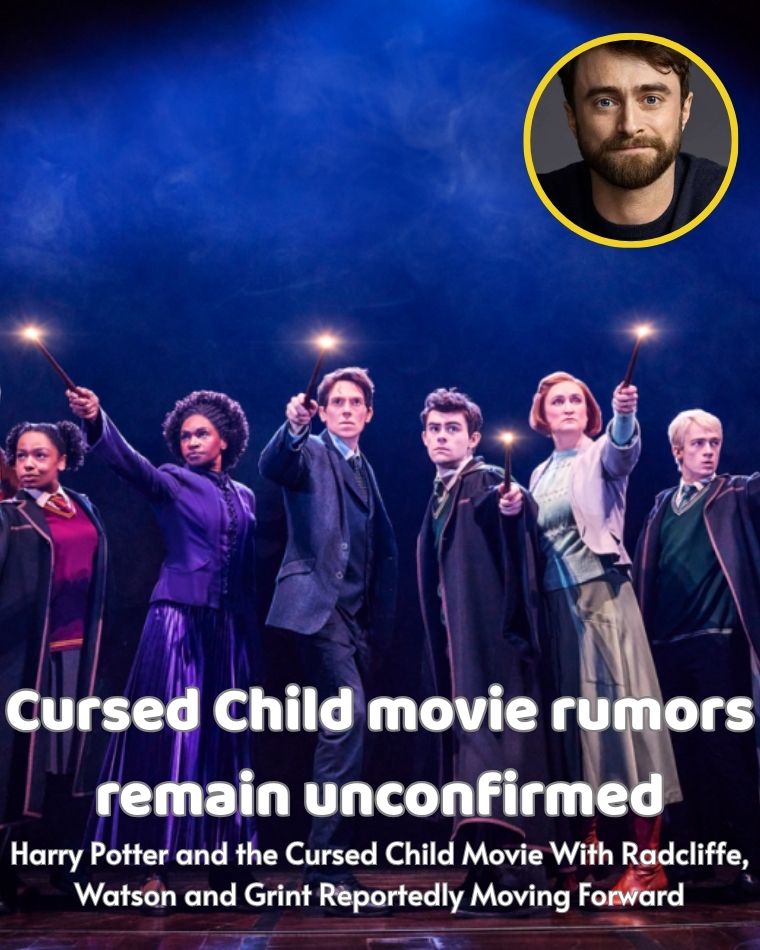
Cre: Wikimedia Commons
Inside the Story of The Cursed Child
Harry Potter and the Cursed Child premiered in London’s West End in 2016 as a two-part theatrical event.
The stage production was crafted from an original story developed by J.K. Rowling, playwright Jack Thorne, and director John Tiffany.
The narrative takes place nineteen years after the climactic events of the Battle of Hogwarts depicted in The Deathly Hallows.
In this sequel timeline, Harry Potter has matured into an overworked civil servant at the Ministry of Magic.
Harry serves as the Head of Magical Law Enforcement while navigating the complex realities of adult life.
He is married to Ginny Weasley and raising three school-age children who must carry the weight of their family name.
The central conflict focuses on his younger son, Albus Severus Potter, who struggles intensely with self-doubt and isolation.
Albus enters Hogwarts under the overwhelming shadow of his father’s global fame and historic heroism.
His experience takes an unexpected turn when he is sorted into Slytherin House alongside Scorpius Malfoy, the son of Harry’s former rival Draco Malfoy.
The unlikely friendship between Albus and Scorpius forms the emotional core of the entire two-part story.
Straining under paternal expectations, the boys attempt to right historical wrongs by using an illicit Time-Turner.
Their reckless temporal meddling alters reality, leading to harrowing alternative timelines where dark magic threatens the wizarding community once more.
The story examines the psychological scars of wartime trauma, the burdens of legacy, and the painful misunderstandings that often divide parents and children.
Harry is depicted not as an infallible savior, but as a flawed parent wrestling with his own childhood neglect and lingering grief.
From West End Triumph to Fan Controversy
When The Cursed Child opened at the Palace Theatre in London in the summer of 2016, professional theater critics responded with ecstatic praise.
Reviewers lauded John Tiffany’s dazzling stagecraft, hypnotic illusions, and choreography that brought practical spell-casting to the stage.
The West End premiere went on to win a record-breaking nine Laurence Olivier Awards, including Best New Play.
Its subsequent transfer to Broadway in 2018 achieved similar critical dominance, earning six Tony Awards including Best Play.
Yet within the broader Harry Potter fandom, the story received a far more polarized response.
Many readers who bought the published rehearsal script criticized the dramatic decisions made by the playwrights.
Chief among the complaints was the use of time travel, which many fans argued contradicted the strict magical mechanics established in The Prisoner of Azkaban.
Other readers objected to the characterization of Harry, viewing his tense interactions with Albus as uncharacteristically harsh.
Certain narrative revelations—such as Lord Voldemort fathering a secret child—were labeled by segments of the community as resembling fan fiction rather than official canon.
Despite the script’s divisive reception on paper, the live production remains a commercial juggernaut in London, New York, and international venues.
Any studio attempting to adapt the play into a feature film would have to navigate these mixed feelings among core moviegoers.
Translating stage illusions into computer-generated movie imagery could strip away the very practical magic that earned the theatrical show its acclaim.
Screenwriters would face the delicate task of restructuring a complex stage drama into a coherent cinematic runtime without alienating dedicated fans.
Daniel Radcliffe’s Creative Dilemma
For Daniel Radcliffe, returning to the role of Harry Potter would represent a momentous creative and psychological crossroads.
Radcliffe spent an entire decade of his formative youth portraying the Boy Who Lived across eight blockbuster films.
Stepping back into the glasses and lightning bolt scar would mean revisiting an all-consuming cultural phenomenon that dominated his childhood.
Portraying the adult Harry in The Cursed Child would also require addressing dark and emotionally exhausting material.
The narrative demands an actor to portray a father struggling with parenting failures and post-traumatic stress.
Radcliffe would have to channel the weight of an older, weary hero whose domestic battles are just as punishing as his duels with dark wizards.
Emotionally, taking up the wand again could revive an intense level of global scrutiny and media obsession that he spent years escaping.
Radcliffe has consistently valued personal autonomy, privacy, and an unhurried lifestyle outside the blockbuster studio machinery.
Signing on for a studio tentpole would require months of global press tours and intense fan conventions that test any performer’s patience.
Furthermore, he has frequently expressed deep respect for the narrative closure achieved in 2011’s The Deathly Hallows – Part 2.
Disrupting that clean, celebrated conclusion is not a decision any actor would take lightly without an undeniable script.
Revisiting his most famous role could also rekindle public debates surrounding the broader intellectual property, introducing external pressures that have nothing to do with filmmaking.
For an artist who cherishes peace of mind, the emotional toll of re-entering that orbit might outweigh any financial compensation the studio could assemble.
Radcliffe has consistently demonstrated that personal creative fulfillment takes precedence over commercial nostalgia.
Defying the Franchise Machine: Radcliffe’s Bold Career Pivot
Daniel Radcliffe’s professional trajectory since concluding The Deathly Hallows stands out as one of the most unconventional in modern Hollywood.
Rather than chasing superhero franchises or multi-picture studio deals, he embarked on an eclectic journey through independent cinema and live theater.
He made daring choices that deliberately dismantled his clean-cut child-star persona in favor of eccentric, challenging characters.
Radcliffe starred as a grieving young man who sprouts demonic horns in Alexandre Aja’s dark supernatural comedy Horns.
He astounded audiences and critics alike by playing a flatulent, talkative corpse in the surreal comedy-drama Swiss Army Man.
In Guns Akimbo, he played an ordinary coder who wakes up with handguns surgically bolted to his hands in a lethal live-streamed deathmatch.
He transformed into the eccentric parody musician Weird Al Yankovic in the critically acclaimed biopic Weird: The Al Yankovic Story.
Alongside his film roles, Radcliffe committed himself deeply to the stage, performing in Broadway musicals and gritty dramas.
His daring turn on Broadway in Peter Shaffer’s Equus proved early on that he was determined to be recognized as a serious dramatic actor.
His recent triumph in the Broadway revival of Stephen Sondheim’s Merrily We Roll Along earned him his first Tony Award.
This rich body of work demonstrates a performer who actively avoids commercial repetition in favor of artistic novelty and narrative risk.
A massive studio return to The Cursed Child would directly contradict the artistic philosophy he has pursued for over a decade.
Rejoining a mega-budget corporate franchise would represent a regression into the exact commercial machinery he purposely left behind.
Radcliffe has made it clear that he relishes the freedom to collaborate with daring directors on singular, oddball scripts.
Trading that creative flexibility for years of franchise commitments remains highly unlikely given his demonstrated career priorities.
The Original Trio on Leaving Hogwarts Behind
The sentiments expressed by Daniel Radcliffe are closely mirrored by his longtime co-stars Emma Watson and Rupert Grint.
Over the years, the three actors have consistently spoken of their Harry Potter days as a deeply cherished, yet entirely finished, chapter of their lives.
Radcliffe has addressed the possibility of returning on several occasions, emphasizing that he currently has no desire to play the character again.
In a candid interview with The New York Times, Radcliffe compared his situation to that of Mark Hamill and Harrison Ford returning to Star Wars.
He noted that those actors had roughly thirty to forty years of distance before they stepped back into their signature galaxy.
For Radcliffe, barely a decade had passed since he hung up the Gryffindor robes, making any immediate return feel entirely premature.
“I’m getting to a point where I feel like I made it out of Potter okay, and I’m really happy with where I am now,” Radcliffe explained.
He added that returning to that character would represent a massive transformation in his current day-to-day life that he does not seek.
While he stopped short of issuing an absolute, lifetime refusal, he underscored that it is simply not something he is interested in pursuing today.
Emma Watson has shown an identical reluctance to jump back into long-term commercial film commitments.
Following the franchise finale, Watson balanced high-profile roles such as Beauty and the Beast and Little Women with academic pursuits at Brown University and Oxford.
In recent years, Watson has stepped back from consistent screen acting, devoting substantial time to human rights activism and environmental advocacy.
Watson has voiced deep gratitude for Hermione Granger while underscoring that she views that stage of her life as completed.
She has repeatedly indicated that any creative return to big-budget studio projects would require an extraordinary script and exceptional circumstances.
Her co-star Rupert Grint has voiced similar thoughts when asked about returning to the lovable Ron Weasley.
Grint has enjoyed a quiet, grounded career flourishing in television, most notably working on the psychological thriller series Servant.
Grint has commented that playing Ron was such a massive part of his upbringing that letting the character rest felt healthy and necessary.
While Grint has joked in interviews that he might consider returning if everyone else agreed, he always frames the idea as highly improbable.
The collective sentiment among the trio remains one of profound appreciation for their shared past, paired with zero urgency to revive it.
Commercial Pressures and the Complex Road Ahead
From a purely corporate perspective, Warner Bros. Discovery faces powerful financial incentives to keep exploring the Wizarding World.
Harry Potter remains one of the most lucrative and recognizable intellectual properties in entertainment history.
The original eight films generated billions of dollars at the global box office and established a multi-generational merchandise empire.
Yet the studio’s cinematic expansion encountered turbulent waters with the Fantastic Beasts prequel spin-offs.
Diminishing box-office returns and muddled storytelling led the studio to pause that five-film prequel roadmap prematurely.
Given that backdrop, executives would naturally view an adaptation of The Cursed Child with the original stars as the ultimate box-office guarantee.
The prospect of marketing the return of Radcliffe, Watson, and Grint would ignite unprecedented media coverage and ticket presales worldwide.
However, corporate enthusiasm cannot compel three established actors to sign contracts against their creative instincts.
All three performers secured generational financial independence from their childhood work, leaving them free from monetary coercion.
None of them require a massive studio paycheck to sustain their lifestyles or their chosen artistic projects.
Their decisions will always be governed strictly by creative integrity, script quality, and personal lifestyle desires.
Moreover, any film adaptation would require the active collaboration and sign-off of author J.K. Rowling, who maintains strict artistic control over the franchise.
Rowling has historically insisted that The Cursed Child was written specifically for the stage and should remain an exclusive theatrical experience.
Her stance on preserving the theatrical integrity of the production adds an additional layer of resistance to any immediate movie transition.
Without aligned interests between the author, the studio, and all three lead actors, greenlighting a production remains virtually impossible.
The Reality Behind the Rumors
When analyzing the latest round of reports, audiences must separate wishful internet commentary from authenticated industry reality.
Speculative rumors about a Cursed Child movie have surfaced almost every year since the play made its London debut in 2016.
The persistent recurrence of these stories speaks to the enduring emotional bond audiences share with the characters of Harry, Hermione, and Ron.
Viewers who grew up alongside the actors long to see them reunite as adults confronting the hardships of parenthood.
That emotional yearning creates fertile ground for unverified rumors to spread rapidly across digital platforms and fan forums.
Yet until Warner Bros. issues an official press release or the actors confirm talks through established trade publications, skepticism is essential.
Daniel Radcliffe continues to pursue bold, boundary-pushing roles that challenge traditional perceptions of his talent.
Emma Watson remains focused on her advocacy work, independent creative pursuits, and selective artistic endeavors.
Rupert Grint continues to carve out an authentic path in character acting and television drama.
All three have moved forward into mature adulthood, comfortable with the artistic legacy they crafted together.
For now, Harry Potter and the Cursed Child continues to thrive where it was always designed to exist: live on the theater stage.
The magical memories created by the original film series remain safe, untarnished, and firmly preserved in cinema history.
Whether the original trio will ever reunite on screen decades from now remains an open question for the future.
At present, however, any talk of a greenlit Cursed Child movie starring Daniel Radcliffe is purely speculative wizardry.
Để lại một phản hồi