Marvel Studios is officially taking from its classic vault to anchor the beginning of its next cinematic chapter.
Starring Ryan Gosling and helmed by director Shawn Levy, the newly announced supernatural solo film marks a transformative direction for Marvel Phase 7.
Beyond the star-studded creative pairing, the project breaks an extraordinary release precedent that has governed the studio’s cinematic universe since its inception.
A Historic Milestone in Marvel Studios Scheduling
The Marvel Cinematic Universe has maintained strict discipline when pacing and resurrecting legacy characters over the past two decades.
Whenever the studio decides to reimagine an existing comic book hero, timing has always dictated the transition.
Yet, this upcoming Ghost Rider movie breaks a historic pattern for a company that has traditionally been careful about its reboot timeline.
The project was officially unveiled at San Diego Comic-Con, instantly making waves across the global entertainment landscape.
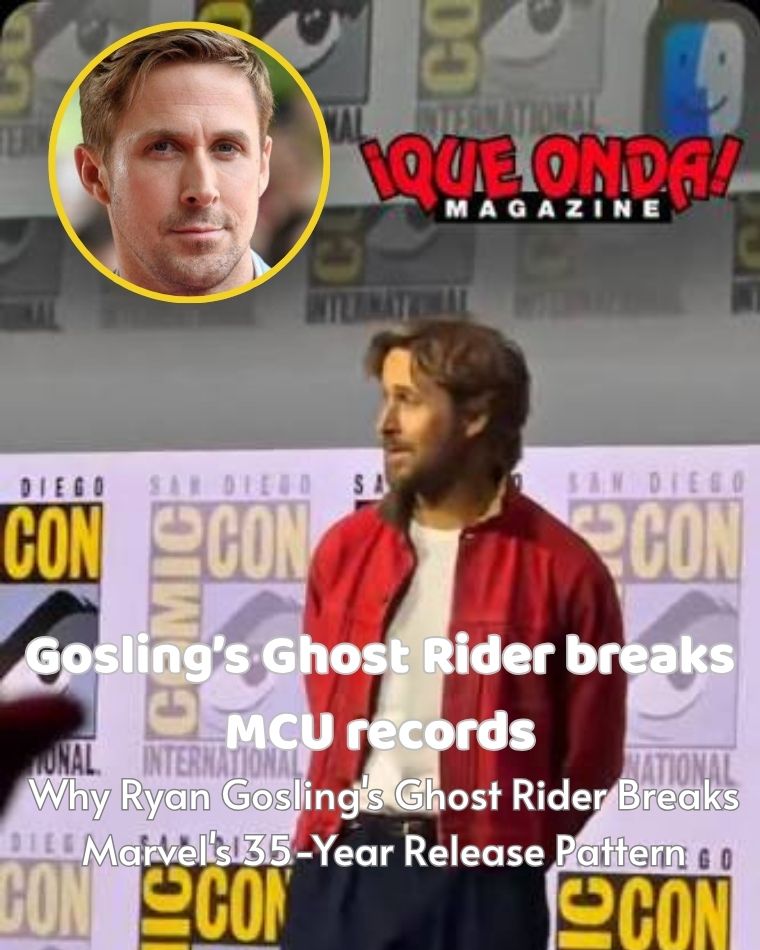
Kevin Feige took the stage to announce that Phase 7 will feature the flaming antihero in his own dedicated theatrical release.
Shawn Levy will direct the feature, bringing his blockbuster storytelling instincts to one of Marvel’s darkest comic book properties.
Ryan Gosling is officially attached to bring the Spirit of Vengeance to life on the silver screen.
Beyond the announcement of the lead actor and director, Marvel Studios has deliberately kept specific plot details tightly under wraps.
The studio leadership is working to keep a tight lid on production plans while developmental work continues behind closed doors.
Executives cannot deny that Ghost Rider represents a massive calculated risk for the overarching brand.
The project breaks a tradition that stretches back across the entire history of modern superhero adaptations.
Cre: Getty Images
The Longest Reboot Gap in Studio History
Ryan Gosling will not be the first Hollywood star to steer Johnny Blaze’s roaring, hellfire-fueled motorcycle onto the big screen.
Academy Award winner Nicolas Cage originally portrayed the fiery character across two high-profile studio releases.
Cage first took up the leather jacket in 2007 with Sony Pictures’ original Ghost Rider.
That first film showed commercial promise and drew a passionate audience, prompting Sony to greenlight an action sequel.
In 2011, the studio delivered Ghost Rider: Spirit of Vengeance to global theaters.
Unfortunately, Spirit of Vengeance failed to maintain critical standing among moviegoers and comic book enthusiasts.
While it managed acceptable global box-office receipts, the sequel was heavily panned by critics and longtime fans alike.
Following that reception, the big-screen motorcycle hero was shelved for over a decade.
A television iteration of the character later surfaced in Marvel’s Agents of S.H.I.E.L.D. on ABC.
Marvel Studios has maintained an intentionally complicated relationship with the television branch’s canon.
Industry insiders note that Shawn Levy’s production is highly unlikely to acknowledge the events of Agents of S.H.I.E.L.D.
Consequently, Levy and Gosling possess an entirely clean slate to rebuild the supernatural icon from scratch.
However, clearing that slate requires dusting off a dormancy period spanning roughly seventeen years.
The gap between Spirit of Vengeance and Gosling’s 2028 entry represents the longest reboot dormancy in Marvel Studios history.
Marvel has never waited seventeen years between an existing theatrical iteration and its cinematic reinvention.
How Marvel Handled Reboots Across Past Decades
A close examination of past superhero rollouts illustrates just how unusual this prolonged seventeen-year window truly is.
Kevin Feige and his executive team initiated their very first character reboot early in the franchise’s lifespan.
The Incredible Hulk arrived in theaters in 2008 starring Edward Norton.
That release occurred just five years after director Ang Lee brought the Jade Giant to cinemas in 2003 with Eric Bana.
While Ang Lee’s Hulk has garnered a loyal cult following over time, its commercial reception prompted an immediate five-year overhaul.
Marvel quickly integrated the character into the founding core of the Marvel Cinematic Universe without missing a beat.
A similar fast-tracked reboot trajectory defined the turbulent cinematic history of Spider-Man.
Sony Pictures released The Amazing Spider-Man 2 in 2014 featuring Andrew Garfield in the web-slinging suit.
Persistent rumors in the early 2010s suggested Garfield’s iteration might cross over into Marvel Studios’ expanding sandbox.
However, mixed critical responses and leaked studio emails dismantled those crossover intentions.
Rather than letting the wall-crawler languish in development limbo, Sony and Marvel Studios reached an unprecedented creative partnership.
Tom Holland was cast as Peter Parker and made his sensational debut in 2016’s Captain America: Civil War.
His standalone film, Spider-Man: Homecoming, arrived in theaters in 2017.
That meant the reboot window between Andrew Garfield’s sequel and Tom Holland’s solo feature was a mere three years.
A comparable timeline shift occurred with the beloved heroes of Marvel’s First Family.
The Fantastic Four required tremendous public goodwill after Josh Trank’s 2015 reboot faced widespread backlash.
Marvel carefully teased their arrival by placing their spacecraft in the post-credits sequence of Thunderbolts*.
Taking an intentional decade-long break allowed the property to shed past missteps before entering The Fantastic Four: First Steps.
The mutant collective of the X-Men is navigating a similar reinvention pathway.
Following 2019’s Dark Phoenix, the mutant roster is slated for a theatrical reboot under director Jake Schreier in 2028.
Even with the X-Men taking nine years between major ensemble films, that timeline still pales in comparison to Ghost Rider’s gap.
Waiting seventeen years between standalone big-screen outings places Ghost Rider in a class of its own.
What Ryan Gosling Brings to the Spirit of Vengeance
Ryan Gosling’s casting provides the production with substantial critical credibility alongside massive mainstream marquee appeal.
Gosling brings an exceptional track record of leading character-driven genre pictures that challenge conventional Hollywood tropes.
His past performances demonstrate an ability to embody stoic grit, internal vulnerability, and razor-sharp charisma.
From stylized cinematic thrillers to grand studio tentpoles, Gosling has consistently balanced critical respect with commercial magnetism.
During Marvel’s Hall H presentation at Comic-Con, Gosling expressed genuine enthusiasm for the antihero.
The actor addressed the electrified crowd, openly reflecting on his longstanding desire to portray the supernatural rider.
Gosling remarked on stage that Johnny Blaze was a character he had actively pursued for a very long time.
Nobody could ever accuse Nicolas Cage of delivering a half-hearted performance in his original outings.
Cage routinely publicized his deep personal passion for Marvel comic lore whenever discussing his movie projects.
Gosling matches that commitment by demonstrating a years-long creative interest in portraying the Spirit of Vengeance.
That genuine dedication often galvanizes production crews, directors, and screenwriters to strive for excellence.
Working under the proven commercial direction of Shawn Levy ensures the adaptation balances audience accessibility with high-octane spectacle.
The collaborative chemistry between Levy and Gosling suggests the creative team is determined to avoid the narrative pitfalls of previous eras.
A Matured Supernatural Landscape and Darker Tone
When the original Ghost Rider debuted in 2007, it occupied an isolated cinematic sandbox.
Shared superhero universes did not exist in the contemporary mainstream theatrical landscape back then.
As a direct result, Sony’s creative teams had to construct their supernatural lore entirely from scratch.
Audiences had to be taught the mechanics of demonic pacts, hellfire curses, and metaphysical vengeance in a vacuum.
In contrast, Marvel Studios’ upcoming adaptation inherits two full decades of comprehensive world-building.
The modern cinematic universe has already explored sorcery, alternate dimensions, and mystical artifacts across numerous phases.
Because of this expansive foundation, Levy does not need to spend excessive runtime justifying the existence of mystical phenomena.
Audiences are already primed to accept complex occult mechanics within Marvel’s broader cinematic tapestry.
Furthermore, changing creative philosophies across Marvel Studios open the door to a darker, more visceral aesthetic tone.
Marvel previously broke its traditional tonal boundaries with the record-shattering success of Deadpool & Wolverine.
By allowing Ryan Reynolds and Hugh Jackman to unleash mature humor and graphic action, Marvel proved that mature storytelling works.
While Marvel has not officially confirmed whether Levy’s Ghost Rider will receive an R rating, the precedent has been established.
Even if the studio pursues a strict PG-13 rating, the creative leadership is intentionally steering away from campiness.
Levy and Gosling are positioned to deliver an intense, grounded narrative that treats the occult source material with absolute sincerity.
Johnny Blaze’s torment, personal sacrifice, and battle against damnation require a mature dramatic lens.
Positioning Ghost Rider in Marvel Phase 7
The scheduling of Ghost Rider represents a calculated shift in how Marvel intends to organize Phase 7.
Following the multiversal climaxes expected in Avengers: Doomsday and Avengers: Secret Wars, the franchise must evolve.
Introducing an established Hollywood heavyweight in an occult tentpole signals an aggressive expansion into uncharted thematic territory.
Ghost Rider allows Marvel to solidify its supernatural and street-level corners alongside the cosmic and mutant sagas.
Rather than relying strictly on established Avengers formulas, Marvel is diversifying its tonal offerings for global audiences.
The long hibernation of Johnny Blaze has successfully cleared away the lingering disappointment of 2011’s sequel.
Absence has generated genuine curiosity and nostalgia among older audiences, while younger demographics will discover the antihero anew.
Breaking its customary reboot schedule demonstrates that Marvel Studios is no longer bound by rigid franchise timelines.
By granting properties the necessary time to breathe, the studio avoids audience fatigue and protects the cultural value of its roster.
Ryan Gosling’s arrival on the fiery motorcycle promises to redefine what an MCU supernatural blockbuster can achieve.
Phase 7 is officially prepared to chart a fiery path into Marvel’s boldest cinematic chapter yet.
Để lại một phản hồi