Ryan Gosling has constructed one of modern cinema’s most idiosyncratic careers by systematically placing his trust in visionary directors rather than corporate franchises.
Instead of anchoring multi-picture superhero universes, the Canadian actor routinely wagers his star capital on polarizing auteurs, experimental duos, and narrative rulebreakers.
From indie milestones to grand studio odysseys, Gosling operates not as an ordinary hired hand, but as an indispensable creative architect whose taste reshapes mainstream cinema.
The Director-First Doctrine: Prioritizing Vision Over Studio Security
The modern studio ecosystem is overwhelmingly driven by intellectual property, pre-sold brands, and interconnected cinematic universes.
Most leading men of Gosling’s stature are pressured to headline perpetual franchise cycles to guarantee box-office viability.
Gosling deliberately stepped outside that industry blueprint from the earliest stages of his career.
His central artistic principle has consistently been simple: commit to the filmmaker’s singular voice rather than the safety of a corporate brand.
He has repeatedly rejected orthodox commercial vehicles in favor of challenging screenplays guided by uncompromising storytellers.
When Gosling agreed to star in Nicolas Winding Refn’s Drive in 2011, he effectively chose the director himself after receiving the action script.
Gosling handpicked the Danish auteur because he sensed Refn could transform a standard Los Angeles crime thriller into a hypnotic, neon-soaked fairy tale.
That fateful meeting set the tone for Gosling’s subsequent decades in cinema.
His filmography became a living laboratory for radical directorial visions.
He partnered with Shane Black for The Nice Guys to breathe chaotic wit and kinetic subversion into the buddy-cop formula.
He signed on with Denis Villeneuve for Blade Runner 2049, accepting the monumental pressure of continuing Ridley Scott’s sci-fi monolith.
He even aligned with filmmaker pairs like the Safdie brothers and Daniels during development phases, seeking directors whose chaotic visual rhythms push cinematic boundaries.
Every strategic choice Gosling makes signals a desire to step onto artistic terrain where comfort is banned.
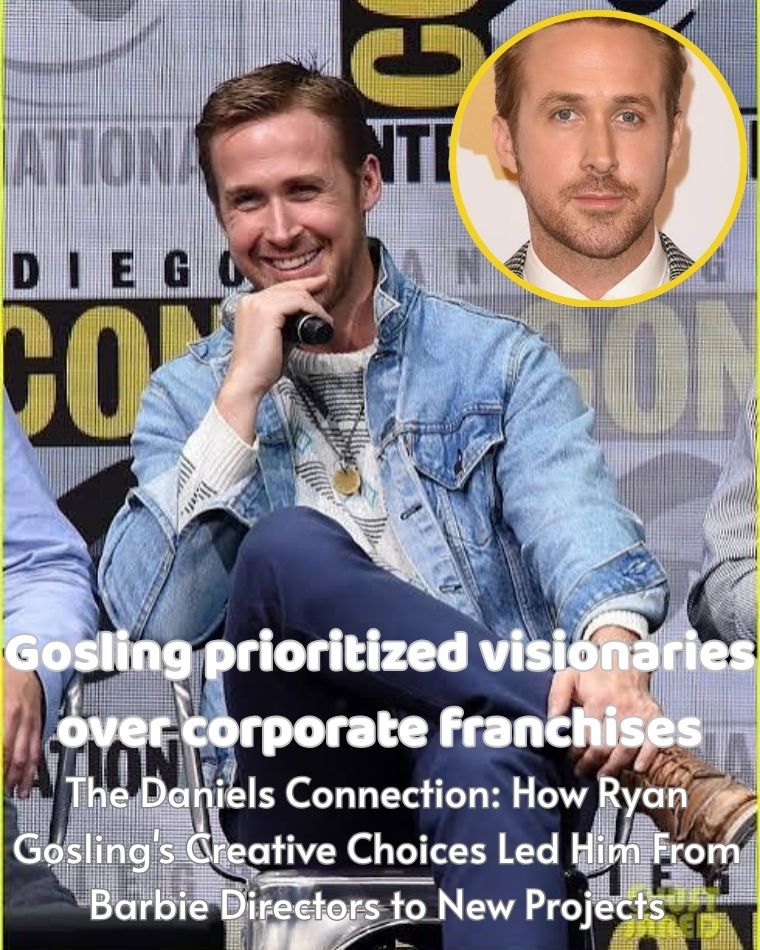
Cre: Wikimedia Commons — Gage Skidmore / Alireza6513 (CC BY-SA 3.0)
Elevating Genre: Transforming Pulps into High Art
A recurring hallmark of Gosling’s filmography is his instinct for elevating familiar genre material through high-caliber directorial voices.
In less visionary hands, Drive could easily have landed as a disposable straight-to-streaming vehicle.
Under Refn’s meticulous direction and Gosling’s stoic presence, it evolved into an instant cult classic celebrated for its sonic texture and visual restraint.
Their subsequent reunion on Only God Forgives doubled down on nightmarish hyper-stylization, confirming Gosling’s total willingness to alienate casual audiences for artistic purity.
Gosling similarly revolutionized the romantic melodrama alongside director Derek Cianfrance.
Their breakthrough collaboration on Blue Valentine stripped away Hollywood sentimentality to deliver a raw, emotionally brutal anatomy of marriage.
Cianfrance and Gosling reunited for The Place Beyond the Pines, a sprawling triptych examining generational guilt, fate, and American myth.
In both instances, Gosling utilized Cianfrance’s documentary-influenced realism to subvert what audiences expect from a romantic leading man.
Gosling does not seek genres to satisfy box-office demographics.
He hunts for genre skeletons that ambitious auteurs can flesh out with genuine emotional weight and technical daring.
His comedic work operates under the exact same artistic rigor.
With Shane Black on The Nice Guys, Gosling channeled physical slapstick and louche desperation to elevate classic film noir tropes.
Even his Oscar-nominated turn as Ken in Greta Gerwig’s Barbie demonstrated how auteur direction can transform consumer toy intellectual property into subversive cultural satire.
Without a director possessing an uncompromising point of view, Gosling simply does not step in front of the camera.
Precision Meets Vulnerability: The Technical Demands of Gosling’s Collaborators
The directors who populate Gosling’s filmography share a distinct creative trait: they demand mathematical technical precision alongside raw psychological vulnerability.
Consider his multi-film partnership with Damien Chazelle, which produced La La Land and First Man.
Chazelle is renowned for obsessive structural control, complex long takes, and musical timing.
For La La Land, Gosling spent months learning jazz piano from scratch so Chazelle could film uninterrupted, unedited takes of his hands on the keys.
He understood that digital trickery or camera cuts would shatter the emotional honesty of Chazelle’s tribute to golden-age cinema.
Two years later, Gosling and Chazelle re-teamed to deconstruct American heroism in First Man.
Playing astronaut Neil Armstrong required Gosling to express grief through silence and minute facial twitches inside claustrophobic, vibrating spacecraft cockpits.
Chazelle’s hyper-focused lenses captured an internal psychological portrait masked behind mid-century stoicism.
This delicate synthesis of technical discipline and quiet vulnerability was equally evident in Denis Villeneuve’s Blade Runner 2049.
Villeneuve and master cinematographer Roger Deakins created vast, punishing architectural frames of a dystopian future.
Gosling’s replicant protagonist, Officer K, had to exist harmoniously within those monumental, color-coded visual compositions.
At the same time, Gosling had to convey the heartbreaking awakening of an artificial soul realizing its own insignificance.
Very few modern movie stars can anchor a 150-million-dollar canvas without leaning on theatrical vanity.
Gosling willingly subordinates his ego to the director’s geometry, serving as an organic element within the visual tapestry.
More Than an Actor: The Method of an Active Co-Creator
Industry veterans who have shared sets with Gosling consistently remark that he refuses to function as passive talent awaiting line readings.
He approaches every screenplay as an active collaborator, contributing extensively to character psychology, dialogue, wardrobe, and thematic tone.
During the production of The Place Beyond the Pines, Gosling brought deeply personal concepts to director Derek Cianfrance.
It was Gosling who proposed that his character, Luke Glanton, should be covered in haphazard homemade tattoos, including a dagger beneath his eye.
When Gosling initially felt self-conscious on set and wanted to wash the dagger tattoo off, Cianfrance insisted he keep it.
The director recognized that Gosling’s discomfort mirrored the character’s permanent, impulsive regrets.
During the bank robbery sequences in that same film, Cianfrance cast real bank tellers who had survived actual robberies.
Gosling improvised under high pressure, shouting until his voice cracked to puncture the tellers’ comfort and elicit authentic terror.
His investment in character construction was just as profound on Greta Gerwig’s Barbie.
Gosling actively helped build Ken’s absurd internal logic, proposing lines, improvised reactions, and musical flourishes that defined the pop-culture phenomenon.
He co-wrote and improvised parts of the musical set piece “I’m Just Ken,” treating light satire with the exact same gravity as high drama.
Directors treasure Gosling because he acts as an on-set sounding board rather than an entitled celebrity.
He enters pre-production with extensive research files, physical training regimens, and structural questions about the script’s emotional spine.
When a director encounters an obstacle, Gosling works shoulder-to-shoulder with them to uncover an unconventional solution.
Behind the Scenes: Expanding Autonomy Through Producing
Gosling’s ambition to shape cinematic storytelling naturally led him to claim formal control behind the camera.
He recognized early that the most reliable method for protecting challenging cinema is holding producer power.
He earned an executive producer credit as early as 2010 on Cianfrance’s Blue Valentine.
His producing credit was not a vanity title; it reflected years of fighting to get the low-budget, emotionally demanding film financed and protected from censorship.
In 2014, Gosling took the ultimate auteur gamble by writing, producing, and directing his own feature debut, Lost River.
A dark, surrealist fable heavily influenced by David Lynch and Nicolas Winding Refn, Lost River premiered at the Cannes Film Festival.
While the film polarized mainstream critics, it demonstrated Gosling’s absolute commitment to poetic, non-linear cinematic expression.
Directing granted Gosling an invaluable technical understanding of camera blocking, sound design, and post-production editing.
Armed with that directorial literacy, he returned to acting with an even sharper appreciation for what filmmakers endure.
His producing banner, General Admission, has since become a major vehicle for backing bold visions.
He produced David Leitch’s stuntman love letter The Fall Guy, using his leverage to celebrate cinema’s unsung blue-collar crew members.
His producing slate includes the sci-fi adaptation Project Hail Mary, directed by Phil Lord and Christopher Miller.
By producing his own star vehicles, Gosling ensures that idiosyncratic filmmakers maintain creative freedom against studio interference.
The Magnet for Duos: Why Creative Partnerships Gravitate to Gosling
One of the most intriguing patterns in Gosling’s trajectory is his magnetism for filmmaking duos and collaborative teams.
Directing duos operate on consensus, constant dialogue, and layered perspectives.
Gosling flourishes inside those communal environments because his own creative process is fundamentally conversational.
His career began with Anna Boden and Ryan Fleck on the 2006 indie drama Half Nelson.
Boden and Fleck directed Gosling to his first Academy Award nomination for his portrayal of Dan Dunne, a drug-addicted inner-city history teacher.
The film’s intimate, docu-style aesthetic required an actor capable of rolling with flexible blocking and organic dialogue.
Gosling matched the co-directors beat for beat, solidifying his reputation as an actor who thrives in democratic artistic environments.
His career trajectory has naturally extended to Phil Lord and Christopher Miller for the expansive outer-space epic Project Hail Mary.
Lord and Miller are masters of combining anarchic humor, emotional depth, and boundary-pushing visual inventiveness.
Choosing Lord and Miller over standard blockbuster directors underscores Gosling’s steadfast philosophy: even big-budget sci-fi must possess an off-kilter human soul.
Gosling has similarly tracked projects with the Safdie brothers and Daniel Kwan and Daniel Scheinert (The Daniels).
These filmmakers represent the cutting edge of contemporary cinema, known for manic pacing, hyper-sensory world-building, and high emotional stakes.
Visionary partnerships see in Gosling an actor who does not need to be coddled.
They see a collaborator who relishes chaos, welcomes rigorous debates on set, and commits fully to extreme directorial concepts.
Resisting the IP Trap: A Lone Star in the Modern Hollywood Machine
In contemporary Hollywood, true movie stars who avoid franchise long-term contracts are a vanishing species.
Almost every contemporary contemporary peer has donned a superhero cape or signed multiple-picture sequel options.
Gosling remains the defining anomaly of his generation.
He has repeatedly turned down conventional comic-book blockbusters throughout his twenties, thirties, and forties.
When he does engage with massive intellectual property, he does so strictly on his own philosophical terms.
Blade Runner 2049 was a meditative, three-hour philosophical inquiry rather than an action-packed popcorn vehicle.
Barbie was an existential feminist comedy helmed by an indie auteur rather than a traditional toy commercial.
Gosling participates in large-scale productions only when the filmmaker is permitted to interrogate the mythos of the material itself.
This refusal to be trapped inside generic cinematic universes has kept his public persona remarkably fresh.
Audiences never view Ryan Gosling as a corporate brand mascot.
They view him as a discerning curator whose name on a theatrical marquee guarantees an intriguing artistic experience.
Every ticket purchased for a Gosling film represents a vote of confidence in the director standing behind him.
His filmography is free of algorithmic formula because he refuses to let studio algorithms dictate his calendar.
He treats fame not as an end in itself, but as financial currency to be spent on risky, original cinema.
The Cultural Imprint: Curating a Golden Age of Screen Acting
Looking back across three decades of work, Gosling’s director-first philosophy has built one of modern cinema’s most durable filmographies.
From The Believer and Half Nelson to Drive, La La Land, and Barbie, his body of work mirrors the evolution of independent and studio ambition.
He has demonstrated that an actor can achieve global superstardom without sacrificing artistic integrity.
His performances have entered the cultural lexicon because they were nurtured by filmmakers who granted him room to explore darkness, vulnerability, and absurdity.
Gosling proves that an actor’s greatest asset is not his physical vanity or commercial marketability.
An actor’s true superpower is his taste in collaborators.
By seeking out filmmakers who refuse to play it safe, Gosling ensures his work endures long after opening weekend box-office numbers fade.
As Hollywood continues to grapple with algorithmic trends and franchise fatigue, Gosling’s career remains a vital beacon for original filmmaking.
He stands as definitive proof that cinema thrives when stars put their capital behind true auteurs.
In an industry governed by safe corporate calculations, Ryan Gosling continues to choose the director, choose the risk, and let the art speak for itself.
Để lại một phản hồi