Amazon MGM Studios has formally launched its Academy Awards campaign for the science fiction blockbuster Project Hail Mary, starring Ryan Gosling.
The timing of this campaign push marks a pivotal moment in the studio’s broader trajectory toward major awards prestige.
The promotional launch coincides directly with the rising awards chatter around Artificial, a former Amazon MGM project that has now entered the Oscar conversation under indie distributor Neon.
Together, these parallel narratives offer a revealing look at how a tech-backed entertainment giant balances commercial spectacle, prestige credibility, and evolving festival strategy in the modern streaming era.
The formal push behind Project Hail Mary reflects Amazon MGM’s deliberate commitment to treating big-budget genre cinema as a serious awards vehicle.
Adapted from the bestselling novel by Andy Weir and directed by Phil Lord and Christopher Miller, the film stands as one of the studio’s most ambitious investments to date.
Drew Goddard penned the screenplay, translating Weir’s intricate, math-heavy survival narrative into a cinematic journey anchored by Gosling’s central performance.
Amazon MGM has positioned the title as an across-the-board Academy contender rather than a narrow technical player.
The campaign deliberately balances the movie’s immense global box office footprint with classic awards messaging centered on craft, emotional resonance, and intellectual rigour.
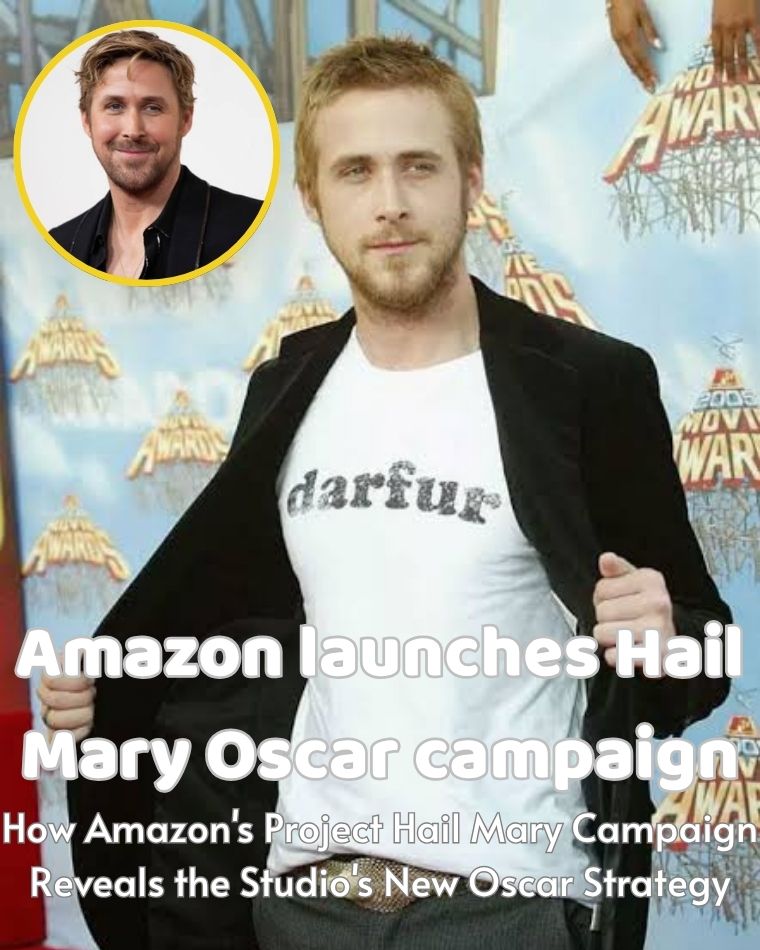
Cre: Wikimedia Commons — CC BY-SA 2.0
The awards campaign highlights Ryan Gosling’s performance as Ryland Grace, a schoolteacher-turned-astronaut tasked with saving Earth from catastrophic solar dimming.
Gosling carries long stretches of the narrative entirely on his own shoulders inside a claustrophobic spacecraft.
Industry observers note that performing against elaborate physical sets and complex visual effects requires an exacting standard of emotional grounding.
Gosling’s run in the Best Actor category arrives amid stiff competition from rising seasonal contenders.
The campaign emphasizes his balance of scientific curiosity, dry humor, and desperate humanity.
Campaign organizers are framing the role as a showcase of acting discipline within high-concept genre filmmaking.
Alongside Gosling, the film features Sandra Hüller in an authoritative supporting turn, adding established international prestige to the ensemble.
One of the most distinctive aspects of the film’s campaign is the bid for puppeteer and creature performer James Ortiz.
Ortiz brought the alien character Rocky to life using practical puppetry combined with subtle physical performance.
Amazon MGM is actively pitching Ortiz for Best Supporting Actor, marking a historic campaign for a puppet-driven character.
Campaign materials emphasize the tactile collaboration between Gosling and Ortiz on practical soundstages.
This dynamic between human protagonist and extraterrestrial engineer forms the emotional heartbeat of the adaptation.
By spotlighting Ortiz alongside traditional acting categories, the studio is testing Academy norms regarding hybrid performance art.
The adaptation of Andy Weir’s literary work is central to the film’s awards narrative.
Weir previously saw his novel The Martian receive seven Academy Award nominations following its 2015 adaptation directed by Ridley Scott.
Like its predecessor, Project Hail Mary champions scientific problem-solving, rigorous methodology, and interstellar ingenuity.
Screenwriter Drew Goddard, who also earned an Oscar nomination for scripting The Martian, returned to adapt Weir’s narrative for Lord and Miller.
Goddard’s adaptation focuses on translating alien communication through musical chords and mathematical harmonies into coherent cinematic language.
The film recently garnered the Sloan Science in Cinema Prize, providing independent validation of its commitment to real-world scientific principles.
The Sloan honor reinforces the studio’s argument that Project Hail Mary belongs in the lineage of scientifically grounded cinematic masterpieces.
Winning the Sloan prize equips the campaign with critical legitimacy among industry voters who value intellectual authenticity.
The technical departments form the primary foundation of the movie’s Oscar expectations.
Phil Lord and Christopher Miller collaborated with leading craftspeople to create zero-gravity environments without relying exclusively on digital backdrops.
The campaign positions the film as a frontrunner in Best Sound, Best Visual Effects, and Best Original Score.
Sound designers built an intricate acoustic palette that reflects atmospheric density, mechanical systems, and alien vocalizations.
Visual effects teams integrated practical spacecraft interiors with scientifically accurate astronomical physics.
The film’s cinematography captures the contrast between the freezing abyss of space and warm, functional interior machinery.
Amazon MGM is also mounting campaigns in Best Production Design, Best Film Editing, Best Makeup and Hairstyling, and Best Costume Design.
The overall technical presentation highlights how practical craft and digital augmentation can co-exist harmoniously.
Directorial duo Phil Lord and Christopher Miller bring a unique pedigree to the Best Director race.
Having won the Academy Award for Best Animated Feature with Spider-Man: Into the Spider-Verse, the filmmakers are seeking recognition from the Academy’s directing branch.
Their direction balances massive visual scope with intimate character dynamics between two lone survivors.
While science fiction spectacles often get pigeonholed into below-the-line categories, the campaign argues that the direction is essential to the emotional clarity of the narrative.
The logistical difficulty of mounting a large-scale hard sci-fi production forms a recurring theme in guild screening panels.
Voters across various branches are being reminded of the physical challenges involved in constructing believable zero-gravity action.
The launch of this awards campaign arrives against a fascinating backdrop of studio maneuvering.
As reported by Gold Derby, the timing of the campaign intersects with the rising momentum of Artificial, an acclaimed drama directed by Luca Guadagnino.
Artificial, starring Andrew Garfield as Sam Altman and Yura Borisov as Ilya Sutskever, chronicles the intense turmoil surrounding the rise of artificial intelligence.
The tech drama was initially developed under the Amazon MGM umbrella before the studio dropped the project.
Independent distributor Neon acquired the cast-off title and successfully premiered it at the New York Film Festival to enthusiastic critical acclaim.
Following its festival debut, Artificial shot up the Gold Derby prediction leaderboards across major categories, including Best Picture, Best Director, and Best Supporting Actor for Garfield.
Critics have described Guadagnino’s film as a contemporary classic and an incisive tech docudrama that rivals Aaron Sorkin’s The Social Reckoning.
The irony of Amazon MGM’s former property gaining awards traction under a rival banner adds a dramatic subtext to the awards season.
Dropping Artificial allowed Amazon MGM to streamline its capital and marketing muscle behind Project Hail Mary.
However, watching an abandoned project surge in critical favor creates external pressure on the studio’s chosen champion.
The divergence between the two films reflects two very different philosophies of contemporary prestige cinema.
Artificial represents the sharp, auteur-driven dialogue drama favored by traditional critics.
Project Hail Mary represents the grand-scale theatrical epic designed to restore public faith in original cinematic spectacle.
Both films find themselves competing for voter attention in an increasingly crowded Oscar landscape.
Industry analysts note that studios often face delicate decisions when curating their annual awards slates.
By fully committing to Lord and Miller’s production, Amazon MGM made a decisive strategic bet on populist prestige.
The ongoing debate over whether tech conglomerates can successfully identify awards gold remains a talking point across Hollywood.
The evolution of streaming platforms and tech companies into dominant Oscar forces has permanently restructured the campaign ecosystem.
Historically, major studios held a near-monopoly on high-end awards lobbying.
Over the past decade, digital platforms have invested unprecedented resources to secure critical recognition and industry validation.
Amazon MGM Studios occupies a unique space in this transformed landscape.
Following the acquisition of historic Metro-Goldwyn-Mayer, the company inherited both a storied legacy and extensive theatrical distribution infrastructure.
Unlike competitors who frequently prioritize direct-to-consumer streaming releases, Amazon MGM made a public pledge to theater owners to support widespread theatrical distribution.
Project Hail Mary received an extensive theatrical window that generated hundreds of millions of dollars globally before transitioning to Prime Video.
That traditional theatrical success gives the film a distinct advantage with conservative Academy voters who champion the exhibition sector.
Voters who resent straight-to-streaming releases view a robust box office run as proof of genuine audience engagement.
The dual identity of Amazon MGM as both a legacy studio and a modern digital powerhouse shapes every facet of its awards lobbying.
Campaign managers can leverage global e-commerce touchpoints and Prime Video ecosystems alongside classical print, outdoor, and guild screenings.
The Academy’s historical relationship with science fiction has traditionally been ambivalent.
While genre classics routinely dominate craft categories, breakthroughs into Best Picture and Best Director have remained relatively scarce.
Milestones like Gravity, The Martian, Arrival, and Denis Villeneuve’s Dune series gradually eroded the bias against speculative fiction.
Christopher Nolan’s Oppenheimer demonstrated that audiences and Academy members alike embrace technically demanding, intellectually rigorous narratives.
Project Hail Mary seeks to capitalize on this expanding voter appetite for sophisticated scientific narratives.
The campaign underscores that the story is fundamentally a humanist parable about international cooperation, sacrifice, and survival.
By emphasizing empathy over cold technical jargon, Amazon MGM hopes to overcome lingering genre prejudice among older branch members.
The path to nominations will require sustained strategic momentum through the winter precursor season.
Key industry stops including the Critics Choice Awards, the Golden Globes, and the British Academy Film Awards will signal whether the campaign is gaining broad traction.
Guild recognition will serve as the most reliable indicator of broad industry support.
Screen Actors Guild support for Gosling and the ensemble would represent a massive breakthrough against heavy dramatic contenders.
Similarly, nominations from the Directors Guild of America and the Writers Guild of America are vital for maintaining Best Picture viability.
The visual effects and sound branches are expected to deliver substantial support given the scale of the production.
Balancing commercial celebration with prestige gravitas remains a tightrope walk for any major studio.
By launching early, Amazon MGM ensures that screeners and guild screenings are locked in before the calendar becomes crowded.
Whether Project Hail Mary converts its widespread popularity into golden statuettes will test the Academy’s current values.
At the same time, the parallel ascent of Artificial under Neon will serve as an intriguing counterpoint throughout the race.
For Amazon MGM Studios, the campaign represents far more than a single movie’s Oscar chances.
It stands as a public statement of intent regarding the studio’s ongoing identity as a premier producer of world-class cinema.
Để lại một phản hồi