Hollywood stars Henry Cavill and Russell Crowe have arrived on Scotland’s Isle of Skye to film the ambitious Highlander reboot, but the production has sparked frustration among local island residents. While the project marks a celebrated return to the franchise’s ancestral Scottish roots, production logistics have caused noticeable disruptions across the island’s landscape. Filming continues across key locations after clearing required production permits, as filmmakers balance community preservation with the demands of an international blockbuster.
Hollywood Arrives in the Scottish Highlands
A major Hollywood production has set up operations across the scenic expanses of the Isle of Skye.
The high-profile shoot brings Henry Cavill and Oscar winner Russell Crowe directly to Scotland’s rugged northern coast.
The project marks the official cinematic reboot of Highlander, the immortal warrior fantasy epic first introduced to global audiences in 1986.
Film crews, specialized vehicles, and aerial units have established staging zones across multiple rural sites.
For Scotland’s entertainment sector, the arrival of such an expansive production represents a major international milestone.
Yet the sheer scale of the operation has quickly altered the atmosphere across the remote island community.
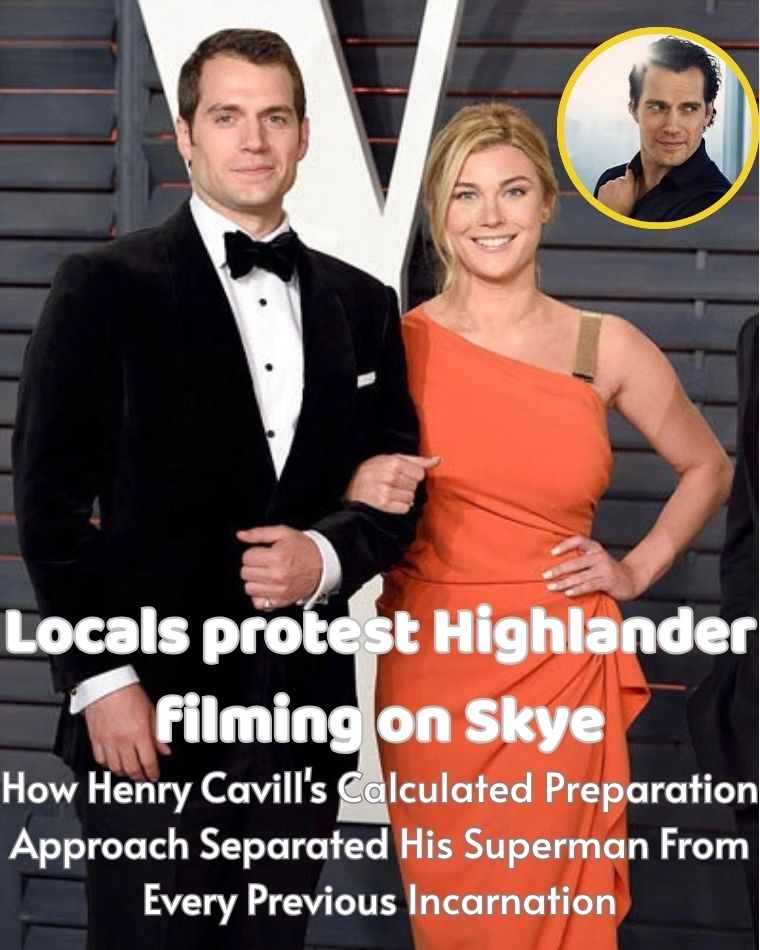
Cre: Wikimedia Commons — Gage Skidmore (CC BY-SA 2.0)
The Spark Behind the Island Tensions
Local residents on the Isle of Skye have voiced growing frustration over daily disruptions caused by the ongoing film shoot.
Initial enthusiasm reportedly gave way to irritation as the physical footprint of the film crew began to expand.
Island inhabitants have pointed to heavy logistical traffic, restricted public footpaths, and constant helicopter operations as primary nuisances.
The Isle of Skye covers roughly fifty miles in length and houses a tight-knit permanent population of approximately 13,000 residents.
In small, ecologically sensitive areas, the sudden influx of hundreds of crew members, trailers, and heavy equipment leaves a visible footprint.
Several public pathways frequently used by walkers, residents, and seasonal visitors have experienced access restrictions during active shooting hours.
Locals noted that the low-flying helicopters required for panoramic aerial cinematography have caused persistent noise across otherwise quiet valleys.
Community members have expressed concern regarding how continuous industrial activity could affect the island’s fragile natural terrain.
Despite these vocal complaints, studio representatives and location managers confirmed that production adheres to all pre-approved regional permits.
The Enduring Legacy of the Highlander Mythology
The Highlander franchise originally debuted four decades ago, establishing an enduring cult following worldwide.
The 1986 original feature starred French-American actor Christopher Lambert as Connor MacLeod, a sixteenth-century Scottish clansman.
In that original story, MacLeod is fatally wounded on the battlefield, only to miraculously survive and discover his true nature as an ageless immortal.
Mentored by the flamboyant swordsman Juan Sánchez-Villalobos Ramírez, played originally by Sean Connery, MacLeod learned the ancient laws governing his kind.
The immortals are bound to battle each other throughout human history, culminating in a fateful gathering known as “The Gathering”.
The film combined sweeping Highland landscapes, stylized sword choreography, and a memorable soundtrack composed and performed by rock band Queen.
The franchise later expanded across theatrical sequels, television spin-offs, animated adaptations, and comic books.
For millions of fans, the emotional core of the entire franchise remains firmly anchored in the historic mists of the Scottish Highlands.
Returning to Scotland’s Ancestral Roots
Bringing the Highlander reboot back to real Scottish terrain represents a key creative decision for the creative team.
The Isle of Skye is internationally renowned for its dramatic geological formations, sheer coastal cliffs, and sweeping peat moorlands.
Key landmarks across Skye offer a timeless visual identity that CGI sets cannot easily replicate.
Production units have constructed several period-accurate sets designed to blend directly into the island’s rocky slopes.
Cinematographers are relying heavily on natural Scottish light, shifting weather patterns, and rolling coastal fog to establish the reboot’s visual tone.
For decades, filmmakers have utilized Scotland’s unique geography to evoke ancient myth and historical authenticity.
Returning to Skye bridges the modern reboot directly back to the geographic heart of the 1986 original narrative.
However, utilizing real-world protected environments naturally brings studio ambitions into direct contact with environmental conservation needs.
A Modern Powerhouse Cast
Henry Cavill leads the reboot as Connor MacLeod, stepping into the legendary boots first worn by Christopher Lambert.
Cavill has spent years building an international profile as a leading man adept at demanding physical action and fantasy storytelling.
His previous performances in The Witcher, Man of Steel, and Mission: Impossible – Fallout have demonstrated his sword-fighting capability and screen presence.
Cavill has frequently shared his deep personal affection for fantasy lore and historical sword combat.
Joining Cavill on set is Academy Award-winning actor Russell Crowe, who brings veteran depth and gravitas to the ensemble.
Crowe has long maintained an iconic status in the action-drama genre following his career-defining turn in Ridley Scott’s Gladiator.
Seeing Cavill and Crowe share scenes across the Scottish Highlands provides significant star power for this reimagining.
Industry analysts consider this pairing a powerful asset as the studio aims to establish a fresh franchise tentpole.
The Logistics of Location Filmmaking
Managing a major Hollywood production on a remote Scottish island presents significant logistical hurdles.
Large crews require substantial transport fleets, specialized catering infrastructure, power generation units, and mobile wardrobe departments.
On an island with limited arterial road networks, even minor vehicle convoys can create notable transit delays for residents.
Skye’s single-track lanes and fragile verges are susceptible to wear and tear when handling heavy transport lorries.
Unpredictable Highland weather frequently forces production schedules to shift on short notice, extending shooting windows.
Helicopters remain essential for transporting high-definition camera rigs to inaccessible cliff edges, though they generate significant ambient noise.
Local authorities regularly balance the economic advantages of location filming against the preservation of resident welfare.
Municipal councils often welcome film productions because they generate revenue for regional hospitality providers, caterers, and drivers.
At the same time, maintaining open access for emergency services and daily agricultural transport remains a constant priority.
Balancing Heritage Conservation and Creative Ambition
The dispute on the Isle of Skye mirrors broader debates occurring in picturesque communities around the world.
Rural landscapes frequently face intense pressures whenever they become featured filming destinations or viral tourism hotspots.
Conservationists emphasize that Skye’s peat bogs and fragile alpine flora require careful stewardship to prevent long-term degradation.
Public access to hiking paths forms a cornerstone of Scottish outdoor tradition, governed by the Land Reform (Scotland) Act.
When commercial shoots close established footpaths, local recreationalists and walking tour operators naturally express pushback.
Production companies often implement environmental management plans, including ground-protection mats, waste removal, and post-filming restoration.
Yet even temporary restrictions can cause friction among residents whose livelihoods rely on unimpeded daily travel.
Transparent communication between production location managers and community councils remains critical during long shoots.
The High Stakes of 1980s IP Reboots
The Highlander reboot represents a substantial financial and artistic investment in classic fantasy intellectual property.
Major studios continue to explore classic 1980s properties that carry established fan recognition combined with open world-building potential.
Highlander possesses a distinct concept that spans historical eras, from medieval Scotland to contemporary urban settings.
This broad temporal canvas gives screenwriters and choreographers immense creative freedom.
Directed by veteran action filmmaker Chad Stahelski, known globally for the John Wick franchise, the reboot aims to deliver intricate swordplay.
Stahelski’s background in stunt coordination suggests the reboot will emphasize authentic martial arts and practical action sequences.
Rebooting a beloved classic inevitably carries high expectations from longtime fans of the original film.
The production team faces the challenge of honoring original mythology while modernizing its narrative pacing for contemporary audiences.
Henry Cavill’s substantial global fanbase provides early commercial momentum for the upcoming theatrical release.
Looking Ahead for the Isle of Skye and the Production
Despite the community friction, filming on Skye is pushing ahead toward completion.
Cast and crew members are scheduled to complete their remaining Highland exterior sequences before transitioning to studio stages.
Local businesses on Skye continue to see mixed impacts, navigating traffic interruptions while welcoming commercial patron spending.
Once post-production wraps and the film arrives in cinemas worldwide, Skye’s dramatic peaks will take center stage on global movie screens.
The project serves as a reminder of Scotland’s enduring magnetic pull for visionary cinematic storytellers.
The creative team remains focused on delivering an action epic worthy of the franchise’s enduring four-decade heritage.
Để lại một phản hồi