The Isle of Skye has become the scenic battleground for Hollywood’s high-stakes reboot of the fantasy classic Highlander, bringing global movie stars and massive production crews to the Scottish Highlands.
However, the arrival of lead actor Henry Cavill and veteran co-star Russell Crowe has sparked growing frustration among local residents due to severe disruptions and environmental concerns.
As production expands across remote moorlands and ancient valleys, the friction on the island highlights the ongoing struggle between worldwide film shoots and fragile community environments.
The dramatic landscapes of the Scottish Highlands are once again serving as the spiritual heart of the legendary fantasy franchise.
Nearly four decades after the original film captivated audiences, the reboot seeks to honor the rich lore of the immortal warrior clan.
The Isle of Skye was chosen deliberately to provide an untamed, authentic backdrop matching the original 1986 film’s aesthetic.
Spanning roughly 50 miles in length, the island is globally famous for its jagged mountains and sweeping Atlantic coastal views.
Its unique geographical features make it an ideal setting for centuries of swordfights and cinematic lore.
For the creative team, filming on authentic Scottish ground was an essential requirement rather than relying entirely on synthetic soundstages.
The project brings Hollywood star Henry Cavill into the defining role of Connor MacLeod.
Cavill steps into the legendary shoes originally filled by Christopher Lambert.
Adding considerable heavyweight star power to the production is Academy Award winner Russell Crowe.
Crowe has joined the cast to provide veteran gravitas to the high-stakes narrative.
Both actors have been seen on location across Skye as cameras roll on major action set-pieces.
Their presence immediately drew international media attention and heightened global fan anticipation.
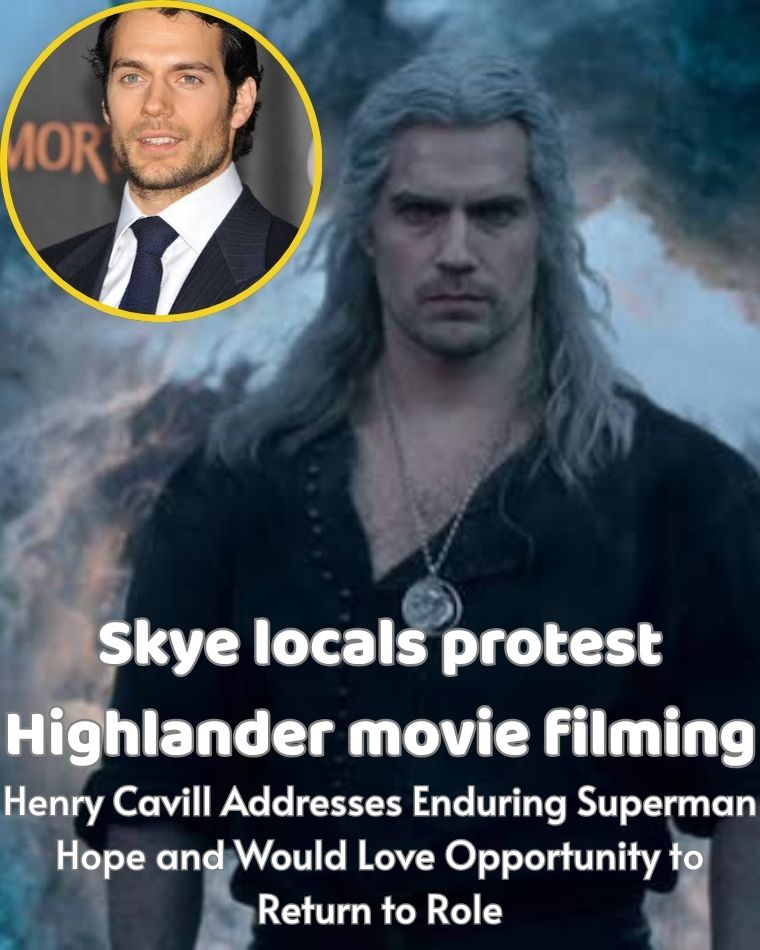
Cre: Wikimedia Commons — Gage Skidmore (CC BY-SA 2.0)
Yet behind the glitz of major movie star sightings, island residents have expressed serious fatigue.
The Isle of Skye is home to a permanent population of just over 13,000 people.
While locals initially welcomed the production with genuine excitement, that enthusiasm quickly cooled down.
“At first we were quite excited about having Highlander filmed on Skye,” one local resident noted.
“It’s not often you get big Hollywood actors roaming about,” the islander acknowledged.
The scale of the filming operation soon began to overwhelm the island’s narrow rural infrastructure.
Continuous noise from low-flying production helicopters has severely disrupted everyday peace across the region.
“The helicopters make so much noise that it’s hard to think,” the resident complained.
Aviation activity has been constant as crews capture sweeping aerial panoramas of the mountains.
In addition to aerial disturbances, ground movement across the island has faced stringent controls.
Access to key public footpaths and community trails has been repeatedly restricted by location security.
“The number of restrictions on public footpaths is getting on our nerves,” an island source stated.
Public walking routes are vital arteries for both daily community recreation and local rural livelihoods.
Long closures have left residents feeling locked out of their own backyards.
“We think they’re here for at least a few more weeks and it’s just become a huge nuisance,” the resident shared.
“Most people here just want it to be over,” the source added frankly.
Daily road closures and traffic delays have compounded the logistical strain on Skye’s single-track roadways.
Equipment trucks, mobile trailers, and support vehicles have filled staging areas around the island.
For an island whose community relies on quiet mobility, the corporate machinery of cinema has felt jarring.
Environmental sensitivity remains another central worry for Skye’s protective population.
The island’s fragile peat moors, rocky paths, and thin alpine turf take decades to recover when trampled.
Heavy machinery, temporary installations, and repeated crew foot traffic inevitably exert pressure on sensitive ecosystems.
Community members worry that months of intensive logistics will leave lasting scars on pristine conservation areas.
Nevertheless, official filming permits and site agreements indicate the production cleared necessary administrative clearances.
Location managers negotiated with regional Scottish bodies and land authorities before trucks rolled in.
Standard industry protocols typically mandate site remediation and landscape restoration once cameras wrap up.
Yet for residents living through the active schedule, theoretical guarantees do not erase current daily distress.
The clash mirrors similar debates in rural tourism hotspots across Western Europe.
Whenever blockbuster cinema enters delicate rural habitats, immediate disruptions collide with local well-being.
The original 1986 Highlander remains deeply ingrained in cinematic pop culture history.
Directed by Russell Mulcahy, the first installment blended historical drama, 1980s urban grit, and immortal mythology.
Its narrative introduced Connor MacLeod, a Scottish warrior banished from his clan after surviving fatal combat.
MacLeod discovers his true nature under the mentorship of Juan Sánchez-Villalobos Ramírez, famously played by Sean Connery.
The film cemented its cult status through iconic sword duels and an unforgettable rock soundtrack composed by Queen.
Decades later, the concept of immortal combatants battling across eras remains potent intellectual property.
The reboot is viewed by studio executives as a major commercial gamble on beloved 1980s fantasy lore.
Reviving the franchise demands balancing reverence for original traditions with contemporary action filmmaking.
Henry Cavill brings a devoted global following from his roles in high-profile action and fantasy productions.
Cavill’s dedication to rigorous physical training and swordplay choreography has been well documented by filmmakers.
His portrayal of Connor MacLeod aims to ground the immortal warrior in grit and historical authenticity.
Paired alongside Russell Crowe, the duo provides undeniable prestige to the ensemble.
Crowe’s presence adds commanding gravitas that evokes the seasoned mentorship found in classic action cinema.
Their scenes on Skye are expected to form the emotional bedrock of MacLeod’s Scottish origins.
The Scottish Highlands have long been an indispensable character within the Highlander universe.
Sweeping glens, heather-covered ridges, and brooding skies provide a visual grandeur that CGI cannot replicate.
Filming directly on Skye roots the story in an ancient, timeless atmosphere.
Production crews have worked carefully to transform outdoor sectors into period-accurate battlegrounds.
Stunt performers, medieval costumes, and armor props have turned wild hillsides into sixteenth-century clanscapes.
However, the sheer footprint required to shoot these expansive battle scenes is precisely what triggered pushback.
Large base camps require extensive power generators, catering facilities, and crew trailers.
When tucked into isolated highland glens, such industrial footprints become impossible to conceal from nearby hamlets.
The low rumble of machinery and sudden flash of production lights contrast sharply with island silence.
Furthermore, tourism patterns on the Isle of Skye have already been strained in recent post-pandemic seasons.
The island often struggles with visitor congestion along narrow single-track corridors during peak summer months.
Having major Hollywood infrastructure occupy public routes adds an unexpected layer of complication.
While film commissions champion film tourism for bringing economic injections, resident satisfaction remains fragile.
Local shopkeepers and hospitality venues often see mixed results when large closed-set shoots arrive.
Catering crews are frequently self-contained, meaning local spending is not always evenly distributed.
Despite the vocal opposition from islanders, the production team has pushed forward with its filming schedule.
Producers have adhered to agreed schedules to keep the costly international calendar on target.
Delays on a tentpole production can cost hundreds of thousands of dollars per day.
Hence, helicopters have kept flying and cameras have kept running through temperamental Highland weather.
Filmmakers have reportedly attempted to mitigate frictions by adjusting flight corridors and rescheduling sensitive takes.
Yet the inherent friction between commercial entertainment and local peace remains an unresolved dynamic.
The Isle of Skye episode underscores a broader debate across the global entertainment industry.
From remote Scottish moors to historic Mediterranean villages, popular filming destinations are demanding better boundaries.
Residents are no longer silent when their living spaces are transformed into closed movie sets.
They demand earlier consultation, clear caps on disruption, and absolute transparency regarding environmental protection.
For the Highlander reboot, the visual splendor of Skye will undoubtedly look spectacular on the silver screen.
Cinematographers will showcase the island’s misty peaks and dramatic sea views in breathtaking clarity.
Audiences worldwide will marvel at the raw wilderness that shaped Connor MacLeod’s legendary journey.
Yet for the 13,000 residents who call Skye their home year-round, the magic of the movies has felt exhausting.
Many on the island are counting down the final days until the cameras pack up and depart.
When the last helicopter lifts off, Skye will finally return to its quiet, windswept rhythm.
Để lại một phản hồi