Hollywood royalty Henry Cavill and Russell Crowe have arrived in northern Scotland to shoot the eagerly awaited reboot of the cult fantasy classic Highlander.
The high-profile production on the picturesque Isle of Skye has sparked considerable frustration and protest among island residents facing continuous disruption to daily life.
While producers celebrate returning the immortal mythology to its historic Scottish roots, the collision between a blockbuster movie operation and a quiet island community exposes deep tensions across remote Highland regions.
The Isle of Skye is globally celebrated for its dramatic geology, mist-shrouded moors, and iconic natural beauty.
The remote destination stretches across approximately 50 miles of rugged terrain.
Just over 13,000 residents call the tranquil Scottish island their permanent home.
Hollywood producers selected this unique geography to anchor the visual identity of the rebooted fantasy franchise.
The original film, released in 1986, introduced audiences to immortal swordsmen engaged in a centuries-long secret conflict.
Actor Christopher Lambert starred in the original classic as the immortal warrior Connor MacLeod.
The 1986 cinematic adventure cemented its enduring cult classic status through intense sword battles, mythical lore, and an unforgettable soundtrack performed by Queen.
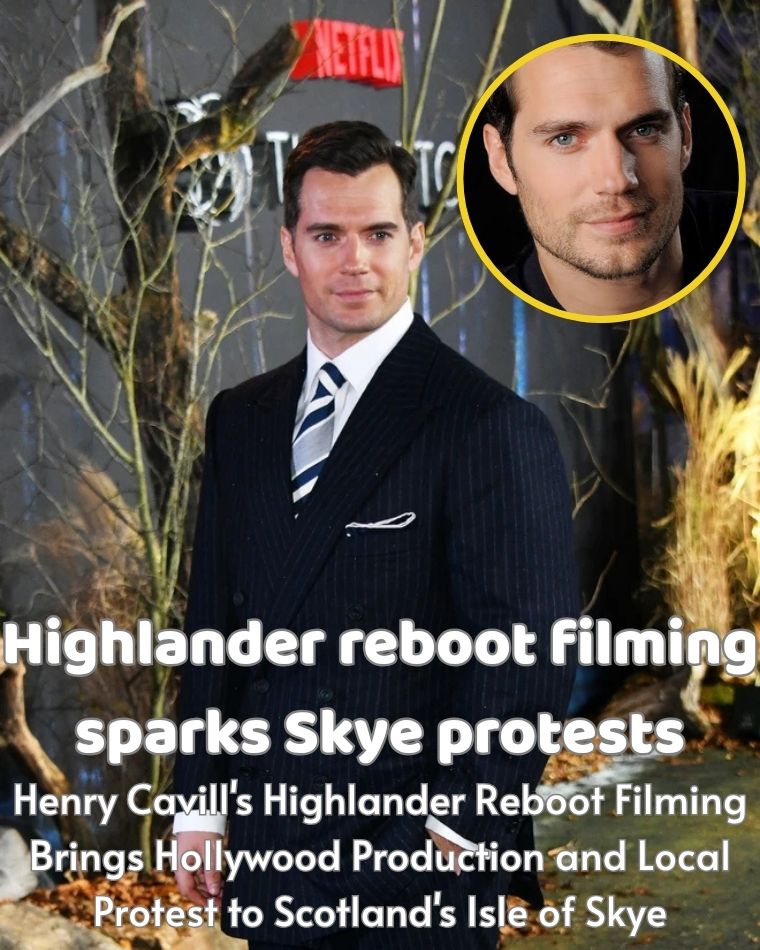
British star Henry Cavill now steps into the lead role of Connor MacLeod.
The character begins his journey as a 16th-century Scottish Highlander who discovers his astonishing immortality after surviving fatal combat.
Veteran actor Russell Crowe joins the cast, contributing commanding gravitas to the high-stakes swordplay franchise.
Production scouts selected the dramatic Trotternish landscape and wild moors on Skye to replicate the ancient battlegrounds essential to the lore.
Cre: Wikimedia Commons
However, the arrival of massive production units has triggered notable local opposition.
Residents initially greeted the film crew with curiosity and pride.
Seeing major Hollywood celebrities filming on local soil represented a rare spectacle for islanders.
That early goodwill quickly dissipated as the true scale of filming disruption materialized.
Logistical operations brought heavy vehicular movement along narrow island roads.
Strict access closures were placed on several popular public footpaths across scenic walking areas.
Island walkers and outdoor workers found themselves barred from long-standing rights of way.
Persistent helicopter activity quickly emerged as a primary grievance for the surrounding neighborhoods.
Local reports indicated multiple helicopters ferry personnel and capture panoramic aerial shots overhead throughout the day.
Residents have openly lamented the relentless engine noise echoing through once quiet valleys.
The continuous roar has made normal concentration and outdoor tasks nearly impossible for nearby homes.
Local observers noted that enthusiasm vanished when the quiet atmosphere gave way to industrial film noise.
Cre: Wikimedia Commons
Long-term islanders expressed acute fatigue over the extended filming calendar scheduled on Skye.
Several community voices warned that having rights of way blocked for weeks transformed excitement into pure nuisance.
Many local residents have openly admitted they simply want the entire Hollywood entourage to pack up and depart.
The situation illustrates an ongoing battle between global cinematic commercialism and local community preservation.
The Scottish Highlands have long welcomed major movie productions seeking ancient, sweeping backdrops.
Productions bring undeniable regional visibility and substantial commercial spending to nearby hospitality businesses.
Yet fragile island infrastructure frequently strains under the weight of fleet vehicles and hundreds of crew members.
Single-track roads on Skye are notoriously vulnerable to heavy congestion during tourism spikes.
Adding cinematic transport fleets creates immediate friction for locals attempting essential daily commutes.
Environmental sensitivity represents an equally prominent factor in local discontent.
Skye features delicate moorland turf, rare flora, and geologically sensitive hill trails.
Crews have erected period-specific set dressings to blend seamlessly into open fields and rocky crags.
Islanders worry that heavy equipment and repetitive site traffic could cause long-lasting ground scarring.
Despite community frustration and voiced grievances, production activities have steadily pressed forward.
The continuation of filming indicates producers successfully cleared all necessary local council permits and regulatory agreements beforehand.
High-level location agreements typically outline strict mitigation measures, cleanup mandates, and road management plans.
Nevertheless, official paperwork often fails to eliminate the immediate acoustic and physical intrusion felt by residents.
The production team faces the delicate challenge of executing ambitious action sequences while managing community relations.
For Hollywood executives, the new Highlander stands as an enormous financial gamble on 1980s fantasy intellectual property.
Reviving vintage genre franchises requires substantial capital, high-end visual effects, and elaborate staging.
The reboot banks heavily on Henry Cavill’s dedicated international fanbase.
Cavill has cultivated extensive credibility in period fantasy through prior blockbuster action roles.
His renowned dedication to physical training and authentic sword combat makes him a natural fit for Connor MacLeod.
Russell Crowe brings decades of prestigious action pedigree following iconic historical epics like Gladiator.
Pairing Cavill and Crowe provides formidable star power intended to appeal across distinct generations of moviegoers.
Director Chad Stahelski, acclaimed for reinventing modern action staging, has promised complex stunt design and grounded swordplay.
Delivering authentic sword clashes demands sprawling outdoor spaces where practical action can unfold naturally.
Filming on soundstages with green screens could not replicate the moody atmosphere of Scotland’s genuine terrain.
The winds, low-hanging clouds, and rugged stone of Skye provide an irreplaceable cinematic authenticity.
The original 1986 film drew enormous strength from genuine Scottish castles and Highland vistas.
Returning the narrative to its true geographic cradle honours the heritage of the beloved franchise.
Yet the islanders living alongside these iconic backdrops bear the full brunt of production logistics.
Their quiet lifestyle has been temporarily traded for aerial surveillance, motor convoys, and security checkpoints.
Crowe’s presence in Scotland has also attracted crowds of persistent onlookers and autograph collectors.
The veteran star was recently involved in a widely reported interaction with fans demanding photos outside his accommodation.
Crowe maintained that he managed the crowd firmly to ensure public pathways remained unobstructed.
The actor noted that order and space were essential when dealing with dense groups without personal bodyguards.
Such incidents underscore how celebrity attention ripples through otherwise peaceful Scottish towns.
As cameras continue rolling, the film crew must balance cinematic ambitions with local respect.
Once filming concludes, the production will move to studios and post-production suites.
The Isle of Skye will eventually return to its trademark quiet solitude.
Local communities will inspect the hills to ensure the ancient landscapes suffered no permanent harm.
Audiences around the world will eventually watch Cavill and Crowe battle across Skye’s dramatic cliffs on cinema screens.
For movie fans, Skye will stand as the timeless realm of immortal swordsmen.
For the 13,000 residents who live there, the shoot remains a vivid reminder of the disruptive cost of modern movie making.
The tension between heritage preservation and entertainment commerce will continue to define filming in protected environments.
Để lại một phản hồi