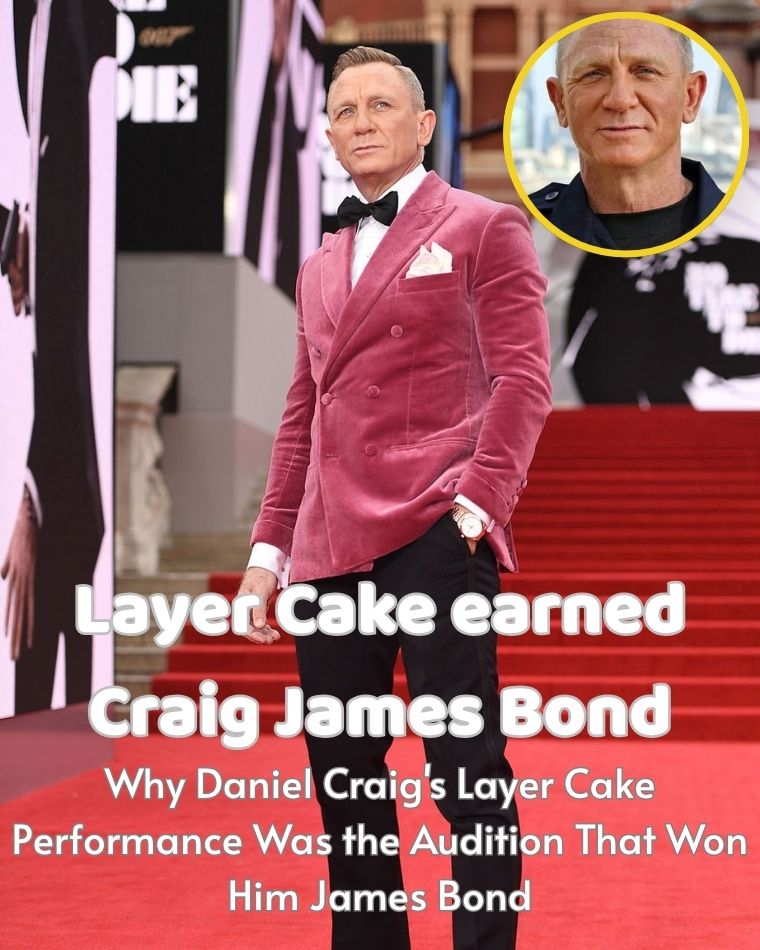
Two years before reinventing Agent 007 in Casino Royale, Daniel Craig delivered a career-defining turn in Matthew Vaughn’s British crime thriller Layer Cake. Playing an unnamed narcotics distributor navigating a perilous criminal exit, Craig demonstrated the exact balance of grounded grit, intellectual calculation, and psychological exhaustion that Barbara Broccoli and Michael G. Wilson required to launch a new cinematic era. His 2004 performance directly established the aesthetic, tonal, and thematic framework that transformed James Bond from gadget-heavy spectacle into character-driven realism.
The Crime Thriller That Shifted British Cinema
In 2004, director Matthew Vaughn made his feature directorial debut with an adaptation of J.J. Connolly’s novel Layer Cake.
The story centered on an unnamed cocaine distributor operating quietly within the London underworld.
Unlike traditional cinematic crime figures who revel in chaos and swagger, Craig’s protagonist operated with corporate precision.
He wore bespoke suits and maintained strict rules designed specifically to avoid prison sentences and unnecessary violence.
His entire career strategy depended on remaining invisible while accumulating sufficient wealth to retire early.
However, the criminal hierarchy never permits clean departures without exacting severe costs.
A demanding syndicate chief assigned him two conflicting tasks: locating a drug kingpin’s missing daughter and brokering a massive shipment of ecstasy pills.
These tasks immediately drew him into violent encounters with rival factions and unpredictable operators.
Craig brought a distinct blend of composure and mounting desperation to every sequence.
Audiences witnessed a modern antihero who calculated risks mathematically rather than charging forward recklessly.
Cre: Wikimedia Commons
The Audition Producers Never Formally Scheduled
During the early 2000s, Eon Productions faced a critical artistic crossroads regarding the future of the James Bond franchise.
Pierce Brosnan had concluded his tenure with Die Another Day in 2002.
While that installment achieved commercial success, its invisible cars and excessive computer-generated effects drew widespread criticism.
Producers Barbara Broccoli and Michael G. Wilson recognized that modern audiences demanded authentic physical stakes.
The worldwide success of grounded espionage cinema had altered audience expectations entirely.
Broccoli and Wilson needed an actor capable of stripping away cartoonish artifice.
When the producing duo viewed Layer Cake, they observed an actor already executing that exact tonal balance.
Craig’s nameless distributor was not an undercover government agent, yet he moved through danger with lethal precision.
He demonstrated complete mastery of physical space during confrontations while never appearing invulnerable.
His performance communicated that violence carried genuine physiological and psychological consequences.
Every blow left visible bruises, and every betrayal took an emotional toll on his composure.
Broccoli later identified that specific viewing as the moment she knew Craig was the ideal choice for Ian Fleming’s hero.
Scenes That Showcased Physicality and Vulnerability
Several key sequences within Layer Cake highlighted the precise range needed to execute a franchise reboot.
In one pivotal scene inside a sunlit tea shop, Craig’s character is suddenly assaulted by a brutal enforcer.
The violence arrived without theatrical fanfare or stylized martial arts choreography.
Instead, the camera captured awkward, desperate self-defense where survival required ruthless improvisation.
Craig portrayed real physical panic followed immediately by cold tactical reassessment.
Another vital sequence involved the protagonist purchasing a customized firearm inside an ordinary flat.
He handled the weapon with calm, practiced familiarity rather than cinematic bravado.
He understood the mechanical purpose of the tool without glorifying the destruction it caused.
Later in the narrative, he suffered a terrifying ambush inside an underground parking facility.
Trapped inside a car while heavy gunfire shattered the glass, his eyes conveyed profound terror paired with sharp situational awareness.
He did not pose as an untouchable action hero immune to mortality.
That palpable sense of human vulnerability became Craig’s signature contribution to modern action cinema.
📸 [ẢNH: Nhà sản xuất phim Barbara Broccoli tại một sự kiện công chiếu điện ảnh]
Nguồn: Wikimedia Commons — Ảnh giấy phép Creative Commons Attribution 2.0 Generic
A Visual and Tonal Blueprint for Casino Royale
The creative impact of Layer Cake extended far beyond Daniel Craig’s personal casting process.
Director Matthew Vaughn utilized a muted visual palette dominated by cool greys, sterile glass, and sharp lighting.
The production design favored austere modern architecture over opulent, romanticized hideouts.
Action set pieces emphasized practical stunts, heavy impacts, and rapid environmental navigation.
When director Martin Campbell began filming Casino Royale in early 2006, the production embraced very similar visual language.
Casino Royale stripped away eccentric villainous lairs in favor of functional corporate suites and sun-bleached construction sites.
The legendary foot chase across Madagascar reflected the same ground-level intensity established in British independent crime dramas.
Bond bled through his shirts and sustained swollen tissue across his face throughout missions.
Like the nameless distributor, Bond wore tailored clothing that suffered realistic tearing during combat.
The narrative treated tactical miscalculations as genuine threats rather than minor narrative pauses.
Layer Cake had demonstrated that audiences would embrace a protagonist who appeared genuinely exhausted by violence.
Casino Royale adopted that philosophy and applied it across an international scale.
Diverging From Previous Action Protagonists
Throughout the 1990s and early 2000s, mainstream action cinema frequently celebrated invincible protagonists.
Characters tossed off humorous one-liners immediately after terminating opponents.
Death rarely carried weight, and moral ambiguity was largely relegated to secondary antagonists.
Craig’s interpretation of Vaughn’s protagonist rejected those comfortable commercial conventions.
His character spent substantial screen time silently processing regret and anticipating consequences.
He conveyed deep intellectual isolation through subtle facial shifts rather than expository dialogue.
When forced to eliminate an enemy, he showed physical tremors and emotional disturbance rather than triumphant satisfaction.
This grounded methodology directly challenged the established formula of classic British espionage.
James Bond had historically represented unshakeable aristocratic poise under extreme duress.
Craig preserved the sophistication while introducing an underlying current of working-class ferocity.
He moved like an experienced boxer forced into high society rather than an entitled socialite playing at espionage.
This fusion created an authentic dynamic that felt relevant to twenty-first-century geopolitical tensions.
The Initial Public Backlash and Industry Skepticism
When Eon Productions officially announced Daniel Craig as the sixth James Bond in October 2005, the public reaction proved remarkably hostile.
The formal press conference along the River Thames involved Craig arriving aboard a military speedboat wearing a life vest.
Tabloid newspapers seized upon minor details to question his suitability for the legendary role.
Commentators complained that his blond hair and rugged facial features diverged from traditional character descriptions.
Internet forums launched dedicated boycott campaigns demanding that producers reverse their decision.
Critics doubted whether an actor known for independent dramas like Some Voices and The Mother possessed international star power.
Industry skeptics questioned whether mainstream moviegoers would accept a less conventionally polished 007.
The intense media scrutiny created immense pressure throughout principal photography across Europe and the Bahamas.
Crew members and producing partners maintained silence while continuing rigorous daily filming schedules.
They understood that the general public had simply not yet seen the grounded vision Craig was crafting.
Those who had studied Layer Cake remained confident that the performance would silence skepticism upon release.
Redefining Ian Fleming’s Literary Agent
Paradoxically, Craig’s gritty portrayal in Layer Cake positioned him closer to Ian Fleming’s original literary creation than many predecessors.
Fleming’s novels depicted James Bond as a troubled civil servant burdened by dangerous assignments.
In the books, Bond drank heavily to suppress psychological trauma and frequently questioned his trade.
He was described as having a hard, cold mouth and a cruel edge beneath his tailored dinner suits.
The cinematic series had gradually softened those edges over four decades of commercial expansion.
By observing Craig navigate moral degradation in Layer Cake, producers recognized an actor capable of accessing Fleming’s original tone.
His character was neither sadistic nor heroic; he was simply a disciplined technician trapped in violent circumstances.
When Casino Royale debuted in November 2006, critical reception shifted almost overnight.
Reviewers praised Craig for revitalizing a stagnant franchise through sheer dramatic commitment.
Audiences responded enthusiastically to the emotional depth he brought to Bond’s romance with Vesper Lynd.
The skepticism of late 2005 vanished as the film achieved record-breaking worldwide box office returns.
The Legacy of Craig’s Pre-Bond Work
The narrative path leading from Layer Cake to Casino Royale illustrates how independent cinema regularly reshapes commercial franchises.
Without Matthew Vaughn’s uncompromising direction, Craig might have remained categorized primarily as a character actor.
Layer Cake provided the precise stage needed to demonstrate that psychological complexity and physical action could coexist seamlessly.
The film proved that an actor could look natural in an expensive tailored suit while projecting genuine menace.
That specific combination remains one of the rarest qualities in modern screen acting.
Craig carried that aesthetic through five blockbuster installments spanning fifteen consecutive years.
His tenure concluded in 2021 with No Time to Die, cementing his status as one of the most successful franchise leads in history.
Subsequent action franchises adopted the realistic, bruising fight mechanics popularized during his run.
The era of effortless, consequence-free heroism was largely replaced by stories examining physical wear and mental strain.
Film historians frequently analyze Layer Cake today as the essential prologue to modern franchise storytelling.
It remains a masterclass in controlled performance and economic visual storytelling.
For Daniel Craig, playing an unnamed criminal seeking an escape hatch became the exact vehicle that unlocked cinema’s most coveted badge.
Để lại một phản hồi