Long before the world recognized him as the quintessential modern James Bond or the sharp-tongued detective Benoit Blanc, Daniel Craig spent years sharpening his dramatic craft across the demanding landscapes of British television.
A graduate of the Guildhall School of Music and Drama, Craig stepped away from conventional paths to tackle raw, complex characters within historical and social period pieces.
These television productions tested his technical control, emotional range, and psychological honesty, laying the groundwork for an enduring career on international cinema screens.
The Forgotten Masterclass of British Period Dramas
International cinema enthusiasts often perceive Daniel Craig as an actor who materialized overnight into high-budget Hollywood blockbusters.
That impression overlooks more than a decade of meticulous screen work inside the BBC and independent British broadcasting systems.
British period television has never been merely about decorative costumes, idyllic country manors, or polite tea conversations.
For serious actors, costume drama serves as a rigorous testing ground for physical restraint, psychological depth, and vocal precision.
Craig deliberately chose projects that avoided easy romanticism, gravitating toward raw period environments that challenged conventional television archetypes.
These scripts required performers to disappear into historical dialect, peculiar gait, and rigid class dynamics rather than relying on surface charisma.
In that demanding production environment, an actor either develops deep internal technique or gets buried beneath heavy garments and set decoration.
Craig embraced the discipline, discovering how quiet gestures can telegraph profound emotional fractures across an entire narrative arc.
The small screen did not constrain his ambition; it forced him to eliminate vanity and strip away superficial affectation.
Working with restricted budgets and tight broadcast schedules taught him how to deliver maximum dramatic resonance on the first take.
Audiences accustomed to glossy franchise spectacles miss the delicate foundation that makes Craig’s screen presence feel singularly authentic.
By immersing himself in distinct cultural eras, Craig learned that history is shaped by wounded, ordinary figures rather than invulnerable archetypes.
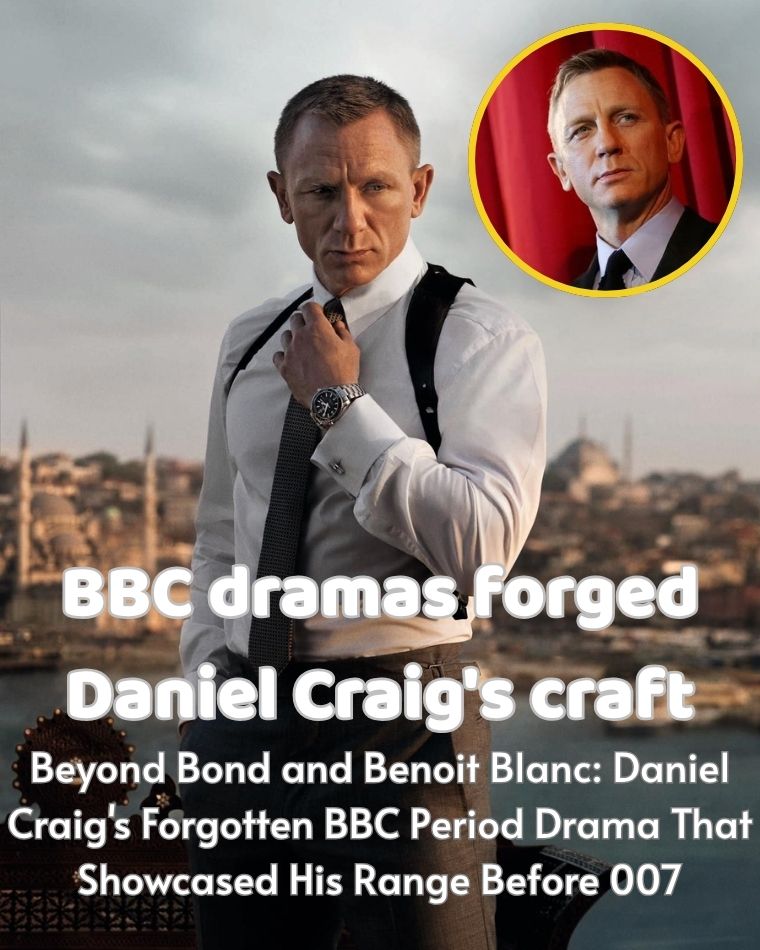
Cre: Wikimedia Commons
The Breakthrough: Geordie Peacock in Our Friends in the North
The defining benchmark of Craig’s television era arrived in 1996 with Peter Flannery’s landmark BBC drama serial, Our Friends in the North.
The ambitious nine-part epic tracked four Newcastle companions over three turbulent decades, spanning from 1964 all the way to 1995.
Craig shared the screen with formidable talents Christopher Eccleston, Gina McKee, and Mark Strong.
Craig portrayed George “Geordie” Peacock, an impulsive, naive, and fundamentally wounded young man whose journey becomes a heartbreaking spiral.
Geordie flees northern domestic strife for the chaotic underbelly of London, getting ensnared in Soho nightlife, police graft, and deep personal trauma.
Playing Geordie across thirty fictional years presented a terrifying technical test for any young performer.
Craig had to evolve his character from an energetic adolescent into a haunted, middle-aged figure worn thin by chronic grief and institutional abuse.
He achieved this transformation not through prosthetic tricks alone, but through visceral alterations in his breathing, posture, and ocular focus.
Every passing decade left a visible emotional residue across Geordie’s weary countenance.
The series confronted northern social decay, labor unrest, and political corruption with uncompromising emotional honesty.
Craig refused to sweeten Geordie’s erratic decisions, ensuring the audience recognized both his tragic tenderness and his devastating self-destruction.
When Geordie finally encounters his old friends decades later, Craig conveys a lifetime of sorrow using little more than a shattered glance.
Critical circles in the United Kingdom immediately recognized that an extraordinary new cinematic heavyweight had arrived on British television.
The performance proved Craig could anchor massive, sprawling narratives without ever sacrificing intimate, nuanced truth.
Exploring Moral Ambiguity Beyond Conventional Heroes
Geordie Peacock was far from an isolated experiment in Craig’s evolving repertoire.
Craig consistently avoided the uncomplicated leading-man roles routinely offered to handsome young British actors of his generation.
Instead, he actively pursued characters burdened with glaring character flaws, internal shame, and ethical ambiguity.
Period drama served as the ideal arena for exploring characters whose choices were suffocated by their historical circumstances.
In television adaptations like Moll Flanders (1996), Craig embraced moral fragility, showing that human desire frequently collides with societal survival.
In Sharpe’s Eagle (1993), Craig stepped into the boots of Lieutenant Berry, playing an arrogant, corrupt officer opposite Sean Bean.
Playing unlikable antagonists in costume pieces helped Craig dismantle the vanity that frequently traps emerging stars.
He discovered how to uncover human vulnerability within cruel or compromised men without pleading for cheap audience sympathy.
Costume dramas demanded total mastery of non-verbal dialogue, subtle subtext, and strict historical manners.
Actors in these productions had to convey resentment, lust, or grief through rigid, polite physical interactions.
Craig mastered the practice of internalizing turbulent emotions beneath an impassive exterior.
That specific skill would later become the defining hallmark of his mature screen presence.
Rather than announcing an emotion through broad theatricality, he learned to suppress it on camera.
The camera registered that internal tension, creating an unmistakable, magnetic presence that held viewers captivated.
Historical roles provided a continuous workshop in emotional distillation, showing him that quiet choices carry the sharpest bite.
The Bridge to Archangel and Dramatic Maturity
Even on the verge of major cinematic stardom, Craig maintained his allegiance to prestigious British small-screen storytelling.
In 2005, the BBC produced Archangel, a gripping television film based on the acclaimed political thriller novel by Robert Harris.
Craig took on the role of Fluke Kelso, a washed-up, cynical English historian attending an academic conference in post-Soviet Moscow.
Kelso gets drawn into a dangerous mystery involving Joseph Stalin’s secret personal notebook and long-buried Soviet state secrets.
The atmosphere in Archangel was bleak, frosty, and heavy with historical disillusionment.
Craig inhabited the character of the weary academic with authentic physical and intellectual fatigue.
He was not an infallible action star; he was an obsessive scholar driven by curiosity into circumstances far beyond his physical control.
The performance demonstrated Craig’s rare talent for making analytical intellect feel immediate and dramatically suspenseful.
Filmed in freezing conditions in Russia and Eastern Europe, the production reflected the unglamorous dedication that Craig brought to screen work.
He carried the weight of the historical narrative with quiet determination, eschewing showy flourishes.
Archangel was broadcast on the BBC during the pivotal window when industry buzz regarding the next James Bond reached a crescendo.
It offered clear evidence that Craig possessed the intellectual gravity required to carry serious, adult-oriented thrillers.
The role highlighted his capability to depict men who are vulnerable, battered, yet unwilling to surrender their principles.
For discerning viewers, Archangel served as a potent bridge linking his early television period work directly to world-class cinema.
How British Television Forged the 007 Revolution
When Barbara Broccoli and Michael G. Wilson announced Daniel Craig as the sixth cinematic James Bond in October 2005, skepticism erupted across mainstream media.
Commentators voiced concern that the blond, intense actor lacked the effortless charm and suave polish traditionally associated with agent 007.
What those detractors failed to realize was that franchise producers specifically sought the gravitas Craig had developed through British television.
Producer Barbara Broccoli had monitored Craig since his breakout in Our Friends in the North, noting his magnetic emotional weight.
When Casino Royale premiered in 2006, Craig altered the DNA of the James Bond character forever.
His 007 was not a detached fantasy figure sipping drinks without an emotional scratch.
Craig gave audiences a Bond who bled, doubted, grieved, and suffered genuine physical and emotional trauma.
The emotional vulnerability on display during Vesper Lynd’s tragic arc drew straight from Craig’s background in British character drama.
The economy of movement he employed inside hotel rooms and interrogation chambers mirrored his training in restrictive period costumes.
Craig understood how to communicate a lifetime of military and psychological scar tissue with minimal spoken dialogue.
His Bond was a man visibly shaped by his era, bearing burdens reminiscent of the working-class figures he inhabited on BBC productions.
The emotional realism that made Casino Royale a critical and commercial triumph was born in television studios years before.
Without Geordie Peacock and the BBC television workshop, the grounded, post-Cold War reinvention of Bond would never have occurred.
British Television as the Ultimate Screen Crucible
The trajectory of Daniel Craig highlights why British television remains an invaluable crucible for world-class screen acting.
In the United Kingdom, television drama has historically shared deep structural DNA with the repertory stage.
Actors are not segregated into rigid hierarchies of “television performers” versus “prestige film stars.”
A performer moves freely between West End stages, BBC miniseries, radio plays, and high-profile cinematic features.
This fluid exchange creates an artistic culture where serving the text takes precedence over personal ego.
BBC productions are notoriously writer-centric, built around complex historical themes and rigorous language rather than special effects.
Performers are pushed to uncover psychological truth across tightly budgeted, demanding schedules.
Working on series like Our Friends in the North gave Craig deep experience alongside seasoned actors like Peter Vaughan and David Bradley.
Observing veteran British character actors taught him how to occupy a frame without superfluous movement.
British period television demands respect for vocal cadence, social class markers, and the historical reality of the characters.
There is no room for anachronistic mannerisms or contemporary vanity in a serious period drama.
An actor must surrender completely to the social etiquette, emotional repressions, and physical labor of the depicted era.
That rigorous discipline cultivates a grounded humility that rarely develops in actors trained solely inside commercial film franchises.
For Craig, this television foundation became an unshakeable anchor across decades of intense Hollywood scrutiny.
Rediscovering Craig’s Early Repertoire
For film enthusiasts who know Craig exclusively through Casino Royale, Skyfall, or Knives Out, his 1990s television catalogue is a revelation.
Revisiting these early works provides a fascinating study in the development of a master screen craftsman.
Our Friends in the North stands as essential viewing for anyone wishing to understand the evolution of modern British drama.
Craig’s transformation across the nine episodes remains one of the most stunning character studies in television history.
Viewers will discover an actor possessing raw, volatile energy, completely unburdened by the weight of global celebrity.
Watching Craig portray Geordie Peacock illuminates the psychological blueprint of his later work.
The quiet pain that broke Geordie’s spirit is the exact same melancholic depth that Craig injected into James Bond’s final moments.
His television archive reveals an artist consistently interested in the human cost of violence, hubris, and class division.
These dramas remind us that long before Craig wore designer tuxedos, he wore the worn wool coats of working-class dreamers.
He earned his place on cinema marquees through sweat, patience, and rigorous dedication to storytelling.
The small screen did not merely showcase his raw talent; it shaped his artistic soul.
Rediscovering these early titles is not an exercise in nostalgia; it is a masterclass in the art of dramatic performance.
The Lasting Mark of a Craftsman
In contemporary cinema, stardom is frequently built upon brand recognition rather than fundamental acting technique.
Daniel Craig represents a compelling balance: a global movie star whose core identity remains that of a working character actor.
His willingness to tackle complex, unglamorous roles stems directly from his formative years on British television.
Whether portraying a conflicted spy, an eccentric detective, or a broken wanderer, Craig works from an internal core of restraint.
He understands that the most powerful moments on film happen in the silence between spoken lines.
That wisdom cannot be acquired through commercial franchise training alone.
It is forged through hours of character work, historical immersion, and intimate narrative stakes.
Craig’s period drama years in the UK provided the ultimate creative education.
They taught him to respect character nuance, embrace human fragility, and honor the broader narrative canvas.
Those lessons accompanied him onto the world’s grandest cinematic stages, redefining blockbuster cinema for a generation.
His early BBC performances stand as a testament to the transformative power of disciplined craft.
They reveal an actor who never sought easy applause, choosing instead the lasting resonance of quiet truth.
Craig’s path serves as a vital reminder that enduring screen presence is constructed one honest frame at a time.
Để lại một phản hồi