The Kansas City Chiefs secured an exhilarating 33-30 overtime victory over the Indianapolis Colts after Patrick Mahomes produced a sensational 30-yard loft to wide receiver Tyquan Thornton.
The clutch completion flipped field position entirely at a moment when the game hung on a knife-edge, putting Kansas City deep into Indianapolis territory and setting up the game-winning drive.
Here is an in-depth film breakdown of how pre-snap diagnostic ability, boundary leverage, and extraordinary ball placement coalesced to create one of the season’s defining offensive plays.
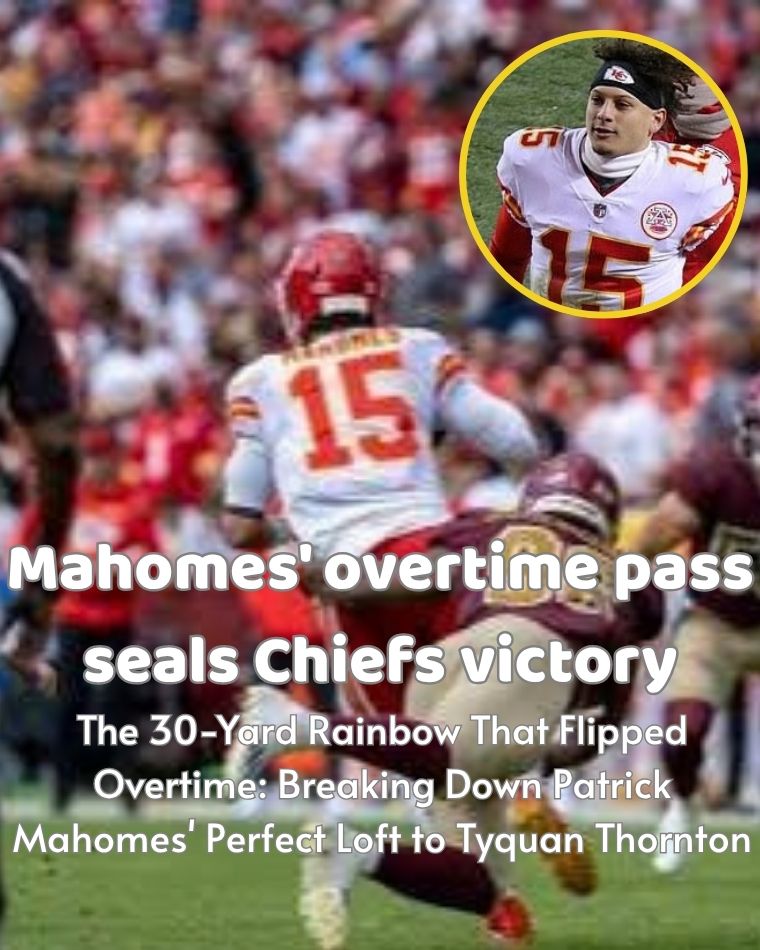
Cre: Wikimedia Commons
Overtime in the National Football League leaves virtually zero margin for schematic miscalculations or mechanical hesitation.
When the Kansas City Chiefs lined up in the extra period against the Indianapolis Colts tied at 30-30, every possession carried game-ending weight.
One blown protection assignment or intercepted pass could instantly hand the opposing sideline decisive field position.
Indianapolis had pushed Kansas City throughout the entire contest, forcing nearly a dozen lead changes and game ties during regulation.
The Chiefs offense needed a play that could bypass the defense’s aggressive underneath congestion without introducing unnecessary turnover volatility.
Patrick Mahomes stepped up to the line of scrimmage knowing the Colts intended to constrict intermediate passing lanes and dare him to test deep single coverage.
The defensive front showed initial balance, but the shell structure hinted at a safety rotation designed to punish inside seams.
Mahomes quickly identified the corner alignment opposite Tyquan Thornton along the perimeter.
Indianapolis aligned in an off-man technique with inside leverage, a common tactic against receivers possessing world-class straight-line speed.
The Colts defensive back surrendered a slight cushion to guard against being beaten clean off the snap on a vertical go-route.
However, that calculated cushion gave Mahomes the exact schematic cue he needed before snapping the football.
If Thornton could stem his route with precision and threaten the defender’s outside shoulder, the boundary would open up an exploitable throwing corridor.
Mahomes recognized that a laser pass might draw closing safety help or get contested by a recovering corner.
Instead, the situation demanded a loft throw—a pass placed with high trajectory that traded velocity for pinpoint dropping touch.
Tyquan Thornton’s route execution served as the essential mechanical catalyst for the play’s explosive outcome.
Selected originally by the New England Patriots in the second round of the 2022 NFL Draft, Thornton brought elite 4.28 speed into Andy Reid’s Kansas City scheme.
At the snap, Thornton did not simply sprint blindly along the sideline.
He attacked the cornerback’s leverage by pushing hard toward the defender’s inside hip across the first ten yards.
This stem forced the defender to freeze his feet and open his hips toward the middle of the field to protect the post.
The moment the cornerback committed his weight toward the inside hash, Thornton snapped his route toward the outside boundary.
By stacking the defender on his back hip, Thornton created a clear path between himself and the sideline.
He maintained sufficient sideline spacing, avoiding the classic wide receiver mistake of pinching himself too close to the white paint.
This disciplined spacing gave Mahomes a wide drop zone to target without requiring an impossible sideline toe-tap.
Separation in the NFL rarely means open prairie grass; it often means a single half-stride of favorable hip positioning.
Thornton generated that decisive half-stride through precise footwork and deliberate route pacing.
His discipline set the stage for Mahomes to unleash the football before the safety over the top could recognize the flight path.
Mahomes operated from a clean pocket, gathering his base and assessing the window as Thornton crossed the twenty-yard mark.
Rather than driving the ball on a flat trajectory, Mahomes altered his arm angle to generate deliberate loft.
Driving the ball with maximum velocity on a line drive would have flattened the trajectory and reduced the receiver’s margin for error.
A flat throw allows a trailing cornerback to dive through the catch point or swat through the receiver’s arms from behind.
By elevating the ball high into the air, Mahomes forced the ball to descend at a steep, dropping angle.
The high arc eliminated the defensive back’s ability to locate and disrupt the football over his shoulder.
The ball traveled thirty air yards before gently dropping over Thornton’s outstretched hands along the sideline.
Mahomes placed the throw into what quarterback coaches routinely term “the bucket.”
Thornton did not have to decelerate or jump erratically back toward the line of scrimmage to secure possession.
He maintained his forward sprinting stride, allowing the ball to land softly into his breadbasket before tracking his cleats inside the sideline boundaries.
The timing between the quarterback’s release and the receiver’s catch point resembled an orchestrated practice rep rather than high-stakes overtime improvisation.
Both players exhibited total faith in the geometric trajectory of the football under immense environmental pressure.
Beyond the technical route dynamics, this throw underscored Mahomes’ refined mechanics and pocket comfort.
Throughout his career, Mahomes has dazzled the football world with off-platform throws and sidearm lasers.
Yet as defenses increasingly deploy two-high safety shells to prevent immediate explosive plays, his reliance on refined touch has become paramount.
Against Indianapolis, Mahomes displayed absolute command of functional base mechanics and lower-body stability.
He transferred his weight cleanly from his plant foot through his hips without overextending his throwing arm.
His pocket maneuverability was calm, calculated, and devoid of unnecessary panic.
He climbed into the pocket naturally, demonstrating complete trust in his lower-half balance and core rotational power.
This mechanical stability translated directly into elite ball placement on downfield perimeter attempts.
Touch passes require superior arm strength and grip control to maintain tight spiral rotation while taking velocity off the delivery.
If a passer lacks sufficient arm talent, putting air under the ball turns it into a wobbling flutter ball vulnerable to closing defensive backs.
Mahomes spun a tight spiral with enough backspin to hold its line against wind resistance while remaining soft on reception.
His willingness to target Thornton thirty yards downfield in overtime demonstrated complete confidence in the receiver’s tracking capability.
Head Coach Andy Reid consistently demands that his quarterbacks trust the play structure and strike deep when single coverage presents itself.
Mahomes validated that coaching philosophy with ruthless efficiency on this single snap.
The strategic impact of Thornton’s 30-yard reception went far beyond adding positive yardage to the box score.
Prior to that completion, Kansas City faced the daunting task of conducting a long, grind-it-out drive from deep inside their own territory.
A long drive forces an offense to execute eight to ten consecutive mistake-free plays against an aggressive defense.
One holding penalty or tackle for loss can stall a drive and force a punt in sudden-death territory.
Thornton’s catch instantly moved the Chiefs across the 50-yard line and directly into Colts territory.
Crossing midfield fundamentally transformed Kansas City’s play-calling latitude for the remainder of the possession.
Offensive coordinator Eric Bieniemy and Andy Reid no longer needed to chase low-percentage chunk plays downfield.
They could lean into high-percentage intermediate targets, screen concepts, and reliable rushing lanes.
Just snaps after Thornton’s reception, tailback Ken Walker secured a vital third-down pass and weaved through Indianapolis defenders for a 22-yard gain deep into scoring territory.
That complementary sequence brought Kansas City within easy striking distance for their special teams unit.
Kicker Harrison Butker trotted onto the field and calmly split the uprights on a 40-yard game-winning field goal.
While Butker delivered the official knockout blow, Mahomes’ 30-yard loft to Thornton served as the tactical engine that made the game-winning kick possible.
The play will stand as a textbook clinic on how elite quarterbacks read leverage and manipulate trajectory to break overtime deadlocks.
Để lại một phản hồi