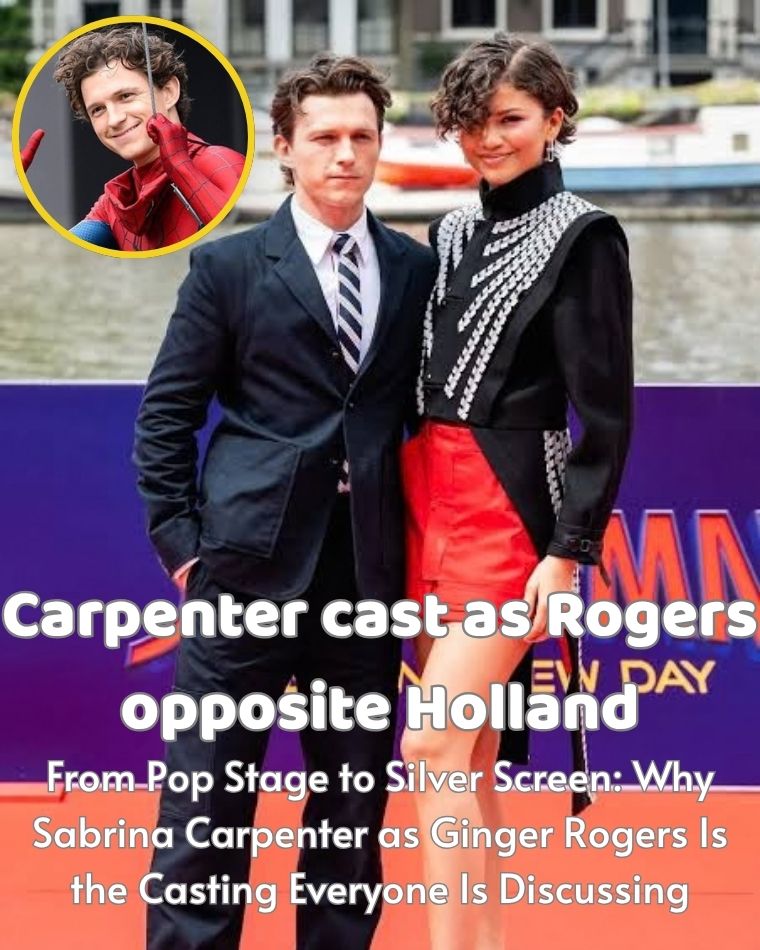
Pop superstar Sabrina Carpenter has reportedly been cast to portray screen icon Ginger Rogers alongside Tom Holland in the upcoming Fred Astaire biographical drama.
Leading entertainment outlets have confirmed the buzz around the pairing, uniting modern music royalty with Hollywood’s celebrated golden era.
Here is an in-depth examination of the high-profile casting report, the rigorous demands of Rogers’ legendary dance legacy, and what this cinematic fusion means for modern audiences.
A modern voice dominating streaming charts is preparing to step backward into the crisp black-and-white elegance of 1930s Hollywood.
The contrast between today’s digital pop landscape and the mid-century studio system could hardly be sharper.
According to multiple major entertainment publications, Sabrina Carpenter is set to take on the role of Ginger Rogers.
She is slated to appear opposite Tom Holland, who portrays Fred Astaire in the biographical feature centered on the legendary performer.
The story was prominently reported across mainstream entertainment journalism, including People, Rolling Stone, Vogue, The A.V. Club, and Paste.
Together, these outlets highlighted the sheer cultural resonance of pairing one of music’s brightest contemporary stars with an enduring screen icon.
The announcement instantly ignited conversation across industry circles and among classic film aficionados.
It shifts the conversation from a traditional historical drama into a broader cultural crossover event.
Playing Ginger Rogers is far more than wearing vintage silken gowns and smiling beneath studio key lights.
The assignment demands an understanding of a specific screen craft that has virtually vanished from mainstream commercial filmmaking.
Cre: Wikimedia Commons — Creative Commons Attribution-Share Alike 4.0 International
Rogers was not merely a decorative screen presence across mid-century cinema.
She was Fred Astaire’s definitive dance partner throughout their landmark run at RKO Pictures during the Great Depression.
Their partnership produced ten celebrated films that transformed the movie musical into a premier American art form.
Together, Rogers and Astaire redefined the grammar of movement captured on celluloid.
Their classic pictures include beloved cinematic benchmarks such as Top Hat, Swing Time, The Gay Divorcee, and Shall We Dance.
In these films, Rogers matched Astaire stride for stride in complex tap choreography, sweeping ballroom waltzes, and intricate duets.
Astaire himself famously insisted that camera movement remain minimal during their elaborate routines.
He believed the choreography belonged to the performers rather than the film editor’s scissors.
As a result, their sequences were recorded largely in wide, unbroken, full-body camera takes.
Every step, syncopation, and balance shift was captured in real time without the modern luxury of quick digital edits.
Rogers famously had to perform everything Astaire did, matched to perfection and executed in towering high heels.
She bore the physical toll of floor-length gowns weighed down with feathers, beads, and trailing trains.
During the filming of their famous routines, wardrobe complications frequently collided with athletic endurance.
A single missed step or miscalculated spin meant starting the entire dance routine over from measure one.
Beyond her athletic and artistic partnership with Astaire, Rogers established herself as an independent Hollywood powerhouse.
She possessed sharp comic timing and dramatic range that extended far beyond ballroom dance floors.
Rogers went on to win an Academy Award for Best Actress for her dramatic lead performance in Kitty Foyle.
She commanded the screen in screwball comedies, romantic melodramas, and stage revivals throughout her storied career.
Any performer stepping into her shoes must project both technical dancing competence and magnetic screen charisma.
That dual demand brings significant attention to Sabrina Carpenter’s casting in the project.
Carpenter brings years of disciplined stage experience, vocal command, and musical precision to the table.
Her extensive concert tours and live stage productions showcase an artist comfortable with intricate movement and timing.
Live theatrical discipline instills muscle memory and a strong intuitive sense of rhythm.
Those performance instincts translate directly into the physical cadence required for classic film choreography.
Yet historical tap and period ballroom dancing demand a vastly different kinetic discipline than modern pop performance.
Studio-era dance routines relied on grounded weight transfers, pristine foot isolation, and rigid upper-body posture.
Every line of the neck, spine, and fingertips carried equal weight in framing the image.
Tom Holland brings an extensive foundational background in dance and acrobatic movement from his early stage work.
Holland first rose to prominence in London’s West End as the title lead in Billy Elliot the Musical.
That rigorous stage background gave him the foundational mechanics essential for channeling Astaire’s effortless physical grace.
Pairing Holland and Carpenter links two performers with early physical disciplines grounded in music and theater.
Their joint casting creates a compelling bridge between classical performance craft and contemporary audiences.
Major coverage from fashion and culture outlets like Vogue and Rolling Stone reflects this powerful crossover appeal.
Publications recognized that Carpenter’s involvement introduces vintage RKO history directly to an entirely new demographic.
Millions of younger pop listeners who may never have seen a 1930s musical will now encounter the work of Rogers and Astaire.
Biographical films inherently walk a fine line between historical homage and modern creative reinvention.
Bringing contemporary star power to historic material can revitalize appreciation for vintage cinema when done with care.
It honors the creative foundations that modern pop choreographers and video directors still borrow from today.
Astaire and Rogers were among the earliest pop icons whose collaborative routines set the standard for cinematic rhythm.
Their visual influence echoes through decades of music videos, stage choreography, and theatrical revivals.
Yet while the casting news has circulated widely, significant narrative details remain closely guarded.
The reporting outlets have refrained from confirming the exact narrative scope or screen time dedicated to Rogers.
It remains unannounced which iconic musical numbers, if any, will be fully recreated on screen.
Neither the production studio nor creative heads have published a formal production calendar or release window.
No reports indicate that principal photography has officially commenced on the production.
Crucially, Carpenter has not issued official public statements or recorded interviews detailing her character preparation.
The reports simply highlight that the project has identified its central dancing partnership.
The technical challenges facing the production team remain substantial and fascinating to consider.
Recreating classic Hollywood studio soundstages requires intricate attention to lighting, sound recording, and art direction.
Modern lenses and digital cameras capture movement with a stark visual clarity that differs from classic silver halide film stock.
Balancing contemporary digital filmmaking tools with the vintage aesthetic of the 1930s will test the creative crew.
The choreography department faces the daunting task of coaching modern actors through demanding retro tap patterns.
Authentic tap dancing requires micro-second acoustic precision where the footwork functions as a percussive musical instrument.
Sound engineers in the golden era often recorded tap sounds in specialized post-production isolation chambers to ensure punchy clarity.
Whether the new film leans toward live acoustic capture or period-accurate foley techniques will influence its sensory realism.
Equally critical is the costume department’s responsibility to balance historical silhouette with movement mechanics.
Rogers’ costumes were custom-engineered marvels designed to accentuate centrifugal momentum on turns.
The famous ostrich-feather gown from Top Hat is a legendary piece of film folklore due to its delicate shedding during filming.
Such historical details remind audiences of the tactile craftsmanship embedded in original studio productions.
For Carpenter, stepping onto this dance floor represents a fascinating creative pivot in a soaring career.
It bridges modern arena-scale pop stardom with the intimate, athletic storytelling of Hollywood’s past.
For the film industry, assembling high-profile contemporary talent around a mid-century subject is a bold creative gambit.
It signals faith that audiences remain captivated by genuine kinetic virtuosity, musical charm, and screen chemistry.
The world now waits to see how this modern pairing interprets the effortless brilliance created nearly a century ago.
Until cameras roll and official footage emerges, the casting stands as an exciting convergence of past and present entertainment icons.
Để lại một phản hồi