Across social media platforms and fan forums, one persistent question continues to overshadow every new development surrounding Sony Pictures’ upcoming Fred Astaire biopic: when will moviegoers actually get to sit down and watch it in a theater?
The entertainment news cycle moves at lightning speed, frequently presenting high-profile casting confirmations as though principal photography were already underway and theater tickets were about to drop.
While industry reporting has recently locked in major co-stars alongside Tom Holland, it has left the production calendar completely untouched, creating an obvious gap between high-level development news and operational studio scheduling.
The Frustrating Gap Between Talent Headlines and Production Schedules
Movie enthusiasts routinely experience a unique form of modern entertainment fatigue whenever an ambitious studio project resurfaces in headlines without an accompanying timetable.
An exciting cast announcement delivers an instant surge of adrenaline, only for fans to realize minutes later that no one has mentioned a production window, a filming kick-off, or a theatrical debut window.
The public often conflates the announcement of actors signing onto a project with the imminent arrival of a movie trailer or poster.
In theatrical film development, however, rounding out an ensemble cast represents a completely different milestone from locking down soundstages, blocking camera setups, and securing a worldwide distribution slot.
Sony’s biographical feature about the golden-age tap icon Fred Astaire finds itself precisely in this transitional territory, generating enormous online conversation while keeping its logistical roadmap firmly behind studio doors.
The core reason audiences keep asking the same scheduling question is straightforward: fans want certainty, yet the reporting thus far provides only names, creative personnel, and broad thematic framing.
To cut through the digital noise and prevent unrealistic expectations, it is crucial to separate what reputable news outlets have firmly verified from what remains entirely unannounced by the studio.
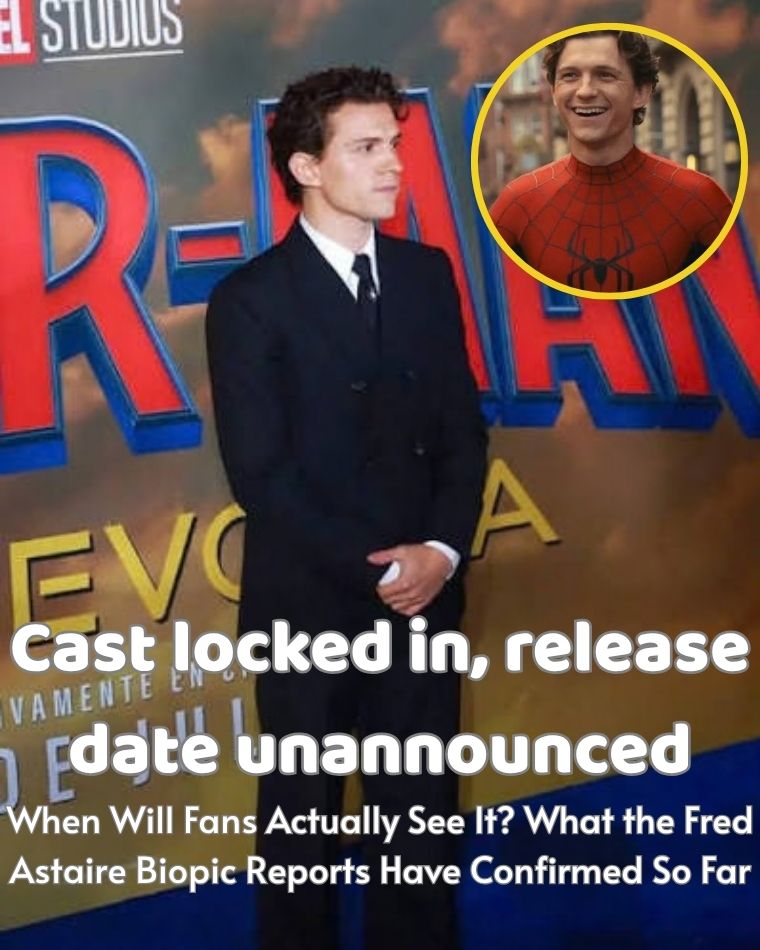
Cre: Gage Skidmore / Wikimedia Commons — Creative Commons Attribution-Share Alike 3.0 Unported
What the Reporting Confirmed: Holland, Qualley, and Carpenter
Recent reports across film trades and entertainment outlets confirmed that Tom Holland will be joined by two of the most sought-after young performers working today: Margaret Qualley and Sabrina Carpenter.
Holland’s attachment to portray Fred Astaire has been acknowledged publicly for years, stemming back to his musical theater roots on London’s West End, where he performed as Billy Elliot during his childhood.
The project gained substantial momentum with the confirmation that Qualley will take on the pivotal role of Adele Astaire, Fred’s older sister and his foundational dance partner during their formative stage career.
Meanwhile, Carpenter was reported for the role of screen icon Ginger Rogers, the legendary Hollywood star whose cinematic pairings with Astaire defined an entire era of musical filmmaking.
Director Paul King, celebrated for helming family hits such as Paddington and Wonka, stands at the helm of the production.
The screenplay comes from Steven Levenson, an acclaimed writer known for Dear Evan Hansen, tick, tick… BOOM!, and the Emmy-winning series Fosse/Verdon.
The creative framework is anchored by Kathleen Riley’s non-fiction biography, The Astaires: Fred & Adele, ensuring the narrative focuses extensively on the sibling dynamic that preceded Astaire’s solo Hollywood stardom.
Alongside his leading role, Holland serves as a producer on the film alongside long-time studio collaborator Amy Pascal and producer Rachel O’Connor.
On paper, this lineup represents an extraordinary convergence of talent, combining seasoned theatrical pedigree with immense mainstream pop-culture visibility.
The “Spider-Man: Brand New Day” Career Window
Contextualizing this dance biopic requires understanding where it sits within Tom Holland’s demanding personal work schedule and franchise commitments.
Entertainment outlets repeatedly highlight that this prestige biographical drama occupies the exact same career juncture as Holland’s next major Marvel Studios tentpole, Spider-Man: Brand New Day.
Leading a billion-dollar superhero franchise demands months of rigorous physical preparation, extensive principal photography, complex visual effects sequences, and extensive worldwide press obligations.
When an A-list actor juggles a massive comic-book spectacle alongside a deeply intricate passion project, the calendar of the former inevitably exerts gravity over the calendar of the latter.
Unlike a standard dialogue-heavy indie drama, a film about Fred Astaire cannot be squeezed quickly into a brief three-week break between blockbuster commitments.
Embodying Fred Astaire requires months of exhaustive, daily choreography rehearsals to master complex footwork, rhythm synchronization, and partner lifts.
Because Spider-Man: Brand New Day anchors Holland’s superhero trajectory, the Astaire film must be carefully coordinated to avoid physical exhaustion and clashing contractual timelines.
This close proximity to Holland’s Marvel schedule is precisely why the film has captured widespread attention as his major prestige follow-up, yet it also explains why production windows remain delicate and deliberately fluid.
The linkage to Spider-Man: Brand New Day illustrates that the actor is entering an ambitious new chapter of his career, balancing popcorn entertainment with historic artistic milestones.
What Has Genuinely Not Been Confirmed
While the cast list and core creative crew read like an awards-season dream team, an objective evaluation of verified reporting reveals significant omissions that fans often overlook.
First and foremost, Sony Pictures has not officially dated the film on any public theatrical release slate.
There is no theatrical premiere year, no targeted season, and no placeholder calendar weekend assigned to this project anywhere in public studio disclosures.
Furthermore, the reporting contains no confirmed start date for principal photography or physical studio production.
No official announcements have outlined where camera crews will set up soundstages, whether filming will occur in the United Kingdom or the United States, or what season production might formally begin.
Trade reports have also avoided setting any concrete expectations regarding distribution strategy, platform rollouts, or international exhibition partners beyond Sony’s core involvement.
Similarly, secondary plot outlines, supporting role additions, and runtime estimates remain entirely unmentioned in authorized press releases.
The verified reporting establishes solely who will write, direct, produce, and play the principal trio.
Everything else circulating on social video clips, entertainment gossip forums, or speculative fan wikis is purely conjecture designed to fill an informational vacuum.
Recognizing these missing details is essential for anyone seeking an accurate, hype-free understanding of where the production currently stands.
Why Major Casting Often Precedes Filming by a Wide Margin
To someone outside the movie business, revealing three prominent stars might seem like proof that cameras will begin rolling within weeks.
Within the Hollywood development ecosystem, however, locking down lead performers is often an early-stage tool rather than the final step before calling action.
Biographical features, particularly musical biopics centered on vintage dance traditions, face unique logistical hurdles that traditional dramas never encounter.
Both Margaret Qualley and Sabrina Carpenter maintain packed professional schedules of their own, spanning indie features, awards contenders, international concert tours, and music production deadlines.
Before three high-profile stars can share a soundstage, their respective agency representatives must negotiate complex alignment windows that fit multiple independent calendars.
In addition, musical biopics require an extensive pre-production phase dedicated to music clearance, archival research, orchestration, and original score arrangements.
Kathleen Riley’s historical material about Fred and Adele Astaire documents a golden era of stage choreography, much of which was never captured on cinematic film.
Recreating dances that survive only in stage photography and contemporary written reviews requires months of historical detective work by choreographers and historians before performers step into the studio.
Attaching notable names allows producers to lock down studio financing, finalize corporate budgets, and commission specialized production design teams.
Consequently, a substantial stretch of time routinely elapses between the initial trade announcement and the physical arrival of actors on a configured set.
Understanding this industry rhythm allows audiences to appreciate recent casting breakthroughs without misinterpreting them as a guarantee of immediate theatrical arrival.
The Danger of Rumoured Dates Circulating Online
In the absence of concrete studio schedules, the digital sphere has developed a predictable habit of inventing its own timelines.
Fan accounts frequently post unverified release years, claiming with supreme confidence that the film will hit cinemas in a specific holiday window or festival circuit.
Algorithmic recommendation feeds amplify these speculative claims, leading casual fans to treat unverified rumors as verified truths.
None of these speculative dates are derived from official studio statements, trade publication reporting, or verified production trackers.
Relying on unofficial digital gossip only sets up audiences for frustration when targeted seasons inevitably come and go without a movie in sight.
A responsible approach to following film news requires treating non-verified social posts with appropriate skepticism.
Until a distributor officially sends a project to its theatrical calendar, any circulating date represents nothing more than educated guesswork or click-driven fantasy.
The entertainment press reported genuine milestones with Qualley and Carpenter coming aboard, but it stayed silent on release dates for a reason: no official timeline exists yet.
What Fans Should Watch for as the Next Real Signal
Since cast announcements do not indicate when a movie will debut, what specific industry milestones should audiences monitor instead?
The first genuine indicator of forward movement will be an official production trade listing announcing a locked start date for principal photography.
When legitimate production publications confirm that cameras have begun rolling, fans can establish a realistic timeline from filming through post-production.
The second critical signal will be formal release calendar updates issued directly by Sony Pictures to theater owners and industry distributors.
Major motion picture studios routinely issue comprehensive release date matrices for upcoming fiscal quarters, securing premium real estate on the theatrical calendar.
The moment this untitled Astaire project receives an assigned theatrical date on Sony’s official slate, its countdown can finally begin in earnest.
Until those verified institutional milestones occur, fans should celebrate the confirmed pairing of Holland, Qualley, and Carpenter as a promising creative step forward.
The talent has been gathered, the director is locked in, and the historical blueprint is established.
However, the question of when audiences will actually see the film remains an open chapter that only time, studio scheduling, and extensive tap rehearsals will answer.
Để lại một phản hồi