Critical consensus across twenty-seven films has fundamentally upended the debate over who wore secret agent 007’s iconic tuxedo best.
While Sean Connery long stood undisputed as the franchise benchmark, modern critical retrospectives now frequently elevate Daniel Craig to the pinnacle of the series.
This profound critical reassessment highlights how vulnerability, psychological depth, and emotional risk-taking have overtaken escapist camp in contemporary cinema.
Across six decades and twenty-seven official James Bond feature films, six distinct actors have donned the immaculate black tuxedo.
Critics have scrutinized every incarnation, dissecting how each performer translated Ian Fleming’s ruthless operative into cinematic legend.
The historical roster spans Sean Connery, George Lazenby, Roger Moore, Timothy Dalton, Pierce Brosnan, and Daniel Craig.
Decades of film reviews and critical syntheses reveal striking shifts in how these men are ranked.
For generations, the conventional wisdom among film scholars was simple: nobody could ever challenge Sean Connery.
Yet modern critical analyses from leading industry reviewers demonstrate an undeniable pivot.
Daniel Craig, whose initial casting sparked widespread skepticism and tabloid derision, has surged to the front of critical rankings.
His five-film tenure fundamentally dismantled and reconstructed the cinematic legacy of James Bond.
At the same time, earlier actors once dismissed or marginalized have experienced extraordinary critical re-evaluations.
Critical sentiment no longer prioritizes easy escapism, effortless quips, or untouchable machismo.
Instead, contemporary film critics consistently favor narrative gravity, emotional weight, and tangible human stakes.
This shifting aesthetic has profoundly rearranged the pantheon of British cinema’s greatest secret agent.
How Critics Rank All Six Bond Actors and the Story Behind the Consensus
When critical aggregators and veteran reviewers systematically rank the six cinematic Bonds, clear patterns emerge.
Daniel Craig and Sean Connery routinely battle for the supreme first and second positions on critical leaderboards.
Connery continues to hold immense reverence for creating the cinematic blueprint that launched a worldwide cultural phenomenon.
Yet Craig frequently secures the top spot in modern retrospective reviews due to the sheer dramatic cohesion of his overarching story.
Behind the two titans, Timothy Dalton and George Lazenby have surged dramatically upward in critical favor.
Dalton, long treated as an awkward detour between Roger Moore and Pierce Brosnan, is now widely celebrated for his intense, faithful interpretation.
Lazenby, despite appearing in merely a single production, benefits from the extraordinary critical esteem afforded to his lone outing.
Conversely, actors who enjoyed colossal commercial runs have found themselves sliding downward in critical standing.
Roger Moore and Pierce Brosnan carried the franchise through sustained periods of box office triumph, yet both face persistent critical skepticism.
Moore’s lighter touch and reliance on whimsical camp often alienate reviewers seeking psychological tension.
Brosnan’s era is frequently categorized by film historians as a polished yet stylistically indecisive transition.
The resulting critical hierarchy demonstrates that box office longevity does not guarantee long-term critical reverence.
Reviews increasingly measure a Bond actor by narrative audacity rather than smooth charm or effortless gadgetry.
The actors who challenged the formula are precisely the ones currently reaping retrospective critical glory.
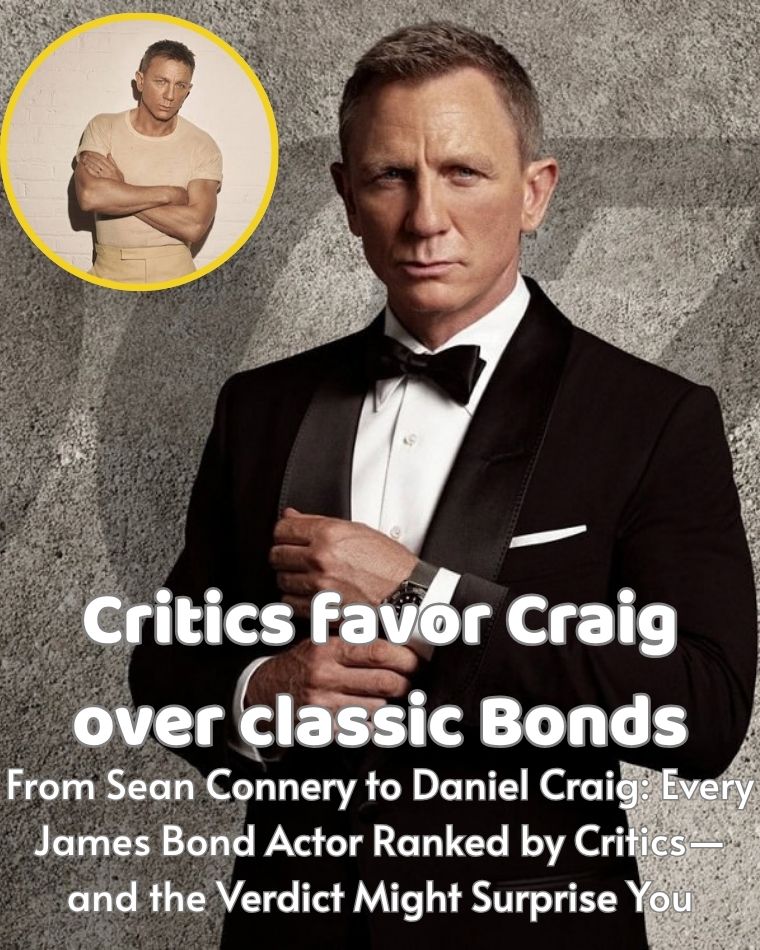
Cre: Wikimedia Commons
Daniel Craig’s Rise from Controversial Casting to Franchise Pinnacle
When Daniel Craig was unveiled as the sixth James Bond in October 2005, the critical and public reaction was largely hostile.
Tabloids mocked his blond hair, blue eyes, and brooding demeanor, doubting he could ever match the suave elegance of his predecessors.
Naysayers questioned whether a physically bruising actor could convincingly deliver debonair martinis and sophisticated double entendres.
Craig promptly obliterated every lingering doubt upon the release of Casino Royale in 2006.
Critics hailed Casino Royale as a revelatory masterpiece that revitalized a stale, drifting espionage formula.
The film stripped away the reliance on invisible cars and outlandish superweapons, replacing them with raw, visceral combat.
Craig presented a fledgling double-zero operative who was unpolished, volatile, and deeply wounded by betrayal.
His physical commitment to action sequences brought an unprecedented sense of genuine peril to every stunt.
Reviewers marveled at his willingness to portray James Bond as an emotionally vulnerable human being capable of genuine romantic agony.
The critical peak reached even greater heights with the release of Skyfall in 2012.
Directed by Sam Mendes, Skyfall earned near-universal critical acclaim, establishing itself alongside Casino Royale as a high-water mark for the entire franchise.
Critics praised the film for interrogating Bond’s childhood trauma, his aging body, and his psychological relationship with his country.
Craig’s five-film arc—progressing through Quantum of Solace, Spectre, and culminating in No Time to Die—crafted a continuous, serialized narrative.
For the first time in six decades of cinema, audiences watched James Bond evolve, endure profound psychological scars, and confront his mortality.
His tenure concluded with the ultimate narrative gamble, allowing the character to suffer, sacrifice, and ultimately die on screen.
That absolute commitment to emotional consequence is precisely why modern critics rank Craig at the summit of the series.
Sean Connery’s Enduring Legacy and the Unshakable Benchmark
Despite Craig’s contemporary ascendancy, Sean Connery remains the immortal gold standard against which all successors are judged.
Connery originated the cinematic role in 1962 with Dr. No, defining the character’s aesthetic DNA in a single stroke.
He combined Scottish working-class grit with refined aristocratic manners, creating an irresistible on-screen presence.
Connery did not merely play James Bond; he established the visual language, posture, and rhythm of the entire spy genre.
His foundational run across the 1960s produced some of the most celebrated cinematic triumphs in motion picture history.
Films like From Russia with Love and Goldfinger established the high watermark for Cold War espionage thrillers.
Critics consistently highlight From Russia with Love as a masterclass in grounded pacing, atmospheric tension, and intense combat.
Meanwhile, Goldfinger perfected the cinematic formula, balancing menacing adversaries, unforgettable henchmen, and brilliant one-liners.
Connery possessed a primal, predatory grace that lent genuine danger to his debonair persona.
When he entered a room, viewers instinctively believed that this man was an exceptionally lethal government assassin.
His delivery of dry, laconic humor never undermined the physical intimidation inherent in the character.
Critics frequently note that without Connery’s magnetic charisma, the fledgling film series might never have survived past its opening entries.
However, modern reviews do not overlook the creative fatigue that crept into his later performances.
By the time he filmed You Only Live Twice and his 1971 return in Diamonds Are Forever, critics noted a visible detachment on screen.
Even with those diminishing returns, Connery’s towering baseline ensures his permanent status as a cinematic titan.
Roger Moore’s Charm and the Critical Skepticism of Pure Camp
Roger Moore holds the distinction of carrying the mantle of James Bond across more official films than any other actor.
Stepping into the role with Live and Let Die in 1973, Moore guided the character through seven distinct feature productions.
For millions of worldwide moviegoers who grew up during the 1970s and 1980s, Moore was the quintessential embodiment of 007.
He brought unmatched wit, infectious charm, and immaculate comedic timing to an increasingly lavish film landscape.
Moore consciously decided never to emulate Sean Connery’s ferocious physical brutality.
Instead, he reimagined James Bond as a globetrotting, urbane bon vivant who deflected mortal danger with an arched eyebrow.
This lighthearted, tongue-in-cheek perspective allowed the franchise to adapt to shifting cinematic trends, from blaxploitation to sci-fi space adventures.
Yet modern critical rankings frequently relegate Moore toward the lower tiers of the six-actor hierarchy.
Critics consistently point to an excess of camp, farcical slapstick, and cartoonish pacing that diluted narrative tension.
While entries like The Spy Who Loved Me earn critical praise for their grand scale, other outings suffered severe critical derision.
Reviewers found it increasingly difficult to invest in suspense when the protagonist never seemed genuinely threatened by surrounding events.
The escalating absurdity of invisible gadgets, double-taking pigeons, and clown suits undermined the dramatic integrity of the character.
Furthermore, critics argue that Moore remained in the demanding action role far too long.
By the time he made A View to a Kill in 1985, the stark age disparity between the veteran lead and his co-stars drew sharp criticism.
While his warmth and generous humor remain deeply cherished by audiences, critical consensus ranks his era among the weakest in psychological depth.
Timothy Dalton: The Radical Re-evaluation of a Bond Ahead of His Time
Perhaps the most fascinating transformation in critical consensus surrounds the two-film tenure of Welsh actor Timothy Dalton.
Dalton took over the franchise for The Living Daylights in 1987 and Licence to Kill in 1989.
At the time of their release, contemporary critics and audiences accustomed to Roger Moore’s sunny levity were baffled by the shift.
Many contemporary reviewers branded Dalton’s interpretation as excessively grim, humorless, and uncomfortably severe.
Decades later, retrospective critical evaluations have performed a complete, breathless reversal on Dalton’s performance.
Today, film scholars and critics routinely describe Timothy Dalton as the visionary Bond who was fundamentally ahead of his time.
A classical Shakespearean stage actor, Dalton approached the cinematic role with rigorous fidelity to Ian Fleming’s literary texts.
He envisioned James Bond not as a glamorous superhero, but as an exhausted, conflicted professional killer burdened by his grim responsibilities.
In The Living Daylights, Dalton infused the espionage drama with genuine Cold War paranoia, professional exhaustion, and grounded romance.
In Licence to Kill, he anticipated the gritty revenge cinema of the modern era by taking Bond off the reservation on an unauthorized blood vendetta.
Dalton performed grueling stunt sequences himself, bringing an aggressive, brooding physicality back into the fray.
Contemporary critics now recognize that Dalton’s two films directly laid the thematic groundwork for Daniel Craig’s acclaimed era nearly twenty years later.
His willingness to strip away comfortable franchise tropes and present an abrasive, psychologically scarred operative was simply too radical for 1980s multiplexes.
In contemporary critical rankings, Dalton has climbed out of the basement to sit securely as one of the most respected actors to ever inhabit the role.
Pierce Brosnan and George Lazenby: Commercial Triumph versus Cult Legacy
The contrasting critical fortunes of Pierce Brosnan and George Lazenby offer a compelling study in franchise legacy.
Pierce Brosnan arrived in 1995 with GoldenEye, successfully shepherding James Bond into a complex post-Cold War geopolitical landscape.
Brosnan was universally recognized as possessing the perfect physical and charismatic attributes for the secret agent.
He effortlessly blended Sean Connery’s lethal edge with Roger Moore’s debonair elegance and effortless charm.
GoldenEye was an undeniable critical and commercial triumph, celebrated for questioning Bond’s relevance as a “sexist, misogynist dinosaur.”
Yet critics argue that Brosnan’s four-film tenure suffered from diminishing artistic returns and a lack of clear thematic identity.
Subsequent entries leaned heavily into explosive Hollywood pyrotechnics, formulaic action tropes, and increasingly outlandish science fiction gimmicks.
Reviewers frequently categorize Brosnan as a transitional figure—a brilliant performer trapped inside an era that lacked a cohesive, defining artistic vision.
By the time his era ended with the CGI excesses of Die Another Day, critical goodwill had largely evaporated.
In stark contrast, George Lazenby made only one cinematic appearance in 1969’s On Her Majesty’s Secret Service.
An Australian model with virtually no acting experience, Lazenby faced brutal critical mockery upon the film’s initial release.
He was unfairly dismissed as a clumsy imposter attempting to fill the impossible shoes of Sean Connery.
Over the ensuing decades, On Her Majesty’s Secret Service has experienced an astonishing critical ascension.
Film directors, historians, and critics now frequently cite the film as one of the very finest entries in cinema history.
Lazenby’s raw, unvarnished performance lent James Bond a poignant emotional vulnerability that had never been seen before.
The tragic climax, in which Bond’s new bride Tracy is assassinated, gave the character profound emotional heartbreak.
Because Lazenby never participated in subpar sequels, his single film remains an unblemished, emotionally resonant cult masterpiece among modern reviewers.
Why Vulnerability and Risk-Taking Now Define Critical Acclaim
The evolution of James Bond critical rankings illuminates a much broader revolution in cinematic storytelling.
Throughout the twentieth century, James Bond served primarily as an escapist fantasy for global audiences.
Viewers expected an invulnerable hero who could dispatch global syndicates, seduce glamorous allies, and brush off dust without wrinkling his lapels.
In that escapist framework, lighter iterations like Roger Moore flourished, while darker interpretations like Timothy Dalton faced resistance.
However, the twenty-first-century cinematic landscape permanently recalibrated the expectations of film critics.
Audiences and critics grew weary of indestructible, formulaic action icons who never paid an emotional price for violence.
Reviewers began seeking complex psychological motivation, lingering trauma, and characters who could visibly fail.
This critical evolution explains why Daniel Craig’s five-film arc now dominates contemporary retrospectives.
Craig allowed James Bond to bleed, mourn, make catastrophic miscalculations, and display visible anguish.
His films treated 007’s license to kill not as a glamorous superpower, but as a corrosive psychological burden that poisoned personal relationships.
Films like Casino Royale and Skyfall succeeded critically because they took monumental narrative risks.
They dared to deconstruct a beloved British institution, stripping away safe comfort-food conventions to locate raw humanity underneath.
The critical re-evaluation of Timothy Dalton and George Lazenby stems from this exact same critical transformation.
Both actors dared to present a James Bond anchored in emotional reality, tragic loss, and literary grit.
Conversely, the purely debonair, camp-heavy interpretations have steadily drifted down critical rankings.
The contemporary consensus is unmistakable: critics revere the actors who risked dismantling the myth to discover the man.
The Definitive Critical Legacy Across Six Decades of Espionage Cinema
As the James Bond cinematic franchise stands on the threshold of its next chapter, the critical record remains crystal clear.
The historical debate over the greatest 007 is no longer a simple coronation of Sean Connery’s foundational charisma.
Instead, it has transformed into a profound artistic contest between Connery’s indelible original mold and Daniel Craig’s psychological tour de force.
Connery crafted the immortal archetype, establishing the suave swagger and lethal posture that captivated the entire world.
Craig revolutionized that archetype for a modern age, bringing unprecedented emotional depth and tragic finality to the narrative.
Behind them, Timothy Dalton has secured overdue vindication as an uncompromising visionary who arrived two decades before his time.
George Lazenby retains an enviable cult prestige for anchoring one of the most heartbreaking and formally brilliant films in the series.
Pierce Brosnan remains remembered as a supremely gifted performer who kept the franchise commercially afloat during an uncertain transitional decade.
Roger Moore endures as an icon of joyful wit, even if critics remain cool toward his era’s unrepentant camp.
Ultimately, the shifting critical consensus proves that the James Bond franchise thrives on bold reinvention rather than safe complacency.
The actors who challenged the cinematic template and exposed the spy’s human vulnerabilities have won the battle of critical history.
Their enduring artistic triumphs ensure that secret agent 007 will remain an endlessly fascinating subject of cinematic study for decades to come.
Để lại một phản hồi