In 2002, Adam Sandler took a massive professional gamble that fundamentally altered how Hollywood understood his artistic range. By partnering with director Paul Thomas Anderson on Punch-Drunk Love, Sandler stepped away from his lucrative comedy formula to deliver a raw, emotionally complex performance that paved the way for modern dramatic roles by comedic actors.
In 2002, Adam Sandler made a daring career decision that forever reshaped his legacy in American cinema.
He agreed to star as the lead in Paul Thomas Anderson’s singular romantic drama Punch-Drunk Love.
At the time, this creative union shocked both film critics and mainstream moviegoers across the globe.
Sandler had spent the previous decade establishing himself as one of Hollywood’s most reliable and bankable comedy icons.
Audiences had grown accustomed to his trademark mix of childlike silliness, broad slapstick, and explosive physical comedy.
Yet director Paul Thomas Anderson recognized a deeper, untapped emotional reserve within the celebrated comedian.
Anderson saw an underlying sadness and volcanic tension beneath the surface of Sandler’s familiar screen personas.
He chose to harness those specific traits rather than sand them down for a conventional dramatic piece.
The result was Barry Egan, a deeply isolated and emotionally volatile novelty supplier based in Los Angeles.
Barry spends his working days surrounded by empty warehouse corridors, cheap plastic plungers, and relentless internal anxiety.
He wears a striking royal blue suit every single day like a piece of protective psychological armor.
His character exists in a state of perpetual alienation, desperately craving love while struggling against sudden fits of destructive fury.
Sandler was asked to completely strip away his regular comedy safety nets and familiar comic cadences.
There were no easy punchlines or reassuring wink-at-the-camera moments to soften Barry’s awkwardness.
Instead, the performance required Sandler to sit directly inside intense vulnerability, social dread, and simmering pain.
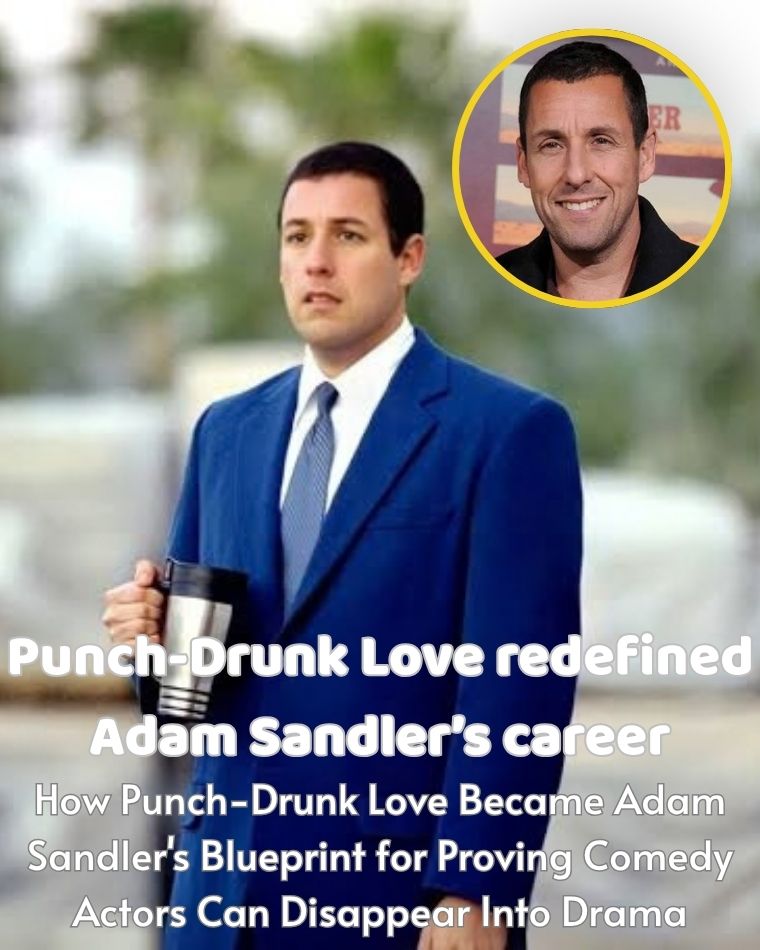
Cre: Wikimedia Commons
Playing Barry Egan demanded an unprecedented level of emotional exposure from an actor known for juvenile laughs.
Barry suffers from constant psychological harassment at the hands of his domineering, hyper-critical sisters.
Their relentless belittling drives Barry to quiet weeping and uncontrollable physical outbursts, including shattering glass patio doors in frustration.
Rather than portraying this anger as a punchline, Anderson treated Barry’s distress with absolute artistic seriousness.
Sandler met the challenge by delivering a grounded, agonizingly delicate portrait of chronic loneliness.
His eyes conveyed a haunting mix of terror, gentleness, and an overwhelming yearning for human acceptance.
When Barry encounters Lena Leonard, played with radiant warmth by Emily Watson, his fragile reality begins to shift.
Lena accepts Barry exactly as he is, meeting his awkward quirks with genuine affection and stillness.
Their romance unfolds through surreal encounters, intense phone calls, and an audacious scheme to collect frequent flyer miles through pudding purchases.
Sandler captured the terrifying thrill of falling in love when one feels fundamentally unlovable.
He resisted every instinct to fall back on his established comedy mannerisms during intense romantic scenes.
Every stutter, nervous fidget, and cautious smile felt earned through careful, unvarnished character work.
The role forced Sandler to confront the darker currents that had always lingered beneath his commercial work.
Anderson recognized that the furious outbursts in Sandler’s past comedies were rooted in real human frustration.
By treating that emotional frustration as authentic drama, the production unlocked Sandler’s true potential as a leading dramatic performer.
The film stripped away commercial distractions to present an honest examination of isolation and longing.
Sandler proved he possessed the dramatic discipline required to headline an uncompromising auteur project.
When Punch-Drunk Love premiered in 2002, it instantly disrupted audience expectations.
Mainstream viewers who bought tickets expecting a conventional laugh-out-loud comedy were often bewildered by the film’s tense rhythm.
The frantic percussion, jarring soundscapes, and claustrophobic framing made for an unconventional viewing experience.
Some fans struggled to connect with an Adam Sandler who refused to offer comfort or familiar humor.
However, film critics immediately recognized the extraordinary nature of what Sandler and Anderson had accomplished together.
Major publications praised Sandler for delivering a brave, career-best performance that subverted his entire star persona.
Reviewers marveled at how seamlessly the actor translated his nervous energy into genuine dramatic pathos.
The critical community celebrated the film’s boldness in placing a commercial comedy king inside an avant-garde romantic study.
Sandler earned prestigious award nominations and glowing accolades from critics who had previously dismissed his artistic abilities.
The performance silenced long-time skeptics who had written him off as an actor of limited range.
It established unequivocally that Sandler’s comedic instincts could be repurposed to create riveting, high-wire dramatic tension.
The critical triumph proved that great comedic talent often stems from acute emotional sensitivity.
Punch-Drunk Love challenged the traditional boundaries dividing prestige drama and broad entertainment.
It stood as definitive evidence that a comic performer could enter art-house cinema without erasing their unique identity.
Sandler did not try to imitate classic dramatic actors; he made the drama fit his specific emotional frequency.
That singular creative breakthrough sent ripples through the entertainment industry during the early 2000s.
The film proved that comedic timing is fundamentally tied to an innate understanding of human vulnerability and rhythm.
By honoring Sandler’s innate presence, the production crafted an enduring milestone in modern independent cinema.
The enduring impact of Barry Egan became the foundational blueprint for Sandler’s subsequent dramatic career.
Without Punch-Drunk Love, audiences would never have witnessed Sandler’s breathless, career-defining tour de force in Uncut Gems.
In Uncut Gems, directed by the Safdie brothers, Sandler tapped into the very same kinetic, self-destructive desperation first seen in Barry Egan.
His character Howard Ratner exists on the exact same spectrum of high-wire anxiety and tragic vulnerability.
The relentless nervous energy that Anderson carefully shaped in 2002 found its explosive modern evolution in the diamond district of New York.
Later dramatic triumphs, including his praised leading turn as a weary basketball scout in Hustle, directly trace back to this pivotal origin.
In Hustle, Sandler displayed the quiet dignity, warmth, and worn-down persistence that he first explored opposite Emily Watson.
Barry Egan showed Sandler that he did not need to alter his fundamental soul to inhabit serious, demanding characters.
He learned to channel his authentic physical presence, rhythmic speech, and raw heart into complex cinematic portraits.
Directors now understood how to write prestige parts tailored specifically to Sandler’s distinct emotional signature.
Punch-Drunk Love taught the film industry to respect Sandler not merely as a hitmaker, but as a serious acting powerhouse.
The film granted Sandler the artistic credibility to move freely between mainstream commercial projects and demanding auteur cinema.
He no longer had to defend his legitimacy as a serious dramatic actor in front of sceptical industry peers.
Each subsequent dramatic outing reaffirmed the profound discoveries made during his historic collaboration with Anderson.
Audiences began to eagerly anticipate his rare, electric excursions into dramatic storytelling.
The performance ensured that whenever Sandler chose to enter serious dramatic territory, the cinema world paid rapt attention.
His work across two decades confirms that Barry Egan was not an accidental fluke, but a deliberate awakening.
Beyond Sandler’s individual career, Punch-Drunk Love exerted a transformative influence on Hollywood’s broader creative ecosystem.
The film broke the rigid industry barrier that previously separated mainstream comedy headliners from serious art-house prestige.
For decades, studios and casting directors treated broad comedians as novelty choices ill-suited for heavy psychological material.
Anderson’s daring experiment proved that comedy stars often possess emotional ranges far deeper than industry typecasting suggests.
Comedic performers spend years mastering precision, emotional honesty, audience empathy, and high-stakes timing.
When those refined technical skills are redirected into dramatic storytelling, the results can be electrifying and unforgettable.
A whole generation of contemporary directors took note of how Anderson unlocked Sandler’s hidden depth.
Filmmakers began aggressively looking to popular comedians to anchor complex, emotionally devastating character studies.
The critical validation of Punch-Drunk Love gave permission to other comedic performers to take audacious dramatic risks without fear.
It showed comedic talent that stepping into dramatic cinema did not require abandoning their natural instincts or charisma.
The project dismantled the outdated snobbery that treated dramatic acting as superior to the discipline of comedy.
Instead, it showcased that great acting draws from the very same well of human truth, regardless of genre label.
Industry observers began viewing comedic performers through a far more curious, expansive lens.
The success of the film forever altered the vocabulary of independent casting decisions and prestige drama development.
It opened lucrative creative avenues for artists who felt confined within the narrow box of formulaic studio humor.
Hollywood learned that comedic rage, manic anxiety, and loneliness could yield cinema of extraordinary emotional power.
Punch-Drunk Love became a permanent masterclass in how to elevate an actor’s existing strengths within a brand-new dramatic context.
More than two decades after its initial 2002 theatrical premiere, Punch-Drunk Love stands as a monumental cultural landmark.
The film thoroughly disproved the arguments of Sandler’s harshest detractors who believed he could never carry serious art.
It remains a glowing testament to what can happen when a visionary director trusts a comedy actor’s hidden pain.
Anderson did not seek to change Sandler into someone else; he simply provided a canvas that matched the scale of his talent.
Barry Egan remains one of the most uniquely moving romantic protagonists ever captured on celluloid.
Sandler’s electric blue suit and vulnerable eyes have become unforgettable symbols of cinema’s capacity for surprising reinvention.
The legacy of the film continues to resonate across the film industry whenever a comedian takes a bold dramatic leap.
It stands as an unshakeable bridge connecting Sandler’s earliest comedic instincts to his modern prestige masterworks.
Every dramatic triumph Sandler has achieved since 2002 owes a direct debt to the courage shown in Punch-Drunk Love.
The film validated Sandler’s artistry and permanently expanded what audiences believe comedic actors are capable of achieving.
Để lại một phản hồi