Veteran comedian Chris Rock has openly revealed that Adam Sandler’s relentless dramatic performance in the 2019 crime thriller Uncut Gems fundamentally reshaped his own creative vision while directing and starring in his gritty new feature, Misty Green.
The revelation spotlights a lifelong creative kinship that traces back to their legendary early-1990s tenure on Saturday Night Live, illustrating how two titans of American humor continually inspire each other to explore unexpected, raw emotional depths.
Even as Rock dives headfirst into serious auteur cinema, the duo maintains their trademark comedic bond, simultaneously gearing up for their highly anticipated reunion in Grown Ups 3.
There is a singular, electrifying sensation in watching an artist you know intimately shed every familiar habit on screen.
For decades, audiences understood exactly what to expect from Adam Sandler: chaotic warmth, disarming silliness, and a deeply relatable, easygoing charisma.
Yet when Sandler stepped into the high-stakes Diamond District of New York City in 2019, something shifted across the entire cinematic landscape.
Among the millions captivated by that transformation was Chris Rock, a performer whose own artistic trajectory mirrors Sandler’s in extraordinary ways.
Speaking during recent appearances and festival screenings for his newest project, Misty Green, Rock reflected on the profound impact Sandler’s performance had on him as a filmmaker and storyteller.
Rock admitted that watching his longtime friend disappear into a state of utter desperation altered how he evaluated his own dramatic ambitions.
He described the experience as a revelation that pushed him to rethink tone, tension, and vulnerability in dramatic storytelling.
When comedy legends reach the pinnacle of their craft, stepping outside their established comfort zone requires extraordinary courage.
Sandler proved that comedic energy does not need to be extinguished to serve a drama; rather, it can be repurposed into pure, unadulterated tension.
That specific revelation became a vital compass for Rock as he developed the script and visual language of Misty Green.
The Uncut Gems Phenomenon and the Anatomy of Howard Ratner
To understand why Sandler’s dramatic turn moved Rock so deeply, one must revisit the sheer sonic and narrative ferocity of Uncut Gems.
Released in 2019 by A24, the film centered entirely around Howard Ratner, an obsessive, fast-talking Manhattan jeweler caught in an escalating spiral of debt, sports gambling, and catastrophic risks.
The character of Howard Ratner was not designed to elicit easy sympathy or neat redemption arcs.
Instead, Ratner was an embodiment of manic momentum, constantly outrunning disaster while convinced that the next massive wager would finally set everything right.
Sandler brought a physical commitment to the role that astonished industry critics and longtime fans alike.
His voice was hoarse, his posture perpetually tense, and his eyes burned with an unsettling, desperate optimism.
Every scene required Sandler to operate at an exhausting emotional frequency without ever dropping his guard.
There was no pause button, no narrative breather, and no polite dramatic sentimentality.
Rock watched this performance not merely as an admiring spectator, but through the analytical eye of an experienced director and writer.
He recognized that Sandler had unlocked a rare theatrical paradox: making a profoundly reckless character utterly impossible to look away from.
Sandler earned widespread critical acclaim and captured the Independent Spirit Award for Best Male Lead for the role.
For Rock, observing his peer command the screen with that level of uncompromised authenticity proved that an entertainer known for comedy could conquer dramatic realism on their own specific terms.
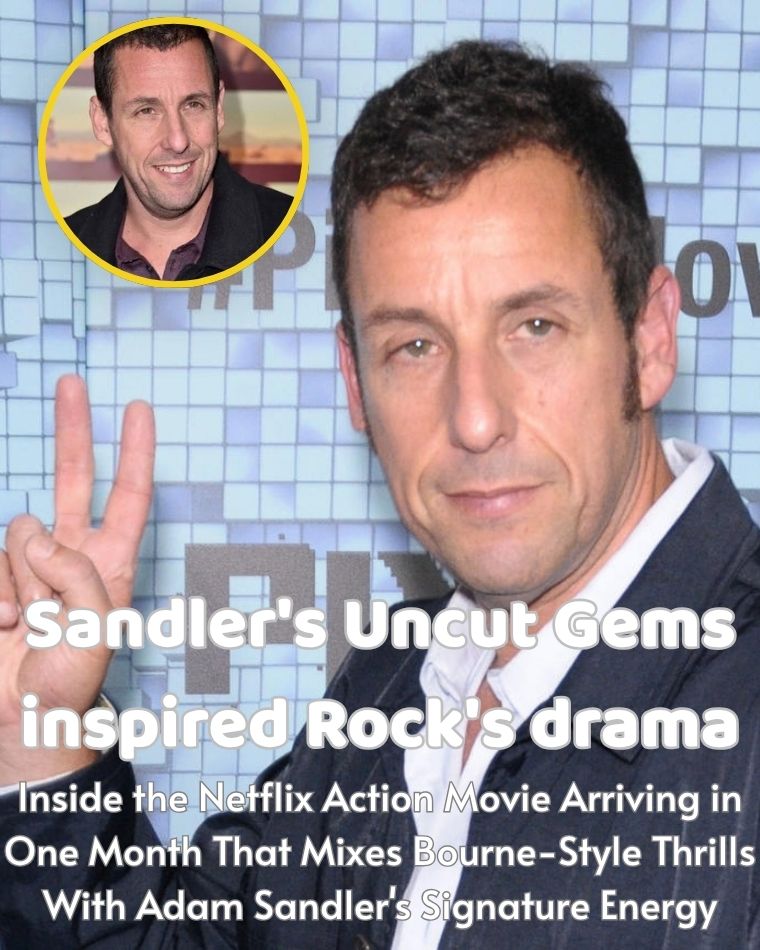
Cre: Wikimedia Commons
The Safdie Brothers’ Direction and the Engine of Chaos
The brilliance of Howard Ratner was also inseparable from the kinetic filmmaking style established by directors Josh and Benny Safdie.
The Safdie brothers built a distinctive cinematic signature characterized by overlapping dialogue, sensory overstimulation, claustrophobic close-ups, and a pulsating electronic score.
Rather than placing Sandler within a traditional Hollywood framework, the directors immersed him directly into the real, abrasive rhythms of the city.
They demanded that Sandler abandon all calculated vanity, stripping away familiar mannerisms to inhabit pure, unscripted anxiety.
The camera pressed intimately against Sandler’s face, capturing every bead of sweat and twitch of calculation.
The sound design actively assaulted the viewer, creating an atmosphere where danger lurked behind every closed door.
This immersive, uncompromising directorial method resonated powerfully with Rock as an auteur.
Rock recognized that real human drama rarely unfolds with sanitized lighting and polite pauses between sentences.
Real crisis is messy, loud, disorienting, and relentless.
By witnessing how the Safdies channeled Sandler’s intrinsic stamina into an atmospheric masterclass, Rock gleaned invaluable lessons about pacing and dramatic tension.
It demonstrated that directing a dramatic feature does not require imitating conventional arthouse tropes.
Instead, a filmmaker can construct visceral intensity out of personal observation, kinetic rhythm, and total emotional honesty.
Rock saw how the Safdies refused to let the audience off the hook, a lesson he would carry straight into the production of his own drama.
Misty Green: Chris Rock Steps Behind the Camera for Heavy Drama
The direct artistic beneficiary of these creative reflections is Misty Green, Rock’s ambitious dramatic feature.
Written and directed by Rock, the film examines the precarious, unforgiving ecosystem of modern Los Angeles and the entertainment industry.
The narrative centers on an award-winning actress struggling in the throes of a fading career who attempts to engineer a major comeback while confronting deep-seated personal demons.
British actress Rosalind Eleazar delivers a powerhouse performance in the title role, portraying a woman wrestling with self-destructive instincts and missed opportunities.
Rock himself stars as Jordan, an experienced industry veteran and former agent whose complicated history with Misty anchors the emotional stakes of the story.
The impressive ensemble cast also features acclaimed talents including Adam Driver, Daniel Kaluuya, Anna Kendrick, and Topher Grace.
Having held its world premiere at prestigious venues like the Toronto International Film Festival and the New York Film Festival, the movie presents an unvarnished examination of artistic ambition.
Rather than softening the edges of his characters, Rock leaned straight into their human flaws and anxieties.
The camera work and pacing deliberately reflect the uneasy internal psychology of someone running out of chances.
In recent conversations regarding the tone of the movie, Rock highlighted films like Uncut Gems as key reference points for capturing raw, high-pressure environments.
He wanted the audience to experience the dread and urgency that accompanies a career on the brink of collapse.
By refusing to sugarcoat his characters’ destructive impulses, Rock crafted a drama that feels modern, urgent, and emotionally grounded.
Shared Comedy Roots: From 30 Rock to the Stand-Up Trenches
The artistic dialogue between Rock and Sandler is backed by more than three decades of mutual respect and personal history.
Both men emerged from the fierce stand-up comedy circuit of the late 1980s before joining the legendary ensemble cast of NBC’s Saturday Night Live.
During their pivotal run in Studio 8H in the early 1990s, they navigated the brutal demands of live television alongside peers like Chris Farley and David Spade.
The crucible of Saturday Night Live forged an unbreakable bond among that specific generation of comedic talent.
They shared tiny writers’ offices, rehearsed sketches deep into the night, and weathered sudden cancellations and critical skepticism together.
Both performers possessed distinctive creative voices that eventually outgrew the sketch format and launched them into blockbuster film careers.
Sandler built a commercial empire through beloved classics like Happy Gilmore and Billy Madison, while Rock redefined stand-up comedy with legendary specials like Bring the Pain.
Yet throughout their parallel ascents, they remained fiercely protective of one another’s talents.
Whenever either took a bold creative gamble, the other was unfailingly among the first to offer encouragement.
Comedians share an unspoken shorthand that outsiders rarely fully comprehend.
They understand the brutal discipline required to construct a joke, hold an audience’s silence, and endure public vulnerability.
That shared comedic foundation established a deep layer of trust between them.
When Rock watched Sandler embrace total dramatic exposure in Uncut Gems, he saw someone from his original tribe accomplishing something groundbreaking.
It felt personal, inspiring, and directly applicable to his own aspirations behind the camera.
The Dual Balance: Returning for Grown Ups 3
While Misty Green represents Rock’s deepening journey into dramatic storytelling, it exists alongside the joyous camaraderie of his comedic roots.
Even while navigating the film festival circuit for his drama, Rock confirmed that he and Sandler are actively reuniting for Grown Ups 3.
The beloved franchise, which debuted its original installment in 2010, has become a multi-generational blockbuster brand celebrating enduring friendship.
Production on the third installment recently brought the ensemble cast together in Europe, creating an atmosphere that Rock described as an absolute joy.
The project brings back familiar faces like Kevin James, David Spade, Salma Hayek, and Maya Rudolph, alongside returning favorite Rob Schneider.
For Rock, working on Grown Ups 3 is more than a commercial enterprise; it represents a heartfelt reunion with his closest friends and family.
Rock even shared that his daughter Zahra has joined the cast, marking a special milestone after spending her childhood visiting the earlier movie sets.
The dual existence of Misty Green and Grown Ups 3 encapsulates the extraordinary range of modern comic artists.
One week, Rock is overseeing complex dramatic scenes alongside Oscar-nominated dramatic actors.
The next, he is sharing spontaneous laughs and physical gags with friends he has known since the early 1990s.
This balance prevents artistic calcification.
It proves that an artist does not need to abandon where they came from in order to explore new narrative territories.
Why Comedic Masters Excel When Transitioning to Drama
The history of cinema is rich with comedians who shocked audiences by delivering extraordinary dramatic performances.
From Robin Williams in Good Will Hunting to Jim Carrey in The Truman Show, comic actors frequently exhibit remarkable dramatic range.
Stand-up comedy and dramatic acting share fundamental creative DNA that is often overlooked by casual viewers.
Both disciplines demand an acute, razor-sharp sensitivity to rhythm, timing, and emotional authenticity.
A great comedian spends decades standing alone before skeptical crowds, studying human micro-expressions and learning when to push forward or pull back.
They possess an instinctive understanding of pain, shame, and social friction—the exact raw materials required for dramatic storytelling.
When a comedic actor steps into a serious role, they bring an intense awareness of subtext to the table.
They know how people use humor as a defensive armor to conceal trauma, fear, or profound loneliness.
In Uncut Gems, Sandler utilized Howard Ratner’s relentless banter as an active weapon to keep existential panic at bay.
In Misty Green, Rock approaches Hollywood ambition with that same unblinking recognition of human frailty.
He understands the quiet terror of fading relevance because he has observed the entertainment industry from every imaginable angle for forty years.
The artistic transition from comedy to drama is not a rejection of one’s past, but its highest emotional evolution.
When artists of this caliber push each other to take huge risks, the entire medium of cinema becomes richer for it.
A Lasting Creative Dialogue Between Two Legends
Ultimately, Rock’s public praise for Sandler’s dramatic work underscores something profoundly rare in Hollywood: genuine, uncompetitive creative solidarity.
In an industry often marked by fleeting partnerships and shallow rivalries, their bond has endured across five separate decades.
They celebrated each other’s early breakthrough stand-up specials when they were still trying to pay the rent.
They supported each other through immense public pressures and personal milestones.
Now, as mature artists and filmmakers, they continue to serve as each other’s sounding boards and sources of artistic courage.
Sandler demonstrated that an established funny man could command the respect of cinephiles worldwide without compromising his unique, manic frequency.
Rock absorbed that masterclass, channeled its kinetic energy, and crafted a dramatic vision entirely his own with Misty Green.
Whether they are cracking unscripted jokes across the dinner table in Grown Ups 3 or steering boundary-pushing dramas on the festival circuit, their creative partnership continues to evolve.
Cinema thrives whenever artists are willing to be moved and challenged by the achievements of their peers.
And in the extraordinary artistic relationship between Chris Rock and Adam Sandler, that inspiration continues to pay incredible artistic dividends.
Để lại một phản hồi