Alfonso Cuarón’s arrival to direct the 2004 cinematic release of Harry Potter and the Prisoner of Azkaban fundamentally transformed the trajectory of the entire franchise.
The film marked the pivotal threshold where Daniel Radcliffe transitioned from a child performer delivering memorized cues into an actor of deep emotional interiority.
By replacing the polished storybook framing of the initial adaptations with European art-house naturalism, Cuarón established an enduring creative benchmark that redefined modern blockbuster filmmaking.
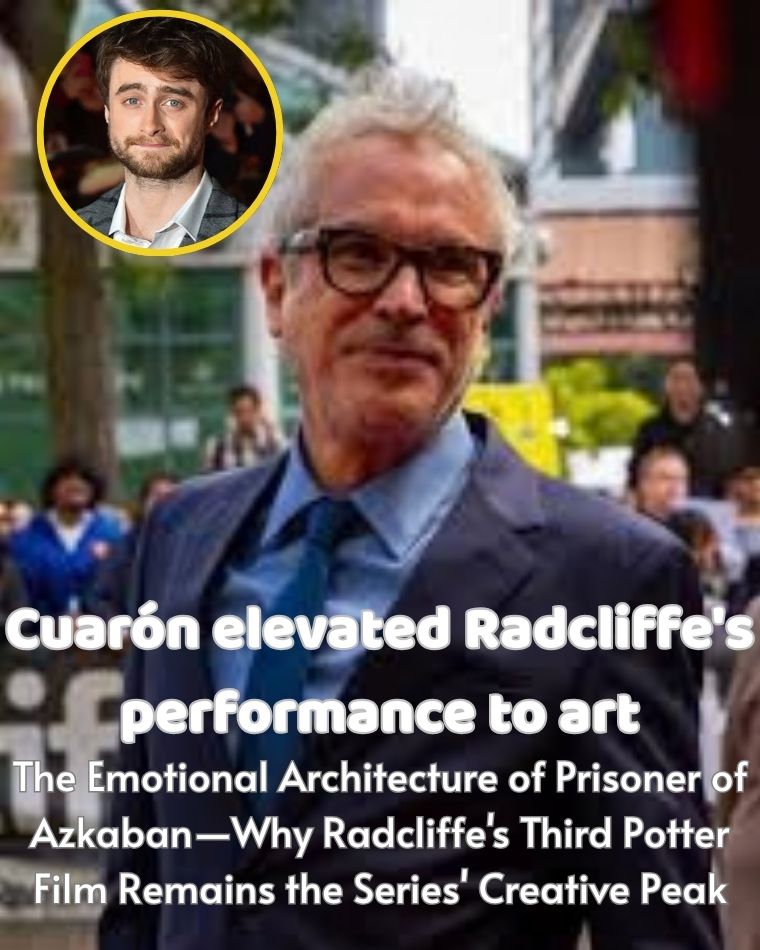
Cre: Wikimedia Commons — Oneras / CC BY-SA 2.0
1. Alfonso Cuarón’s Art-House Sensibility and the Reimagining of Hogwarts
When Warner Bros. announced Mexican auteur Alfonso Cuarón as director following Chris Columbus, industry observers recognized a deliberate departure from traditional commercial aesthetics.
Cuarón entered the wizarding world with a visual discipline shaped by personal character-driven dramas rather than sanitized studio expectations.
He refused to view the magical boarding school as a sterile stage set detached from natural physical geography.
Instead, the filmmaker immersed the castle within the rugged topography of the Scottish Highlands, introducing torrential rain, biting wind, and overgrown hillsides.
This tactile realism required the young ensemble to shed performative child-acting mannerisms and ground themselves in genuine adolescent behavior.
Cuarón insisted that Daniel Radcliffe, Rupert Grint, and Emma Watson wear everyday muggle clothing and disheveled uniforms rather than pristine wizarding robes.
This visual recalibration subtly altered the narrative baseline from whimsical wonder to messy teenage alienation.
To break down rehearsed habits, Cuarón famously instructed the leading trio to write first-person essays explaining their respective characters’ psychology.
Radcliffe turned in a single page focused directly on Harry’s interior burden and unresolved grief.
That reflective exercise established an emotional vocabulary that stripped away superficial heroism in favor of raw vulnerability.
The cinematic framing pivoted from wide, brightly illuminated tableaus toward tight handheld tracking shots that lingered on Radcliffe’s expressive reactions.
Every frame demanded that Radcliffe inhabit the camera’s close proximity with authenticity rather than theatrical projection.
The production no longer permitted easy answers or simplistic emotional beats for its young star.
Cuarón’s artistic gaze challenged Radcliffe to listen, breathe, and internalize unspoken trauma on screen.
2. The Dementor Encounters: Confronting Existential Dread and Trauma
The central thematic catalysts of the 2004 narrative are the Dementors, spectral prison guards that consume human happiness and amplify subconscious horrors.
In earlier installments, villainous threats like giant serpents or three-headed beasts provoked externalized, comic-strip shock.
The Dementors, by contrast, represented internal psychological collapse, despair, and paralyzing grief.
When the Hogwarts Express stalls on the rain-swept tracks and ice forms across the windowpanes, Harry’s confrontation with the cloaked figure requires Radcliffe to portray involuntary panic.
He had to convey physical asphyxiation and the psychological agony of hearing his mother’s final screams echoing across memory.
Radcliffe avoided melodramatic hyperventilation, choosing instead to portray sudden sensory paralysis and spiritual exhaustion.
The sequence exposed Harry’s acute fragility before his peers, stripping him of the stoic courage typical of generic fantasy protagonists.
During the Quidditch match amid a raging thunderstorm, Radcliffe sustained that same interior horror as Dementors swarmed the field.
The camera focused on his eyes as consciousness fractured under suffocating psychic weight.
Rather than portraying Harry as an untouchable boy hero, Radcliffe presented him as a deeply traumatized orphan repeatedly undone by past tragedy.
Cuarón staged these encounters as somatic shocks that drained the character of warmth and physical stamina.
Radcliffe absorbed that directorial instruction by letting silence, vacant stares, and trembling hesitation dictate his physical demeanor.
These scenes forced the audience to reckon with the lingering psychological scars of survival.
Radcliffe transformed an encounter with special-effects entities into a masterclass in portraying debilitating panic.
3. The Sirius Confrontation: Navigating Betrayal, Rage, and Moral Choice
Harry’s narrative momentum throughout the third act is propelled by righteous fury following the revelation that Sirius Black allegedly betrayed his parents.
In the village of Hogsmeade, upon learning the apparent truth beneath the Three Broomsticks, Radcliffe delivers a breakthrough emotional sequence.
Breaking down in the freezing winter snow, Harry unleashes furious declarations of murderous revenge while trembling from absolute devastation.
Radcliffe captured the precise cracked pitch of an adolescent mind buckling under overwhelming betrayal.
He avoided performative crying, allowing his voice to fracture under the sheer impossibility of processing adult deception.
This emotional momentum culminated inside the rotting wooden confines of the Shrieking Shack.
Cornering Gary Oldman’s wild-eyed Sirius Black, Radcliffe stood opposite one of world cinema’s most formidable dramatic actors.
Instead of shrinking in the veteran performer’s shadow, Radcliffe elevated his own performance to meet the scene’s volatile energy.
He wielded his wand not like an action protagonist, but like an emotionally shattered boy terrified of his own violent capacity.
The physical choreography of the standoff highlighted Harry’s internal conflict between retributive violence and ancestral honor.
Radcliffe communicated Harry’s calculations through intense micro-expressions, weighing the impulse to kill against the memory of his father.
When the truth regarding Peter Pettigrew surfaced, Radcliffe gracefully guided Harry through the sudden collapse of his misplaced vengeance.
The transition from blind malice to redemptive mercy demonstrated extraordinary maturity for a fourteen-year-old lead.
Radcliffe showed that true moral restraint requires vastly more emotional courage than giving in to bloodlust.
4. The Patronus Sequence: A Visual Metaphor for Emotional Mastery
The casting of the Patronus charm functions as the film’s defining narrative and thematic architecture.
Professor Remus Lupin, played with delicate melancholia by David Thewlis, instructs Harry that the spell demands recalling a uniquely powerful happy memory.
This magic is not a weapon drawn from martial agility, but a manifestation of psychic resilience against consuming despair.
During the private training sessions inside the empty Defense Against the Dark Arts classroom, Radcliffe mapped the arduous labor of emotional excavation.
The young actor had to demonstrate how painful it is for an isolated orphan to identify genuine joy.
When Harry first offers faint memories of riding a broom or passing an exam, the spell collapses in failure.
Radcliffe conveyed the mounting humiliation and exhaustion of confronting a void where family love should have existed.
Only when Harry searches for the imagined warmth of his parents speaking together does the silver wisp solidify.
Radcliffe played the breakthrough not as triumphant bravado, but as quiet, transcendent relief.
The training sequence visually illustrated the difficult discipline of mastering one’s own traumatic triggers.
This emotional discipline paid off during the film’s climactic sequence at the moonlit Black Lake.
Believing initially that his deceased father cast the stag Patronus that saved his past self, Harry realizes through the time-turner that he must rescue himself.
Standing along the riverbank against a swarm of Dementors, Radcliffe embodied the realization of adult self-reliance.
He bellowed the spell with resolute spiritual authority, anchoring the supernatural moment in earned psychological maturity.
The blazing silver light became an external manifestation of a boy choosing survival over destructive grief.
5. Performance Continuity Across the Franchise’s Remaining Chapters
The dramatic breakthroughs forged under Cuarón’s direction set the definitive emotional template for the remainder of Radcliffe’s tenure.
When Mike Newell took over the helm for The Goblet of Fire, Radcliffe retained the interior gravity developed during the third chapter.
The harrowing graveyard confrontation with Voldemort and the subsequent breakdown over Cedric Diggory’s body directly echoed the emotional honesty discovered in 2004.
Later, director David Yates capitalized on this psychological foundation throughout the final four installments of the saga.
In The Order of the Phoenix, Radcliffe pushed Harry’s emotional volatility into clinical representations of isolation and post-traumatic stress.
His performance navigated survivor’s guilt, institutional persecution, and domestic alienation with unyielding realism.
The quiet, weary gaze that defined Harry during the Horcrux hunt in The Deathly Hallows can be traced back to the shadowed hallways of Azkaban.
Cuarón taught Radcliffe how to externalize emotional weight without overstating it through dialogue.
He unlocked the physical presence required to carry an eight-film blockbuster franchise on subtle performance dynamics.
Had the series maintained the innocent presentational style of the earliest chapters, the darker narrative demands of the late films would have faltered.
Instead, Radcliffe possessed the technical range and emotional stamina necessary to depict an exhausted soldier of fate.
His progression affirmed that young actors could sustain serious psychological inquiry within commercial studio cinema.
Azkaban remained the transformative furnace where Radcliffe’s enduring screen legacy was cast.
6. The Tonal Benchmark: Why Azkaban Remains the Franchise High Point
More than two decades after its 2004 debut, Harry Potter and the Prisoner of Azkaban endures as the franchise’s most celebrated cinematic achievement.
Cuarón recognized that adolescence is not an adventure of shiny wonder, but a disorienting, melancholy passage into moral ambiguity.
He allowed the edges of the frame to remain murky, mysterious, and unresolved.
The film trusted its audience to tolerate stillness, atmospheric dread, and unresolved family grief without rushed exposition.
Stuart Craig’s redesigned sets, Michael Seresin’s desaturated chiaroscuro cinematography, and John Williams’s experimental score formed a cohesive artistic tapestry.
Yet all those technical elements would have unraveled without an emotional anchor grounded in Daniel Radcliffe’s breakthrough performance.
Radcliffe transformed Harry from an observational conduit of magic into a deeply wounded, intensely determined young human being.
The movie proved that a mass-market franchise could balance corporate expectations with authentic cinematic authorship.
It demonstrated that commercial fantasy reaches its greatest artistic heights when it honors the emotional complexity of growing up.
Cuarón and Radcliffe captured lighting in a bottle by treating children’s trauma with uncompromised dramatic sincerity.
Ultimately, The Prisoner of Azkaban endures because it understood that conquering darkness begins within the quiet recesses of the human heart.
Để lại một phản hồi