Director Richard Linklater has officially confirmed that his unprecedented multi-decade film adaptation of Stephen Sondheim’s classic musical will resume shooting in a few months.
The project marks modern cinema’s most audacious long-term production schedule, planned to document its characters across two full decades of artistic and human evolution.
Speaking directly about the status of the film, Linklater delivered a clear progress report on the production timeline, stating simply: “See you in 2040”.
The acclaimed filmmaker shared these updates while reflecting on the unconventional mechanics required to capture authentic aging without prosthetic makeup or digital trickery.
His announcement has reignited widespread fascination across the entertainment industry regarding how independent cinema engages with real human time.
The adaptation brings Stephen Sondheim and George Furth’s legendary 1981 Broadway musical Merrily We Roll Along to the cinematic medium in nine discrete production chapters.
While the broader theatrical world recently celebrated an acclaimed Broadway revival featuring Daniel Radcliffe, Linklater’s feature film constructs its own cinematic lineage.
The movie stars Paul Mescal as the conflicted composer Franklin Shepard, Ben Platt as playwright Charley Kringas, and Beanie Feldstein as theater critic Mary Flynn.
The forthcoming shoot represents the fourth segment of the planned nine-part filming sequence, crossing a vital milestone in the journey toward 2040.
Cinema history features very few creative endeavors that demand both cast and crew to commit twenty full years to a single unified narrative.
Cre: Wikimedia Commons
A Radical Twenty-Year Timeline Moving in Reverse
The foundational drama of Merrily We Roll Along traces the disintegrating bond of three close creative collaborators across twenty tumultuous years.
Originally debuting on Broadway in 1981, the stage production was adapted from a 1934 theatrical play conceived by George S. Kaufman and Moss Hart.
Unlike conventional biographical dramas, the narrative operates entirely in reverse chronological order.
The drama opens in 1976, revealing Franklin Shepard as a cynical, immensely wealthy Hollywood producer who has abandoned his musical ambitions and betrayed his closest companions.
From that bitterly disillusioned zenith, the story travels backward step by step across pivotal turning points in the characters’ personal and professional histories.
The narrative journey eventually concludes in 1957 on a quiet rooftop apartment in New York City.
There, the three young dreamers gaze up at the sky, brimming with pure artistic integrity and profound belief in their shared future.
Transferring this reverse trajectory onto a twenty-year cinematic production presents an extraordinary technical and philosophical puzzle.
Because the actors must grow physically older over twenty calendar years while the narrative moves backward, the shoot demands precise structural planning.
Linklater divided the entire twenty-year shooting schedule into nine distinct filming segments staged across the multi-decade window.
Audiences sitting down in theaters in 2040 will watch an organic physical transformation that mirrors the psychological peeling back of life’s bitterness.
Rather than relying on modern computer-generated de-aging software, Linklater insists that genuine biological time remains the most expressive cinematic tool.
The fourth filming period, scheduled to commence in just a few months, brings the ensemble together once again to construct the middle architectural joints of the tale.
For Linklater, this patience is essential to honoring Sondheim’s bittersweet study of youthful aspiration and subsequent compromise.
Broadway Acclaim and Daniel Radcliffe’s Theatrical Horizon
While Linklater crafts his decades-long celluloid experiment, Merrily We Roll Along recently completed a triumphant renaissance on the live stage.
Director Maria Friedman mounted a landmark revival that played off-Broadway before transferring to Broadway to universal critical acclaim.
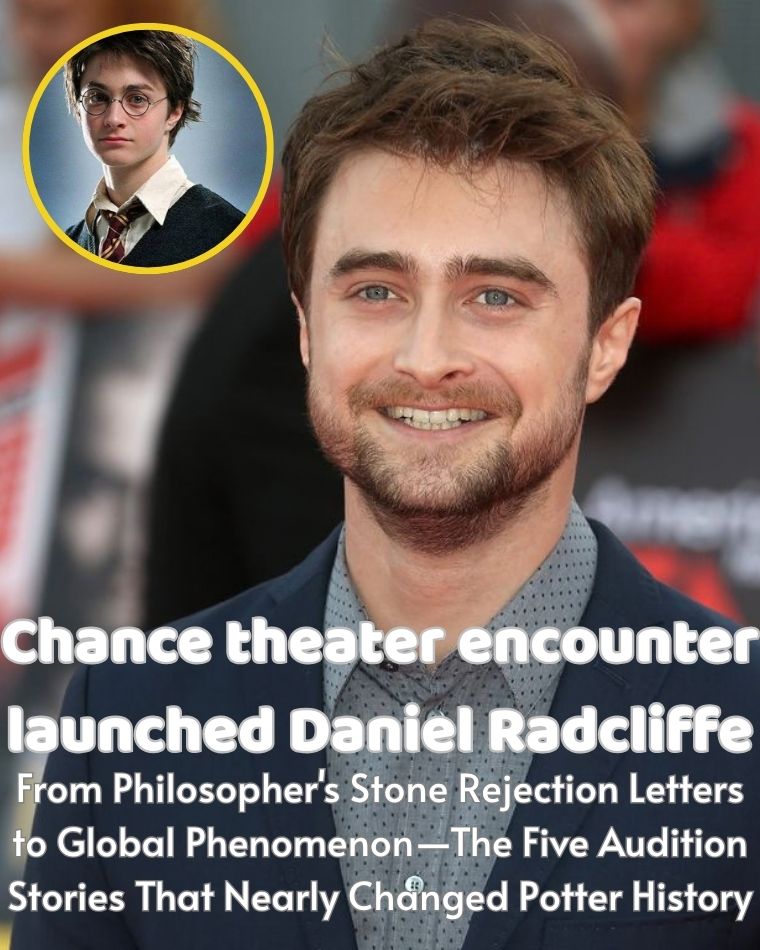
That stage revival starred Jonathan Groff as Frank, Lindsay Mendez as Mary, and Daniel Radcliffe in a celebrated, Tony-winning portrayal of lyricist Charley Kringas.
The stage production earned seven Tony Award nominations and secured four wins, revitalizing public appraisal of a musical once deemed problematic upon its 1981 Broadway premiere.
Radcliffe’s kinetic performance of the show-stopping number “Franklin Shepard, Inc.” became one of the definitive live theater highlights of the decade.
The immense cultural visibility generated by the Broadway run provided mainstream audiences with a renewed appreciation for Sondheim’s intricate musical score.
For Radcliffe, conquering Sondheim’s notoriously complex rhythms on Broadway cemented his reputation as an adventurous performer unwilling to rest on childhood laurels.
Since concluding his run in the global Harry Potter film franchise, Radcliffe has intentionally prioritized challenging, offbeat creative gambles.
His eclectic body of work spans psychological stage thrillers like Equus, independent oddities like Swiss Army Man, and intense physical survival odysseys like Jungle.
The stage revival of Merrily affirmed that theatrical material demanding fearless vulnerability brings out Radcliffe’s strongest dramatic instincts.
A high-definition captured presentation of that very Broadway production was released into cinemas, ensuring that the stage trio’s electrical chemistry remains immortalized for theater history.
Yet even as the stage version reached peak popularity, Linklater’s feature film quietly pushed ahead on its parallel temporal path.
The cinematic casting sees Ben Platt inhabiting Charley Kringas, while Paul Mescal carries the weight of Franklin Shepard’s shifting moral landscape.
The mutual existence of both projects highlights the boundless interpretive richness nestled within Sondheim’s masterwork.
From Boyhood to Decades-Spanning Cinematic Experiments
Richard Linklater is no stranger to the artistic demands of chronicling real-time human development across extended temporal frameworks.
Between 2002 and 2013, the Austin-based director famously filmed Boyhood, following actor Ellar Coltrane from childhood through his arrival at college.
Shot in brief annual increments over twelve consecutive years, Boyhood received critical acclaim and earned multiple Academy Award nominations.
With Boyhood, Linklater demonstrated that the camera could serve as a patient witness to the subtle shifts in human voice, posture, and awareness.
The director explored temporal progression through a different prism in his beloved Before trilogy starring Ethan Hawke and Julie Delpy.
Spanning Before Sunrise in 1995, Before Sunset in 2004, and Before Midnight in 2013, that romantic series tracked its central couple across nine-year real-world leaps.
However, Merrily We Roll Along expands that durational philosophy to twenty years—nearly double the production window of Boyhood.
Committing to a twenty-year continuous shoot requires an extraordinary degree of faith between the director, his performers, and the production team.
Actors must commit to returning to the same fictional headspace across shifting decades, major personal life events, and evolving industry conditions.
Contracts must adapt to unforeseen scheduling conflicts, career developments, and the shifting logistical landscape of international film financing.
The creative team must maintain narrative unity and aesthetic consistency across equipment evolutions and changing camera technologies.
Yet it is precisely that friction between ordinary time and artistic structure that animates Linklater’s directorial philosophy.
By embracing the passage of actual years, the film turns time itself into an active creative collaborator.
Each physical nuance that emerges across the actors’ faces will reflect authentic lived experience rather than artificial styling.
Navigating the Logistical Realities of a 2040 Destination
Announcing a projected delivery date of 2040 sets an expectation that challenges the hyper-accelerated release patterns of contemporary entertainment.
In an era dominated by rapid streaming algorithms and immediate media turnaround, a twenty-year production feels almost monastic in its discipline.
The project began filming in 2019, shortly before the COVID-19 pandemic introduced unprecedented halts to international film sets.
Cast adjustments occurred along the way, with Paul Mescal taking over the central role of Franklin Shepard to ground the film’s complex musical center.
The production has continued to gather its ensemble for scheduled intervals, capturing designated scenes before releasing the cast to pursue outside projects.
The cast also features Beanie Feldstein portraying Mary Flynn, alongside Mallory Bechtel and Broadway performer Hannah Cruz in key supporting roles.
Stephen Sondheim himself granted enthusiastic permission for the multi-decade screen adaptation before his passing in November 2021.
Sondheim recognized that Linklater’s concept solved the narrative challenge that had hindered previous attempts to film the musical.
On stage, making three young performers believably age backward across twenty years frequently strained theatrical suspension of disbelief.
By capturing the reverse timeline over two decades of actual shooting, Linklater reverses the aging illusion directly in camera.
When the story opens at the end of their friendship, the actors will appear as their older, mature selves.
As the film moves backward to their youthful initial encounter, audiences will watch the actors as they appeared twenty years earlier when production began.
This reverse emotional trajectory creates an uncanny cinematic experience where the loss of innocence is echoed by physical rejuvenation.
The upcoming fourth chapter promises to add crucial weight to this expanding cinematic tapestry as the shoot resumes in a few months.
The Enduring Cultural Power of Stephen Sondheim’s Creation
The journey of Merrily We Roll Along from a troubled 1981 debut to a celebrated artistic benchmark stands as one of modern theater’s great redemption narratives.
When the original Broadway staging closed after only sixteen performances, critics questioned whether the reverse structure could ever connect with broad audiences.
Over subsequent decades, careful revisions by Stephen Sondheim and George Furth clarified the emotional arc connecting Frank, Charley, and Mary.
The musical’s beloved songs, including “Not a Day Goes By,” “Good Thing Going,” and “Our Time,” emerged as core treasures of American musical theater.
The show examines how small, almost imperceptible compromises gradually erode human loyalty and shared artistic ideals.
It asks audiences to contemplate the exact moment an idealist turns into a pragmatist, and whether true camaraderie can survive personal ambition.
Linklater’s cinematic adaptation treats these themes not merely as lines in a script, but as commitments written onto human bodies across twenty years.
The actors will navigate marriage, career shifts, personal victories, and quiet heartbreaks in their own lives while maintaining this singular fictional narrative.
By the time the production wraps and prepares for its 2040 public debut, the movie will serve as both a Sondheim adaptation and a time capsule of an entire creative era.
The enduring resonance of the musical—reaffirmed by Radcliffe and Groff on Broadway and now nurtured on film by Linklater—proves the timelessness of Sondheim’s inquiry.
With the camera crew preparing to roll again in just a few months, Linklater’s marathon moves steadily toward its next station.
Audiences worldwide will be waiting patiently to see how the years unfold when the final reel screens in 2040.
Để lại một phản hồi