Before Daniel Radcliffe became the undisputed face of the global wizarding phenomenon, the quest to cast Harry Potter stood as one of the most nerve-wracking, high-stakes gambles in contemporary Hollywood history.
A massive open search in 2000 sifted through thousands of young audition tapes across the United Kingdom, leaving director Chris Columbus and producer David Heyman increasingly anxious as production deadlines rapidly approached.
The turning point did not emerge from a conventional talent agency showcase or an exhausting open casting call, but through an entirely unplanned encounter inside a crowded London theater.
1. The Massive Scale of the Original Casting Search
In the spring of 2000, Warner Bros. and director Chris Columbus faced a daunting casting challenge that could make or break their multi-million dollar cinematic investment.
J.K. Rowling’s literary series had already exploded into an international publishing juggernaut, creating immense expectations among millions of passionate readers worldwide.
Finding a real-life boy who could embody Harry Potter meant discovering a child capable of carrying a massive global tentpole on his shoulders.
Producers did not merely require a gifted child actor who could memorize lines accurately and hit marks under hot studio lights.
They were searching for an elusive combination of vulnerability, fierce inner resilience, and an instinctive aura of genuine wonder.
As producer David Heyman famously observed during the search, the role demanded an old soul residing inside the body of a young child.
The character of Harry Potter was defined by severe trauma and profound isolation, yet he had to remain endlessly curious and fundamentally decent.
Casting director Susie Figgis, working alongside director Chris Columbus, oversaw open auditions that processed thousands of hopeful applicants across Great Britain.
Production offices were completely overwhelmed by submissions sent in by ambitious stage parents and inexperienced young schoolboys.
Open casting calls drew serpentine lines around London audition halls, attracting thousands of hopefuls eager for a shot at stardom.
Despite evaluating an ocean of audition tapes, the filmmakers found themselves utterly empty-handed as summer approached.
Many child prodigies appeared overly rehearsed, projecting an artificial theatrical polish that felt wholly unconvincing on camera.
Other untrained contenders lacked the necessary screen presence to anchor an epic cinematic universe.
Director Chris Columbus was visibly losing sleep as pre-production deadlines for Harry Potter and the Sorcerer’s Stone tightened day by day.
The entire creative team recognized that selecting the wrong lead actor would permanently derail the burgeoning franchise before filming even commenced.
The immense pressure from Warner Bros. executives only magnified the tension inside the London casting rooms.
Every candidate who stepped in front of the lens seemed to miss the mark by a frustratingly narrow margin.
The search had reached an agonizing creative impasse, with the studio desperately searching for a miracle.
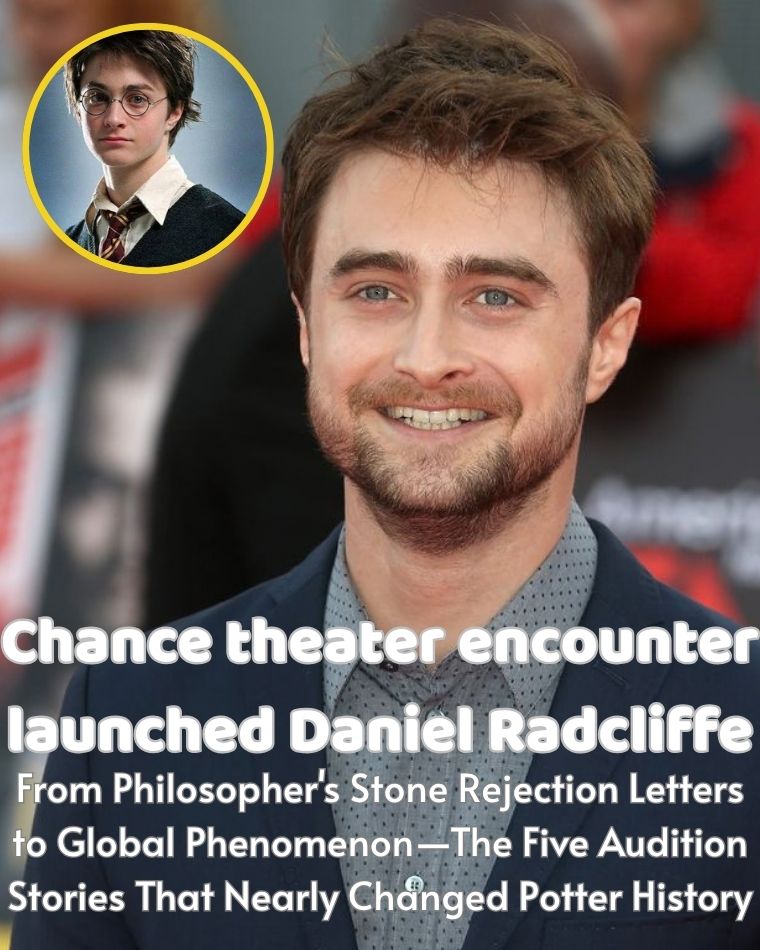
Cre: Wikimedia Commons — CC BY-SA 2.0
2. An Accidental Theater Encounter and Reluctant Parents
The critical breakthrough that forever changed cinematic history occurred completely by chance on a warm evening in London.
Producer David Heyman and screenwriter Steve Kloves decided to take a brief hiatus from their grueling casting duties by attending a West End theater production.
They took their seats at a performance of the comedic play Stones in His Pockets.
Sitting just behind them in the audience was literary agent Alan Radcliffe, accompanied by his wife Marcia Gresham and their eleven-year-old son, Daniel.
Throughout the first act of the performance, David Heyman found his attention repeatedly drawn away from the stage and toward the young boy seated behind him.
Heyman could not shake the feeling that he was looking directly at the living, breathing embodiment of Harry Potter.
The boy possessed an intense curiosity in his bright eyes, paired with a natural quietness that instantly commanded attention.
During the intermission, Heyman turned around to introduce himself to the family, as he was already casually acquainted with Daniel’s father.
Heyman gently broached the subject, asking whether Daniel might be interested in auditioning for the title role in the upcoming Potter adaptation.
To Heyman’s utter surprise, Daniel’s parents were deeply skeptical and vehemently opposed to the proposal.
Alan Radcliffe and Marcia Gresham were intimately familiar with the brutal pitfalls of the entertainment industry, having both worked within it.
Earlier casting inquiries regarding Daniel had suggested that production might involve filming several movies in the United States.
Daniel’s parents feared that relocating their young son across the Atlantic for multiple years would completely uproot his childhood.
They were terrified of the toxic Hollywood machine consuming their eleven-year-old child and derailing his normal education.
Consequently, the Radcliffes had already declined earlier overtures from casting representatives prior to the theater encounter.
They wanted to shield Daniel from the predatory scrutiny and relentless pressures of international tabloid fame.
David Heyman refused to let this golden opportunity slip away into the London night.
The producer spent the following morning persistently contacting Daniel’s parents by telephone to alleviate their legitimate anxieties.
He passionately assured the family that the entire production would remain firmly based on British soil.
Heyman promised that Daniel’s schooling and emotional well-being would be rigorously protected by the studio throughout filming.
Reluctantly, Alan and Marcia agreed to sit down for an informal tea with Heyman to discuss potential safeguards.
Only after receiving personal reassurances about child labor protections and local filming did the family permit Daniel to formally test.
The accidental theater encounter had opened a narrow door that formal auditions had utterly failed to unlock.
3. The Decisive Screen Test That Captivated Chris Columbus
Director Chris Columbus had actually noticed Daniel Radcliffe prior to the West End encounter, having caught a broadcast of the BBC television adaptation David Copperfield.
Columbus had pointed excitedly at the television monitor during production meetings, urging casting directors to seek out that exact boy.
However, casting directors had repeatedly informed him that Radcliffe’s parents were completely unwilling to let their son audition.
When David Heyman miraculously secured the family’s permission for a screen test, the studio atmosphere shifted overnight.
Daniel walked into the Leavesden audition facility in the late summer of 2000 for a comprehensive on-camera screen test.
The wardrobe department fitted him with round wire-rimmed spectacles, instantly transforming his appearance into the iconic character.
The camera rolled, and the young actor was asked to read scenes opposite potential co-stars, including Emma Watson and Rupert Grint.
The resulting test footage captured an undeniable, magical chemistry between the three young performers.
Columbus observed a unique quality in Radcliffe that set him completely apart from every other boy who had auditioned.
Radcliffe did not push for dramatic effect or perform with theatrical exaggeration.
Instead, he listened with remarkable stillness, projecting an instinctive vulnerability that felt entirely genuine.
When the scene required courage, Radcliffe demonstrated a quiet, resolute backbone that conveyed profound strength.
The camera captured a haunting innocence in his gaze that perfectly reflected an orphan discovering a hidden world.
Author J.K. Rowling was subsequently shown Radcliffe’s screen test tapes for her personal approval.
Upon watching the footage, Rowling expressed immense relief, remarking that seeing Dan on screen felt exactly like being reunited with her long-lost son.
The lingering doubts among Warner Bros. executives evaporated in a single viewing of that audition tape.
Columbus and Heyman officially had found their boy, ending a grueling casting marathon that had spanned nearly a year.
Radcliffe famously learned he had secured the role while relaxing at home in the bath, leading his parents to celebrate in joyful disbelief.
4. Alternate Realities: Contenders Who Almost Claimed the Wand
The history of 21st-century cinema could easily have taken a radically different course had early casting discussions prevailed.
During the earliest stages of development, renowned filmmaker Steven Spielberg was attached to direct the first adaptation.
Spielberg had envisioned casting young American star Haley Joel Osment, who had earned an Academy Award nomination for The Sixth Sense.
However, author J.K. Rowling maintained strict creative control over the project and insisted on an unyielding principle: the core cast had to be exclusively British.
This strict British-only mandate promptly halted early consideration of American child stars.
When Chris Columbus assumed directorial duties, he strongly championed American child actor Liam Aiken.
Aiken had previously collaborated with Columbus on the emotional 1998 family drama Stepmom.
Columbus was so impressed with Aiken’s natural abilities that the young American was briefly offered the coveted part.
Aiken flew to London under the exhilarating belief that he had officially secured the titular role of a lifetime.
Yet the celebratory moment lasted merely twenty-four hours before the production reversed its decision.
Once Rowling reaffirmed her uncompromising British casting mandate, Aiken’s casting was reluctantly retracted due to his American nationality.
The production was immediately plunged back into an urgent search across the British Isles.
Prominent British youth actors were subsequently considered, including Gabriel Thomson, who had previously appeared in Great Expectations.
Hundreds of capable British boys advanced to final-round callbacks before the selection narrowed down to a tiny handful of candidates.
Had an American actor assumed the lead mantle, the authenticity of the British boarding school setting might have fractured irrevocably.
Radcliffe’s eleventh-hour discovery spared the studio from making a fatal compromise that could have alienated the global readership.
5. The Decade-Long Transformation of an Eleven-Year-Old Boy
Signing the contract to portray Harry Potter in August 2000 was not simply an acting assignment; it was a life-altering commitment.
At just eleven years old, Daniel Radcliffe committed to a grueling, marathon filmmaking schedule spanning over a decade.
What began as an agreement for two initial feature films rapidly evolved into an unprecedented eight-movie epic journey.
Radcliffe spent the entirety of his adolescence on closed studio sets rather than in traditional school classrooms.
Leavesden Studios in Hertfordshire transformed into his permanent everyday home for the subsequent eleven years.
Private tutors provided his daily education inside production trailers positioned alongside cavernous soundstages.
Radcliffe matured from a wide-eyed child into an adult man directly under the unblinking gaze of international cameras.
He endured intense physical demands, performing high-wire stunt sequences and swimming for weeks in giant water tanks.
The psychological weight of carrying a multi-billion dollar cinematic franchise would have crushed many seasoned performers.
Yet Radcliffe developed an extraordinary work ethic that earned universal respect from veteran British acting royalty.
Co-stars such as Alan Rickman, Maggie Smith, and Gary Oldman consistently praised his unflagging professionalism on set.
Throughout the intense pressures of worldwide celebrity, Radcliffe remained remarkably humble, dedicated, and grounded.
His steadfast commitment ensured that the creative core of the saga remained entirely stable across an entire decade of production.
6. How One Casting Choice Shaped Two Decades of Cinema
The serendipitous decision to cast Daniel Radcliffe continues to reverberate across the modern global entertainment landscape.
Radcliffe’s performance provided the beating emotional heart that anchored all eight films across a golden cinematic run.
Audiences formed an extraordinarily intimate psychological bond with the character because they watched an actual child mature in real time.
Had Columbus and Heyman selected a less resilient child actor, the punishing schedule might have resulted in messy mid-series recasting.
The franchise’s unprecedented critical and commercial stability fundamentally rewritten Hollywood’s modern blockbuster playbook.
It proved to major studios that sprawling, serialized book adaptations could achieve monumental success if anchored by faithful casting.
The cultural triumph of the original cast established the essential groundwork for spin-offs, theme parks, and stage productions.
Radcliffe himself used the unparalleled platform to champion risk-taking independent cinema, theater revivals, and Broadway musicals.
He deliberately pursued challenging, avant-garde artistic roles to prove his versatility far beyond the wizarding world.
Reflecting on the summer of 2000 reveals how razor-thin the margin between triumph and catastrophic failure truly was.
A missed play at the West End or a stubborn parental refusal would have steered pop culture down an entirely different road.
The accidental discovery of an eleven-year-old boy in a theater audience remains cinema’s most rewarding, consequential roll of the dice.
Để lại một phản hồi