Sophie Turner’s journey from a teenage newcomer in epic fantasy to a commanding leading lady in modern action marks one of the most calculated transformations in contemporary television and film.
Rather than chasing fleeting blockbuster fame, she deliberately balanced large-scale studio productions with emotionally grueling independent projects to hone her dramatic depth and physical agility.
This steady, decade-long evolution has firmly established her as a versatile performer capable of anchoring the biggest entertainment franchises in the world.
The Winterfell Crucible: Forging Emotional Resonance in Game of Thrones
Sophie Turner’s public trajectory began in 2011 when she first appeared on screens worldwide as Sansa Stark in HBO’s groundbreaking fantasy series Game of Thrones.
Cast in August 2009 when filming began while she was only 14 years old, she grew up directly in front of an audience of tens of millions.
At the outset, Sansa Stark represented the innocence and naive romanticism of youth within the brutal, unforgiving universe crafted by George R.R. Martin.
Over eight sprawling seasons running through 2019, Turner transformed Sansa from an isolated, vulnerable captive into the steely, calculating Queen in the North.
The demanding television role required an intricate, slow-burning physical and emotional endurance rarely asked of adolescent performers.
Turner had to portray quiet psychological survival, internalizing trauma and learning political manipulation from the ruthless adversaries surrounding her character.
Her work earned widespread acclaim and culminated in a Primetime Emmy Award nomination for Outstanding Supporting Actress in a Drama Series in 2019.
More importantly, it gave her unprecedented dramatic credibility across the global entertainment industry.
Sansa Stark was not an acrobatic action role in the traditional martial arts sense, but it gave Turner invaluable physical discipline on massive outdoor sets.
Working in freezing mud, restrictive period costumes, and intricate stage blocking built an innate stamina that later served her on stunt-heavy projects.
She learned how camera angles capture subtle physical shifts and emotional weight amidst chaos and large ensemble casts.
By the time the series concluded its historic run, Turner was far more than a familiar child actor looking for her next routine credit.
She had become an experienced screen presence ready to tackle the physical demands of high-budget genre filmmaking.
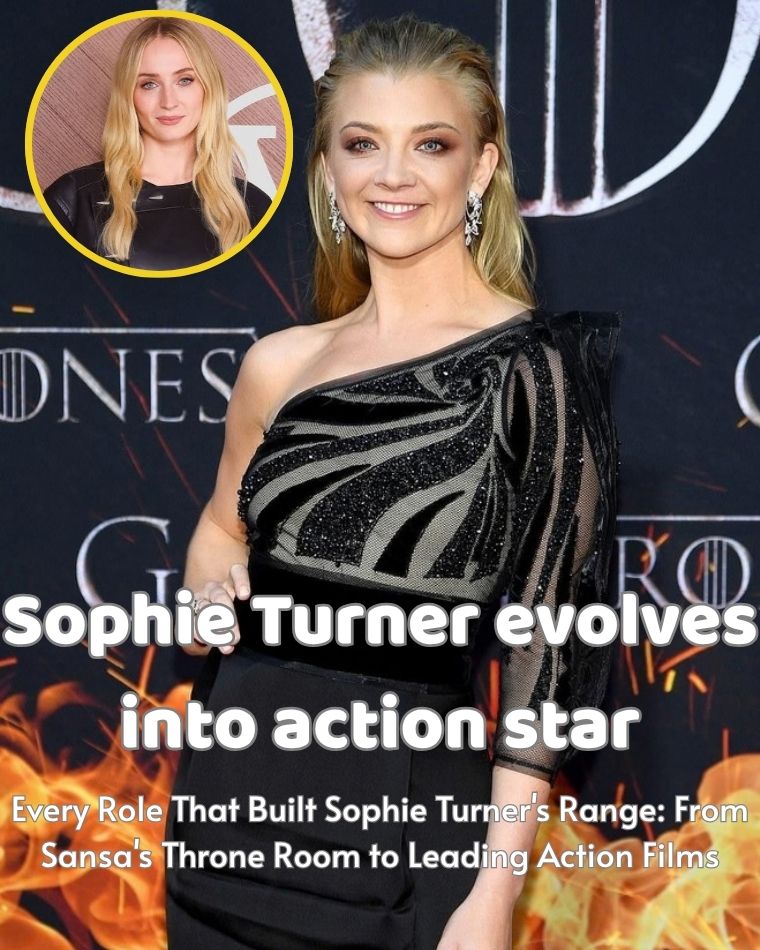
Cre: Wikimedia Commons
Stepping Into Superpowers: Taking on Jean Grey in X-Men: Apocalypse
While still anchoring major story arcs on television, Turner made a decisive transition into studio blockbuster filmmaking by joining the 20th Century Fox X-Men franchise.
She debuted as the young mutant telepath Jean Grey in the 2016 summer tentpole X-Men: Apocalypse.
Stepping into a part previously established by Famke Janssen carried immense pressure from comic enthusiasts and moviegoers alike.
Turner deliberately leaned into the vulnerability of an adolescent whose raw psychic powers terrified her.
The production exposed Turner to full-scale technical filmmaking, requiring extensive wirework, harness suspension, and motion-capture choreography.
She had to act convincingly against green screens while projecting absolute cosmic power through her posture and gaze alone.
X-Men: Apocalypse proved to studio heads that Turner possessed the kinetic screen presence to match established action veterans like Michael Fassbender and Jennifer Lawrence.
Working on complex wire rigs taught her the physical balance and spatial awareness necessary for modern science fiction spectacle.
Instead of shrinking beneath the visual effects, Turner anchored the film’s climactic sequence with pure emotional gravitas.
Her performance signaled that she could comfortably transition from medieval drama to comic book battles without sacrificing character authenticity.
This key phase expanded her commercial footprint beyond television screens into international theatrical multiplexes.
It demonstrated her readiness to absorb rigorous physical direction under demanding schedule constraints.
Most crucially, it opened the door for Turner to headline a massive superhero picture entirely on her own shoulders.
Defying Franchise Comfort Zones: Grounding Craft in Independent Cinema
Many young actors catapulted into global franchises remain trapped inside corporate blockbusters, but Turner intentionally pursued contrasting indie projects.
As early as 2013, she made her feature film debut in Isabel Coixet’s psychological thriller Another Me.
Playing dual roles as Fay and Lila Delussey forced Turner to confront themes of paranoia, psychological fracture, and grief without the safety net of expensive special effects.
In 2015, she showcased a sharper, comedic physical dynamic playing undercover assassin Heather alongside Hailee Steinfeld in Barely Lethal.
Barely Lethal allowed Turner to experiment with lighthearted hand-to-hand combat choreography, teen satire, and athletic stunt coordination.
Three years later, she took on the titular role in the 2018 independent drama Josie.
In Josie, Turner delivered a sultry, menacing performance as an enigmatic young woman shaking up an isolated southern town.
The role strip-mined any lingering assumptions that she was limited to aristocratic British period roles or clean-cut teenage archetypes.
Later that same year, she joined the sci-fi comedy Time Freak, exploring grounded timing, romance, and dialogue-driven character dynamics.
These indie films deliberately dismantled the predictable typecasting that frequently derails child stars.
Each project operated on a modest budget, where raw acting instincts and immediate camera intimacy replace digital trickery.
Turner used these smaller sets to test different vocal accents, physical expressions, and darker narrative registers.
By taking artistic risks outside the studio bubble, she maintained critical credibility as a serious character actor.
This artistic curiosity proved essential in building the multifaceted grit required for contemporary action heroines.
Bearing the Weight of a Franchise: Dark Phoenix and Leading-Lady Pressures
In 2019, Turner faced the most significant test of her cinematic career when she headlined X-Men: Dark Phoenix.
Unlike her supporting role in Apocalypse, Dark Phoenix positioned her front and center as the psychological and physical core of the narrative.
The film tackled one of the most iconic and emotionally volatile arcs in Marvel comic history.
Turner portrayed Jean Grey as an unstable force torn apart by buried childhood trauma and uncontrollable psychic cosmic power.
To prepare for the demanding role, Turner immersed herself in research regarding schizophrenia, mental health struggles, and dissociative identity experiences.
She aimed to give Jean’s destructive outbursts a grounded human tragedy rather than playing her as a cartoonish villain.
The physical demands of the production reached new heights, featuring grueling high-wire aerial stunts, continuous combat sequences, and complex blue-screen blocking.
Turner spent months training to ensure her physical movements conveyed immense weight, explosive power, and sheer muscular tension.
She sustained entire emotional sequences while suspended in midair, balancing intricate technical choreography with visceral dramatic tears.
Carrying the promotional circuit and narrative weight of a multimillion-dollar studio blockbuster tested her resilience at every level.
Even when studio restructuring complicated the film’s rollout, critics singled out Turner’s raw dedication and screen presence as a clear highlight.
She proved capable of commanding the frame alone, generating genuine menace and profound empathy in equal measure.
Dark Phoenix established that Turner possessed the rare gravitas needed to helm tentpole action spectacles as the undisputed primary protagonist.
The Modern Pivot: Thrillers, Prestige Limited Series, and Streaming Range
Following the conclusion of both Game of Thrones and her X-Men tenure in 2019, Turner entered an ambitious new chapter centered on streaming flexibility.
In 2020, she took the lead role of Jane in the intense survival thriller series Survive.
Playing a suicidal plane crash survivor battling the wilderness forced Turner into grueling physical environments, crawling through snowdrifts and enduring frigid temperatures.
Survive tested her physical stamina in real-world wilderness survival scenarios far removed from sanitized soundstages.
In 2022, she joined the star-studded ensemble of HBO’s true-crime drama The Staircase alongside Colin Firth and Toni Collette.
Her portrayal of Margaret Ratliff demonstrated her ability to blend into prestigious prestige drama with quiet, naturalistic precision.
That same year, Turner delivered an electric cameo as Erica Norman in the Netflix dark teen comedy Do Revenge.
Her explosive, scene-stealing comedic meltdown became an instant viral sensation across social media platforms.
The performance showcased sharp comedic timing and an utter willingness to parody her own glamorous image.
In 2024, she took center stage in the British crime drama series Joan, playing the real-life jewel thief Joan Hannington.
The role required glamorous disguise, working-class vulnerability, sharp-witted heist tension, and fierce maternal drive.
Continuing her momentum into 2025 and 2026, Turner starred in the thriller Trust and the high-stakes heist drama Steal.
She also ventured into executive producing with the gothic period piece The Dreadful, signaling a desire for creative authority behind the camera.
Each of these modern projects layered another vital skill onto her foundational dramatic talent: physical endurance, naturalistic timing, and sharp wit.
Becoming Lara Croft: The Culmination of an Action Hero’s Apprenticeship
All of Turner’s varied artistic choices crystallized in September 2025, when Amazon Prime Video officially confirmed her casting as Lara Croft.
She was chosen to lead the massive live-action series adaptation of the legendary Tomb Raider video game franchise.
Created and executive produced by Emmy-winner Phoebe Waller-Bridge, the series represents Amazon MGM Studios’ flagship adventure undertaking.
Filling the boots previously worn on the silver screen by Angelina Jolie and Alicia Vikander is an enormous mantle.
Yet industry observers immediately recognized why Turner emerged as the ideal candidate over competing contenders.
Her entire career trajectory has functioned as an unintentional masterclass for this very character.
Lara Croft demands far more than raw physical fitness and athletic gunplay.
The character is an aristocratic English archaeologist who possesses aristocratic poise, intellectual brilliance, dry British humor, and ruthless combat grit.
Turner has embodied every one of those distinct components across her previous roles.
Sansa Stark gave her the innate aristocratic bearing, quiet resilience, and royal posture.
Jean Grey supplied the blockbuster stunt training, wirework mastery, and large-scale action experience.
Survive and Joan provided the rugged outdoor survivalism, cunning resourcefulness, and morally complex edge.
Principal photography for Tomb Raider commenced on January 19, 2026, featuring complex location shoots across England and Spain.
The demanding production proved immediately taxing, with Turner enduring rigorous physical training and stunt choreography.
Turner’s arrival at the summit of the action-adventure genre was never an accident of luck or viral popularity.
It was built through a methodical, ten-year process of calculated risk-taking across independent cinema, superhero blockbusters, and prestige television.
Sophie Turner has dismantled every early stereotype, cementing her status as one of Hollywood’s most formidable and multifaceted leading ladies.
Để lại một phản hồi